

Let's ditch the textbook definitions.
Think of social media return on investment (ROI) like this: for every dollar, hour, or creative spark you pour into platforms like Instagram or LinkedIn, what are you actually getting back? It’s the ultimate reality check—the thing that tells you if your efforts are just making noise or driving real business results.
What Is Social Media Return On Investment Anyway?
Imagine your social media strategy is a vending machine. Everything you put in—ad spend, the time it takes to create content, your team's salaries—are the coins you drop in the slot.
The social media ROI is the snack or drink that comes out. Was it worth the price? Did you get the tasty chips you wanted, or just a stale pack of crackers? That's what ROI tells you.
This measurement forces you to look past the flashy "vanity metrics" like follower counts and likes. While those numbers feel good, they don't pay the bills. Real ROI zeroes in on the stuff that hits your bottom line.
Moving Beyond Vanity Metrics
Relying on likes and follows alone is like judging a restaurant by how many people peer at the menu in the window instead of how many actually come in and eat. A big follower count looks impressive, but it's not a business goal. A truly successful strategy has to connect those thumbs-ups to tangible outcomes.
Instead of getting distracted, you should be tracking metrics like these:
- Lead Generation: How many potential customers did that last LinkedIn post actually bring in?
- Sales Revenue: Can you trace a direct line from a specific Instagram campaign to real dollars in your account?
- Customer Loyalty: Are you building a community that keeps coming back for more, boosting customer lifetime value?
- Brand Awareness: Is your social media buzz translating into more people typing your website URL directly into their browser?
Measuring social media ROI is about proving your social channels are a revenue center, not just a cost center. It’s the hard data you need to justify your budget, fine-tune your strategy, and show the higher-ups that what you’re doing works.
Why Every Business Needs to Measure ROI
Figuring out your social media ROI is non-negotiable, whether you’re a solopreneur or a massive agency. It’s what allows you to stop guessing and start making smart, data-driven decisions that fuel real growth. Without it, you’re just throwing spaghetti at the wall and hoping something sticks.
This is exactly where a tool like OneUp becomes a game-changer. Instead of drowning in a dozen different analytics dashboards, OneUp brings everything together. You can see post-level and summary analytics for all your accounts in one clean interface. This includes Facebook, Instagram, X (Twitter), LinkedIn, Pinterest, TikTok, YouTube, and Google Business Profiles.
This makes it ridiculously easy to connect your efforts—like a scheduled Reel on Instagram or a carousel on LinkedIn—to the results they produce. With features like custom cross-network reports and scheduled email reporting, you can build a clear picture of your ROI without wasting hours in spreadsheet hell. That clarity is the secret to turning your social media presence into a predictable growth engine.
Why You Must Track Your Social Media ROI
Let's be blunt: tracking your social media return on investment isn't just a "good idea"—it's a business necessity. Not measuring your ROI is like driving a car blindfolded. Sure, you’re moving, but you have no clue if you're heading toward your destination or straight into a ditch. Solid ROI data is the GPS for your entire social strategy.
This data is also your best friend when it comes time to justify your marketing budget. Stakeholders and executives speak the language of numbers. Showing them clear proof that your social media efforts are bringing in more value than they cost is the only way to get the resources you need to keep growing.
Pinpoint Success and Eliminate Waste
Imagine knowing, with total certainty, which social media platforms and content formats are crushing it for your brand. That's the kind of clarity you get from tracking ROI. You can see exactly which campaigns are driving sales and which ones are just taking up space. This lets you double down on what works and cut what doesn't.
This knowledge is pure gold for optimizing future campaigns. For example, your data might reveal that your short-form videos on one platform have a massive 300% ROI, while your static image posts on another are barely breaking even. With that insight, you can confidently shift your budget and creative energy to the channels that deliver real, measurable returns.
Transform Data Into Action with OneUp
Gathering and making sense of all this data can feel like a huge headache, but it doesn't have to be. This is where a tool like OneUp comes in, turning a complicated task into one of your biggest strengths. OneUp is built to turn raw numbers into clear, actionable insights—no data science degree required.
The platform's analytics make ROI tracking simple and effective. Here’s how:
- Post-Level and Summary Analytics: You can drill down into the performance of a single post or zoom out for a high-level view of your whole strategy. See what’s truly connecting with your audience at a glance.
- Custom Cross-Network Reports: Pull data from all your connected accounts—Facebook, Instagram, LinkedIn, TikTok, you name it—into one clean report. This makes comparing performance across platforms ridiculously easy.
- Scheduled Email Reporting: Put your reporting on autopilot. Have detailed performance summaries sent straight to your inbox (or your boss's), keeping everyone in the loop without any extra work.
Tracking ROI isn't about creating more reports to file away. It's about making smarter decisions. It’s the difference between just being busy on social media and being effective on social media.
This level of detailed tracking is becoming more critical every year. As social platforms evolve, their power as advertising channels just keeps growing. In 2025, the average ROI from paid social media advertising has climbed to an impressive $5.28 for every $1 spent—a big jump from the previous year.
This trend shows the massive profit potential when your strategies are guided by solid data. You can learn more about these advertising trends and what they mean for your business by reading the latest social media statistics.
The Metrics And Formulas For Calculating ROI
If you want to calculate your social media return on investment, you first have to speak the language of data. That means getting past surface-level vanity metrics like follower counts and digging into what actually moves the needle for your business.
Think of it like this: it's the difference between counting the people window shopping outside your store versus tracking who comes inside, browses the aisles, and actually buys something.
These crucial metrics fall into four main categories, each mapping to a different part of the customer's journey. Getting a handle on them is the first real step to painting an accurate ROI picture.
This breakdown shows how solid ROI tracking ties directly back to core business functions. It’s what you need to justify your budget, figure out what’s working, and make your next campaigns even better.
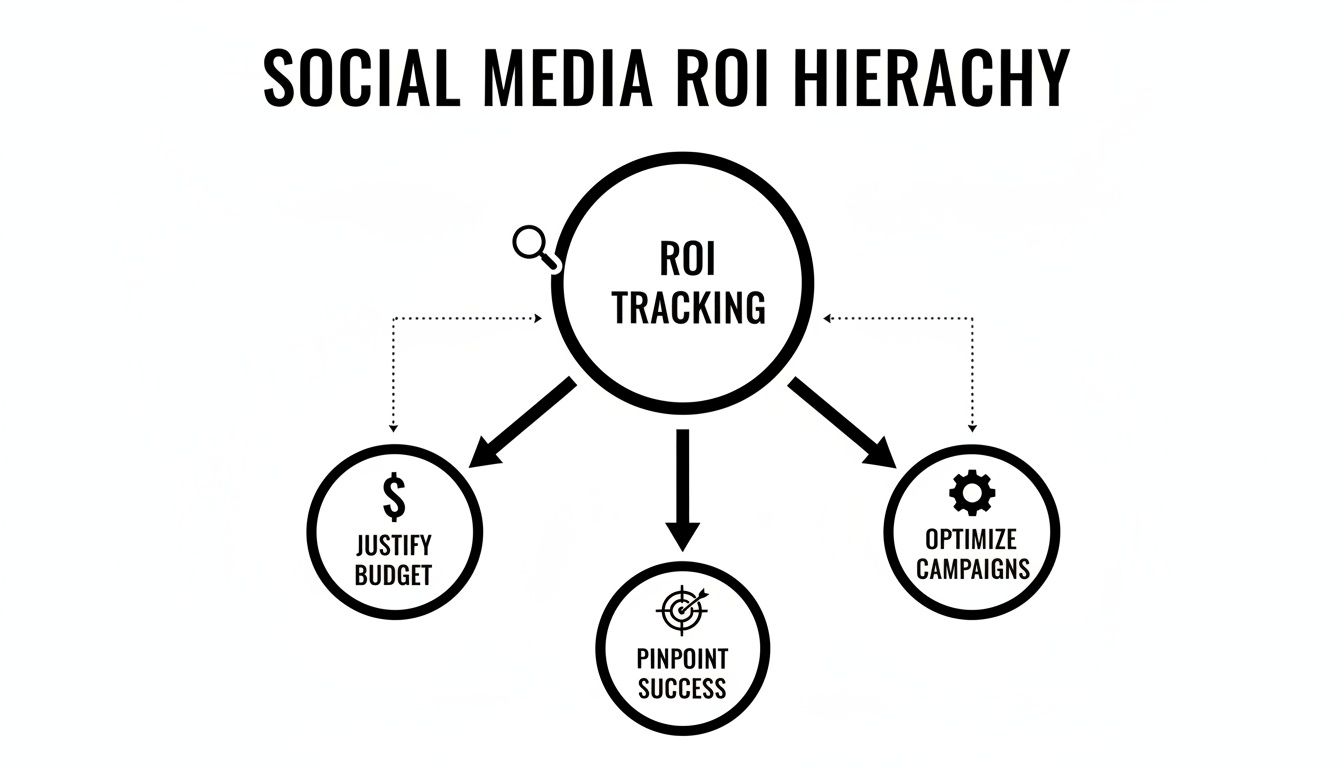
As you can see, measuring ROI isn't just about crunching numbers for a report. It's a strategic loop that gives you the clarity to make smarter, more profitable decisions.
The Four Pillars Of ROI Metrics
To get the full picture, you need to be tracking metrics across the entire marketing funnel. Here's a quick rundown:
- Reach & Awareness: This is the top of your funnel—how many eyeballs are you getting on your content? The key things to watch here are impressions (how many times a post was seen) and audience growth rate.
- Engagement: This is all about how people interact with what you post. It’s a huge signal that your message is connecting. You'll want to track likes, comments, shares, and saves.
- Conversion: This is where your social efforts start turning into real business actions. These metrics are the closest to the money, including things like clicks, lead form completions, and direct sales.
- Customer Loyalty: This looks at the long-term payoff. Metrics like customer retention rate and customer lifetime value (CLV) show how social media helps you build relationships that last.
With a tool like OneUp, you don’t have to bounce between a half-dozen different analytics dashboards to get this data. OneUp’s dashboard pulls all these metrics together from your unlimited connected accounts, a feature included in every plan. You get one clear view of performance across every platform, making it a whole lot easier to spot trends and measure what matters.
The Core Social Media ROI Formula
Once you've identified your key metrics, you can plug them into the fundamental formula for social media ROI. It's a simple calculation that cuts straight to the chase: are your efforts profitable?
Social Media ROI (%) = (Net Profit / Total Investment) x 100
Let’s quickly break that down:
- Net Profit: This is the total money you made from your social media activities, minus what you spent.
- Total Investment: This is every penny you put in. It’s more than just ad spend—it includes tool subscriptions, content creation costs, and even the prorated salaries of your team for the time they worked on a campaign.
For a broader look at the different ways to approach this, check out this guide on how to calculate marketing ROI.
To build a complete picture of your ROI, you'll need to pull data from various stages of the customer journey. The table below outlines the essential KPIs you should be tracking.
Essential Social Media ROI Metrics
| Category | Metric | What It Measures | Example Tool/Method |
|---|---|---|---|
| Awareness | Impressions & Reach | The total number of people who saw your content. | Native social analytics (Facebook Insights, etc.) |
| Awareness | Audience Growth Rate | The speed at which your follower count is increasing. | Social media management tools like OneUp |
| Engagement | Likes, Comments, Shares | How users are interacting directly with your posts. | OneUp's Analytics Dashboard |
| Engagement | Amplification Rate | The rate at which followers share your content. | Manual Calculation: (Shares / Followers) x 100 |
| Conversion | Click-Through Rate (CTR) | The percentage of viewers who clicked a link in your post. | Google Analytics, Bitly |
| Conversion | Cost Per Click (CPC) | The amount you pay for each click on a paid ad. | Ad platform dashboards (e.g., Meta Ads Manager) |
| Conversion | Leads Generated | The number of potential customers captured via social. | CRM software (HubSpot, Salesforce) |
| Revenue | Sales Revenue | Direct revenue attributed to social media campaigns. | Google Analytics (with UTM tracking) |
| Revenue | Customer Lifetime Value (CLV) | The total profit a customer generates over time. | CRM data, Customer data platform |
| Revenue | Return on Ad Spend (ROAS) | The revenue generated for every dollar spent on ads. | Ad platform dashboards |
Tracking a mix of these KPIs gives you a much more nuanced and accurate understanding of your performance than just looking at sales alone.
Calculating ROI With A Real-World Example
Let's see the formula in action. Imagine a small e-commerce brand runs a paid Instagram campaign for a new line of sneakers.
-
Calculate the Total Investment:
- Instagram Ad Spend: $500
- Social media tool (prorated monthly cost): $50
- Social media manager's time (5 hours @ $40/hour): $200
- Total Investment = $750
-
Measure the Return (Profit):
- The campaign drove $2,500 in sales through their website.
- Net Profit = $2,500 (Revenue) – $750 (Investment) = $1,750
-
Calculate the Final ROI:
- ROI = ($1,750 / $750) x 100 = 233%
What does that 233% actually mean? It means for every $1 the business spent, it got back $2.33 in profit. That's the kind of clear, powerful number that proves your strategy is working and tells you exactly where to put your money next.
Your Step-By-Step Guide To Measuring ROI
Turning your social media goals into a hard social media return on investment number isn't about guesswork. It requires a clear, repeatable process that connects your day-to-day social media grind directly to your bottom line.
By following a structured roadmap, you can account for every dollar spent and every action taken. This creates a reliable and defensible ROI calculation you can confidently present. Let's walk through the five essential steps.
Step 1: Set Clear and Measurable Objectives
You can't hit a target you can't see. Before you even think about posting, you need to know what success looks like by setting S.M.A.R.T. (Specific, Measurable, Attainable, Relevant, Time-bound) goals. A fuzzy objective like "increase engagement" is useless for calculating ROI.
A strong objective sounds more like this: "Generate 50 qualified leads through our LinkedIn campaign this quarter with a cost per lead under $40." See the difference? This gives you a specific target to measure against, making the final ROI calculation a piece of cake.
Step 2: Accurately Track Your Social Media Spend
The "investment" part of your ROI calculation is a lot more than just your ad budget. To get the real picture, you have to track every single cost associated with your social media efforts. This is a common tripwire for marketers and leads to inflated, inaccurate ROI figures.
Your total investment should include:
- Ad Spend: The direct cost of any paid social campaigns on platforms like Facebook or Instagram.
- Tool Subscriptions: The monthly or annual fees for your scheduling and analytics tools, like OneUp.
- Content Creation Costs: Any money spent on visuals, videos, or copy, including freelancer fees or stock photo subscriptions.
- Labor Costs: An estimated slice of your team's salaries for the time they spend managing social media.
Adding all this up gives you the true "I" in the ROI formula.
Step 3: Implement Robust Tracking Mechanisms
To prove your social media activity is driving real business results, you need a bulletproof way to follow the user's journey. Without proper tracking, you're flying blind, with no clue which posts or ads are actually bringing in the bacon.
The workhorses for this job are UTM parameters and conversion pixels. UTMs are little snippets of code you add to your URLs that tell analytics tools exactly where a click came from. Pixels (like the Meta Pixel) track what users do on your website after they've seen one of your ads.
Setting up these tracking mechanisms is non-negotiable. It’s the bridge that connects your social media efforts to tangible outcomes like website visits, sign-ups, and sales.
Step 4: Execute Your Campaign and Collect Data
With your goals set, costs tallied, and tracking in place, it's time to hit 'Go.' This is where your strategy comes to life. A powerful scheduling tool is your best friend for executing the plan efficiently.
Using a platform like OneUp, you can dial in every last detail. You can add a first comment to posts to get the conversation started, customize link preview thumbnails to make your links more clickable, and schedule Instagram Reels and Stories to grab your audience's attention. You can even repeat your posts at custom intervals to maximize their reach and perfect your feed's aesthetic beforehand using an Instagram grid planner to see how posts will look.
While your campaign is running, your tracking tools are working in the background, collecting all the data you'll need for the final step. Just let it run its course to gather enough information for a solid analysis.
Step 5: Analyze Results and Report Your ROI
Once your campaign wraps up, it's time to put all the pieces together. Start by pulling your performance data. With OneUp, you can use the unified analytics dashboard to see metrics from all your networks in one place, saving you from having to log into a dozen different platforms.
Compare your results against the objectives you set back in Step 1. Did you hit your lead or sales targets? Now, it's time for the magic formula: (Net Profit / Total Investment) x 100. This final percentage tells the real story of your campaign’s success.
When you're reporting, highlight the platforms that gave you the most bang for your buck. For many, Facebook is still the king. In fact, Facebook stands out as the social media platform delivering the highest ROI for marketers globally, with 28% of respondents in a recent survey naming it their top choice. This isn't likely to change soon, as 83% of worldwide marketers actively use Facebook for their campaigns.
Use OneUp’s custom reporting features to build a compelling narrative for your clients or your boss. This closes the loop, clearly demonstrating the value your social media strategy delivered and making it easy to justify future investment.
How To Streamline And Automate ROI Tracking
Let's be honest: manually calculating your social media return on investment is a nightmare. You're juggling spreadsheets, digging through different analytics dashboards, and spending way too much time trying to connect the dots. It's a classic recipe for burnout and mistakes.
The only way to get a clear, accurate picture without losing your mind is to use the right tools to automate the whole thing. This isn't just about saving a few hours; it's about shifting ROI tracking from a painful quarterly chore to a real-time strategic advantage.
Lowering Investment To Boost ROI
A huge part of getting a better ROI is shrinking the "investment" side of the formula. This really comes down to being more efficient with your time and resources. Every hour you waste on clunky processes is money down the drain, and every hour you save directly bumps up your ROI.
This is where OneUp comes in, with features built to cut down on the manual grind.
- AI Caption Generator: Stuck staring at a blank screen? The generator can whip up great captions in seconds, letting you focus on the bigger picture.
- Canva Integration: You can design your visuals right inside OneUp and schedule them immediately. No more downloading from one app just to re-upload to another.
- Bulk Post Uploading: Got a month's worth of content ready? You can schedule it all in one go with a CSV file. This is a game-changer for busy teams.
- Auto-Post from RSS feeds: Automatically share content from your favorite blogs or news sites, keeping your feeds active with relevant content without any manual work.
Using these tools directly cuts your labor costs, which is one of the fastest ways to see your ROI climb.
Using A Unified Inbox For Qualitative Insights
Not every win shows up on a spreadsheet. Things like customer sentiment, brand perception, and how fast you respond to comments are incredibly valuable. They build loyalty and long-term value, but trying to track them across every single platform is almost impossible.
OneUp's unified Social Inbox solves this by pulling all your comments, mentions, and DMs from Facebook, Instagram, and LinkedIn into one clean feed. You can see what people are saying, gauge the overall mood, and jump on customer questions right away. A faster response time and a clear view of your brand's conversation are massive assets.
Proving Value With Agency-Focused Features
If you're an agency, proving ROI isn't just important—it's how you keep your clients. Clear, transparent reporting is everything. But building those reports manually is tedious and leaves the door open for errors.
OneUp has features specifically for agencies to make this process smooth and professional.
- Client Approval Workflows: Send posts to clients for review and get their sign-off right in the platform. It keeps everyone on the same page and creates a clear record of approvals.
- Read-Only Calendar Links: Give your clients a live look at their content calendar. This builds trust and cuts down on all the "what's posting next week?" emails.
- Create separate workspaces for each client: Keep all of a client's accounts, posts, and analytics completely separate for better organization and security.
These tools help agencies show off their hard work and its value, making it easier to justify their fees while keeping things efficient behind the scenes.
The real point of automation isn't just doing things faster; it's about doing them smarter. When you centralize your data and workflow, you can finally connect every social media action to a real business result without all the manual heavy lifting.
Automating The Final Report
The last piece of the puzzle is putting all that data together. OneUp’s reporting features are built to prove social media’s impact by letting you create custom, cross-network reports. You can pull data from all your profiles into a single, easy-to-understand dashboard.
Even better, you can schedule these reports to be automatically emailed out daily, weekly, or monthly. This means you, your team, and your boss get a clear summary of your social media return on investment delivered right to their inbox, no effort required. This keeps everyone aligned and ensures your strategy is always guided by data, not guesswork.
Plus, with OneUp's ability to connect unlimited social accounts on any plan, you can experiment with different strategies across all your profiles without extra costs. To see how this powerful feature fits into different plans, you can explore OneUp's pricing options.
Advanced Strategies For Maximizing Your ROI
So, you've gotten the hang of tracking your basic social media ROI. Awesome. Now it's time to kick things up a notch.
The real magic happens when you move beyond just posting your own content and running standard ads. Advanced strategies are all about tapping into powerful forms of social proof—letting others do the talking for you—to build rock-solid credibility and drive killer returns.
One of the best ways to do this is with influencer marketing. This isn't just about paying someone with a huge follower count. It's about partnering with creators who have a genuine, trusted connection with the exact people you want to reach.
Harnessing Authentic Voices For Growth
Influencer marketing works so well because it feels real. A recommendation from a trusted creator comes across like a tip from a friend, not a flashy billboard. The numbers back this up, too. Influencer marketing pulls in an incredible average ROI of $5.78 for every $1 spent, blowing many traditional digital ad formats out of the water.
Another powerhouse tactic is user-generated content (UGC). Think of it as turning your happiest customers into your most convincing marketing team. When you run campaigns that encourage and feature content created by your actual users, you build authentic trust and can drive sales at a fraction of the cost.
Streamlining Advanced Campaigns With OneUp
Pulling off these kinds of campaigns requires some serious coordination, and that's where a solid social media tool is a lifesaver.
-
Managing Collaborations: For your influencer partnerships, OneUp’s shared media library and client approval workflows become your command center. Influencers can drop their content right in, and you can give it the green light before it ever gets scheduled. No more messy email chains.
-
Monitoring UGC Campaigns: OneUp’s Social Inbox is perfect for keeping tabs on a UGC campaign. It brings all your mentions and comments into one place, so you can easily track campaign hashtags and find the best customer content to share.
-
Optimizing Post Performance: To make sure your influencer and UGC posts land with maximum impact, you can use an Instagram hashtag generator to find relevant tags and boost your visibility. Plus, with the ability to tag users and locations, you can ensure creators get the credit they deserve.
For teams that want to get serious about these strategies, framing your goals with an objectives and key results framework—supported by a good OKR management tool—can be a game-changer. By mixing these advanced tactics with smart tools like OneUp, you can push your social media ROI to a whole new level.
Your Top Social Media ROI Questions, Answered
Let's tackle some of the most common questions that pop up when it's time to calculate your social media return on investment.
How Can I Measure ROI For Organic Social Media?
This is the million-dollar question, isn't it? Measuring the ROI of organic posts can feel like trying to catch smoke, mostly because there's no direct ad spend to compare against.
The trick is to assign a real monetary value to the goals you're hitting. For instance, you could calculate the lifetime value of a new lead that came from a LinkedIn post. Or maybe it's the value of website traffic that a single tweet drove, which you can track perfectly using UTM parameters.
Don't forget, your "investment" isn't zero. It includes your team's time creating and managing all that content, plus the cost of any tools you use. A platform like OneUp actually helps here by making content creation faster with its AI caption generator and Canva integration. Less time spent equals a lower investment, which directly boosts your ROI.
What Is A Good Social Media ROI Benchmark?
Honestly, there’s no magic number. A "good" ROI is completely relative—it changes wildly depending on your industry, profit margins, and what you were trying to achieve with a campaign in the first place. A 300% ROI might be incredible for a high-margin software company but completely unrealistic for a low-margin retailer.
The only benchmark that truly matters is your own. The real goal is to get better over time. Are you improving quarter over quarter? With OneUp’s custom cross-network reports, you can easily see your performance trends and know for sure if the strategic tweaks you're making are actually paying off.
How Can I Justify The Cost Of A Social Media Tool?
To get buy-in for a new tool, you have to show that the value it brings to the table is worth more than its price tag. That value really comes from two places: making your team more efficient and getting better results.
First, calculate the hours you'll save on all the manual stuff—scheduling posts, pulling reports, and answering comments. OneUp tackles this with features like bulk post uploading and a unified Social Inbox. You can also save drafts of posts, letting team members collaborate without accidentally publishing unfinished content.
Then, draw a direct line from the tool's features to real business outcomes. For example, using the ability to add a first comment can spike engagement, which leads to more leads or sales. When you can show it’s a revenue driver and not just another expense, the justification becomes a no-brainer.
Ready to stop guessing and get a crystal-clear view of your social media ROI? OneUp gives you all the tools you need—from a unified inbox to automated reporting—all in one simple plan. Start making data-driven decisions and finally prove your social media's value. Explore OneUp and see how it works.