

A solid content strategy for social media is basically the blueprint for your brand's entire digital personality. It’s the game plan that decides what you post, why you're posting it, and who you're trying to reach. Every single piece of content should be pulling you one step closer to your actual business goals.
Why You Need a Social Media Content Strategy
Picture this: you're building a skyscraper. Would you just start throwing down bricks and hope for the best? Of course not. You'd need a detailed architectural plan. Your social media content strategy is that exact plan for your brand online.
It's what turns your social media channels from a bunch of random, off-the-cuff posts into a powerful, intentional engine for growth. Without a strategy, you're just adding to the noise. With one, you're building a real asset for your business.
This kind of planned approach means every post, Story, and video has a clear job to do. It helps you move past chasing likes and comments and start hitting measurable business targets. For a deeper dive, a good guide on how to create a social media marketing strategy can help you build that solid foundation.
From Random Acts to Intentional Impact
Let’s be real: social media is crowded. A clear strategy is your only hope for cutting through the clutter with any kind of consistency.
By 2025, a staggering 65.7% of the entire world's population will be on social media. The average person juggles nearly seven different platforms a month and spends about 141 minutes a day scrolling. That's an incredibly small window to grab someone's attention.
This chart breaks down how a high-level strategy connects all the dots, from your big-picture goals down to the content you create every day.
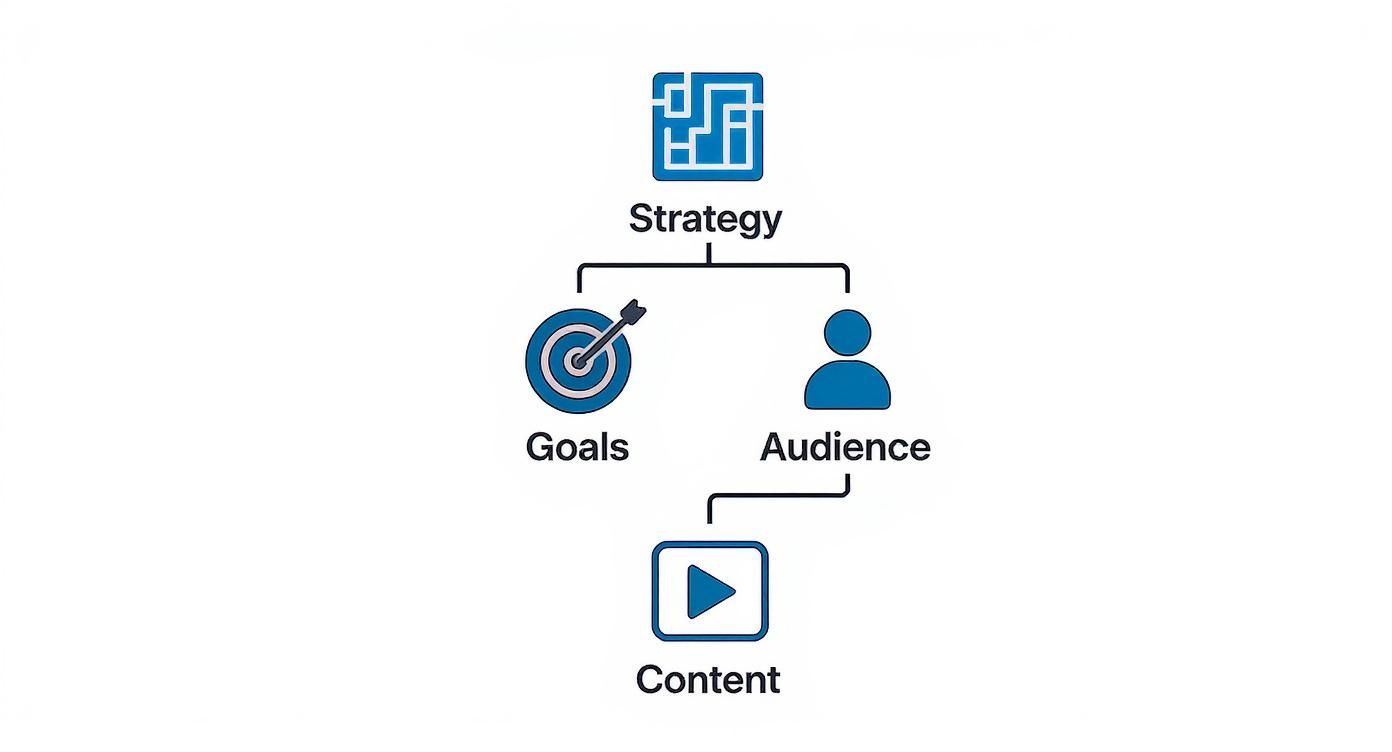
As you can see, a successful outcome doesn't happen by accident. It starts with a smart blueprint that guides everything else you do.
A documented strategy moves your social media efforts from a daily chore into a system for predictable growth. It’s the difference between guessing what might work and knowing what will.
The Benefits of a Documented Plan
When you stop posting on a whim and start following a strategy, you’ll see some real, tangible benefits. This is what separates the brands that truly succeed online from those that are just… there.
Here’s what having a clear plan actually gets you:
- Achieve Consistency: A strategy keeps your brand voice, visuals, and messaging straight across every platform. People start to recognize you, and that builds trust.
- Improve Efficiency: Instead of scrambling, you can use tools like OneUp to execute your plan smoothly. Schedule all your posts for Facebook, Instagram (including direct publishing for Reels, Stories, and Carousels), TikTok, YouTube (including Shorts), and Google Business Profiles from one simple calendar.
- Make Data-Driven Decisions: When you have goals, you can track the right numbers. You’ll quickly learn what your audience loves (and what they ignore), so you can stop guessing and start optimizing.
- Scale Your Efforts: A written-down strategy makes it a thousand times easier to grow your team. With OneUp, you can add unlimited team members with different permissions at no extra cost and set up post-approval workflows to keep everything on-brand.
Setting Goals and Defining Your Audience
Every solid social media strategy kicks off with two simple questions: "What are we actually trying to do here?" and "Who are we talking to, anyway?" This isn’t about making stuff up; it's about laying a data-backed foundation that informs every single thing you post.
Without clear goals, you’re just throwing content into the void. It's like a ship without a rudder. Vague ideas like "get more followers" or "boost engagement" aren't goals; they're wishes. A real strategy needs to be precise, with a clear way to know if you're winning or losing.

From Vague Hopes to SMART Goals
To give your strategy some teeth, you need to use the SMART goal system. This classic framework is perfect for turning those fuzzy daydreams into real, actionable targets. It breaks down into five parts: Specific, Measurable, Achievable, Relevant, and Time-bound.
- Specific: Nail down exactly what you want to do. Instead of "more engagement," try "Increase Instagram Story replies and poll responses."
- Measurable: Slap a number on it. For example, "Increase Instagram Story engagement by 20%."
- Achievable: Be real with yourself. If your engagement is currently 2%, shooting for 50% next month is just setting yourself up for failure.
- Relevant: Make sure this goal actually helps the business. Does it tie back to bigger objectives like driving website traffic or getting more leads?
- Time-bound: Set a deadline. For instance, "Increase Instagram Story engagement by 20% over the next quarter."
Suddenly, your wishy-washy idea becomes a clear mission: "Increase Instagram Story engagement by 20% over the next quarter to boost community interaction and drive traffic to our new product page." Now that's a plan.
Uncovering Who Your Audience Really Is
Once you know where you're going, you need a map. For social media, that map is a deep, almost personal understanding of your audience. Creating content without this is like trying to tell a joke to a room full of strangers—it’s probably going to bomb.
You have to go way beyond basic demographics. It's time to build out detailed user personas that get into the psychographics of your ideal followers. What are their challenges? What's their sense of humor? What motivates them, and what keeps them scrolling at 2 AM?
A classic mistake is creating content for the audience you wish you had, not the one that's actually following you. Your data is the only thing that can bridge that gap.
So, where do you find this intel?
- Platform Analytics: The built-in tools on Instagram, Facebook, and TikTok are treasure troves of data on your followers' age, location, and when they're most active.
- Social Listening: Keep an eye on conversations about your brand, your competitors, and your industry. You'll quickly find out what people really care about.
- Customer Feedback: Your comments, DMs, and reviews are pure gold. They tell you exactly what your audience’s pain points and desires are, in their own words.
Don't forget about generational differences—they matter a lot here. For example, Gen Z users spend about 54% more time on social media than the average person. They're heavily influenced by what they see, with 63% saying social ads and reviews are the biggest factor in their buying decisions. They also find social ads more relevant than what they see on TV, which tells you just how important personalized content is. You can dig deeper into these trends and what they mean for marketers by checking out key social media marketing statistics.
Ultimately, a strong social media content strategy stands on these two legs. Your goals give you the "why," and your audience insights give you the "who" and "what." When you get those two things working together, your content stops being just another post in the feed and starts building real connections that actually move the needle for your business.
Developing Content Pillars and Choosing Formats
Are you tired of that daily, heart-pounding panic trying to figure out what on earth to post? A real content strategy for social media gets rid of that stress by building on content pillars.
Think of these pillars as the main support beams for your content house. They're the 3-5 core themes your brand will talk about, over and over again. This gives your content a predictable structure, making the whole creation process a lot less chaotic. Your pillars live in that sweet spot where what you know meets what your audience actually cares about.
For example, a local coffee shop's pillars might be 'Brewing Techniques,' 'Coffee Bean Origins,' and 'Cafe Culture.' Every single post they create would fit neatly into one of those buckets. This reinforces who they are and builds a consistent story, ensuring you're not just posting at random but strategically becoming the go-to expert on specific topics.
How to Define Your Content Pillars
Figuring out your pillars is simpler than it sounds. It's really just about organizing your knowledge and mapping it to what your audience wants to see. A strong pillar isn't just a product category; it's a conversation starter.
Start by brainstorming topics where these three areas overlap:
- Your Expertise: What can you speak about with authority? What unique knowledge or angle can your brand own?
- Your Audience's Passions: What are your followers' hobbies, challenges, and dreams? What problems can you solve for them?
- Your Brand's Niche: Where do you fit in the larger industry? What specific perspective is uniquely yours?
Once you have a list, start grouping related ideas together until you have 3-5 distinct, big-picture themes. These become the bedrock for every piece of content you make. Using a tool like OneUp, you can even create content categories based on these pillars. This helps you schedule posts under specific themes and make sure you're keeping a balanced content mix over time by viewing them on your color-coded calendar.
By defining clear pillars, you turn content creation from a reactive daily chore into a proactive, strategic operation. You'll always have something to talk about, keeping your brand message focused and powerful.
Matching Content Formats to Your Pillars and Platforms
Okay, so your pillars are set. Now what? The next step is deciding how you'll bring them to life. This is where content formats come into play. The same idea—like a coffee brewing technique—can be a quick Instagram Reel, a detailed image carousel, or even an engaging Facebook Live Q&A.
Choosing the right format really depends on the platform and what you're trying to achieve. The data is clear: ads that are tailored to a platform's native style can see 3x more click-through rates than generic, one-size-fits-all content.
So, how do you pick the right format for the job? This table breaks it down, connecting your strategic goals with the content formats that get the best results.
Matching Content Formats to Strategic Goals
| Strategic Goal | Primary Content Format | Why It Works | Example Platforms |
|---|---|---|---|
| Build Awareness | Short-Form Video (Reels, TikToks, Shorts) | Highly shareable and loved by algorithms, these formats are perfect for reaching new people who don't follow you yet. | Instagram, TikTok, YouTube |
| Drive Engagement | Carousels, Polls, and Quizzes | Interactive formats get people to save, share, and comment, which signals to the platforms that your content is valuable. | Instagram, Facebook, LinkedIn |
| Educate Audience | Tutorials and How-To Guides | In-depth formats build authority and provide real value, positioning your brand as a trusted expert. | YouTube, Pinterest, Blogs |
| Generate Leads | Webinars, Case Studies, Testimonials | These formats showcase results and social proof, building the trust needed to guide followers toward a purchase. | LinkedIn, Facebook, Website |
On visual-heavy platforms like Instagram, the overall look and feel of your feed is everything. A clean, well-organized grid that reflects your content pillars can make a huge difference in how your brand is perceived. This is where planning your visual layout becomes a key part of your strategy. Using an Instagram grid planner can help you see how your posts will look together, ensuring a cohesive and professional vibe that pulls followers in and keeps them around.
By strategically mapping your pillars to these formats, your social media content strategy becomes a well-oiled machine. Every single piece of content serves a purpose and moves you one step closer to your goals.
How to Automate and Streamline Your Workflow
Look, a brilliant strategy is just a nice document if it never sees the light of day. The real magic happens when you build a bridge from your plan to actual, tangible results. This is where you create a seamless workflow, powered by a solid content calendar and the right tools. It's how your content strategy for social media goes from theory to a consistent, well-oiled machine.
Think of your content calendar as the conductor of an orchestra. It tells each platform what to play and when, making sure everything sounds great together. Without it, you're just making noise—missed posts, random content, and that last-minute scramble we all know and hate. A good calendar keeps you organized, consistent, and always a few steps ahead.
But a calendar on its own doesn't post for you. That's where a powerful automation tool like OneUp comes in. It handles all the tedious, repetitive tasks so you can get back to what matters: creating killer content.
This is the OneUp dashboard, a central hub where you can schedule and manage everything for all your social accounts in one spot.
The big takeaway here is centralization. Having one place to schedule everything saves a ridiculous amount of time and cuts down on mistakes. No more jumping between five different tabs just to get a single post out.
Centralizing Your Content with the Right Tool
Picking the right tool is make-or-break for turning your strategy into something you can actually manage. You need a platform that not only supports all your active channels but also has features that solve your biggest workflow headaches.
With a platform like OneUp, you can line up posts for all the major players from one single screen. This covers:
- Facebook (Pages and Groups)
- Instagram (including direct publishing of Stories, Reels, and Carousels)
- TikTok
- YouTube (including Shorts and video descriptions with timestamps)
- Google Business Profiles (including CTA buttons and event posts)
- X (formerly Twitter), Pinterest, and LinkedIn
This unified approach is the first, most crucial step to a smoother workflow. Instead of logging into eight different apps, you get a single command center for your entire social presence.
Advanced Features That Save Serious Time
To really get your workflow humming, you need more than just basic scheduling. Think about what eats up most of your time—planning content in big batches, keeping it all organized, and writing captions. The best tools help automate exactly that.
OneUp has a few game-changing features built for this:
- Bulk Uploader: This thing is a lifesaver, especially if you're managing multiple brands or planning content way in advance. You can upload hundreds of posts at once from a CSV file or directly from your computer, letting you schedule out months of content in minutes.
- Content Categories: Remember those content pillars we talked about? This is where they come to life. You can tag your scheduled posts with categories (like 'Brewing Tips' or 'Cafe Culture') and view them on a color-coded calendar to make sure your content mix is balanced.
- Repeating Posts: Got some killer evergreen content? Set it to post again automatically on a recurring basis, like every few weeks or months. This keeps your best stuff circulating to new followers without you having to lift a finger.
- AI Caption Writer: Staring at a blank cursor? The built-in AI assistant can whip up compelling caption ideas to get you started. And if you need more inspiration to craft that perfect hook, check out OneUp's dedicated Instagram caption generator.
By automating scheduling, content organization, and even caption writing, you claw back hours of your time. Those are hours you can pour back into strategy, talking to your community, and digging into analytics—the stuff that actually moves the needle.
At the end of the day, streamlining your workflow isn't just about saving time. It's about making sure your hard work on strategy actually pays off with flawless, consistent execution. Combine a smart content calendar with a powerful tool, and you've got a system that turns social media from a reactive chore into a proactive growth engine for your business.
Maximizing Reach with Advanced Content Tactics
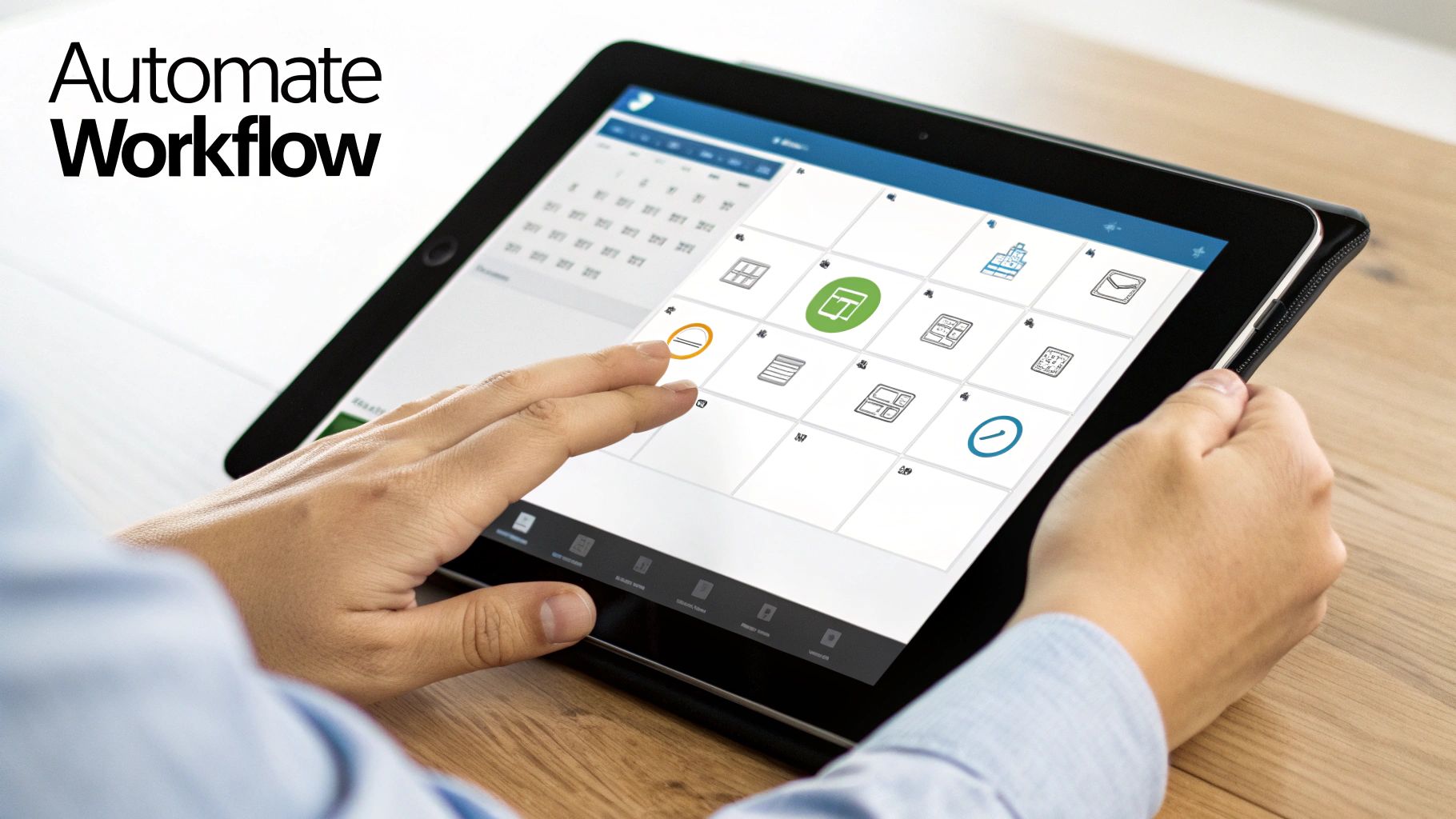
Okay, you’ve got a solid plan and your workflow is humming along. That's the foundation. But a truly killer content strategy for social media is all about optimization. Once the machine is running, it's time to layer in the pro moves that squeeze more juice out of every single post. This is where you graduate from just doing the plan to actively working smarter.
Think about it: instead of being on a constant hamster wheel of content creation, what if you could amplify what's already proven to work? This means recycling your best evergreen posts to catch all the people who missed them the first time around. It's about making tiny tweaks that deliver a huge impact, like keeping your captions clean by tucking hashtags into the first comment.
Unlocking Efficiency with Purpose-Built Features
To pull off these advanced tactics without chaining yourself to your desk, you need tools built for exactly this kind of thing. This is where a platform like OneUp becomes your secret weapon, offering specific features that handle the heavy lifting of pro-level optimization.
These aren't just shiny objects; they're features that directly boost your content's performance and your team's sanity.
- Repeating Posts: Got some evergreen content that always gets love? Use OneUp’s repeating post feature to automatically reshare it. Set it to repeat every few weeks or months, and forget it. This keeps your most valuable content in front of new eyes long after you first hit "publish."
- Automatic First Comment: Keep your captions clean and focused on the message. OneUp lets you automatically schedule your hashtags to post in the first comment on Instagram and Facebook. You get all the discoverability without cluttering up your post. Need help finding the right tags? An Instagram hashtag generator can be a lifesaver.
- Canva Integration: No more downloading and re-uploading graphics. The direct Canva integration lets you design visuals right inside the scheduler. Click publish in Canva, and boom, it's attached to your post and ready to go.
- UTM Parameter Tracking: Stop guessing where your traffic comes from. OneUp can automatically add custom UTM parameters to your links, giving you crystal-clear data in your Google Analytics.
Streamlining Collaboration and Ideation
As your strategy gets bigger, so does your team. And managing content creation and approvals across a bunch of people can get messy, fast. A good workflow needs a central hub where everyone is on the same page.
The best content strategies are built on smooth collaboration. When your team can brainstorm, create, approve, and schedule in one seamless flow, you cut out the friction and free up brainpower for what really matters: creativity and results.
OneUp tackles this head-on with features built for teamwork:
- Post Approval Workflows: Keep your brand voice consistent by setting up post approval workflows. Team members can submit posts for a quick review, and the right people get a notification to give the final nod before anything goes live. No more rogue posts.
- AI Post Idea Generator: Hit a creative wall? It happens. The AI assistant can spit out fresh post ideas that fit right in with your content pillars, helping you fill those calendar gaps in seconds.
These features turn your strategy document into a living, breathing operation that’s efficient and collaborative. But to really make your content pop, you need to stay on top of advanced techniques. A great next step is to explore some strategies for making social media videos that get noticed to take your visual game to another level.
Measuring Your Performance and Optimizing for Growth
Let's be real: a social media content strategy isn't a "set it and forget it" kind of thing. It's a living plan that needs to adapt based on what's actually happening out in the wild. Pushing out great content is only half the job. The other half is listening to what your analytics are telling you and making smart moves based on that data.
This is how you create a feedback loop that turns your social channels from a guessing game into a predictable engine for growth.
To keep from drowning in a sea of numbers, it helps to break your metrics into three simple buckets: Awareness (how many people see your stuff), Engagement (how many people interact with it), and Conversion (how many people take the action you want). Think of it as the journey people take with your content, from just seeing it to actually becoming a customer.
Interpreting the Data and Taking Action
Once you're tracking these numbers, you can start playing detective.
Is your reach sky-high but engagement is dead? People are seeing your content, but it's not hitting the mark. That's your cue to start tweaking your messaging or testing completely different creative formats.
On the flip side, maybe your engagement is awesome—lots of likes and comments—but nobody is clicking your links. Your audience loves what you're posting, but they aren't motivated to take that next step. Time to experiment with stronger, clearer calls-to-action (CTAs).
The whole point of measurement isn't just to report on what happened. It’s to figure out what to do next. Data is your roadmap for making things better and better, ensuring all your hard work actually pays off.
Optimizing Your Strategy for a Mobile-First World
Optimizing also means keeping an eye on the big picture. For example, social media ad spending is expected to hit a staggering $276.7 billion in 2025. And by 2030, a massive 83% of that will be spent on mobile ads. This just hammers home the need for a mobile-first approach.
And when you see that 78% of consumers now prefer to discover new products through short-form video, it becomes crystal clear where you should be putting your creative energy. You can dig into more of these critical social media statistics on SproutSocial.com.
A tool like OneUp is built for this kind of ongoing, data-driven work. With its post-level and summary analytics, you can easily see how you’re doing across every single network. You can even get custom cross-network reports and scheduled email updates sent right to your inbox. This makes it a piece of cake to spot trends, compare what’s working where, and double down on your winners—all without having to juggle a dozen different tabs.
Frequently Asked Questions
How Often Should I Post on Social Media?
This is the million-dollar question, isn't it? But the honest answer is there's no single magic number that works for every brand out there.
The golden rule? Consistency is always more important than frequency. A good starting point is about 3-5 times per week for platforms like Instagram or Facebook, and daily for something as fast-paced as X (formerly Twitter).
But the real key is letting your own data tell you what works. Keep a close eye on your analytics. You'll start to see patterns that reveal the best posting cadence for your specific audience. Tools like OneUp make this easy by showing you which times and frequencies are actually getting you the most engagement.
What Is the Difference Between a Content Strategy and a Content Calendar?
It's easy to get these two mixed up, but the difference is pretty simple when you think about it like building a house.
Your content strategy for social media is the architectural blueprint. It’s the ‘why’ and the ‘what’ of everything you do. It defines your goals, who you’re talking to, and the core content pillars that shape your brand’s voice. It’s the big-picture plan.
The content calendar, then, is the construction schedule. It's the 'when' and the 'how'. This is the day-to-day, nuts-and-bolts schedule of posts that actually brings your strategy to life. Your strategy tells you what needs to go into your calendar.
How Do I Find New Content Ideas?
When you feel like you've hit a wall, don't panic. There are a few tried-and-true places to look for inspiration.
First, just listen to your audience. What questions are they asking in your comments and DMs? This is a goldmine of content ideas. A unified social inbox, like the one OneUp offers, helps you keep tabs on all these conversations in one place so you never miss a message.
Next, do a little friendly spying. Check out what your competitors' top-performing posts are. You're not looking to copy, but to find inspiration. You can also look inward and repurpose your own content—turn that long blog post into a quick video or an eye-catching carousel.
And if you’re really stuck, don’t be afraid to use a creative assist. OneUp’s AI Post Idea Generator can give you fresh concepts based on your content pillars.
Finally, the easiest way to find out what people want? Just ask them! Run a poll or a Q&A and let your audience tell you exactly what they want to see next.
Ready to turn your strategy into a smooth, automated workflow? With OneUp, you can schedule posts across every major platform, manage approvals, and track performance all from one central hub. Start your free trial and see how easy it is to execute a winning content strategy.