

Let’s be honest: just posting stuff on social media isn't a strategy. That's just making noise.
A real social media content strategy is the game plan behind every single thing you create and share. It’s not about winging it or posting whenever you feel like it. It’s a deliberate plan that answers what you post, when you post it, and—most importantly—why you’re even bothering in the first place.
This is what turns your social profiles from a content graveyard into an engine for actual growth.
The Blueprint for Your Digital Voice
Trying to do social media without a strategy is like trying to build a house without a blueprint. You might end up with a few walls, but it’s probably not going to be a place anyone wants to live. You're just throwing content at the wall and hoping something sticks.
A social media content strategy gives you that blueprint. It provides the direction, turning random posts into a cohesive story that builds your brand, pulls in your audience, and gets you tangible results.
Anyone can post content. The hard part is making it count. A written-down strategy is your North Star, keeping your tone, message, and visuals consistent across every platform. That consistency is what builds brand recognition and, more importantly, trust with your followers.
Why a Documented Strategy Matters
Having a formal strategy isn't just about staying organized. It's a serious business tool that helps you:
- Align with Business Goals: It connects every post, video, and story directly to what actually matters—whether that's getting more leads, building brand awareness, or keeping customers happy.
- Use Resources Efficiently: It stops you from wasting time and money on content that flops, so you can double down on what your audience truly loves.
- Achieve Measurable Success: It pushes you past vanity metrics like follower count and forces you to focus on KPIs that show real business impact, like conversion rates and lead quality.
So, what's the difference between having a plan and just… doing things? Let's break it down.
Strategy vs Tactics At a Glance
It's easy to get bogged down in the day-to-day "doing" of social media and forget the bigger picture. This table clarifies the difference between the long-term "why" (your strategy) and the short-term "how" (your tactics).
| Element | Strategy (The Why) | Tactics (The How) |
|---|---|---|
| Timeframe | Long-term (months/years) | Short-term (days/weeks) |
| Focus | Big picture goals, brand building | Specific actions, campaigns |
| Example | "Become the go-to resource for B2B marketers on LinkedIn." | "Post 3 educational carousels and 2 video tips on LinkedIn per week." |
| Measurement | Business KPIs (e.g., lead quality, share of voice) | Post metrics (e.g., likes, comments, shares, clicks) |
| Flexibility | Consistent and stable | Agile and adaptable to trends |
Seeing the difference makes it clear: tactics without strategy are just random acts of marketing. Strategy gives your tactics purpose and direction.
In today's crowded space, this strategic focus is non-negotiable. As of 2025, social media ad spend has ballooned to an incredible $276.7 billion globally. For social media managers juggling multiple accounts, that means your organic content has to work smarter, not just harder.
This is why prioritizing mobile-first formats like short videos and Reels is critical—a whopping 78% of users prefer them for finding new products. Discover more insights about social media trends on sproutsocial.com.
Ultimately, a killer strategy ensures your content doesn't just add to the noise, but actually cuts through it. A great way to amplify your own efforts is by incorporating a winning user-generated content (UGC) strategy. When you plan with purpose, you create a social presence that doesn't just grab attention—it drives meaningful action.
Establishing Your Five Core Content Pillars
A great social media strategy isn't built on random posts and crossed fingers. It's a structure, a framework. The most solid ones are built on what I like to call the five core pillars.
Each pillar supports the others, turning your social media from a content-posting machine into a strategic tool that actually grows your business. Let's walk through how to build each one.
Pillar 1: Define Your SMART Goals
Before you even think about what to post, you have to know why you're posting. Your social goals shouldn't exist in a vacuum; they need to be tied directly to your bigger business objectives. The best way to do this is with the SMART framework—Specific, Measurable, Attainable, Relevant, and Time-bound.
Forget vague goals like "get more engagement." That's not a goal; it's a wish.
A real, powerful goal sounds like this: "Increase qualified leads generated from LinkedIn by 15% in Q3 by promoting our new case study." See the difference? It's specific (leads from LinkedIn), measurable (15%), attainable (based on past performance), relevant (it drives sales), and time-bound (Q3). This kind of clarity is your North Star for every piece of content you create.
Pillar 2: Develop Detailed Audience Personas
You can't connect with people if you don't know who they are. Creating detailed audience personas is like building a character profile for your ideal customer. And no, just knowing their age and location isn't enough.
You have to dig deeper. What are their biggest frustrations? What motivates them? What's a day in their life really like? When you understand their journey—the questions they're asking, the content they're already consuming—you can create posts that meet them right where they are with real solutions. That’s how you build trust.
Pillar 3: Establish Core Content Themes
Okay, you know your goals and your audience. Now, what are you actually going to talk about? Your core content themes (some people call them content pillars) are the 3-5 key topics your brand will own, day in and day out. These themes should live right at the intersection of what your brand is an expert in and what your audience genuinely cares about.
For a B2B software company, these themes might look like:
- Productivity Hacks: Simple, actionable tips their audience can use immediately.
- Team Collaboration: Best practices for working better together.
- Industry Trends: Expert takes on what's next in their field.
These themes are the backbone of your content calendar. They ensure every post you publish builds your authority and keeps you relevant. When you're planning this out, a tool like OneUp is a lifesaver. You can use its account categories feature to group your social profiles by theme (or by client), making sure your "Productivity Hacks" content hits the right channels at the right time. You can even create shared posting schedules for each category to keep your cadence consistent.
This diagram shows how your high-level blueprint guides both your big-picture strategy and the specific tactics you use every day.
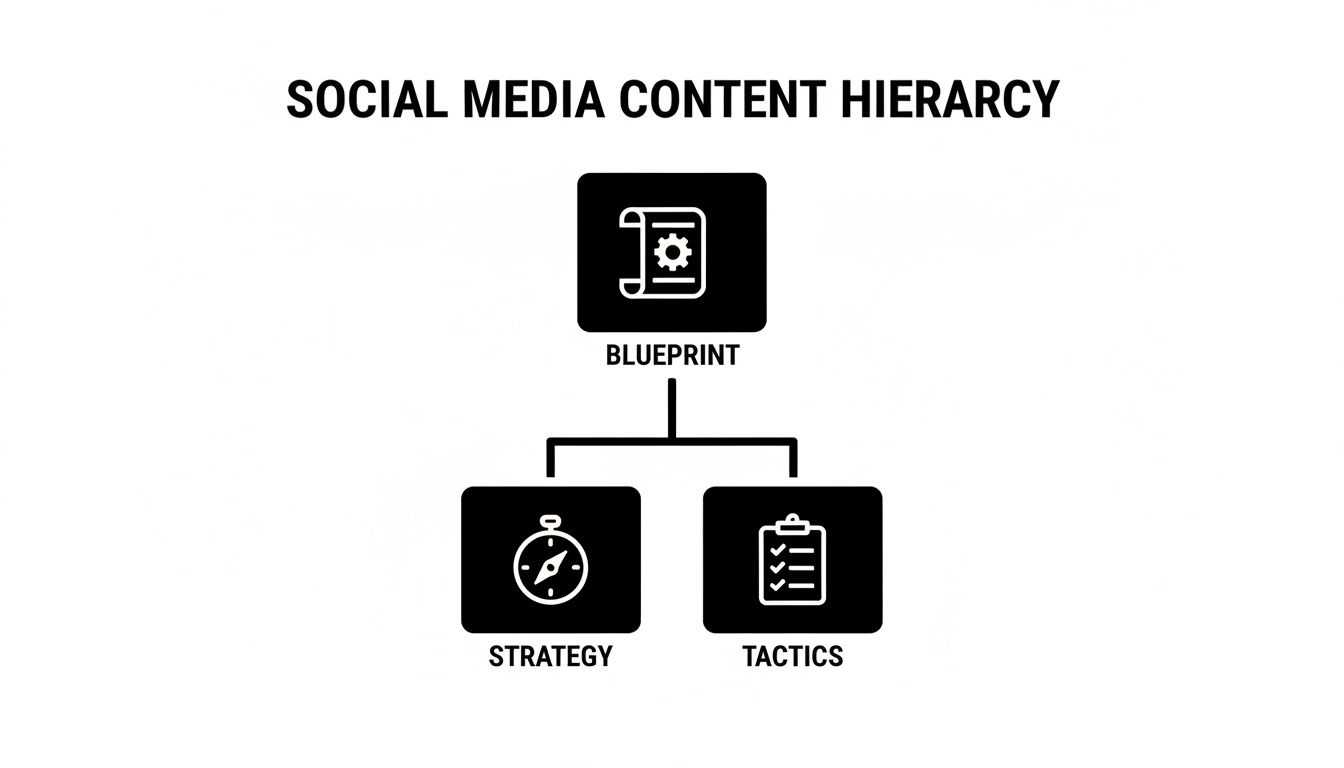
As you can see, tactics like individual posts are the very last step—they're the execution of a strategy that was planned out way in advance.
Pillar 4: Select Platforms and Content Formats
Your audience isn't everywhere, so your brand shouldn't be either. The fourth pillar is all about being selective—choosing where you'll show up and what you'll post when you get there. Pick the platforms where your ideal customers are actually active and hanging out. A brand targeting Gen Z? You're probably on TikTok and Instagram. C-suite execs? LinkedIn is your playground.
Just as important is picking the right content format mix. A study by Sprout Social found that short-form video is the most engaging content type out there. Your strategy has to reflect that reality.
Don't just slap the same static image on every platform and call it a day. Tailor your content to what works best on each network—think Reels on Instagram, longer videos on YouTube, and quick thoughts on Threads.
This is another spot where having the right scheduler is non-negotiable. OneUp supports a ton of platform-specific formats, letting you schedule everything from Instagram Reels and Stories (with link stickers) to YouTube Shorts, TikTok videos, and even Google Business Profile posts. It makes sure your content is always optimized for the platform it's on, which makes a huge difference in performance.
Pillar 5: Create a Consistent Calendar and Cadence
The last pillar is all about execution. Your content calendar and a consistent posting cadence are what bring the whole strategy to life. A calendar lets you plan ahead, batch your content creation (a huge time-saver), and keep a steady stream of quality posts flowing.
Consistency is how you build an audience. They learn when to expect content from you, which keeps your brand at the top of their minds.
Your cadence—how often you post—doesn't have to be overwhelming. It's far better to post three amazing, engaging posts a week than seven mediocre ones. With OneUp, you can bulk schedule posts months out via CSV and even set your best evergreen content to automatically recycle at set intervals. This keeps your profiles active without you having to be chained to your desk, and you can even automatically add UTM parameters to your links for better tracking.
This final piece, supported by the other four pillars, is what turns random acts of social media into a powerful, predictable growth engine.
Choosing Platforms and Formats That Actually Convert
Once you have your core pillars locked in, the next big piece of the puzzle is deciding where to post and what to create. It's so tempting to try and be everywhere at once, but that's a fast track to burnout and content that doesn't land anywhere.
The real goal is to be surgical. Pick the platforms where your audience actually hangs out and choose the formats that align with your goals.
I like to think of it like fishing. You wouldn't waste your time casting a net in a desert pond, right? You go where the fish are, and you use the bait they'll actually bite. For social media, LinkedIn is a deep ocean for B2B thought leadership, while TikTok is a fast-moving river of pure, unadulterated entertainment. Each one needs a totally different hook.

Aligning Platforms with Purpose
The secret is to match the platform's vibe with your content's job. Don't just blast the exact same post across every network—that rarely works. You've got to tweak your message to feel native to each platform if you want to see real results.
- LinkedIn: Think of this as your professional stage. It’s perfect for long-form articles, industry deep dives, case studies, and polished videos that scream "expert."
- Instagram: This is a visual-first world built on aesthetics and great storytelling. High-quality images, Reels, Stories, and carousels that show off your brand's personality are what win here.
- TikTok & YouTube Shorts: These platforms run on entertainment and whatever's trending right now. Success comes from short, snappy videos that feel authentic, creative, and maybe a little educational—but in a fun way.
Trying to manage all of this by hand is a nightmare. This is exactly where a tool like OneUp saves the day. It lets you schedule your content across 13+ platforms—including Instagram, TikTok, YouTube, LinkedIn, Threads, Pinterest, and even Bluesky—all from one place. You can also customize the same post for each social network, ensuring your message is consistent but still tailored for each audience.
Mastering the Right Content Formats
Picking the right format is just as critical as picking the right platform. As we head into 2025, one thing is crystal clear: video is king. Research shows that 78% of people prefer watching short videos to discover new products, and YouTube is growing faster than both Instagram and Facebook. Organic video builds trust like nothing else, and user-generated content (UGC) can spike engagement by as much as 28%. If you want to nerd out on the numbers, Sprinklr has the full findings on social media marketing statistics.
This video-first reality means your content plan has to lean heavily on formats like:
- Reels and TikToks: Short, punchy videos that are perfect for grabbing attention and jumping on trends.
- YouTube Shorts: Another short-form video powerhouse that can get you in front of a huge audience on the world’s number two search engine.
- Instagram Stories: These are your go-to for behind-the-scenes glimpses, polls, and Q&As that get your community talking.
Your content format should never be an afterthought. It's a strategic choice that directly impacts how your audience connects with your message. Even the most brilliant idea will fall flat if it's in the wrong package.
With OneUp, you can schedule Reels, Stories, and YouTube Shorts directly from the platform. You can even add custom thumbnails to your videos and tag products in your Instagram posts, which is a huge deal for making your content pop and driving sales. And for a platform like Instagram where the look of your feed is everything, you can map it all out with a dedicated Instagram grid planner to keep it looking sharp and professional.
Driving Engagement Beyond the Post
A winning social media strategy doesn't stop the second you hit "publish." The real magic, the part that leads to conversions, happens in the moments after your post goes live. That first wave of engagement—the likes, comments, and shares—is what tells the algorithm your content is worth showing to more people.
One of my favorite tactics is to get the conversation started immediately. For example, instead of stuffing your caption with links, drop them in the first comment. It keeps the caption clean and gives people a reason to engage.
This is another simple but powerful feature built right into OneUp. The ‘Add a follow-up comment’ function lets you automatically post that first comment with a link, call-to-action, or extra hashtags right as your content goes live. It’s a small trick that kickstarts engagement, drives traffic, and helps turn those passive scrollers into paying customers.
Streamlining Your Content Workflow for Efficiency
Let's be real: a brilliant social media strategy is just a nice-looking document until you actually do something with it. The real test, especially for busy agencies and marketing teams, is turning that plan into a steady stream of content that shows up on people's feeds.
This is where your workflow comes in. It's the bridge between your big ideas and your daily posts. The goal isn't to work harder; it's to stop the last-minute chaos and build a smooth, predictable system for getting things done. We're talking about a well-oiled machine that frees you up to think about strategy and creativity, not just what to post right now.

A visual plan, like a content calendar, is your command center. It shows you everything at a glance, helping you spot content gaps, make sure you're mixing up your formats, and stay consistent without the daily scramble.
Building Your Content Creation Engine
First things first: stop the madness of hunting through random folders and Slack channels for the latest graphic. You need a central hub for all your content and assets. This becomes your single source of truth.
Think of your workflow as an assembly line. Each step—from idea to approval to publication—should be clearly defined and repeatable. When everyone on the team knows their role and the process, bottlenecks disappear and quality goes up.
This is exactly what platforms like OneUp are built for. With a direct Canva integration, your team can whip up graphics and videos right inside the scheduler, skipping the whole download-and-re-upload dance. Plus, a shared media library keeps all your approved assets organized and ready for anyone who needs them. You can even save post templates to quickly reuse your best-performing formats.
And for those days when the words just aren't coming, an Instagram caption generator can be a lifesaver for sparking ideas and getting copy done faster.
Mastering Batching and Scheduling
If there's one secret weapon every productive social media manager has, it's content batching. Instead of trying to create and post something new every single day, you block off time to create a whole week's—or even a month's—worth of content at once. It's a game-changer for focus and efficiency.
Once your content is ready to go, a solid scheduling tool is your best friend. Here’s how to put your scheduling on autopilot:
- Bulk Uploading: Manually scheduling dozens of posts for a big campaign or multiple clients is a huge time-suck. With OneUp, you can bulk upload posts via a CSV file or its Chrome Extension, turning hours of tedious work into a few clicks.
- Post Recycling: Not every post has a one-and-done lifespan. Your best evergreen content—like blog promotions or popular tips—can keep delivering value for months. OneUp's post recycling feature automatically re-publishes this content at intervals you choose, keeping your feeds active and getting more mileage out of your greatest hits.
- Content Repurposing: For maximum efficiency, get good at repurposing content for efficiency. That one blog post or podcast episode can be sliced and diced into a dozen different social media posts, from quote cards to video clips.
Eliminating Approval Bottlenecks
For anyone working in a team or with clients, the approval process can be the biggest headache. Endless email chains, confusing feedback, and missed deadlines can throw a wrench in the most carefully laid plans. You absolutely need a formal approval workflow.
This is where a tool with built-in collaboration shines. OneUp offers a client approval workflow that cuts through the chaos. You can schedule the posts, then send a simple link to your client or manager. They can see everything, approve or reject posts, and leave feedback right there—no login required. It creates a clear, simple system that keeps projects moving and ensures content goes live on time.
How to Measure and Optimize Your Strategy
Getting your social media content strategy built is a huge accomplishment, but it's definitely not a "set it and forget it" kind of deal. The last—and you could argue, most important—piece of the puzzle is figuring out how to measure what’s working and what’s falling flat.
Without data, you're just throwing content at the wall and hoping something sticks. But with the right numbers, you can turn your strategy into a living, breathing thing that gets smarter and delivers better results over time.
This all starts with looking past the surface-level vanity metrics. Follower counts and post likes might give you a quick ego boost, but they don't tell you if your content is actually helping your business. Real optimization begins when you zero in on the key performance indicators (KPIs) that actually matter.
Identifying KPIs That Matter
The right KPIs are the ones that draw a straight line from your social media activity to your business objectives. So instead of just counting up likes, you need to track the actions that show people are genuinely interested in what you have to offer.
Here are the metrics that should really be on your radar:
- Conversion Rate: This is the big one. It tells you how many people took the action you wanted—like signing up for your newsletter or buying a product—after clicking a link in your post.
- Click-Through Rate (CTR): This number shows you the percentage of people who saw your post and were compelled enough to actually click your link. A healthy CTR means your content and call-to-action are hitting the mark.
- Engagement Quality: Don't just count comments; read them. Are people asking real questions and starting conversations, or are they just dropping a fire emoji? High-quality engagement means you're building a real connection.
Tracking these metrics is like getting a report card for your content. It tells you exactly which content pillars, formats, and messages are resonating with your audience, allowing you to double down on what works and cut what doesn't.
This data-first mindset is so important, especially when you remember how different each platform is. For example, engagement rate projections for 2025 show some big gaps: LinkedIn is expected to lead at 6.50%, with Facebook at 5.07% and TikTok at 4.86%. This pretty much proves that a copy-paste strategy across all your channels is a recipe for wasted effort. Discover more insights about these platform differences on dreamgrow.com.
Using Analytics to Refine Your Approach
Consistent analysis is what powers your optimization engine. When you regularly check your performance data, you start to see patterns. You can spot your top-performing posts and make smart tweaks to your strategy. This is where a good analytics tool becomes your best friend, especially for agencies and managers juggling a ton of accounts.
OneUp makes this whole process way simpler with its analytics suite. You can easily zoom out for a high-level overview or dive deep into the nitty-gritty without getting lost in a sea of spreadsheets. For example, the post-level insights show you exactly how every single piece of content performed, helping you figure out which topics and formats your audience can't get enough of.
You can also pull custom cross-network reports to see the whole picture at once. This is perfect for comparing how you're doing on Instagram vs. LinkedIn vs. TikTok, all in one place. It gives you a crystal-clear view of where your time is best spent. And to keep everyone in the loop, you can set up scheduled email reporting to automatically send performance updates to clients or your team.
Optimizing Content for Maximum Reach
Data isn't just about looking backward; it's about planning what's next. As you dig into your metrics, pay close attention to the content that gets the best engagement and conversions. You might find that your educational carousels do way better than single-image posts, or that posts with a certain type of hashtag get a huge bump in reach.
This is where you can start getting tactical. For instance, if you see that a few specific hashtags are consistently driving engagement on Instagram, you can build them into your strategy for future posts. To make this even easier, tools like an Instagram hashtag generator can help you find relevant and trending tags to get more eyes on your content. By constantly testing and tweaking these little details, you make sure your social media strategy is always evolving and driving a better return on your investment.
Your Social Media Strategy Questions Answered
Even the best-laid plans run into questions on the ground. As you start putting your social media content strategy into action, you're bound to hit a few snags or wonder if you're doing things right. This section is all about tackling those common hurdles head-on, so you can keep moving forward.
How Often Should I Post on Social Media?
Let’s get one thing straight: consistency always trumps frequency. There's no secret number of posts that unlocks the algorithm. The real goal is to create a reliable schedule that your audience learns to expect. Posting erratically is way worse than posting a little less often.
A solid starting point for most platforms like Instagram and Facebook is about 3-5 times per week. The trick is actually sticking to it. This is where a good scheduling tool becomes your best friend.
A platform like OneUp is built for exactly this. You can bulk schedule posts months out using a CSV file or its browser extension, making sure your calendar never runs dry. Plus, its post recycling feature can automatically republish your top-performing evergreen content, keeping your feed active even when you’re not.
What Is the Best Way to Manage Multiple Client Accounts?
Juggling multiple client accounts is all about bulletproof organization. You need to keep everything separate to avoid the nightmare scenario of posting the wrong content to the wrong account. Trust me, it happens.
The only sane way to do this is with a tool designed for it. In OneUp, you can group social accounts into different categories—one for each client. Each category gets its own schedule, its own media library, and its own analytics. It’s like having a separate, walled-off workspace for every brand.
This separation is non-negotiable for keeping brand voices distinct and preventing embarrassing mix-ups. For agencies, features like team member roles and client approval workflows are just as critical. A client can approve or reject posts with a simple link, no login needed, which saves everyone a ton of headaches.
How Can I Consistently Generate Fresh Content Ideas?
Creative block is real. When it hits, the first thing you should do is go back to your content pillars. They’re your foundation. From there, you can start exploring. Use social listening to see what your audience is actually asking about, keep an eye on industry trends, and see what your competitors are doing that seems to be working.
Don't forget about repurposing. It’s a game-changer. That one blog post you wrote? It can become an Instagram carousel, a series of tweets, and a short video script. That glowing customer review? Turn it into a beautiful graphic.
And when you're really stuck, a little tech can give you a nudge. OneUp's built-in AI assistant can whip up caption ideas and unique images, while its RSS feed automation can pull in relevant articles to share, keeping your content pipeline full with way less effort.
How Do I Prove the ROI of My Social Media Efforts?
This is the million-dollar question. To prove the return on investment (ROI) from social media, you have to connect your activity to real business results. The most straightforward way is using UTM parameters on every single link you share. This lets you track exactly how many clicks and conversions came from your social channels inside Google Analytics.
If your main goal is brand awareness, you'll be looking at metrics like reach, impressions, and your brand's share of voice online. No matter what, you need a solid analytics tool to pull all this data together.
OneUp makes this part easier by letting you generate custom, cross-network reports. You can also automatically add UTM parameters to all your scheduled posts, saving time and ensuring consistent tracking. You can even schedule these reports to be automatically emailed to clients or your boss. It’s the best way to show, with hard data, how your work on social is directly impacting the bottom line.
Ready to turn your strategy into seamless execution? OneUp provides all the tools your team or agency needs to schedule, manage, and analyze your social media content in one place. Stop juggling platforms and start building a powerful, efficient workflow. Explore plans and start your free trial at oneupapp.io.