

If you want to boost your social media engagement, you have to stop thinking like a broadcaster and start thinking like a conversation starter. The goal isn't just to put content out there; it's to create something so interesting, useful, or relatable that people can't help but react. When you get people talking, sharing, and saving, the algorithms take notice, and that's when the magic of organic growth really kicks in.
Why Real Engagement Matters More Than Follower Counts
Look, it's tempting to get obsessed with your follower count. We've all been there. But a huge audience that just scrolls past your content is like a packed stadium where everyone's on their phone. They might be in the building, but they're not actually watching the game.
The real health of your social media isn't measured in followers; it's measured in genuine engagement. These are the meaningful actions that tell you your content is actually hitting the mark—not just being seen, but being felt.
- Comments: A comment isn't just a comment. It's proof that someone stopped, thought about what you said, and took the time to write a reply. That's a direct line to building a real relationship.
- Shares: When someone hits that share button, they're basically giving your brand a personal recommendation to their own circle. It's the digital version of word-of-mouth, and it’s pure gold for extending your reach.
- Saves: This one is a huge signal of value. A save means your post was so helpful or inspiring that someone wants to come back to it again and again. To the algorithms, that screams "high-quality content."
- Direct Messages (DMs): DMs are the most personal you can get. They usually come from your most interested followers and can be a fast track to making a sale or creating a die-hard brand fan.
When you prioritize these actions, your social media accounts transform from a simple marketing channel into a buzzing community hub. You're not just building an audience; you're building a base of advocates.
The Business Impact of Active Participation
Switching your focus from followers to engagement isn't just a mindset shift—it's a business strategy with real, tangible results. Platforms like Instagram and TikTok are designed to keep people hooked, and the algorithms are smart. They know that high engagement means your content is doing exactly that.
To put it simply, when people engage with your posts, the platform sees it as a sign of quality. The reward? Your content gets pushed out to more people, both inside and outside your current follower list. It’s a powerful feedback loop.
When your posts get a flurry of comments, shares, and saves, the platform’s algorithm essentially says, "Hey, people love this stuff. Let's show it to more people." That's how you unlock greater organic reach without spending a dime on ads.
This increased visibility leads directly to a stronger brand presence and more authentic connections. For a deeper dive into this, you can find a ton of proven strategies in these Top Tips & Strategies on How to Increase Social Media Engagement.
Ultimately, it all comes down to this: building a community that genuinely cares about what you have to say is the most sustainable way to grow. And that starts with prioritizing every single interaction.
How Key Engagement Metrics Drive Business Results
It's crucial to understand how each of these little interactions translates into tangible business outcomes. Each metric tells a different story about your audience and the health of your content strategy.
| Metric | What It Measures | Business Impact |
|---|---|---|
| Likes | Initial interest and content appeal. | Boosts visibility in feeds and serves as a basic health check for your content's resonance. |
| Comments | Audience connection and conversation level. | Builds community, provides direct feedback, and signals strong relevance to algorithms. |
| Shares | Content value and brand advocacy. | Expands organic reach exponentially and acts as powerful social proof, driving new followers. |
| Saves | Usefulness and evergreen potential. | Indicates high-quality, valuable content that algorithms are more likely to promote over time. |
| Reach/Impressions | Content visibility and brand awareness. | Measures how many unique users see your content, a key indicator of brand recognition. |
| Direct Messages (DMs) | High-intent interest and lead generation. | Creates a private channel for customer service, lead nurturing, and building deeper relationships. |
By tracking these metrics, you move beyond guesswork. You can clearly see what's working, what's not, and how your social media efforts are contributing directly to your company's bottom line.
Creating Content That Sparks a Conversation
Let's be honest: passive scrolling is the enemy. If your content just sits there, it's going to get scrolled past. To really boost your engagement, your posts need to do more than just exist—they need to be a pattern interrupt. They have to give people a reason to stop, think, and actually interact.
This means you have to stop thinking like an advertiser and start thinking like a conversation starter.
Right now, the single best way to do that is with video. It's not even a debate anymore. A staggering 78% of people would rather learn about a new product from a short video than any other format. This has completely changed the game, putting platforms like TikTok front and center.
The numbers don't lie. TikTok's average return on ad spend (ROAS) is 2.4x higher than old-school display ads, and its engagement rate of 4.86% is just massive. Even though Instagram's overall engagement has dipped a bit, Reels are still king, clocking in at a 0.50% rate—that's more than three times better than Facebook's 0.15%. With 93% of marketers now focusing on social media, video isn't just a "nice-to-have"; it's your core strategy.
Your goal is to turn your feed into a destination, not just a digital billboard.
The Power of Asking the Right Questions
One of the easiest ways to get people talking is literally just to ask them something. Sounds simple, but there's an art to it. A lazy question gets a lazy answer, or worse, no answer at all.
Avoid "yes" or "no" questions like the plague. They're conversation killers.
Instead, frame your questions to pull out opinions, stories, and real thoughts. Here’s what I mean:
- Weak Question: "Do you like our new feature?" (This just begs for a "Yes" or "No.")
- Strong Question: "What's the first thing you would do with our new feature?" (This invites creativity and makes them part of the process.)
That small tweak makes a world of difference. It brings your audience into the fold.
Captivating Your Audience with Visual Storytelling
Beyond asking questions, you need to forge a real connection, and visual storytelling is how you do it. People connect with other people, not faceless logos. Sharing what happens behind the curtain is one of the best ways to humanize your brand and build some serious trust.
Here are a few ideas you can steal:
- A Day in the Life: Give a quick tour of your workspace or introduce a team member (and their weird coffee order).
- The Making Of: Show the messy, unglamorous process of creating your product.
- Share Your Wins (and Losses): Talk about a big milestone you hit. Or, even better, share a lesson you learned from a project that completely flopped. That kind of realness builds loyalty.
Content like this makes your audience feel like they're on the inside, and that's a powerful thing.
This graphic really nails the three key actions you should be chasing: comments, shares, and saves.
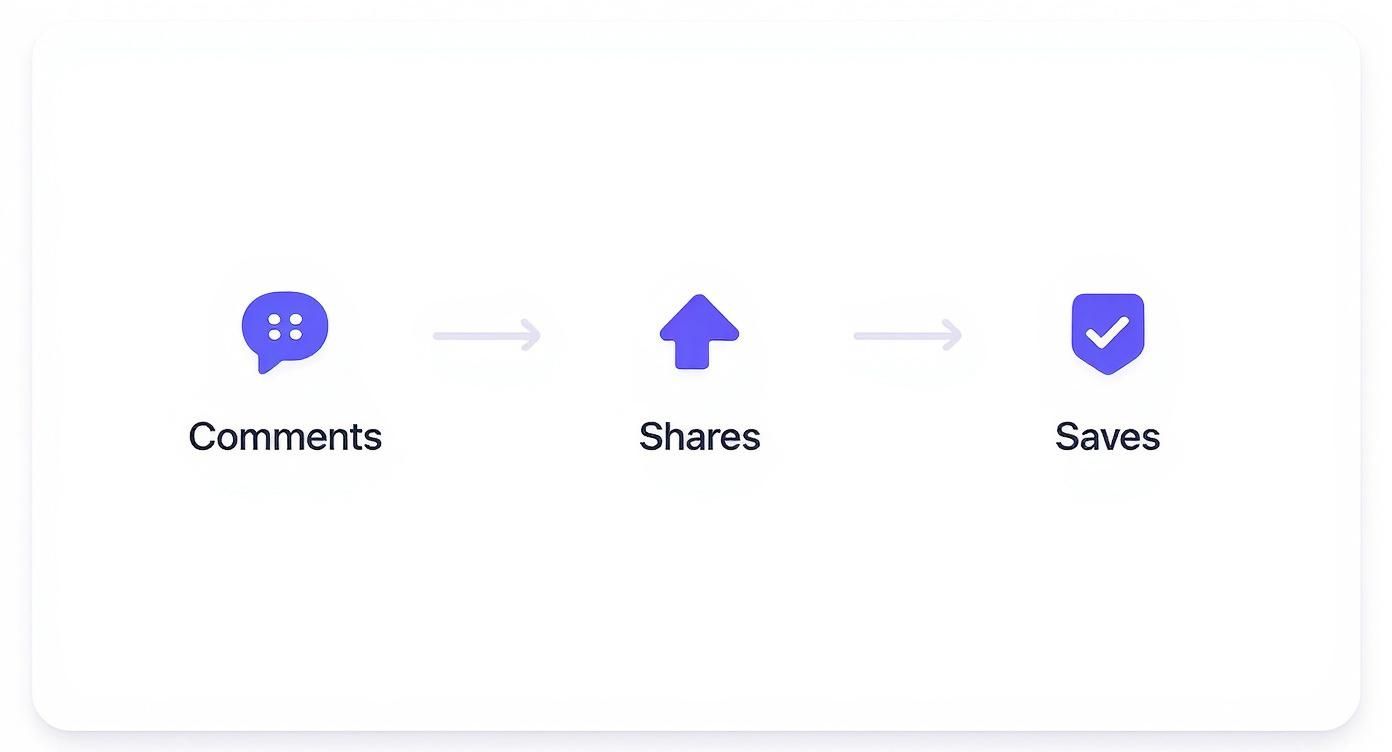
Forget vanity likes. Each of these metrics shows a much deeper level of commitment from your audience, which is exactly what the algorithms love to see.
Interactive Formats That Drive Participation
Interactive content is gold because it turns passive scrollers into active participants. Polls and quizzes are perfect for this. They’re low-effort for the user but high-impact for your engagement.
A good poll isn't just an engagement booster; it's free market research. You can use it to see if people are into a new product idea, figure out their biggest pain points, or just let them feel like their opinion matters.
Imagine a coffee shop running a poll: "Which seasonal flavor should we bring back: Pumpkin Spice or Peppermint Mocha?" It gets people involved and gives the shop direct feedback they can actually use.
Of course, having the right tools in your back pocket makes all this much easier. Making great videos can be a huge time sink, but there are some really effective content creation tools that can speed things up. And even the best photo can fall flat without a killer caption; an Instagram caption generator can be a lifesaver when you're drawing a blank.
Ultimately, tools like OneUp's AI post and image generator can handle a lot of this for you. You can get compelling captions and on-brand images in seconds, freeing you up to focus on the stuff that really matters: strategy and actually talking to your community.
Building a Consistent and Effective Posting Cadence
Let's be real: creating amazing content is only half the battle. If you post at the wrong times or your schedule is all over the place, even the most incredible video will just sit there, collecting digital dust. A smart, consistent posting cadence is what actually gets your hard work in front of an engaged audience.
Consistency is everything. When your followers know they can expect something new from you around a certain time, they start to look for it. It builds a rhythm, a sense of anticipation that keeps your brand top-of-mind. But that doesn't mean you have to be chained to your desk, manually hitting "publish" all day. That's a one-way ticket to burnout.
This is where you need to work smarter, not harder—with a little help from automation.
Finding Your Posting Sweet Spot
Before you schedule a single post, you have to figure out when your audience is actually listening. Sure, you can find generic advice online—like Wednesdays at 8:00 AM being a "good time"—but your audience is unique. Your job is to find the exact days and hours they're most active and ready to engage.
Start by digging into the native analytics on each platform. Instagram Insights, Facebook's Meta Business Suite, and TikTok Analytics are goldmines of data, showing you precisely when your followers are scrolling. Look for the peaks in activity and use those as your starting point.
But don't just set it and forget it. Think of these times as your first draft.
- Test the waters: Try posting 30 minutes before and after the suggested peak times. You might catch a more focused segment of your audience.
- Track everything: Pay close attention to the engagement rate for each post and what time it went live. After a couple of weeks, you'll start to see clear patterns emerge.
- Don't copy-paste schedules: The crowd you have on LinkedIn is probably not the same one on TikTok. Each network needs its own tailored schedule.
Automating Your Cadence for Maximum Impact
Once you have a data-backed schedule, the real trick is sticking to it without losing your mind. This is where a solid scheduling tool like OneUp becomes your best friend. It lets you build out your content calendar weeks or even months ahead of time, ensuring a steady stream of content goes live at the perfect moment.
Imagine knocking out an entire month's worth of content in just one afternoon. With OneUp's bulk upload feature, you can schedule hundreds of posts from a simple CSV file. For agencies and small teams, this isn't just a time-saver; it's a total game-changer.
A well-organized calendar gives you a bird's-eye view of your entire strategy.
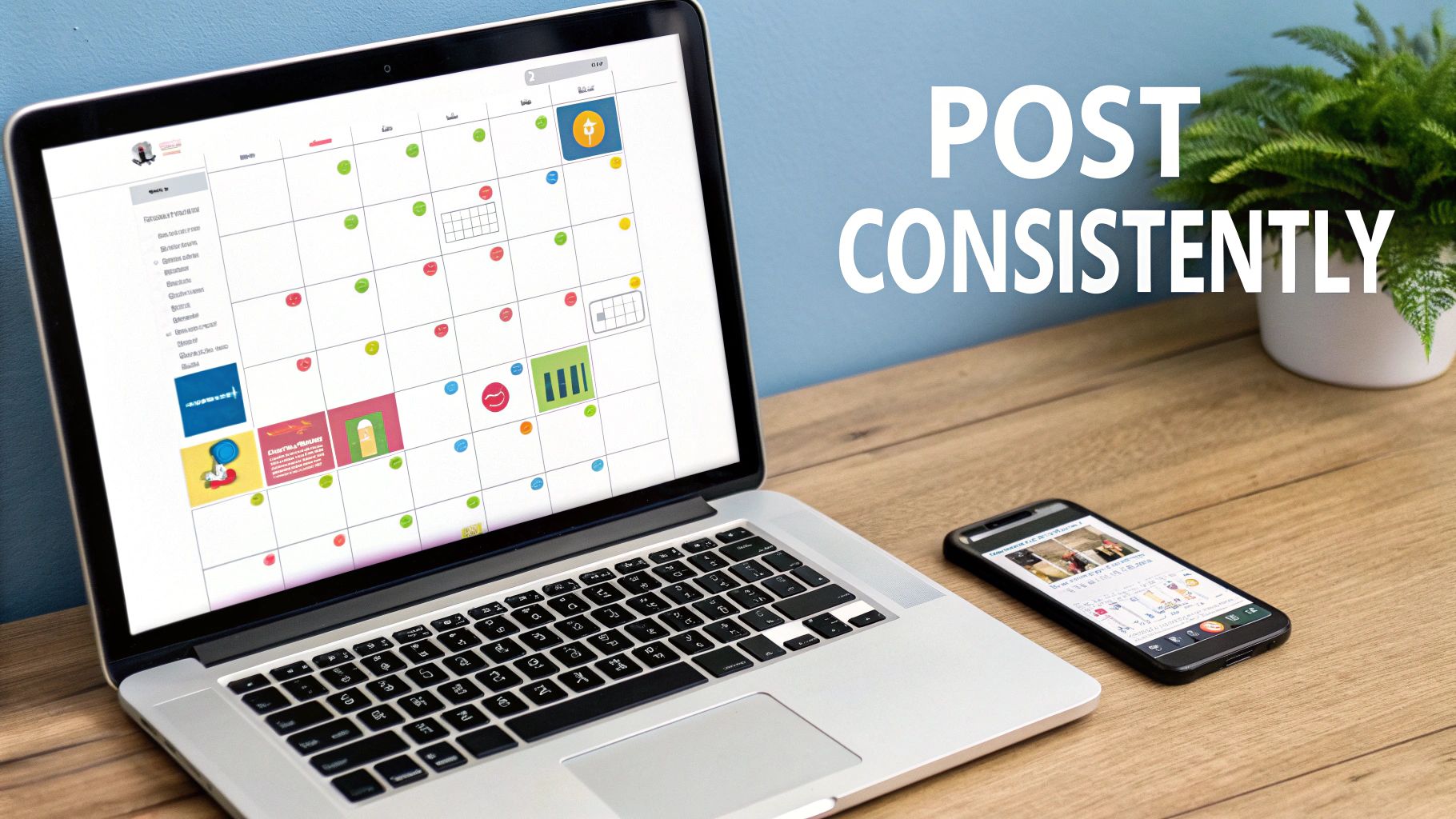
This visual layout helps you balance your content mix and make sure you're showing up consistently everywhere you need to be.
Leveraging Smart Features to Keep Your Feed Active
True consistency isn't just about scheduling new stuff. It's also about breathing new life into your high-performing content. OneUp has some killer features designed to automate engagement opportunities you’d otherwise miss.
One of the most powerful is the ability to set posts to automatically repeat. Got a killer blog post, a glowing customer review, or a foundational tip that people love? Schedule it to pop up again at set intervals. This keeps your best content in front of new followers without you lifting a finger.
By automatically recycling your evergreen content, you maximize its value and keep your profiles active, filling content gaps and driving sustained engagement over time.
You can also keep your feed fresh by connecting RSS feeds directly to OneUp. This feature automatically pulls and posts new articles from trusted industry blogs, positioning you as the go-to source for curated info. It’s an effortless way to provide value and kickstart conversations.
Streamlining Your Visual Content Workflow
Let's face it: visuals are the lifeblood of social media, but the creation process can be clunky. Jumping between a design tool, your downloads folder, and your scheduler is a huge time suck.
OneUp cuts out the friction by integrating directly with Canva. You can design your graphics, carrolusels, or videos right inside Canva and push them straight to your OneUp schedule without ever leaving the platform. This seamless workflow is absolutely critical for maintaining a beautiful and consistent brand aesthetic.
For a platform like Instagram, where the grid is everything, this is a lifesaver. It helps you maintain that cohesive look that's so important for brand recognition. Pair it with a visual planner, and you can map out your feed's entire look in advance. For that, you can even use tools like OneUp's own Instagram grid planner to get it just right.
When you combine data-driven timing with smart automation, you create a posting rhythm that actually works for you, boosting engagement without adding to your workload.
Turning Your Audience Into a Thriving Community
Let's be honest, engagement isn't just about racking up likes and comments. That's the starting line. The real win is turning those fleeting interactions into a genuine, thriving community.
When you build a community, you get more than just followers. You get advocates—people who champion your brand, defend you in the comments, and feel a real connection to what you're doing. It’s about shifting from collecting an audience to cultivating a loyal tribe.
This doesn't happen by accident. It takes a conscious effort to treat every single interaction as a chance to build a relationship. When someone comments, they're basically knocking on your door. Answering it is what separates the brands that get ignored from the ones that get remembered.
Ultimately, the goal is to make people feel seen, heard, and valued. That’s how you humanize your brand and build the kind of trust that no marketing slogan can ever buy.
Master the Art of the Thoughtful Response
Responding to comments is table stakes. But how you respond is where the magic happens.
A generic "Thanks!" is better than radio silence, but it's a dead end. You need to aim for replies that keep the conversation going. Think of it like a real-life chat—if someone paid you a compliment, you wouldn't just nod and walk off. You'd engage with them.
Ask a follow-up question. Offer a related tip. Acknowledge the specific point they made in their comment. Show them a real person is on the other side of the screen.
This goes for negative feedback, too. A defensive or copy-pasted response can poison the well for everyone watching. Instead, own it. Acknowledge their frustration, offer to take it to DMs, and show that you're committed to fixing things. That kind of transparency can turn a critic into your biggest fan.
Make Your Audience the Star of the Show
One of the best ways to build a community is to put the spotlight on its members. User-generated content (UGC) is absolute gold because it’s authentic, relatable, and makes your audience feel like they're co-creating the brand story with you.
Here are a few simple ways to get the ball rolling with UGC:
- Launch a Branded Hashtag: Give your community a unique hashtag to use when they post about your product or service. This makes it a breeze to find and re-share their awesome content.
- Run a Contest or Challenge: Get people involved by asking them to share photos or videos around a specific theme. The prize could be a product or simply the honor of being featured on your page.
- Spotlight Customer Stories: Make it a regular habit to share testimonials, reviews, or success stories. When you feature someone, you're not just giving them a shout-out; you're showing everyone else that you actually listen.
When you amplify your audience's voice, you send a powerful message: "We value you."
Streamline Your Community Management Workflow
Juggling comments, mentions, and DMs across half a dozen platforms can get out of hand fast. Important messages slip through the cracks, response times crawl, and you miss out on golden opportunities to connect.
This is where a unified management tool isn't just a nice-to-have—it's essential.
A dedicated social inbox doesn't just save you time; it ensures you deliver consistent, high-quality engagement. When everything is in one place, conversations stop falling through the cracks.
Tools like OneUp are built for this. Its Social Inbox consolidates all your comments and direct messages from every platform—Facebook, Instagram, LinkedIn, Google Business Profiles, you name it—into a single feed. You can see and reply to everything from one dashboard, ensuring every person gets the attention they deserve. And to kick off these conversations, using an effective Facebook post generator can help create the posts that get people talking in the first place.
OneUp also makes teamwork a breeze. You can assign conversations to specific teammates and add internal notes for context. This keeps your brand voice cohesive and stops two people from awkwardly replying to the same message. It turns community management from a chaotic free-for-all into a structured, efficient process—the very foundation you need to build a truly engaged and loyal following.
Using Analytics to Fuel Your Engagement Strategy
Posting on social media without checking your analytics is basically like driving with your eyes closed. Sure, you're moving, but you have no clue where you're going—or what’s actually working. If you want to really increase engagement, it’s time to stop guessing and start making data-driven decisions.
Think of analytics as a powerful feedback loop. You post something, measure how people react, and then use what you learned to make your next post even better. This whole process takes the mystery out of what your audience loves and helps you consistently create content that just hits.
Pinpointing the KPIs That Actually Matter
First things first, you need to focus on the key performance indicators (KPIs) that signal a genuine connection with your audience. Likes are nice, but they're often a low-effort tap. You need to dig deeper into the metrics that show your content is resonating on a much more meaningful level.
These are the numbers that really tell a story:
- Engagement Rate: This is your north star. It's calculated by dividing your total engagements (comments, shares, saves) by your reach or followers. This tells you the percentage of people who saw your post and cared enough to actually do something about it.
- Shares and Saves: These are high-intent actions, plain and simple. A share means someone found your content so valuable they were willing to vouch for it to their own network. A save signals that they see it as a resource worth coming back to.
- Comment Quality: Don't just count the comments; read them. Are people asking thoughtful questions or sharing their own stories? Or are they just leaving one-word replies? Meaningful conversations are a sign of a truly healthy community.
Focusing on these moves you past vanity metrics and straight toward real audience insight.
Mastering Your Native Platform Insights
Every single social media platform gives you a free treasure trove of data. Whether it's Instagram Insights, TikTok Analytics, or the Meta Business Suite, they all provide detailed breakdowns of your best-performing content, who your audience is, and when they're most active. You need to spend time here.
Look for patterns in your top-performing posts. Was it a Reel that used a specific kind of hook? A carousel post that broke down a tricky topic? A direct question you asked in the caption? These little clues are the building blocks for a much smarter content strategy.
Your analytics dashboard is the most honest focus group you'll ever have. It tells you exactly what your audience wants more of, straight from their actions, not just their words.
Tools like OneUp can make this process way easier by pulling all your data into one spot. You can get summary and post-level analytics across all your accounts without having to bounce between platforms. OneUp even lets you build custom cross-network reports, giving you that big-picture view of your engagement strategy without juggling a dozen browser tabs.
A Practical Framework for A/B Testing
Once you've got a handle on your baseline numbers, you can start experimenting with purpose. A/B testing is just a fancy way of saying you're comparing two slightly different versions of a post to see which one performs better. It kills the guesswork and gives you hard data on what truly connects with your followers.
And it doesn't have to be complicated. You can run simple tests on everything from your visuals to your calls-to-action (CTAs). For example, does a direct CTA like "Save this post for later" get more traction than a softer one like "What are your thoughts?" Let the data tell you.
To keep your workflow organized, you can use OneUp’s internal notes feature to label your A/B test posts. This way, your whole team can see which variation is which right inside your content calendar.
Simple A/B Testing Ideas to Boost Engagement
Here are a few practical A/B tests you can run on your own content to see what resonates. The goal is to isolate one variable and see how it impacts a specific metric.
| Element to Test | Variable A Example | Variable B Example | Metric to Track |
|---|---|---|---|
| Video Hook | Start with a question. | Start with a surprising statistic. | 3-Second View Rate |
| CTA | "Comment your favorite tip below!" | "Tag a friend who needs to see this." | Comments vs. Shares |
| Image Style | Bright, colorful graphic. | Minimalist, text-based image. | Engagement Rate |
| Caption Length | A short, punchy sentence. | A longer, storytelling caption. | Saves & Comments |
By consistently testing small changes and analyzing the results, you stop taking random shots in the dark. Instead, you build a precise, data-backed system for growing your engagement.
Common Questions About Social Media Engagement
Even with a great plan in place, you're bound to run into some specific questions while trying to get more engagement. Let's tackle some of the most common ones I hear.
How Long Does It Take to See an Increase in Social Media Engagement
This is the big one, isn't it? While there's no magic button, you should start seeing some positive signs within 1-3 months if you're truly consistent. That means posting valuable content and actually talking to your community every single day.
But for that real, meaningful growth—the kind that builds on itself—you're typically looking at 6 months or more. The trick is to stop looking for a quick win and focus on persistence. Sporadic effort only ever gets you sporadic results.
Which Social Media Platform Is Best for Engagement
The best platform is simply where your people are. Forget industry averages for a second. If you're a B2B software company, you'll probably get the most traction on LinkedIn. If you're a fashion brand trying to reach Gen Z, you need to be on TikTok and Instagram Reels. It's that simple.
Don't try to be everywhere at once. Figure out where your audience actually hangs out and master one or two of those platforms first. For example, if you're working with local businesses, engagement on your Google Business Profiles is a goldmine. A tool like OneUp can be a lifesaver here, letting you handle those interactions right alongside your other social accounts.
The most effective platform isn't about what's popular; it's about where your customers are already talking. Find those conversations and add real value.
How Can a Tool Like OneUp Help a Small Team Manage Engagement
For a small team, a tool like OneUp is less of a "nice-to-have" and more like an extra team member who handles all the tedious stuff. This frees you up to focus on strategy and having actual conversations with people.
Here's how it makes a real difference:
- Bulk Scheduling: You can literally plan and schedule a whole month of content in one go using a simple CSV file.
- Content Recycling: Got some great evergreen posts? Set them to automatically repeat on a schedule you choose. This keeps your feed from going silent and gets more mileage out of your best stuff.
- Unified Inbox: The Social Inbox pulls all your comments and DMs from every platform into one clean feed. No more missed messages, and you can reply way faster. There's even a Chrome extension to schedule cool stuff you find while browsing.
Basically, it stops you from constantly jumping between a dozen different apps just to keep the lights on.
Should I Use Hashtags to Increase Engagement
Yes, 100%—but you have to be smart about it. Throwing a bunch of random hashtags at the end of your post is a waste of time. Hashtags are your best tool for getting your content discovered by people who don't follow you yet.
The key is to tailor them to the platform and the specific post. On Instagram, you can use a mix of broad, niche, and branded tags. For LinkedIn, two or three super-relevant hashtags are all you need. On TikTok, riding a trending hashtag can give you a huge visibility boost. Always do a little research on what's relevant in your niche instead of just copying and pasting the same list every time.
Ready to stop juggling tabs and start building a real community? With OneUp, you can schedule your content for months, manage every conversation from one spot, and get the insights you need to grow.