A Data-Driven Look at Whats The Best Time to Post on Instagram

Alright, let's cut to the chase. You want to know the absolute best time to post on Instagram, right?

If you're looking for a quick, data-backed answer, here it is: the most common high-engagement windows are between 11 AM and 1 PM and again from 7 PM to 9 PM on weekdays.

These time slots usually catch people during their lunch break scroll or when they're winding down for the evening. Posting then gives your content a solid initial audience, which is exactly what you want to signal to the algorithm that you've got something good.

But let's be real—that's just the starting line.

Why The "Best Time" Is Just A Starting Point

Treating those generic time slots as gospel is like using a map of New York City to find your way around London. You'll get the general idea, but you’re going to miss all the crucial turns that actually get you where you need to go. They’re a fantastic, data-backed place to begin your testing, but they are by no means the final answer for your account.

Major studies confirm these general windows. For example, an analysis of millions of posts often shows reliable engagement spikes during those mid-morning and early-afternoon weekday hours. It makes sense; it's when the largest number of people, on average, are tapping, scrolling, and commenting.

But your audience isn't an average. They have their own unique daily routines, live in different time zones, and follow you for specific reasons. That's where the real work—and the real results—begin.

Finding your 'best time' isn't about finding a static rule to set and forget. It's a dynamic process of listening to your audience's digital body language and learning their unique rhythm.

Nailing your timing is a cornerstone of any good overall Instagram marketing strategy. This guide is here to take you beyond those generic numbers. We'll show you how to dig into your own data and build a personalized schedule that actually moves the needle.

General Best Times to Post on Instagram (Local Time)

Before we dive into finding your account's unique best times, let's put those common findings into a simple table. Think of this as your baseline—your first set of hypotheses to test. These are the windows where you're most likely to find a chunk of your audience online.

Day of the Week Primary High-Engagement Window Secondary High-Engagement Window
Monday 11:00 AM – 1:00 PM 7:00 PM – 9:00 PM
Tuesday 10:00 AM – 2:00 PM 6:00 PM – 9:00 PM
Wednesday 11:00 AM – 1:00 PM 7:00 PM – 8:00 PM
Thursday 12:00 PM – 2:00 PM 5:00 PM – 7:00 PM
Friday 10:00 AM – 12:00 PM 4:00 PM – 6:00 PM
Saturday 9:00 AM – 11:00 AM 7:00 PM – 8:00 PM
Sunday 10:00 AM – 1:00 PM 6:00 PM – 8:00 PM

Use these times as your starting blocks. But remember, the goal is to refine and personalize this schedule until it perfectly matches your audience's behavior.
Desk flat lay with a smartphone showing social media, a pen, planner, and 'PEAK POSTING TIMES' text.

To do that, you need to understand the 'why' behind the timing—the Instagram algorithm. Then, you need the right tools for the job.

Later in this guide, we'll get into the nitty-gritty of using a scheduler like OneUp to not only plan your content but also to automate your testing process. With features that let you schedule the first comment (perfect for adding hashtags without cluttering your caption) or add alt text to your images for better accessibility, you can build a truly effective and strategic content calendar.

How The Instagram Algorithm Influences Your Timing

To really nail down the best time to post on Instagram, you have to get familiar with the system you’re playing in. Forget all the complicated tech talk; just think of the Instagram algorithm as a personal content curator for every single user. Its only job is to fill each person’s feed with stuff they’ll actually find interesting and engaging.

This personal curator pays close attention to three main signals to decide what makes the cut:

  • Relationship: Who do you talk to the most? The algorithm bumps up content from friends, family, and creators you’re always liking, commenting on, or DMing.
  • Interest: What kind of posts do you usually double-tap? If you’re constantly liking posts about hiking, Instagram’s going to show you more beautiful mountain vistas.
  • Recency: How new is the post? This is the big one for our timing strategy. The algorithm almost always favors fresh content over posts from yesterday or last week.

That obsession with recency is exactly why your timing matters so much. Posting when your audience is asleep is like setting up a food truck in an empty parking lot at 3 AM. You could have the best tacos in town, but nobody’s around to buy them. When you post at a time your followers are actually scrolling, you give your content an instant shot at being seen.

The Snowball Effect of Initial Engagement

That immediate visibility is where the real magic happens. When your post gets a quick burst of likes, comments, and shares right after you hit “Publish,” it sends a huge signal to the algorithm. That first wave of activity basically tells the "curator" that your post is high-quality and people are into it.

In response, the algorithm starts showing it to even more people—followers who might have missed it and even non-followers on the Explore page and hashtag feeds. This kicks off a positive feedback loop: more visibility gets you more engagement, which in turn gets you even more visibility. It’s a snowball effect, and it all starts with that first, perfectly timed push.

The goal isn’t just to post whenever. It’s to post at that perfect moment to trigger the first wave of engagement that proves your content is worth showing to more people. A strong start is what separates a post that takes off from one that just disappears.

Automating Your Timing for Maximum Impact

Trying to manually post at these perfect, precise moments can be a total grind, especially if your best time to post is 9 PM in a different time zone. This is where a scheduling tool like OneUp becomes a game-changer for your strategy. It lets you turn all your timing insights into a consistent, hands-off workflow.

With OneUp, you can line up all your content—from carousels and multi-photo posts to Reels and Stories—to go live right in your peak hours. You can even schedule the first comment to keep your captions clean or add alt text to make your posts more accessible, all from one dashboard. You can also tag users in photos and even add a location tag directly from the scheduler, ensuring every post is fully optimized.

And for those of you managing multiple brands or accounts? OneUp's ability to create scheduling categories is a lifesaver. You can group accounts together and apply different posting schedules to each one. This makes sure every single account is optimized for its own unique audience, without you having to do it all manually. It takes the guesswork out of the equation and makes sure you’re always hitting those crucial engagement windows, giving every post the best possible start.

Finding Your Niche-Specific Posting Windows

While the big, general studies give you a fantastic starting point, the real magic happens when you start to narrow your focus. There's no single "best time to post" that works for everyone. Instead, think of it as a series of unique windows that shift depending on who you're talking to. After all, your audience's behavior isn't one-size-fits-all—it's shaped by their industry, lifestyle, and day-to-day grind.

It's pretty intuitive when you think about it. A B2B tech company's audience is probably scrolling Instagram during the workday, maybe on a coffee break around 10 AM or during their lunch hour. But a fashion brand selling directly to consumers? Their followers are far more likely to be active during the evening commute or while kicking back on the weekend.

Every industry has its own rhythm. Your job is to find that rhythm and sync your posting schedule to it. This is the first real layer of personalization that takes you from throwing content at a wall to actually hitting your target.

Aligning With Your Industry's Pulse

When you understand these niche-specific patterns, you get your content in front of the right people at exactly the right time. For example, accounts in the travel and hospitality world often see engagement pop off on Sundays. Why? Because that’s when people are daydreaming about their next getaway or planning the week ahead. Meanwhile, retail brands might see their best results during weekday lunch breaks and evenings when people are in the mood to browse and shop.

Here are a few examples of how different crowds operate:

  • Professional Services (B2B): Engagement is almost always highest during standard business hours, typically Monday through Friday from 9 AM to 5 PM. Their audience is in a work mindset, looking for industry news and smart insights.
  • Media and Entertainment: These folks are looking for a distraction. You'll find them active during commute times (8-10 AM and 4-6 PM) and later in the evening (7-9 PM) as they unwind with news and entertainment.
  • Retail and eCommerce: Peak times line up perfectly with breaks in the day—lunchtime (12-2 PM) and after work (5-8 PM). Weekends are also prime time, as people have more free time to shop.

Managing Multiple Niches With Precision

This all sounds great, but if you're an agency, freelancer, or a business juggling multiple brands, things can get messy fast. Your B2B client needs a solid weekday schedule, while your lifestyle influencer client needs posts going out on evenings and weekends. Trying to track all that manually is a recipe for mistakes.

This is exactly where a scheduling tool like OneUp becomes a lifesaver. Instead of forcing a one-size-fits-all schedule, OneUp lets you create scheduling categories. You can group social accounts by client, industry, or campaign, and give each group its own unique posting calendar.

For example, you could set up a "B2B Tech Clients" category that only posts during peak workday hours, and a separate "Fashion & Beauty" category that hits those key evening and weekend slots. This setup keeps everything organized in a single dashboard and ensures every account gets the specialized strategy it deserves. Plus, with OneUp, you can generate custom reports to track performance across these different categories, making it easy to prove the value of your niche-specific approach.

Recent data for 2025 shows a growing trend toward midweek and evening engagement for many industries. The numbers show the single hottest hour is often Thursday at 9:00 PM, with Sundays and Wednesdays also seeing strong activity between 8:00 PM and 10:00 PM. This just goes to show how important it is to test beyond the old 9-to-5 window, as that 5 PM to 9 PM weekday slot is becoming a massive opportunity. You can dig deeper into these 2025 posting trends to really fine-tune your strategy.

Moving beyond generic advice and into industry-specific timing is a huge step. But the next step is where you find the real gold: getting even more granular by digging into your own account's data.

Building Your Own Data-Driven Posting Schedule

Alright, let's move past the generic advice. This is where you find your real competitive edge. The ultimate source of truth for the "best time to post" question is sitting right inside your own account's data. We're about to turn theory into action, shifting from educated guesses to a schedule built around your specific audience’s habits.

The process is surprisingly simple. You'll start by digging into your existing audience data, cook up a few theories about your peak times, and then run a structured experiment to see what actually sticks. Think of yourself as a data detective on the hunt for engagement clues.

Step 1: Start with Instagram Insights

First stop: Instagram’s built-in analytics tool, Insights. It’s a goldmine of information that shows you exactly when your followers are most active on the platform. This data takes the guesswork out of the equation and gives you a solid starting point.

Here’s how to find it:

  1. Go to your Instagram profile and tap the Professional Dashboard.
  2. Select Total Followers to see your audience breakdown.
  3. Scroll to the bottom to find the Most Active Times chart.

This chart lays out your follower activity by day and hour. Look for the darkest-colored bars—these are the time slots with the highest concentration of active followers. Jot down the top 4-6 time slots you see across different days. These will form the foundation of your test.

Step 2: Design a Simple Posting Experiment

Now that you've identified your potential peak times, it's time to set up an experiment to see if they hold up. The key here is consistency. You need to post similar types of content at different times to make sure you're comparing apples to apples. A viral Reel posted at 10 AM will always blow a standard image post from 8 PM out of the water, which totally skews your results.

The secret to a good test is isolating the variable of time. By keeping your content quality and format consistent, you can be confident that any major differences in performance are because of when you posted, not what you posted.

For example, if you want to test posting at 11 AM, 2 PM, 5 PM, and 8 PM, you’d schedule four posts of similar quality (like four single-image graphics or four comparable Reels) for those specific times over a week. You’ll want to repeat this for at least two to four weeks to gather enough data to spot real patterns.

This is where a scheduling tool like OneUp becomes a lifesaver. Instead of setting alarms and scrambling to post manually, you can plan out your entire experiment ahead of time. The calendar view makes it easy to lay out all your test posts, ensuring you never miss a beat.

This whole process—from general data to personalized insights—is exactly what you're doing now, as shown in the graphic below.
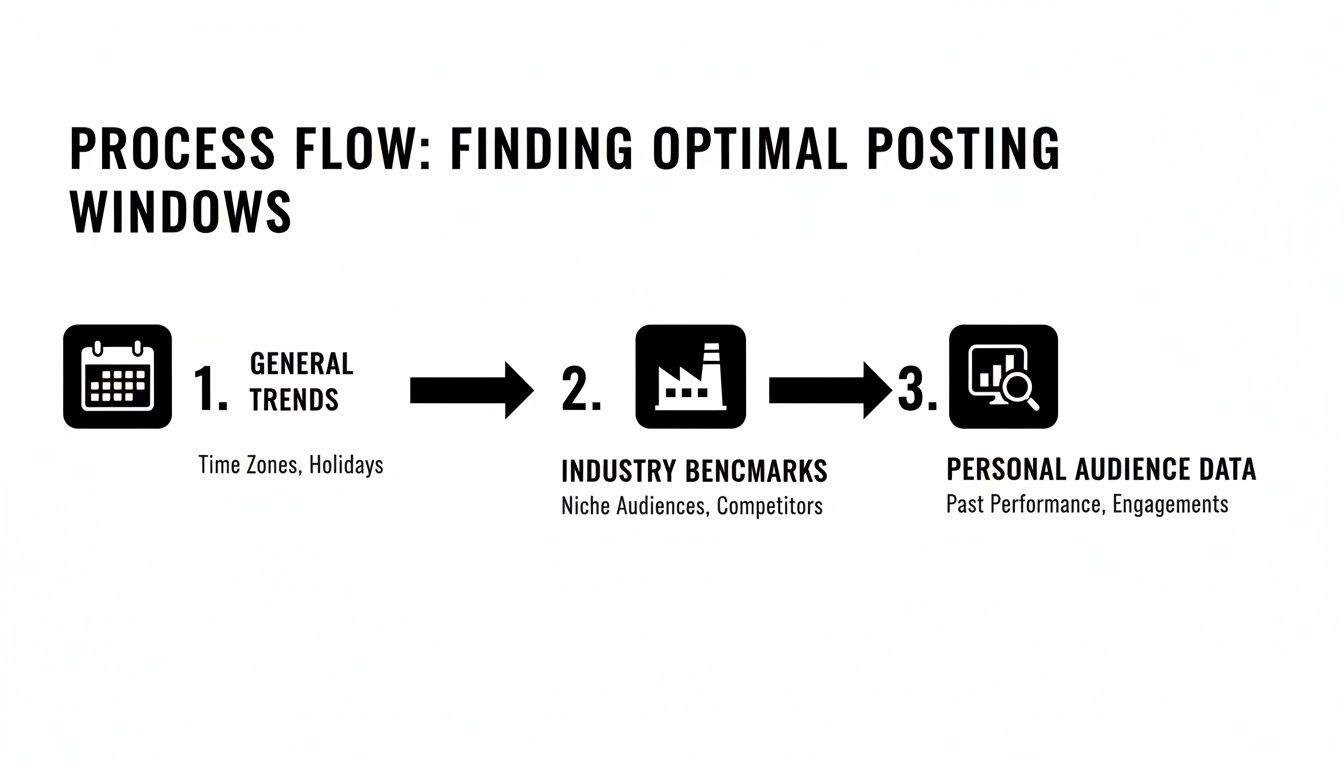
Process flow for finding optimal posting windows, detailing steps: general trends, industry benchmarks, and personal audience data.

You’re essentially layering general knowledge with industry trends and then drilling down into your own analytics to find what truly works for you.

Step 3: Track Key Metrics and Refine

As your experiment runs, you need to keep a close eye on how each post performs. And don't just glance at likes. You should be tracking a range of metrics that signal real engagement and tell the algorithm your content is worth showing to more people:

  • Reach: How many unique accounts saw your post?
  • Likes: The most basic form of feedback.
  • Comments: A much stronger sign of audience connection.
  • Saves: Shows your content is valuable enough for people to come back to.
  • Shares: The ultimate proof that your content really hit the mark.

After a few weeks, take a good look at your data. Are posts at a certain time consistently getting more saves or shares? Boom. That's a winning time slot. This is also a great time to think about content format. Platform-wide studies show that format really can affect timing. For instance, Reels often perform best in different windows than static feed posts. You might find your Reels pop off in the evening around 8 PM, while your image posts do better in the morning. For a deeper dive on this, check out the full research on Iconosquare.com.

OneUp makes this testing process even smoother with its 'Post again' feature. Once you identify a high-performing post, you can easily reschedule it for a different time slot to run a quick A/B test. This helps you figure out if a post’s success was due to the content, the timing, or that magical combination of both. And while you're focused on timing, don't forget the look of your feed; an Instagram grid planner can help keep things looking sharp during your experiments.

Automating Your Perfect Schedule With Precision

Figuring out your account’s perfect posting times is a huge win. But here's the thing: data without action is just trivia. The real growth comes from consistency—hitting those peak windows every single time. This is where you trade manual effort for a smart, automated workflow, and where a scheduling tool becomes your best friend.

Once you know the best times to post on Instagram for your audience, the next logical step is to lock in that schedule. Let's be real, trying to manually post at specific times is a recipe for disaster, especially if your audience is in different time zones. Automating the whole process makes sure every piece of content goes live at the exact moment it'll have the biggest impact.
Modern workspace with tablet displaying a colorful schedule, smartphone, and desktop computer for digital tasks.

This is where a solid platform like OneUp comes in. It’s built to do more than just schedule posts; it helps you run a full-blown content strategy with precision, handling every format Instagram throws at you.

Scheduling Every Content Format

A winning Instagram game isn't just about feed posts anymore. It's a mix of everything, and your automation tool has to keep up. You can't just schedule your feed posts and let your Stories and Reels fall through the cracks.

With OneUp, you can line everything up in one place:

  • Single-Image Posts: The classic. Perfect for those high-impact shots.
  • Multi-Photo Posts and Carousels: Awesome for telling a story, walking through a tutorial, or showing off a product from every angle.
  • Reels: Your ticket to reaching new audiences. You can even schedule them with custom thumbnails to keep your grid looking sharp.
  • Stories: Great for quick updates and getting your audience involved. Schedule them out to keep a consistent daily presence.

This means you can build a complete content calendar that hits your best time slots across all formats, creating a cohesive and always-on vibe for your account.

Leveling Up Your Strategy With Advanced Features

Just posting at the right time is only half the story. The real magic happens when you use features that make each post work harder and make your life easier. OneUp is packed with these kinds of thoughtful details.

For example, you can schedule the first comment on your posts. This is a total pro move. It lets you drop your block of hashtags in the comments, keeping your caption clean and focused on your message without giving up discoverability. You can also add alt text right from the scheduler, which is a must for accessibility and a nice little boost for your SEO.

A great scheduling tool does more than just publish content; it helps you publish better content. It automates the small but crucial details that add up to a more professional, accessible, and effective presence.

If you’re juggling a ton of content, the bulk uploader is an absolute lifesaver. Instead of scheduling posts one by one, you can upload dozens at once from a CSV file. It saves hours of tedious work. Plus, you can keep everything organized in a media library, so finding and reusing your top-performing visuals is a breeze.

Streamlining Agency and Team Collaboration

For agencies and social media managers, things can get chaotic fast. Managing multiple client accounts requires a level of organization that’s nearly impossible without the right system.

OneUp has several features built specifically for these complex workflows:

  • Client Approval Workflows: Create posts and send them to clients for review, all inside the platform. No more digging through endless email chains—all feedback stays in one spot.
  • Shareable Read-Only Calendar Links: Give clients or other team members a view-only link to the content calendar. They can see what’s coming up without being able to make changes, which keeps everyone on the same page.
  • Team Member Access Control: Assign specific social accounts to different team members. This prevents any accidental posts on the wrong profile and keeps everyone focused on their own clients.

This table shows just how much smoother your workflow can get when you switch from manual posting to an automated system with OneUp.

Executing Your Instagram Strategy with OneUp Features

Task Manual Process (Without a Tool) Automated OneUp Workflow
Consistent Posting Manually logging in at exact times, daily. Easy to forget or get delayed. "Set it and forget it." Schedule weeks of content in one session.
Content Variety Juggling different apps and workflows for Stories, Reels, and feed posts. Schedule all formats (Reels, Stories, Carousels) from a single dashboard.
Hashtag Management Pasting hashtag blocks into captions or rushing to add a first comment. Automatically schedule the first comment with your hashtag block.
Client Approvals Sending screenshots or documents via email and tracking feedback manually. Send posts for client review directly within the platform.
Team Coordination Sharing login credentials (risky!) and using spreadsheets to track schedules. Assign specific account access to team members and use a shared calendar.

By bringing all these functions into one dashboard, you build a system that’s efficient, scalable, and pretty much error-proof. You get to spend more time on big-picture strategy instead of getting buried in the day-to-day logistics.

Measuring And Refining Your Strategy Over Time

Let's be clear: figuring out the best time to post on Instagram isn't a "set it and forget it" task. Think of your ideal posting window as a moving target. Audience habits change, the algorithm gets tweaked, and new content trends pop up out of nowhere.

The real key to long-term growth is creating a feedback loop where you consistently measure, learn from the data, and adjust your game plan. It’s a lot like how smart businesses track their metrics to understand how to measure innovation for growth. You have to be just as rigorous with your Instagram performance. This ongoing analysis is what separates the accounts that plateau from the ones that just keep growing.

Creating A Continuous Feedback Loop

To keep your schedule sharp, you have to make a habit of reviewing your performance data. This means setting aside time each month to actually dive into your analytics and hunt for patterns. Are certain days starting to lag in engagement? Has a new, unexpected time slot started to outperform your old reliable windows?

This is where a tool like OneUp really shines. Its analytics suite cuts through the noise and simplifies this whole process, letting you track post-by-post performance without getting lost in spreadsheets. You can quickly see what’s working and what’s not.

An optimized schedule is never truly 'finished.' It's a living strategy that adapts to your audience's behavior. Regular measurement is the pulse check that keeps it healthy and effective.

OneUp’s analytics give you that bird's-eye view of your content's impact over time. You can spot trends in engagement, reach, and other key metrics. This is the hard data you need to make smart decisions about your posting schedule and your content. For example, maybe your data shows a new peak time. The next step could be to refine your hashtag strategy using an Instagram hashtag generator to see if you can give your posts an extra boost in those newly identified slots.

Automating Reports For Easy Analysis

If you're running an agency or working with a team, keeping everyone on the same page is non-negotiable. OneUp makes this dead simple with automated reporting. You can generate custom reports that pull all the important data from across your accounts into one clean summary.

Even better, you can schedule these reports to be automatically emailed to clients, bosses, or team members. This little feature is a huge time-saver. It ensures everyone stays in the loop on performance without you having to do any extra manual work. It's an easy way to show your value and keep the entire team aligned.

This cycle—measure, learn, refine—is the engine that drives consistent Instagram growth. By committing to this process, you ensure your timing strategy stays sharp, effective, and perfectly tuned to your audience.

Got Questions About Instagram Posting Times?

Even with all the data, figuring out the perfect posting time can bring up a few tricky questions. Let's tackle the most common ones so you can fine-tune your strategy.

How Long Should I Test My Posting Times?

Patience is your best friend here. You'll want to test for at least 4 to 6 weeks to get reliable data.

Why so long? A month-long window helps smooth out any weird spikes from holidays, viral news stories, or that one random post that just blew up for no reason. Sticking to your test schedule consistently over this period is the only way to get a clear, trustworthy picture of when your audience is really paying attention. Using a scheduler like OneUp to set everything up in advance is a game-changer for staying consistent.

Does Timing Matter for Instagram Stories and Reels?

Yes, it absolutely does. The algorithms for Stories and Reels are their own beasts, but recency is still a huge factor for both. Posting a Story when most of your followers are online gives you a better shot at being the first one they see in their queue.

For Reels, that initial wave of engagement is critical. A strong start signals to Instagram that you've got something good, which can help push it to a wider audience. With OneUp, you can schedule all your content—including Reels with custom thumbnails and multi-photo Stories—and apply the same testing method to find the prime time for every single format.

What If My Audience Is in Different Time Zones?

This is a super common headache for accounts with a global following. The first step is to dive into your Instagram Insights and see where your top two or three audience locations are. If one city or country is clearly dominant, just focus on that time zone. But if it's a pretty even split, you've got a couple of solid options.

The best trick for a global audience is to find the "overlap" hours. Think about times that work for multiple regions at once, like late afternoon in Europe, which happens to be morning in North America.

Your other option is to simply post more often to hit the peak hours in each of your major time zones. A tool like OneUp is pretty much essential for this, since its bulk uploader lets you schedule posts around the clock. You can hit every sweet spot for every audience segment without having to live on your phone 24/7.


Ready to stop guessing and start scheduling with confidence? OneUp has all the tools you need to test, automate, and lock in the perfect Instagram strategy. Transform your Instagram workflow with OneUp today.
Improving social media engagement: Actionable tips to boost reach and loyalty

Watching your social media engagement flatline is frustrating, but trust me, it's a super common problem. The good news? The fix usually comes down to a few key areas: getting your posting schedule consistent, making sure your content actually resonates with your audience, and actively engaging with your community. It's all about building a consistent, high-quality presence that turns passive scrollers into genuine fans.

Diagnosing Why Your Social Media Engagement Is Low

A desk with a laptop showing social media analytics, a notebook, plants, and text 'AUDIT YOUR FEED'.

Before you can fix the problem, you have to figure out why it's happening in the first place. Are you ghosting your audience for weeks and then spamming them with five posts in one day? That kind of unpredictable rhythm is a killer for engagement. In fact, inconsistency is one of the fastest ways to lose momentum and is often the first place I look for a quick win.

It's also worth asking if you're on the same page as your audience. If you’re constantly pushing sales-heavy content when they're looking for helpful tips or a peek behind the curtain, you're going to hear crickets. Take a quick look at your best- and worst-performing posts. I guarantee you’ll see some clear patterns emerge.

To get started, a quick diagnostic check can reveal a lot. I've put together this checklist to help you pinpoint common issues and find opportunities to turn things around.

Initial Engagement Audit Checklist

Audit Area Key Question to Ask OneUp Feature to Help
Posting Frequency Am I posting regularly, or are there big gaps in my calendar? The drag-and-drop content calendar lets you visualize your schedule across all platforms.
Content Relevance Does my content align with what my top-performing posts tell me my audience likes? Analytics (coming soon) will show you what resonates. For now, check your native analytics.
Community Interaction Am I responding to comments and messages in a timely manner? The Social Inbox centralizes all your DMs and comments from multiple networks.
Platform Presence Am I active on the platforms where my target audience actually hangs out? Unlimited accounts and support for 10+ platforms let you connect and test new channels.
Content Freshness Is my feed getting stale, or am I recycling proven winners? Set posts to repeat automatically at set intervals to keep your feed active with proven content.

Running through these questions is your first step. It forces you to be honest about what's working and what's not, setting you up to make changes that actually move the needle.

The Problem of Inconsistent Posting

Here’s the deal: social media algorithms favor active accounts, and your audience will forget you if you don't show up. But for busy teams and agencies, manually posting every single day across multiple platforms is a huge challenge. This is where automation stops being a "nice-to-have" and becomes a core strategic advantage.

A tool like OneUp is built to solve this exact problem. It’s all about making consistency effortless.

  • Bulk Scheduling: Got a month's worth of content ready? Upload hundreds of posts at once from a CSV file, or even connect an RSS feed to automatically share new blog posts.
  • Evergreen Content Recycling: Set your timeless, top-performing posts to automatically repeat at intervals you choose. Your feed never goes dark, and your best stuff gets seen again and again.
  • Unified Content Calendar: See your entire schedule for Instagram, TikTok, LinkedIn, Google Business Profiles, Threads, Bluesky, Pinterest, and more in one place. It gives you a bird's-eye view of your whole strategy.

By automating the logistics, you claw back hours that are better spent creating killer content and actually talking to your community—the two things that really drive engagement.

Key Takeaway: Consistency isn’t about posting 24/7; it’s about being reliably present. Automation takes the daily pressure off so you can execute your long-term strategy without fail.

Expanding Your Presence Where It Counts

Beyond consistency, you can't grow if you aren't where your people are. Your audience is spread out. The latest data shows the average person uses about 6.8 social platforms per month. We've seen firsthand that brands tailoring their content for a multi-platform strategy get way more interaction. For example, a native document on LinkedIn can pull engagement rates around 5–6.6%—proof that platform-specific content works. You can dive deeper into these stats in this comprehensive social media user report.

This reality makes a central scheduling hub non-negotiable. With OneUp, you can connect and manage unlimited social accounts without paying for extras. This lets you experiment with new channels like Threads, Bluesky, or even Reddit without making your workflow a nightmare. You can create a post, then easily customize the caption and media for each network on the fly, making sure your message always hits the mark.

Creating Content That People Actually Want to Share

A photographer uses a smartphone on a tripod to capture an image of a person in a studio setup.

Let’s get real for a second and move past the vague advice of just "posting great content." We all know that. True engagement comes from a much deeper understanding of what your audience actually wants to see, right now, and delivering it in the formats they love.

There's no magic formula here. It’s about crafting content that feels like it belongs on each platform—content that's designed to stop the scroll, make someone think, and earn a reaction. Today, that means zeroing in on a few high-impact formats that both the algorithms and your audience are rewarding.

Master Short-Form Video for Maximum Reach

Short-form video isn't just a trend anymore; it's the undisputed king of organic engagement. By 2025, formats like Instagram Reels, TikToks, and YouTube Shorts had become the single biggest driver of organic interaction across the board. The numbers don't lie. Some accounts with under 100,000 followers are seeing engagement rates as high as 7.5% per post on TikTok, which absolutely dwarfs what you see on other formats.

The takeaway? If you’re serious about engagement, you need a serious video strategy. For a closer look at the data behind this shift, check out this in-depth industry report.

This doesn't mean you need a film crew and a Hollywood budget. In fact, some of the best-performing videos feel authentic and get straight to the point—think quick tutorials, a genuine behind-the-scenes moment, or a funny take on a trending sound. Just remember, those first 1-3 seconds are everything. Lead with your hook.

Juggling a steady stream of video content can be a grind, which is where tools like OneUp become essential. You can schedule your Reels, TikTok videos, and Shorts to go live at the perfect time and even set custom thumbnails and choose the Reel cover image right from the dashboard, keeping your feed looking polished without any last-minute stress.

Design Interactive and Thought-Provoking Content

Video is crucial, but a well-rounded strategy needs more. Other formats are perfect for sparking different kinds of interaction. For instance, carousels on LinkedIn and Instagram are fantastic for breaking down complex ideas into bite-sized, swipeable slides. They’re built for storytelling and education, which keeps people on your post longer.

Instagram Stories are another goldmine. Features like polls, Q&As, and quizzes are low-effort for your audience but send powerful signals to the algorithm that your content is worth showing to more people.

Of course, these formats need to look good. This is where a smooth design workflow makes all the difference. OneUp’s built-in Canva integration is a lifesaver, letting you create your carousels, Stories, and other graphics without ever leaving the scheduler. No more downloading and re-uploading files—it removes a surprising amount of friction from the process.

Pro Tip: Treat the first slide of a carousel like a headline. Its only job is to get someone to swipe. Use a bold claim, a provocative question, or a stunning visual to hook them immediately.

Streamline Your Multi-Format Strategy

Let's be honest: a modern content strategy is a logistical puzzle. You’re juggling Reels, single-image posts, carousels, and even threaded posts for platforms like X and Threads. Without a central hub, it's incredibly easy to drop the ball.

This is why a scheduler that supports all these native formats is non-negotiable. With OneUp, you can line up your entire content mix in one go:

  • Instagram Reels and Stories: Schedule your vertical videos to post automatically, including adding a Link in Bio or Link Sticker to Stories.
  • Carousel Posts: Plan and publish multi-image posts for Instagram and LinkedIn, with up to 10 images per post.
  • Threaded Posts: Create and schedule entire threads for X and Threads to tell a longer story.
  • First Comment: Automatically add your hashtags, a link, or extra thoughts in the first comment for Instagram, Facebook, and LinkedIn posts to keep your caption clean.

This kind of multi-format support means you can plan your content calendar in one place and maintain a consistent, engaging presence everywhere.

Elevate Your Captions with Smart Assistance

Great visuals stop the scroll, but a killer caption starts the conversation. It can turn a passive viewer into an active commenter. The problem? Writing fresh, compelling copy for every single post is a huge creative drain.

This is a perfect job for an AI partner. OneUp’s AI Caption Writer helps you break through writer's block by generating multiple creative options for your posts. Just feed it a simple prompt, and it will give you captions in different tones, helping you find the perfect words to spark a dialogue.

If you’re looking for more ways to sharpen your copywriting, our guide on the Instagram caption generator is packed with more specialized tips.

By combining powerful visual formats with compelling copy and a workflow that doesn't drive you crazy, you create a content engine that not only looks great but consistently drives the interactions that actually matter.

Building a Thriving Community, Not Just a Follower Count

Look, putting out great content is crucial, but it's only half the battle. If you really want to see lasting engagement, you have to stop broadcasting and start building a real community.

That means shifting your focus away from chasing follower counts and toward nurturing the audience you already have. Every single comment, share, and DM is a chance to turn a passive follower into one of your biggest fans.

When someone takes the time to leave a comment, a prompt and thoughtful reply shows there’s a real person behind the account who's actually listening. It validates their effort and makes them (and everyone else watching) want to jump into the conversation again. That two-way dialogue is exactly what social media algorithms love to see.

Unifying Your Conversations

Trying to manage all these interactions across different platforms can get chaotic, fast. When you're constantly juggling tabs for Facebook, Instagram, LinkedIn, TikTok, and Google Business Profiles, it's inevitable that some messages and comments will slip through the cracks. This is where a centralized tool isn't just a nice-to-have; it's a non-negotiable part of your workflow.

OneUp's Social Inbox was built to solve this exact headache. It pulls all your incoming DMs, comments, and even Google Reviews into a single, clean feed.

  • Reply to Facebook and Instagram comments without ever leaving the dashboard.
  • Manage Instagram and Facebook DMs from one spot.
  • Engage with LinkedIn comments on your company page posts.
  • Respond to TikTok comments to keep the conversation rolling.
  • Answer Google Business Profile reviews and questions, which directly helps your local SEO.

This unified view makes sure no interaction gets missed. It lets you build relationships and manage your brand’s reputation with way more efficiency.

Here’s a peek at how a unified dashboard brings some much-needed clarity to the chaos of social media management.

When you have a central command center like this, you spend less time jumping between apps and more time actually crafting meaningful replies that build loyalty.

Strategies for Proactive Community Management

Responding to comments is good, but being proactive is what really sets you apart. Don't just sit back and wait for the comments to roll in—go out and start the conversations yourself.

Ask open-ended questions in your captions. Celebrate user-generated content by sharing it. Make your audience feel like they're valued members of a club, not just another number on your follower count.

A brand's community is its greatest asset. When you invest in real conversations, your audience will invest in you. They become your best marketers, sharing your content not because you asked, but because they genuinely want to.

Even if you're not in the automotive world, checking out some solid car dealer social media marketing strategies can offer surprising insights. The core principles of building trust and engagement are universal, no matter your industry.

Consistency in Engagement Matters as Much as Content

Just like your posting schedule, your engagement needs to be consistent. A fast reply shows you care and keeps the momentum of a conversation going.

Inside OneUp, you can use features like saved replies (coming soon) to handle frequently asked questions in seconds. This will free you up to spend more time on the more personal, in-depth conversations that really matter.

For agencies juggling multiple clients, this is a total game-changer. You can add unlimited team members and assign specific conversations or entire accounts to different people, making sure the right expert is always on the job. This helps maintain a consistent brand voice and a quick response time, no matter how many accounts you’re managing.

Even the visual harmony of your feed, which you can perfect with tools like an Instagram grid planner, adds to this feeling of a well-managed, attentive brand.

At the end of the day, community management is the real engine of social media engagement. It's the human touch that transforms a simple profile into a thriving hub for your most dedicated fans.

Using Analytics to Make Smarter Content Decisions

Real, sustainable growth in social media engagement doesn't come from chasing viral trends or just guessing what might work next. It’s built on a foundation of data-driven decisions. To get there, you have to look past vanity metrics like follower counts and really dig into the numbers that show what your audience actually connects with.

Think of your analytics as a direct line to your audience. They tell you which topics they care about, what formats they prefer (Reels or carousels?), and even the exact times they're most likely to be scrolling. Tapping into this insight is the only way to build a smarter, more effective content strategy that consistently drives real interaction.

Pinpointing What Truly Resonates

Before you can improve, you have to know what's already hitting the mark. Are your short-form videos getting a ton of saves? Do posts with a question in the caption spark more comments? Answering these kinds of questions means getting a clear look at your post-level performance across every platform.

This is where a solid analytics tool becomes essential. At OneUp, we're building out powerful analytics features (coming soon) that will let you track post performance, compare content types, and spot your top performers without ever leaving the platform. This means you can quickly see what’s driving value and double down on what works.

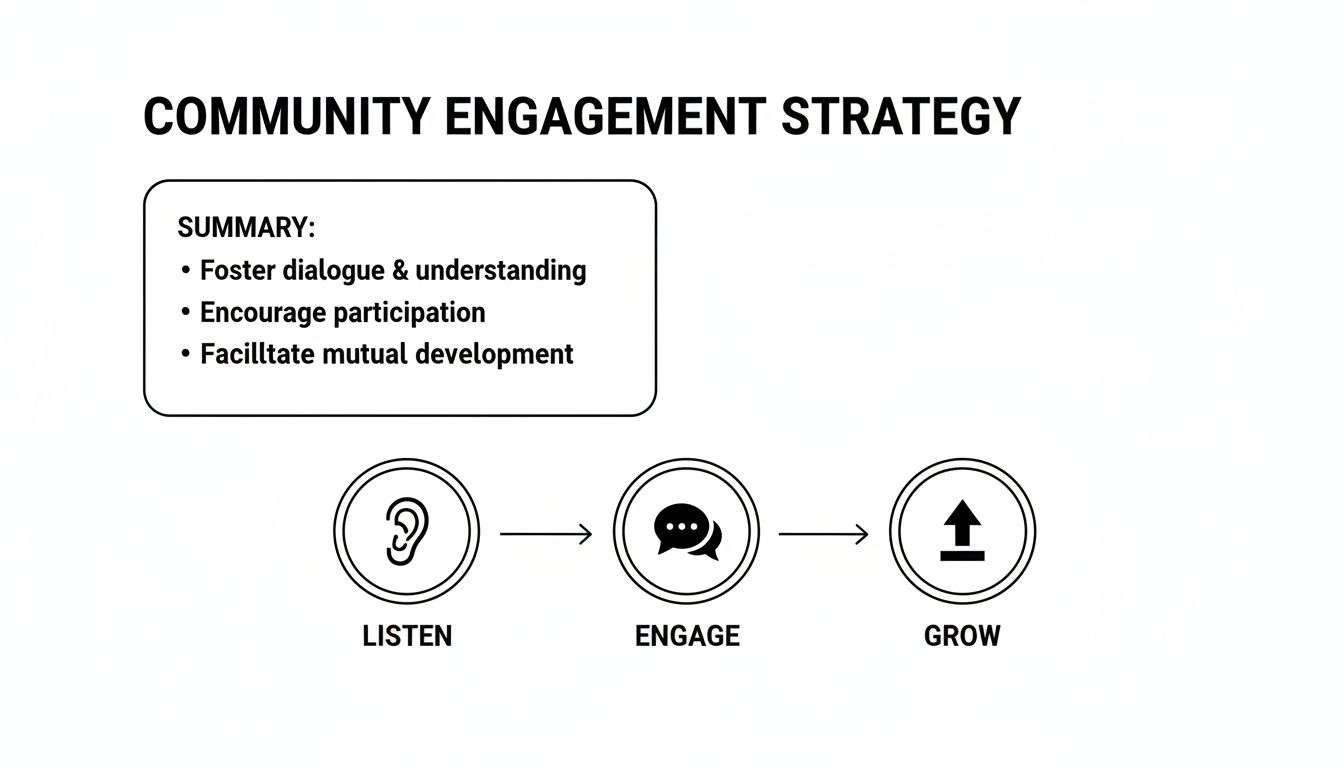
This simple feedback loop is the core of a data-driven engagement strategy.

Community Engagement Strategy with a summary and a three-step process: Listen, Engage, Grow.

This process—listening to the data, engaging based on those insights, and growing as a result—is how you build a lasting connection with your audience.

Identifying the Best Times for Maximum Impact

Posting amazing content when your audience is asleep is like telling a great joke to an empty room. Timing matters. A lot. While industry benchmarks can give you a starting point, your audience has its own unique online habits. The only real way to find your sweet spot is by looking at your own data.

By tracking engagement patterns over time, you can zero in on the exact days and hours when your followers are most active and ready to interact. Scheduling your posts for these peak windows gives your content the best shot at getting that crucial initial traction, which signals to the algorithms that it's worth showing to more people.

Engagement Metrics by Platform and Goal

Not all engagement is created equal. A "like" on Facebook doesn't have the same weight as a "save" on Instagram, especially when your goals are different. Knowing which KPIs to track is crucial for understanding if you're actually moving the needle.

Goal Platform Primary Metric to Track Secondary Metric
Increase Brand Awareness Instagram Reach/Impressions Profile Visits
Drive Website Traffic LinkedIn Link Clicks Post Shares
Boost Community Building Facebook Comments Reactions
Showcase Product Value Instagram Saves Shares via DM
Generate Leads Twitter (X) Link Clicks Replies

This table is just a starting point, but it highlights how your goals should dictate your focus. If you're trying to build a community, comments are king. If you're driving sales, clicks are what you need to watch. Aligning your metrics with your goals makes your data infinitely more useful.

A Real-World Scenario: Proving the Value of Analytics

Picture this: you're managing social media for an e-commerce client. For months, you've been pushing out beautiful, polished static image posts, but engagement has flatlined. The client is starting to question the strategy. Instead of guessing, you go to the data.

Using a tool like OneUp, you can soon generate a custom, white-labeled, cross-network report comparing the performance of different content formats over the last quarter.

The report would show a clear trend: while your single-image posts get consistent likes, the handful of short-form videos you posted had 3x the shares and 4x the saves. The data is undeniable. Armed with this report, you can confidently walk into a meeting and propose a strategic pivot to video, justifying the shift with their own audience's behavior.

Key Takeaway: Data transforms your recommendations from opinions into evidence-based strategies. It's the most powerful tool you have for proving value and getting buy-in for new creative directions.

Streamlining Reporting for Agencies and Teams

For agencies and in-house marketing teams, reporting can be a soul-crushing time suck. Manually pulling data from every social network, mashing it together in a spreadsheet, and then trying to make it look presentable is a massive drain on time that could be spent on, you know, actually creating great content.

This is where automated reporting changes the game. OneUp is built to handle this entire process (with analytics coming soon), making client management and internal updates a breeze.

  • White-Labeled Reports: Generate professional reports that carry your agency's branding, not ours. It puts your value front and center.
  • Cross-Network Insights: Pull data from all your connected social profiles into one clean, comprehensive report. No more toggling between a dozen different analytics dashboards.
  • Scheduled Email Delivery: Set it and forget it. Have your reports automatically generated and emailed to clients or stakeholders on a weekly or monthly schedule.

By automating your reporting workflow, you're not just saving hours of tedious work. You're ensuring that key decision-makers consistently see the impact you're having. That kind of transparency builds trust, strengthens client relationships, and proves the direct connection between your strategy and their business goals.

Scaling Engagement with Smart Paid Strategies

Let's be real: a killer organic strategy is the bedrock of any solid community, but even the best content hits a ceiling. Organic reach is a tough game these days, crowded and competitive. That’s where a smart paid strategy comes in. It’s not about replacing your organic efforts, but acting as a powerful amplifier to get your proven content in front of fresh, highly targeted audiences.

The goal isn't just to throw money at the wall and see what sticks. The most effective approach is a seamless feedback loop between your organic and paid efforts. Think of your organic feed as your testing ground. You see what creative, messaging, and formats truly connect with your audience. Once a clear winner emerges, that's when you put ad spend behind it, knowing you’re investing in content that’s already proven to work.

Identifying Your Winners with Post-Level Analytics

So, how do you decide which posts actually deserve a budget? This is where guesswork gets expensive fast. Instead of going with a gut feeling, you need cold, hard data showing which content is earning the most valuable interactions.

A tool like OneUp is built for this exact scenario. Its upcoming post-level analytics will let you quickly spot your top-performing organic posts based on the metrics that matter most, like saves, shares, and comments. These "winner" posts are your prime candidates for promotion because they've already demonstrated their ability to resonate and drive action. This immediately improves your potential return on ad spend (ROAS).

Amplifying Content and Collaborating with Creators

Once you know what works, you have two main paths for scaling its reach: direct advertising and creator partnerships. Honestly, you need both to truly move the needle on social media engagement. Investing in ads and influencers can seriously multiply your engagement-to-sales outcomes.

It’s no surprise that global social ad spend was projected to surpass $276 billion in 2025 as more and more marketers use paid amplification to monetize their engagement.

At the same time, influencer-driven commerce is a beast of its own. Recent surveys show that nearly half of consumers (around 49%) bought something at least once a month because of influencer content. This is a perfect example of how genuine engagement translates directly into conversions when you pair it with credible creators and paid reach.

The data paints a clear picture: you need a dual approach. Keep building high organic engagement with native content and creator collabs, then strategically apply paid spend to amplify your best stuff for maximum impact.

This entire workflow is much smoother with a unified tool. Using OneUp, you can schedule your content, dig into post-level performance (analytics coming soon), and generate cross-network reports to actually quantify the incremental ROAS from your blended organic, creator, and paid investments.

For those wanting to take their skills to the next level, a comprehensive Social Media Marketing Diploma can provide a deeper strategic framework for these advanced techniques.

Making Smart Budget Allocations

An effective paid strategy is all about efficiency. By promoting content that’s already a proven winner, you’re not just reaching more people—you’re reaching the right people with a message you already know connects. This data-backed approach cuts down on wasted ad spend and massively boosts your chances of success.

OneUp supports this entire workflow by bringing all the key components under one roof. You can manage multiple client accounts with features like post-approval workflows, which are absolutely critical when paid budgets are on the line.

Plus, having unlimited accounts and team members without paying extra per seat means you can scale your operations without your costs spiraling out of control. You can see how this works by checking out the OneUp pricing plans. It’s an integrated system that lets you manage the entire lifecycle of a post—from creation and scheduling to analysis and paid amplification—all from a single, cost-effective platform.

Your Questions on Social Media Engagement Answered

Even with a solid strategy, you're always going to have questions pop up. Here are some of the most common ones I hear from social media managers, with straight-up, actionable answers.

How Often Should I Post to Increase Engagement?

There’s no magic number here. The right posting frequency is all about the platform and your audience.

On a fast-moving feed like X, you might need to post 1-3 times a day just to stay in the conversation. But on a platform like LinkedIn, 3-5 really thoughtful, high-quality posts a week will get you much better results.

What matters more than frequency is consistency. Showing up on a predictable schedule is everything. This is where a scheduler like OneUp becomes indispensable. You can map out your calendar weeks ahead, use the 'repeat post' feature for your evergreen content to fill any gaps, and just maintain that steady presence without the daily scramble.

What Is the Fastest Way to See Better Engagement?

For a quick boost, you need to do two things at once: get really good at short-form video and actively talk to your community in real-time.

Video formats like Reels and TikToks are getting the most organic reach right now, so they're your fastest ticket to getting more eyeballs on your content.

Then, combine that with responding to every single comment and DM you get—and doing it quickly. A tool with a unified Social Inbox, like OneUp, is a lifesaver. It pulls all your interactions from Facebook, Instagram, LinkedIn, TikTok, and even Google Business Profiles into one place so you never miss a beat.

Responding quickly makes your audience feel heard and valued. That’s one of the most powerful ways to build a loyal community that actually wants to engage with your content.

Should I Focus on One Platform or Be Everywhere?

It is so much better to be a rockstar on two or three key platforms where you know your audience hangs out, rather than spreading yourself thin trying to be everywhere.

Get your strategy down cold on your core channels first. Once you've mastered those, then you can think about expanding.

Tools like OneUp make managing multiple platforms way easier. You can schedule content to different 'Categories' (which are just groups of your social accounts), tweak the caption and image for each network from the same draft, and see how everything is performing side-by-side (with analytics coming soon). It lets you grow your presence without your workload exploding.

How Can I Manage Multiple Clients Without Burning Out?

Ah, the classic agency dilemma. The only way to survive is with a centralized platform built for organization and teamwork.

Features like OneUp's 'Categories' are non-negotiable for agencies, letting you keep every client's social profiles neatly separated.

Even better, its internal and external post-approval workflows get rid of those endless email chains trying to get client sign-off. You can also add unlimited team members and give them access only to specific accounts. This is how you prevent chaos and keep every client’s brand voice on point. It’s the key to scaling without losing your mind.


Ready to transform your social media workflow and drive real results? OneUp provides all the tools you need—from scheduling and analytics to a unified inbox and team collaboration features—in one simple, affordable plan. Start your free trial today and see the difference.

How to Create a Content Calendar That Actually Works

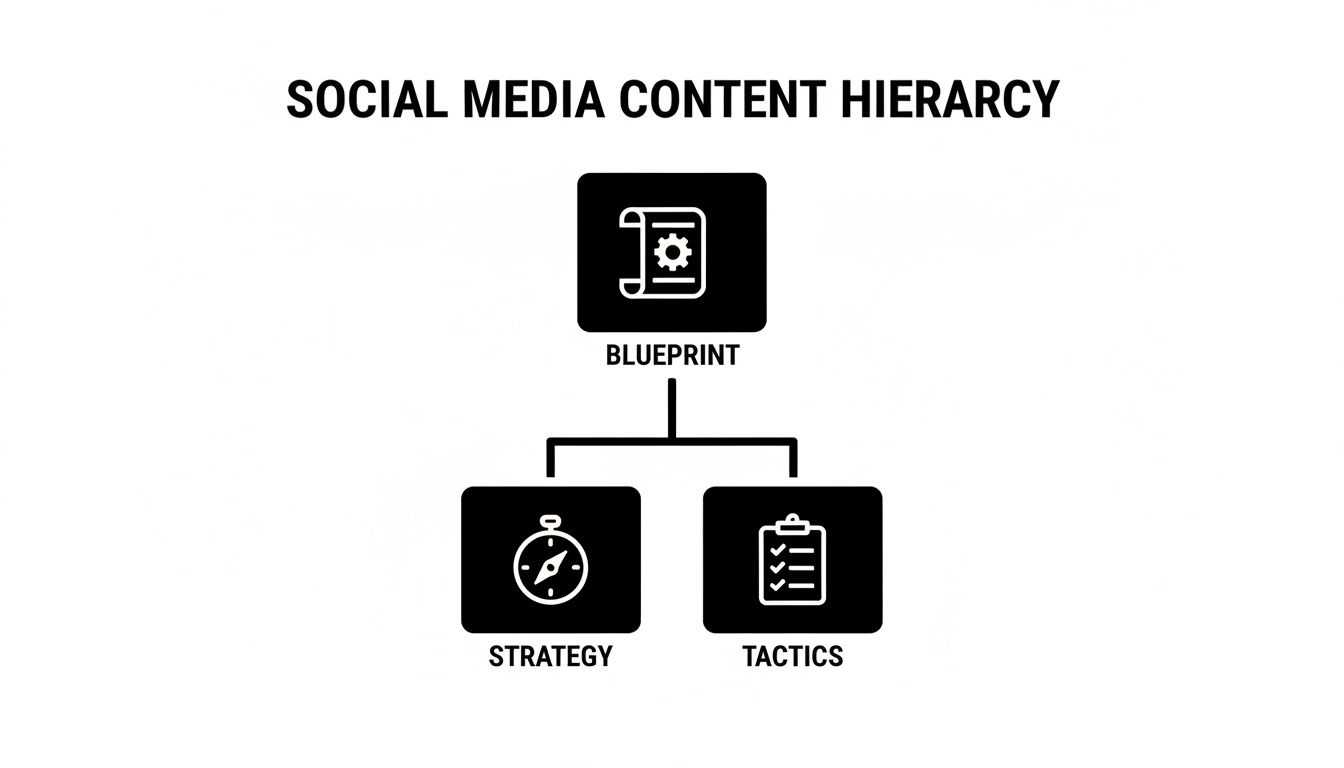
Before you even think about plugging topics into a spreadsheet, we need to get the foundation right. Building a content calendar isn't just about scheduling posts; it's about creating a strategic blueprint that ties every single piece of content back to a real business goal.

Without this crucial first step, you're just making noise. Your content will feel random, your results will be non-existent, and you'll burn through resources with nothing to show for it.

Setting the Stage for a Purpose-Driven Content Calendar

A modern workspace with a laptop, coffee, books, and a notebook. Text overlay reads 'DEFINE SUCCESS'.

A great calendar isn't a to-do list; it’s a direct link between your daily marketing grind and your big-picture business objectives. This initial planning is, hands down, the most important part of the whole process.

Before you get lost in content pillars or editorial workflows, you need a solid strategy. This means creating a comprehensive content marketing strategy that aligns with what your business is trying to accomplish. Get this right, and your calendar will have a clear purpose from day one.

Define Your Core Objectives

First things first: What are you actually trying to achieve here? Pushing out content without a clear "why" is like sailing without a map. Your goals need to be specific, measurable, and directly linked to growing your business.

Common goals I see people start with include:

  • Increasing brand awareness: Just getting your name in front of the right people.
  • Generating qualified leads: Turning browsers into potential buyers for your sales pipeline.
  • Building community engagement: Creating a loyal group of followers who actually interact with your brand.
  • Driving website traffic: Pulling people from social media or Google over to your website.

For example, a B2B SaaS company might set a goal to generate 50 new demo requests a month using LinkedIn content. On the flip side, a D2C apparel brand might aim to grow their Instagram following by 15% this quarter to build hype for their next launch. See the difference?

Craft Detailed Audience Personas

You can't create content people love if you don't know who you're talking to. And I mean really know them. Forget basic demographics like age and location for a second.

What keeps them up at night? What are their biggest pain points? What social media channels are they scrolling through on their lunch break? What problems are they desperately trying to solve?

Let's imagine you're marketing a project management tool. Your persona could be "Alex, the Overwhelmed Agency Manager." Alex is constantly juggling multiple client projects, struggling with team burnout, and terrified of missing deadlines. Suddenly, you know exactly what to create: content like "5 Ways to Stop Scope Creep in its Tracks" or "The Ultimate Project Timeline Template."

A deep understanding of your audience turns content creation from a guessing game into a calculated strategy. When you know their challenges, you can craft content that provides genuine solutions, building trust and authority.

Conduct a Quick Content Audit

Before you plan for the future, take a quick look back. A content audit doesn't have to be some massive, complicated spreadsheet. It's just an honest analysis of what's worked, what flopped, and where the hidden gems are.

Ask yourself a few simple questions:

  • Which topics got the most likes, comments, and shares?
  • What formats killed it? (e.g., videos, carousels, long-form articles)
  • Do we have any "evergreen" posts that are still getting traffic and could be repurposed?
  • What are the gaps? What questions are people asking that we haven't answered yet?

This simple review gives you data-driven direction. If you discover that your short TikTok tutorials consistently blow your static Instagram posts out of the water, that's a huge clue. Your new calendar should lean into what's already proven to work, not just what you think will work.

With your goals set and your audience in sharp focus, it's time to figure out what you’re actually going to talk about. This is where you hammer out your content pillars—the 3-5 foundational themes that will become your brand’s calling card.

Think of them like the main genres on Netflix. Everything you create should fall squarely into one of these buckets.

Content pillars are your guardrails. They stop you from chasing every fleeting trend and make sure every post, video, and article reinforces your expertise. For a small marketing agency, for example, pillars might be "Local SEO Strategies," "Social Media for Small Business," and "Client Success Stories." They're distinct, yet they all tie back to the agency's core mission.

From here, you can start brainstorming specific sub-topics. That "Local SEO Strategies" pillar could spawn posts on Google Business Profile optimization, local keyword research, and how to handle online reviews. Suddenly, that blank calendar doesn't seem so intimidating—it's a structured plan waiting to happen.

Choosing the Right Channels for Your Message

One of the biggest mistakes I see is brands trying to be everywhere at once. It just doesn't work. A technical, long-form article that crushes it on LinkedIn is going to be a total dud as an Instagram Reel.

Every platform has its own vibe, its own audience expectations, and its own content formats. The trick is to map your content pillars to the channels where your ideal customer is already hanging out and ready to listen.

This means you need a strategic platform mix, not just a cross-posting frenzy. You have to adapt the message.

  • LinkedIn: The home for your in-depth articles, case studies, and professional takes. That "Local SEO" pillar could become a comprehensive guide here.
  • Instagram: It's all about the visuals. A carousel post breaking down the key points from your SEO guide or a Reel celebrating a client's win would be a perfect fit.
  • TikTok: Think short, snappy, and educational. A quick "30-Second SEO Tip" is exactly what users are looking for.
  • Google Business Profiles: Non-negotiable for local businesses. This is the spot for direct updates, special offers, and highlights from your "Client Success Stories" pillar.

Your content strategy isn't about creating more content; it's about creating the right content for the right platform. Tailoring your message shows you get the platform's culture and respect your audience's time.

As you start to nail down the specific types of content, these tips for crafting engaging content can give you some great frameworks for making sure your posts actually connect, no matter where you publish them.

Using Categories to Organize Your Calendar

Okay, you've got your pillars and you know which channels you're targeting. How do you keep it all from turning into a chaotic mess?

This is where a tool like OneUp becomes a lifesaver, especially if you're managing multiple brands or clients. Instead of wrestling with a clunky spreadsheet, you can use categories to represent each of your content pillars.

You could create a "Local SEO" category in OneUp, for instance, and schedule all related content under that tag. This lets you see at a glance if you're keeping a healthy balance between your pillars. For agencies, you can also use OneUp to group social media accounts. Just create a group for "Client A" and another for "Client B" to keep their calendars totally separate and organized.

This kind of structure ensures you're delivering a consistent and effective mix across all your profiles, from Facebook and X to TikTok and Google Business Profiles. And for a platform like Instagram where the grid aesthetic is everything, a dedicated tool is key. You can learn more about planning your feed with an Instagram grid planner to make sure your visuals line up with your content strategy.

Getting this organized is what allows you to scale. Whether you're a freelancer with a handful of clients or a business with multiple locations, features like creating custom posting schedules for each category in OneUp put the process on autopilot. You can set your "Local SEO" content to go out every Tuesday and Thursday, while "Client Success Stories" are reserved for Fridays—a steady, strategic flow of content without you having to push buttons all day long.

Dialing In Your Editorial Workflow and Cadence

You've got your content pillars and know which platforms you're targeting. Now, it's time to build the engine that actually powers your content calendar. A solid editorial workflow is what separates a list of ideas from a repeatable, scalable system—it turns creative chaos into predictable, high-quality content.

This process is the secret sauce for consistency. It makes it crystal clear who does what, when, and how. Every piece of content, from a spark of an idea to a published post, should move along a smooth path without hitting roadblocks or missing deadlines.

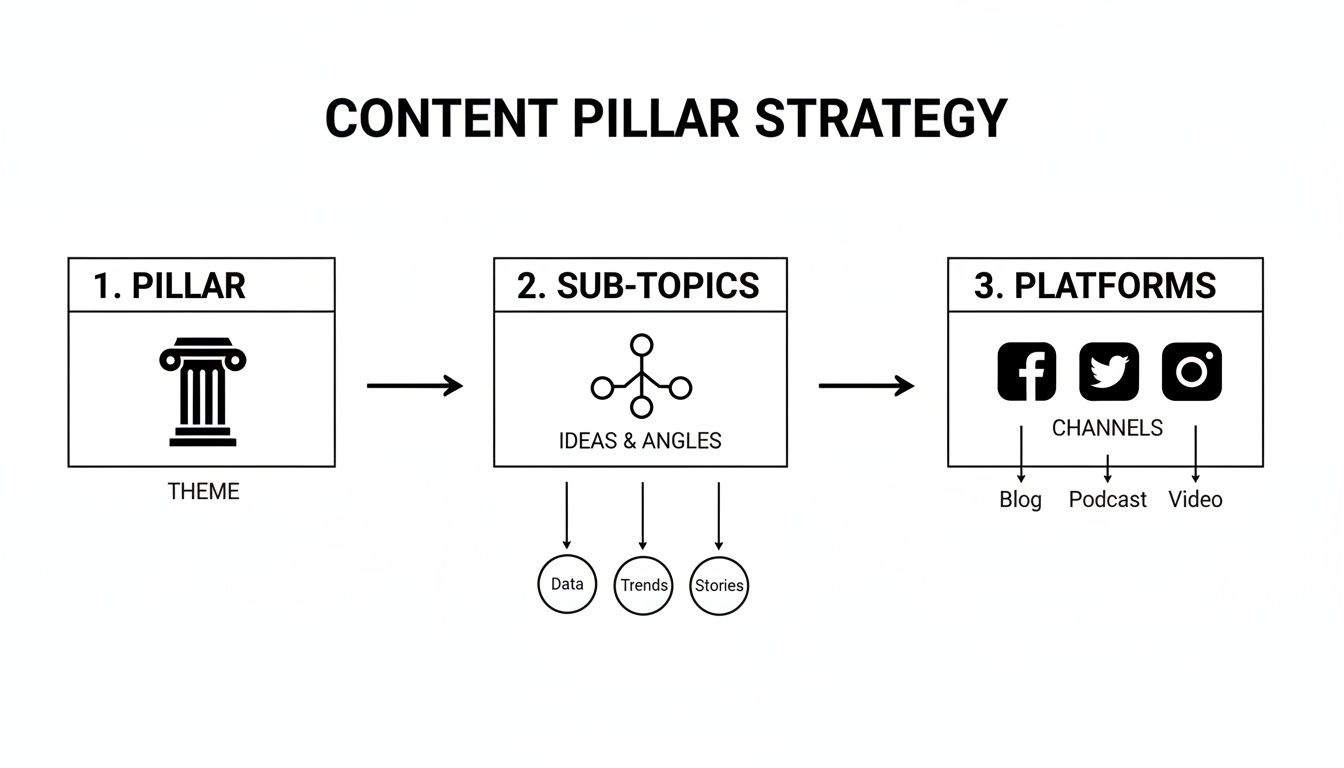
Think of it like this: your core themes branch out into specific sub-topics, and each of those gets tailored for the right channels to maximize its impact.

Flowchart illustrating a content pillar strategy from theme to sub-topics and content channels.

This flow shows how one single idea can be strategically sliced and diced for different platforms, getting you the most bang for your buck.

Building Your Content Production Pipeline

Your production pipeline is just the step-by-step journey each piece of content takes. It doesn’t have to be crazy complicated, but it absolutely must be clear. A typical workflow usually breaks down like this:

  • Ideation: Kicking around initial concepts based on your content pillars and audience research.
  • Creation: Actually writing the copy, designing the graphics, or shooting and editing video.
  • Review: An internal gut check for tone, accuracy, and making sure it aligns with the brand.
  • Client Approval: (Crucial for agencies!) Sending the post to the client for the final thumbs-up.
  • Scheduling: Plugging the approved content into your scheduling tool for a specific date and time.
  • Publishing: The content goes live on its designated social media channels.

For teams juggling multiple clients, this kind of structured approach is non-negotiable. It's how you keep quality high and things moving efficiently without getting stuck in the dreaded "endless email chain" for every single approval.

Streamlining Collaboration and Approvals

Ever heard that 55% of firms let just one person handle the entire editorial calendar? That’s wild, especially when you consider content eats up 26% of most marketing budgets. It's a fast track to burnout, particularly for smaller teams. This is where dedicated tools completely change the game for agencies and freelancers.

OneUp, for example, tackles this headache head-on with a few smart features:

  • Built-in Post Approvals: Forget emailing drafts back and forth. Clients or stakeholders can approve or reject posts right inside the platform.
  • Assigning User Roles: You can give different people different levels of access. A writer might only be able to create drafts, while a manager can approve and schedule everything.
  • Read-only Calendar Sharing: Easily give clients a live look at the content calendar so they're always in the loop, but without giving them permission to accidentally delete a month's worth of work.

These features pull all communication into one place and create a clear, auditable trail for every post—an absolute lifesaver for agency workflows. If you're stuck on crafting the perfect caption, tools like an Instagram caption generator can help get the creative juices flowing and speed things up.

An effective workflow isn't just about speed. It's about building in checkpoints that guarantee quality and consistency. When you define roles and use the right tools, you get rid of the guesswork and empower your team to work with confidence.

Figuring Out Your Posting Cadence

So, how often should you post? There's no magic number here. It completely depends on the platform and what your audience expects. Hit your LinkedIn followers with five posts a day and you'll get unfollowed in a hurry. But post only once a week on TikTok, and you might as well be invisible.

Start by looking up the best practices for each network, but then—and this is key—test what actually resonates with your audience. The goal is to find a sustainable rhythm that keeps people engaged without burning out your content team.

Once you have a target cadence, you can set up a custom posting schedule in a tool like OneUp. You can define specific time slots for each day, and any new post you add to your queue automatically grabs the next open spot. This is huge. It ensures you're consistently posting at peak times without having to think about it. For example, you could tell OneUp to post to Facebook at 9 AM and 2 PM on weekdays, and it will handle the rest.

Put Your Calendar on Autopilot for Maximum Efficiency

Once your workflow is dialed in, the next step is to fill up your calendar and put your scheduling on autopilot. Let's be honest, manually uploading every single post is a fast track to burnout and a massive time-suck. Automation is what turns your calendar from a static plan into a dynamic, content-pumping engine.

This is where the real magic happens. By automating the grunt work, you free up your time to focus on what actually moves the needle: strategy, creative thinking, and genuinely engaging with your audience.

A computer screen displays a content calendar application next to a stack of papers and an 'Automate Scheduling' sign.

Bulk Scheduling to Get Hours of Your Life Back

Ever have a month's worth of amazing content ready to go, only to be stopped dead by the thought of copying and pasting every… single… post? It's a common bottleneck that slows down even the sharpest teams. The solution is simple: think in batches.

With a tool like OneUp, you can use the bulk scheduler to upload hundreds of posts at once from a CSV file. Just pop your posts into a spreadsheet—with columns for the date, caption, and image URL—and upload the whole file in a few clicks. This simple move can turn a full day of tedious data entry into a five-minute task.

This approach is an absolute game-changer for agencies juggling multiple clients or any business with a high-volume content plan.

Keep Your Feeds Buzzing with Evergreen Content Recycling

Not every piece of content is a one-and-done. Your best "evergreen" posts—those killer how-to guides, timeless tips, and foundational case studies—can and should be shared more than once. But manually digging through old posts to find something to republish is the opposite of efficient.

This is where setting your content to automatically recycle becomes so powerful. In OneUp, you can tag specific posts as evergreen and have them republish automatically at set intervals, like every 30, 60, or 90 days.

This one tactic keeps your social feeds consistently active and drives fresh traffic to your most valuable assets, all without you lifting a finger. It's the ultimate "set it and forget it" strategy.

This ensures your new followers always see your best stuff and keeps your brand top-of-mind, even when you're swamped. It’s just a smart way to squeeze every drop of ROI from the content you've already worked hard to create.

Auto-Post Industry News with RSS Feeds

Part of being a thought leader is sharing valuable, relevant content from across your industry—not just your own. But manually hunting for news to curate and share every day is another one of those time-draining tasks we can easily automate.

A super effective tactic is to connect RSS feeds from your favorite industry blogs and news sites directly to your scheduler. OneUp lets you add RSS feeds and have new articles post automatically to your accounts. You can even add your own custom text before or after the article title to add your own spin.

This simple automation hits two birds with one stone:

  • It keeps your calendar full of fresh, relevant material that your audience will love.
  • It solidifies your brand as the go-to source for the latest industry insights.

Measuring Performance to Refine Your Strategy

Your content calendar isn't a "set it and forget it" document. The best ones are living, breathing strategies that you constantly tweak based on what the data tells you. This last step is honestly the most important one: turning performance insights into smarter content.

This is where you close the loop. You use real-world analytics to fuel your next batch of content. Without this feedback process, you’re just throwing content at the wall and hoping something sticks. With it, you're building a content engine that gets sharper and more effective over time.

Moving Beyond Vanity Metrics

Likes and follower counts feel good, but they don't directly translate to business growth. To really get a grip on your content's impact, you need to zero in on the key performance indicators (KPIs) that actually line up with your business goals. Chasing vanity metrics is a surefire way to waste time, while focusing on meaningful data gives you a clear path forward.

Instead of just celebrating likes, start measuring what matters:

  • Engagement Rate: This tells you what percentage of your audience is actually interacting with your posts. A high rate is a flashing sign that your content is hitting the mark.
  • Click-Through Rate (CTR): How many people clicked a link in your post? This is critical if your goal is driving traffic to your website or a specific landing page.
  • Conversions: This is the big one. Did your content lead to a sale, a newsletter sign-up, or a demo request? This metric connects your content directly to revenue.

Keeping an eye on these KPIs is how you build a content calendar that delivers a real return on your effort.

Leveraging a Unified Analytics Dashboard

Hopping between the native analytics of Facebook, LinkedIn, TikTok, and Google Business Profiles is a massive headache. It's almost impossible to get a clear, big-picture view of your performance when all your data is siloed on different platforms.

A centralized tool completely changes the game. Using a platform like OneUp, you can track performance across all your connected social accounts from a single dashboard. This gives you an immediate, at-a-glance read on what's working and what's not, saving you hours of painful, manual data wrangling.

A unified dashboard transforms analytics from a chore into a strategic advantage. When all your data is in one place, you can spot cross-platform trends and make faster, more informed decisions about your content strategy.

This consolidated view makes it dead simple to compare performance. You can easily see if a topic that blew up on LinkedIn could be repurposed for your Instagram audience, for instance.

Generating Custom Reports for Stakeholders

You need to show your clients or your boss that your social media efforts are paying off. A screenshot of your follower count isn't going to convince anyone. You need clean, professional reports that showcase the results you're driving.

With OneUp, you can generate custom, white-labeled PDF reports that pull data from across all your networks. Just select specific date ranges and networks to create tailored reports that put the most important KPIs front and center for your stakeholders.

Even better, you can schedule these reports to be automatically emailed to yourself or your clients on a recurring basis—daily, weekly, or monthly. This automation keeps everyone in the loop without adding another recurring task to your to-do list.

Identifying Top Performers to Guide Future Content

Your analytics are a goldmine of clues about what your audience wants to see from you. By regularly checking your top-performing posts, you can pinpoint the content pillars, formats, and topics that are generating the most buzz and driving the most action.

OneUp’s analytics make this process a breeze. You can sort your posts by likes, comments, shares, or clicks to see what really landed. Did that behind-the-scenes video on Instagram Reels get double the engagement of your usual posts? That's a huge signal to create more content just like it.

This data-driven approach takes the guesswork out of content planning. It gives you a clear roadmap for what to create next, ensuring your calendar is packed with content that you know has a high chance of success. This continuous cycle of measuring, learning, and refining is the real secret to a powerful and sustainable content strategy.

Answering Your Content Calendar Questions

Even with the best-laid plans, a few practical questions always pop up once you start managing a content calendar day-to-day. Let's get into some of the most common hurdles I see and give you some clear, actionable answers to keep things running smoothly.

How Far in Advance Should I Plan Content?

For most businesses, planning content one full month in advance is the sweet spot. This gives your team plenty of breathing room for creation, review, and any approvals, but you're not so locked in that you can't react to what's happening right now.

Of course, for the big stuff—major campaigns, product launches, or seasonal pushes like Black Friday—you'll want to aim for 2-3 months of lead time.

The real secret is building in flexibility. A tool like OneUp lets you schedule posts way out into the future, but its calendar view makes it dead simple to drag and drop things around. That means you can easily pause your scheduled evergreen content to jump on a trending meme without blowing up your entire workflow.

What Is the Best Tool for a Content Calendar?

Look, a simple Google Sheet can work when you're just starting out. I get it. But it becomes a massive bottleneck pretty fast. If you're serious about getting efficient, a dedicated social media management platform is the way to go.

The best tool moves you from just planning content to actively managing the entire lifecycle. It should bring scheduling, collaboration, and analytics together in one place.

Instead of just typing out post ideas in a spreadsheet, a platform like OneUp lets you do so much more:

  • Directly schedule posts to all the major networks, including the tricky ones like Instagram Reels, Stories, and multi-image carousels.
  • Bulk upload hundreds of posts at once from a CSV file. This is a massive timesaver.
  • Keep a central media library of approved images and videos for your whole team to pull from.
  • Set your best-performing content to automatically repeat at whatever interval you choose.

This all-in-one approach is just a smarter way to manage a dynamic content strategy.

How Do I Consistently Find New Content Ideas?

Ah, the age-old problem: keeping the idea well from running dry. It's a challenge for everyone. I always suggest starting by breaking down your core content pillars into different formats. Think how-to guides, behind-the-scenes peeks, industry news commentary, or customer stories.

You also have to listen. Your audience is constantly giving you ideas. Monitor your comments and DMs for recurring questions—those are content goldmines just waiting to be tapped. It also never hurts to keep an eye on what your competitors are doing to see which topics are getting traction in your space.

And when you're well and truly stuck, an AI assistant can be a great brainstorming partner. For example, OneUp's AI caption writer can help you find new angles on a topic or just get you past that initial writer's block, making sure your calendar never has an empty slot.


Ready to move beyond spreadsheets and build a content calendar that actually automates your work and gets results? With OneUp, you can schedule, manage, and analyze all your social media content from a single platform. Start your free trial today and see the difference.

Social Media Content Strategy: Build a Winning Plan from Scratch

Let’s be honest: just posting stuff on social media isn't a strategy. That's just making noise.

A real social media content strategy is the game plan behind every single thing you create and share. It’s not about winging it or posting whenever you feel like it. It’s a deliberate plan that answers what you post, when you post it, and—most importantly—why you’re even bothering in the first place.

This is what turns your social profiles from a content graveyard into an engine for actual growth.

The Blueprint for Your Digital Voice

Trying to do social media without a strategy is like trying to build a house without a blueprint. You might end up with a few walls, but it’s probably not going to be a place anyone wants to live. You're just throwing content at the wall and hoping something sticks.

A social media content strategy gives you that blueprint. It provides the direction, turning random posts into a cohesive story that builds your brand, pulls in your audience, and gets you tangible results.

Anyone can post content. The hard part is making it count. A written-down strategy is your North Star, keeping your tone, message, and visuals consistent across every platform. That consistency is what builds brand recognition and, more importantly, trust with your followers.

Why a Documented Strategy Matters

Having a formal strategy isn't just about staying organized. It's a serious business tool that helps you:

  • Align with Business Goals: It connects every post, video, and story directly to what actually matters—whether that's getting more leads, building brand awareness, or keeping customers happy.
  • Use Resources Efficiently: It stops you from wasting time and money on content that flops, so you can double down on what your audience truly loves.
  • Achieve Measurable Success: It pushes you past vanity metrics like follower count and forces you to focus on KPIs that show real business impact, like conversion rates and lead quality.

So, what's the difference between having a plan and just… doing things? Let's break it down.

Strategy vs Tactics At a Glance

It's easy to get bogged down in the day-to-day "doing" of social media and forget the bigger picture. This table clarifies the difference between the long-term "why" (your strategy) and the short-term "how" (your tactics).

Element Strategy (The Why) Tactics (The How)
Timeframe Long-term (months/years) Short-term (days/weeks)
Focus Big picture goals, brand building Specific actions, campaigns
Example "Become the go-to resource for B2B marketers on LinkedIn." "Post 3 educational carousels and 2 video tips on LinkedIn per week."
Measurement Business KPIs (e.g., lead quality, share of voice) Post metrics (e.g., likes, comments, shares, clicks)
Flexibility Consistent and stable Agile and adaptable to trends

Seeing the difference makes it clear: tactics without strategy are just random acts of marketing. Strategy gives your tactics purpose and direction.

In today's crowded space, this strategic focus is non-negotiable. As of 2025, social media ad spend has ballooned to an incredible $276.7 billion globally. For social media managers juggling multiple accounts, that means your organic content has to work smarter, not just harder.

This is why prioritizing mobile-first formats like short videos and Reels is critical—a whopping 78% of users prefer them for finding new products. Discover more insights about social media trends on sproutsocial.com.

Ultimately, a killer strategy ensures your content doesn't just add to the noise, but actually cuts through it. A great way to amplify your own efforts is by incorporating a winning user-generated content (UGC) strategy. When you plan with purpose, you create a social presence that doesn't just grab attention—it drives meaningful action.

Establishing Your Five Core Content Pillars

A great social media strategy isn't built on random posts and crossed fingers. It's a structure, a framework. The most solid ones are built on what I like to call the five core pillars.

Each pillar supports the others, turning your social media from a content-posting machine into a strategic tool that actually grows your business. Let's walk through how to build each one.

Pillar 1: Define Your SMART Goals

Before you even think about what to post, you have to know why you're posting. Your social goals shouldn't exist in a vacuum; they need to be tied directly to your bigger business objectives. The best way to do this is with the SMART framework—Specific, Measurable, Attainable, Relevant, and Time-bound.

Forget vague goals like "get more engagement." That's not a goal; it's a wish.

A real, powerful goal sounds like this: "Increase qualified leads generated from LinkedIn by 15% in Q3 by promoting our new case study." See the difference? It's specific (leads from LinkedIn), measurable (15%), attainable (based on past performance), relevant (it drives sales), and time-bound (Q3). This kind of clarity is your North Star for every piece of content you create.

Pillar 2: Develop Detailed Audience Personas

You can't connect with people if you don't know who they are. Creating detailed audience personas is like building a character profile for your ideal customer. And no, just knowing their age and location isn't enough.

You have to dig deeper. What are their biggest frustrations? What motivates them? What's a day in their life really like? When you understand their journey—the questions they're asking, the content they're already consuming—you can create posts that meet them right where they are with real solutions. That’s how you build trust.

Pillar 3: Establish Core Content Themes

Okay, you know your goals and your audience. Now, what are you actually going to talk about? Your core content themes (some people call them content pillars) are the 3-5 key topics your brand will own, day in and day out. These themes should live right at the intersection of what your brand is an expert in and what your audience genuinely cares about.

For a B2B software company, these themes might look like:

  • Productivity Hacks: Simple, actionable tips their audience can use immediately.
  • Team Collaboration: Best practices for working better together.
  • Industry Trends: Expert takes on what's next in their field.

These themes are the backbone of your content calendar. They ensure every post you publish builds your authority and keeps you relevant. When you're planning this out, a tool like OneUp is a lifesaver. You can use its account categories feature to group your social profiles by theme (or by client), making sure your "Productivity Hacks" content hits the right channels at the right time. You can even create shared posting schedules for each category to keep your cadence consistent.

This diagram shows how your high-level blueprint guides both your big-picture strategy and the specific tactics you use every day.

A social media content hierarchy diagram illustrating Blueprint leading to Strategy (compass) and Tactics (checklist).

As you can see, tactics like individual posts are the very last step—they're the execution of a strategy that was planned out way in advance.

Pillar 4: Select Platforms and Content Formats

Your audience isn't everywhere, so your brand shouldn't be either. The fourth pillar is all about being selective—choosing where you'll show up and what you'll post when you get there. Pick the platforms where your ideal customers are actually active and hanging out. A brand targeting Gen Z? You're probably on TikTok and Instagram. C-suite execs? LinkedIn is your playground.

Just as important is picking the right content format mix. A study by Sprout Social found that short-form video is the most engaging content type out there. Your strategy has to reflect that reality.

Don't just slap the same static image on every platform and call it a day. Tailor your content to what works best on each network—think Reels on Instagram, longer videos on YouTube, and quick thoughts on Threads.

This is another spot where having the right scheduler is non-negotiable. OneUp supports a ton of platform-specific formats, letting you schedule everything from Instagram Reels and Stories (with link stickers) to YouTube Shorts, TikTok videos, and even Google Business Profile posts. It makes sure your content is always optimized for the platform it's on, which makes a huge difference in performance.

Pillar 5: Create a Consistent Calendar and Cadence

The last pillar is all about execution. Your content calendar and a consistent posting cadence are what bring the whole strategy to life. A calendar lets you plan ahead, batch your content creation (a huge time-saver), and keep a steady stream of quality posts flowing.

Consistency is how you build an audience. They learn when to expect content from you, which keeps your brand at the top of their minds.

Your cadence—how often you post—doesn't have to be overwhelming. It's far better to post three amazing, engaging posts a week than seven mediocre ones. With OneUp, you can bulk schedule posts months out via CSV and even set your best evergreen content to automatically recycle at set intervals. This keeps your profiles active without you having to be chained to your desk, and you can even automatically add UTM parameters to your links for better tracking.

This final piece, supported by the other four pillars, is what turns random acts of social media into a powerful, predictable growth engine.

Choosing Platforms and Formats That Actually Convert

Once you have your core pillars locked in, the next big piece of the puzzle is deciding where to post and what to create. It's so tempting to try and be everywhere at once, but that's a fast track to burnout and content that doesn't land anywhere.

The real goal is to be surgical. Pick the platforms where your audience actually hangs out and choose the formats that align with your goals.

I like to think of it like fishing. You wouldn't waste your time casting a net in a desert pond, right? You go where the fish are, and you use the bait they'll actually bite. For social media, LinkedIn is a deep ocean for B2B thought leadership, while TikTok is a fast-moving river of pure, unadulterated entertainment. Each one needs a totally different hook.

Tablet displaying social media app icons on a wooden desk with coffee, notebook and pen. Text: CHOOSE PLATFORMS.

Aligning Platforms with Purpose

The secret is to match the platform's vibe with your content's job. Don't just blast the exact same post across every network—that rarely works. You've got to tweak your message to feel native to each platform if you want to see real results.

  • LinkedIn: Think of this as your professional stage. It’s perfect for long-form articles, industry deep dives, case studies, and polished videos that scream "expert."
  • Instagram: This is a visual-first world built on aesthetics and great storytelling. High-quality images, Reels, Stories, and carousels that show off your brand's personality are what win here.
  • TikTok & YouTube Shorts: These platforms run on entertainment and whatever's trending right now. Success comes from short, snappy videos that feel authentic, creative, and maybe a little educational—but in a fun way.

Trying to manage all of this by hand is a nightmare. This is exactly where a tool like OneUp saves the day. It lets you schedule your content across 13+ platforms—including Instagram, TikTok, YouTube, LinkedIn, Threads, Pinterest, and even Bluesky—all from one place. You can also customize the same post for each social network, ensuring your message is consistent but still tailored for each audience.

Mastering the Right Content Formats

Picking the right format is just as critical as picking the right platform. As we head into 2025, one thing is crystal clear: video is king. Research shows that 78% of people prefer watching short videos to discover new products, and YouTube is growing faster than both Instagram and Facebook. Organic video builds trust like nothing else, and user-generated content (UGC) can spike engagement by as much as 28%. If you want to nerd out on the numbers, Sprinklr has the full findings on social media marketing statistics.

This video-first reality means your content plan has to lean heavily on formats like:

  • Reels and TikToks: Short, punchy videos that are perfect for grabbing attention and jumping on trends.
  • YouTube Shorts: Another short-form video powerhouse that can get you in front of a huge audience on the world’s number two search engine.
  • Instagram Stories: These are your go-to for behind-the-scenes glimpses, polls, and Q&As that get your community talking.

Your content format should never be an afterthought. It's a strategic choice that directly impacts how your audience connects with your message. Even the most brilliant idea will fall flat if it's in the wrong package.

With OneUp, you can schedule Reels, Stories, and YouTube Shorts directly from the platform. You can even add custom thumbnails to your videos and tag products in your Instagram posts, which is a huge deal for making your content pop and driving sales. And for a platform like Instagram where the look of your feed is everything, you can map it all out with a dedicated Instagram grid planner to keep it looking sharp and professional.

Driving Engagement Beyond the Post

A winning social media strategy doesn't stop the second you hit "publish." The real magic, the part that leads to conversions, happens in the moments after your post goes live. That first wave of engagement—the likes, comments, and shares—is what tells the algorithm your content is worth showing to more people.

One of my favorite tactics is to get the conversation started immediately. For example, instead of stuffing your caption with links, drop them in the first comment. It keeps the caption clean and gives people a reason to engage.

This is another simple but powerful feature built right into OneUp. The ‘Add a follow-up comment’ function lets you automatically post that first comment with a link, call-to-action, or extra hashtags right as your content goes live. It’s a small trick that kickstarts engagement, drives traffic, and helps turn those passive scrollers into paying customers.

Streamlining Your Content Workflow for Efficiency

Let's be real: a brilliant social media strategy is just a nice-looking document until you actually do something with it. The real test, especially for busy agencies and marketing teams, is turning that plan into a steady stream of content that shows up on people's feeds.

This is where your workflow comes in. It's the bridge between your big ideas and your daily posts. The goal isn't to work harder; it's to stop the last-minute chaos and build a smooth, predictable system for getting things done. We're talking about a well-oiled machine that frees you up to think about strategy and creativity, not just what to post right now.

A laptop on a wooden desk displays a content calendar, with a notebook and phone nearby, emphasizing efficient workflow.

A visual plan, like a content calendar, is your command center. It shows you everything at a glance, helping you spot content gaps, make sure you're mixing up your formats, and stay consistent without the daily scramble.

Building Your Content Creation Engine

First things first: stop the madness of hunting through random folders and Slack channels for the latest graphic. You need a central hub for all your content and assets. This becomes your single source of truth.

Think of your workflow as an assembly line. Each step—from idea to approval to publication—should be clearly defined and repeatable. When everyone on the team knows their role and the process, bottlenecks disappear and quality goes up.

This is exactly what platforms like OneUp are built for. With a direct Canva integration, your team can whip up graphics and videos right inside the scheduler, skipping the whole download-and-re-upload dance. Plus, a shared media library keeps all your approved assets organized and ready for anyone who needs them. You can even save post templates to quickly reuse your best-performing formats.

And for those days when the words just aren't coming, an Instagram caption generator can be a lifesaver for sparking ideas and getting copy done faster.

Mastering Batching and Scheduling

If there's one secret weapon every productive social media manager has, it's content batching. Instead of trying to create and post something new every single day, you block off time to create a whole week's—or even a month's—worth of content at once. It's a game-changer for focus and efficiency.

Once your content is ready to go, a solid scheduling tool is your best friend. Here’s how to put your scheduling on autopilot:

  • Bulk Uploading: Manually scheduling dozens of posts for a big campaign or multiple clients is a huge time-suck. With OneUp, you can bulk upload posts via a CSV file or its Chrome Extension, turning hours of tedious work into a few clicks.
  • Post Recycling: Not every post has a one-and-done lifespan. Your best evergreen content—like blog promotions or popular tips—can keep delivering value for months. OneUp's post recycling feature automatically re-publishes this content at intervals you choose, keeping your feeds active and getting more mileage out of your greatest hits.
  • Content Repurposing: For maximum efficiency, get good at repurposing content for efficiency. That one blog post or podcast episode can be sliced and diced into a dozen different social media posts, from quote cards to video clips.

Eliminating Approval Bottlenecks

For anyone working in a team or with clients, the approval process can be the biggest headache. Endless email chains, confusing feedback, and missed deadlines can throw a wrench in the most carefully laid plans. You absolutely need a formal approval workflow.

This is where a tool with built-in collaboration shines. OneUp offers a client approval workflow that cuts through the chaos. You can schedule the posts, then send a simple link to your client or manager. They can see everything, approve or reject posts, and leave feedback right there—no login required. It creates a clear, simple system that keeps projects moving and ensures content goes live on time.

How to Measure and Optimize Your Strategy

Getting your social media content strategy built is a huge accomplishment, but it's definitely not a "set it and forget it" kind of deal. The last—and you could argue, most important—piece of the puzzle is figuring out how to measure what’s working and what’s falling flat.

Without data, you're just throwing content at the wall and hoping something sticks. But with the right numbers, you can turn your strategy into a living, breathing thing that gets smarter and delivers better results over time.

This all starts with looking past the surface-level vanity metrics. Follower counts and post likes might give you a quick ego boost, but they don't tell you if your content is actually helping your business. Real optimization begins when you zero in on the key performance indicators (KPIs) that actually matter.

Identifying KPIs That Matter

The right KPIs are the ones that draw a straight line from your social media activity to your business objectives. So instead of just counting up likes, you need to track the actions that show people are genuinely interested in what you have to offer.

Here are the metrics that should really be on your radar:

  • Conversion Rate: This is the big one. It tells you how many people took the action you wanted—like signing up for your newsletter or buying a product—after clicking a link in your post.
  • Click-Through Rate (CTR): This number shows you the percentage of people who saw your post and were compelled enough to actually click your link. A healthy CTR means your content and call-to-action are hitting the mark.
  • Engagement Quality: Don't just count comments; read them. Are people asking real questions and starting conversations, or are they just dropping a fire emoji? High-quality engagement means you're building a real connection.

Tracking these metrics is like getting a report card for your content. It tells you exactly which content pillars, formats, and messages are resonating with your audience, allowing you to double down on what works and cut what doesn't.

This data-first mindset is so important, especially when you remember how different each platform is. For example, engagement rate projections for 2025 show some big gaps: LinkedIn is expected to lead at 6.50%, with Facebook at 5.07% and TikTok at 4.86%. This pretty much proves that a copy-paste strategy across all your channels is a recipe for wasted effort. Discover more insights about these platform differences on dreamgrow.com.

Using Analytics to Refine Your Approach

Consistent analysis is what powers your optimization engine. When you regularly check your performance data, you start to see patterns. You can spot your top-performing posts and make smart tweaks to your strategy. This is where a good analytics tool becomes your best friend, especially for agencies and managers juggling a ton of accounts.

OneUp makes this whole process way simpler with its analytics suite. You can easily zoom out for a high-level overview or dive deep into the nitty-gritty without getting lost in a sea of spreadsheets. For example, the post-level insights show you exactly how every single piece of content performed, helping you figure out which topics and formats your audience can't get enough of.

You can also pull custom cross-network reports to see the whole picture at once. This is perfect for comparing how you're doing on Instagram vs. LinkedIn vs. TikTok, all in one place. It gives you a crystal-clear view of where your time is best spent. And to keep everyone in the loop, you can set up scheduled email reporting to automatically send performance updates to clients or your team.

Optimizing Content for Maximum Reach

Data isn't just about looking backward; it's about planning what's next. As you dig into your metrics, pay close attention to the content that gets the best engagement and conversions. You might find that your educational carousels do way better than single-image posts, or that posts with a certain type of hashtag get a huge bump in reach.

This is where you can start getting tactical. For instance, if you see that a few specific hashtags are consistently driving engagement on Instagram, you can build them into your strategy for future posts. To make this even easier, tools like an Instagram hashtag generator can help you find relevant and trending tags to get more eyes on your content. By constantly testing and tweaking these little details, you make sure your social media strategy is always evolving and driving a better return on your investment.

Your Social Media Strategy Questions Answered

Even the best-laid plans run into questions on the ground. As you start putting your social media content strategy into action, you're bound to hit a few snags or wonder if you're doing things right. This section is all about tackling those common hurdles head-on, so you can keep moving forward.

How Often Should I Post on Social Media?

Let’s get one thing straight: consistency always trumps frequency. There's no secret number of posts that unlocks the algorithm. The real goal is to create a reliable schedule that your audience learns to expect. Posting erratically is way worse than posting a little less often.

A solid starting point for most platforms like Instagram and Facebook is about 3-5 times per week. The trick is actually sticking to it. This is where a good scheduling tool becomes your best friend.

A platform like OneUp is built for exactly this. You can bulk schedule posts months out using a CSV file or its browser extension, making sure your calendar never runs dry. Plus, its post recycling feature can automatically republish your top-performing evergreen content, keeping your feed active even when you’re not.

What Is the Best Way to Manage Multiple Client Accounts?

Juggling multiple client accounts is all about bulletproof organization. You need to keep everything separate to avoid the nightmare scenario of posting the wrong content to the wrong account. Trust me, it happens.

The only sane way to do this is with a tool designed for it. In OneUp, you can group social accounts into different categories—one for each client. Each category gets its own schedule, its own media library, and its own analytics. It’s like having a separate, walled-off workspace for every brand.

This separation is non-negotiable for keeping brand voices distinct and preventing embarrassing mix-ups. For agencies, features like team member roles and client approval workflows are just as critical. A client can approve or reject posts with a simple link, no login needed, which saves everyone a ton of headaches.

How Can I Consistently Generate Fresh Content Ideas?

Creative block is real. When it hits, the first thing you should do is go back to your content pillars. They’re your foundation. From there, you can start exploring. Use social listening to see what your audience is actually asking about, keep an eye on industry trends, and see what your competitors are doing that seems to be working.

Don't forget about repurposing. It’s a game-changer. That one blog post you wrote? It can become an Instagram carousel, a series of tweets, and a short video script. That glowing customer review? Turn it into a beautiful graphic.

And when you're really stuck, a little tech can give you a nudge. OneUp's built-in AI assistant can whip up caption ideas and unique images, while its RSS feed automation can pull in relevant articles to share, keeping your content pipeline full with way less effort.

How Do I Prove the ROI of My Social Media Efforts?

This is the million-dollar question. To prove the return on investment (ROI) from social media, you have to connect your activity to real business results. The most straightforward way is using UTM parameters on every single link you share. This lets you track exactly how many clicks and conversions came from your social channels inside Google Analytics.

If your main goal is brand awareness, you'll be looking at metrics like reach, impressions, and your brand's share of voice online. No matter what, you need a solid analytics tool to pull all this data together.

OneUp makes this part easier by letting you generate custom, cross-network reports. You can also automatically add UTM parameters to all your scheduled posts, saving time and ensuring consistent tracking. You can even schedule these reports to be automatically emailed to clients or your boss. It’s the best way to show, with hard data, how your work on social is directly impacting the bottom line.


Ready to turn your strategy into seamless execution? OneUp provides all the tools your team or agency needs to schedule, manage, and analyze your social media content in one place. Stop juggling platforms and start building a powerful, efficient workflow. Explore plans and start your free trial at oneupapp.io.

The Best Time to Upload a YouTube Video for Maximum Views

Sure, some studies will tell you the absolute best time to upload a YouTube video is Wednesday at 4 PM, and that weekdays between 3 PM and 5 PM are generally solid bets. These times make sense—they catch people as they’re wrapping up the workday.

But here’s the thing: those are just averages. The real secret to getting traction is buried in your own channel's data. Finding your audience's golden hours is what separates the channels that pop from the ones that fizzle out.

Why Your YouTube Upload Time Matters

Ever uploaded a video and wondered if hitting "publish" at 2 PM versus 8 PM actually makes a difference? I’m here to tell you it absolutely does, especially in those crucial first few hours.

Think of that initial window as your video's audition for the YouTube algorithm.

It's a lot like a rocket launch. You need a powerful initial boost to get into orbit. For a YouTube video, that boost comes from immediate views, likes, and comments. A strong start tells YouTube, "Hey, people like this!" which encourages the algorithm to push it to a wider audience through recommendations and the "Browse features" section.

The Power of the First 48 Hours

The first 24 to 48 hours are everything. This is when your video has the best shot at gaining real momentum. If a video gets a ton of engagement right out of the gate, it's far more likely to get picked up and promoted across the entire platform.

Uploading when your audience is asleep is like launching that rocket into an empty sky—it just falls flat.

On the flip side, publishing right before your viewers are most active ensures your content is fresh and waiting for them the moment they log on. This sparks a positive feedback loop: more initial viewers lead to higher engagement, which signals to the algorithm that you have a hit, which leads to the algorithm showing it to even more people.

Moving Beyond "Great Content Is Enough"

Look, having great content is the price of admission. It’s non-negotiable. But the old myth that "great content is all you need" just doesn't hold up anymore. YouTube is incredibly crowded, and timing is a lever you can pull to give yourself a serious edge. It’s how you make sure all the hard work you put into that video gets the eyeballs it deserves right away. If you want to dig deeper, understanding the importance of video in SEO shows why you need to optimize every single part of your YouTube strategy, including your upload schedule.

This guide is all about moving you from guesswork to a data-driven strategy. We'll get into how to use your own YouTube Analytics and leverage smart scheduling tools so you never miss your perfect upload window again.

Tools like OneUp can even automate this for you, so your timing strategy is executed flawlessly every time. With features like scheduling your YouTube Shorts, bulk uploading from a CSV, dropping an automatic first comment, and even an AI assistant to generate titles and descriptions, you can prep and schedule your content weeks in advance. It’s the easiest way to guarantee you hit those golden hours, every single time.

Finding Your Golden Hours in YouTube Analytics

Stop guessing about the best time to upload a YouTube video. Instead, let's start using the most powerful dataset you have: your own audience's behavior. Generic advice is a decent starting point, but the real treasure map is already waiting for you inside your YouTube Analytics dashboard.

This data tells you exactly when your viewers—the people who already subscribe to and watch your content—are most active on the platform. Publishing a video when they're online and ready to watch is the single most effective way to give your content the initial boost it needs to succeed.

Unlocking the "When Your Viewers Are on YouTube" Report

Your path to a data-driven schedule starts in YouTube Studio. This little report is your key to understanding audience patterns and finally moving beyond guesswork.

Here’s the simple way to find it:

  1. Navigate to YouTube Studio.
  2. Click on the Analytics tab in the left-hand menu.
  3. Select the Audience tab from the top navigation bar.
  4. Scroll down until you find the chart titled "When your viewers are on YouTube."

This simple bar chart is packed with valuable information. You’ll see the days of the week on the left and the hours of the day across the top. The varying shades of purple tell a story: the darker the bar, the more of your viewers are online at that specific time.

Your goal is to identify the clusters of dark purple bars. These are your "golden hours"—the peak activity windows when publishing a new video will have the most immediate impact.

How to Read the Data for Maximum Impact

Just finding the chart isn't enough; knowing how to read it is what makes all the difference. Those dark purple bars represent your biggest opportunities for engagement.

Look for consistent patterns. Do you see a recurring block of dark purple every weekday afternoon? That could be your audience winding down from work. Is Saturday morning consistently a deep shade of purple? That's your weekend sweet spot.

Here’s a critical pro tip: upload your video one to two hours before these peak times. This gives YouTube’s system enough time to process your video in all its glorious resolutions (SD, HD, 4K) and, more importantly, to index its metadata. This way, it's ready to be served to your audience the moment they log on.

This visual breaks down the process: you upload, the algorithm processes it, and then your video hits your audience right when they’re most active.

The key insight here is that your upload time directly influences the algorithm's ability to prime your video for its initial audience push. Get it right, and you're off to the races.

Combining Time Data with Geography

To really sharpen your strategy, you need to cross-reference this activity report with your audience's location. A global audience means you're juggling multiple time zones.

In the same Audience tab, find the Geography report. This shows you exactly which countries your viewers are watching from. If 60% of your audience is in the United States and 20% is in the United Kingdom, you can make a much more informed decision. You might pick a time that catches the East Coast of the US in the late afternoon while still being accessible to your UK viewers in their evening.

While general data suggests certain days are better, your analytics provide the ground truth. For instance, one analysis of over 2 million posts found that Tuesdays can be exceptionally strong, with peak engagement from 5:00-7:00 AM and 1:00-3:00 PM. The early morning slot, in particular, saw twice the engagement of Monday's peak as viewers started their day with new content. See if your data lines up with these broader trends by exploring the full research on YouTube upload times.

This personalized, data-backed approach is how you transform your channel's potential into real, measurable growth. Stop throwing content into the void and start delivering it at the perfect moment.

A Starting Point for New Channels

So you've just launched your channel. You head over to your YouTube Analytics, find the "When your viewers are on YouTube" tab, and… crickets. It's totally empty. It can feel like you're trying to navigate without a map, but don't worry—you don't have to start posting randomly and just hope for the best.

Instead, you can use industry-wide data as a strategic launchpad. These general guidelines are built on widespread user behavior and give you a solid starting hypothesis for figuring out the best time to upload a YouTube video for your brand-new audience.

Think of it this way: your first few videos aren't just about putting content out there. They're about gathering the intel you need to unlock those personalized insights in your own analytics down the road.

Recommended General Upload Times

If you look at broad viewing habits, a clear pattern emerges: people tend to watch YouTube as their workday winds down or during their downtime. That simple insight gives us a few reliable windows to start testing.

Weekday afternoons, usually between 2:00 PM and 4:00 PM in your audience's local time zone, are a great place to start. This slot catches people during their afternoon slump or just as they're wrapping up work for the day.

Likewise, weekend mornings from 9:00 AM to 11:00 AM are often a sweet spot. Viewers are more relaxed, grabbing their morning coffee, and actively looking for something interesting to watch. For new channels, locking in a consistent schedule is a huge part of good strategies for gaining YouTube subscribers.

By using these general times as your initial guide, every video you publish becomes a data point. This initial content helps populate your analytics, eventually revealing your own audience’s unique viewing habits.

This turns your first few uploads from simple content drops into valuable experiments that will shape your entire strategy moving forward.

Building Your Initial Schedule

While afternoons and weekends are strong bets, some days just seem to pack a bigger punch. An analysis of over 1 million videos found that Wednesday often stands out, with engagement hitting a high between 9 AM and 4 PM EST. That's a pretty wide window perfect for tapping into that midweek momentum.

With those general trends in mind, you need a simple, actionable plan to get started. Don't overthink it—just pick one or two of these slots and stick to them for a few weeks to start collecting data.

General YouTube Upload Times (Based on Audience Time Zone)

Here's a quick table to guide your first few weeks of uploads, based on those common viewing patterns.

Day of the Week Optimal Time Window 1 Optimal Time Window 2 Reasoning
Wednesday 2:00 PM – 4:00 PM 9:00 AM – 11:00 AM Taps into the midweek engagement surge as people look for a break.
Thursday 2:00 PM – 4:00 PM 9:00 AM – 11:00 AM Viewers start looking toward the weekend and are more open to new content.
Friday 2:00 PM – 4:00 PM 9:00 AM – 11:00 AM Catches the end-of-week audience as they transition into leisure mode.
Saturday 9:00 AM – 11:00 AM 5:00 PM – 8:00 PM Hits audiences during their prime weekend relaxation and evening viewing hours.
Sunday 9:00 AM – 11:00 AM 5:00 PM – 8:00 PM A great window before the week starts, perfect for weekly recaps or binge-watching.

Remember, the absolute most important thing at this stage is consistency. Pick a couple of these slots, commit to them, and let your audience—and the YouTube algorithm—learn when to expect new content from you. As your channel grows, your own analytics will take over and give you the real answers.

Automating Your Upload Schedule with OneUp

Knowing the best time to upload a YouTube video is one thing, but actually doing it consistently is where the magic happens. This is where automation becomes your secret weapon for growth. Manually hitting "publish" at the perfect time for every single video is a logistical nightmare, especially if you have a global audience or are juggling more than one channel.

A scheduling tool like OneUp turns your timing strategy from a recurring chore into a set-it-and-forget-it system. Instead of setting alarms and scrambling to get everything right, you can knock out an entire month's worth of content in one sitting, with each video locked in for its unique golden hour. It's how you make sure your strategy is executed perfectly every time, even when you're not there.

From Manual Uploads to Automated Precision

Picture this: you've spent weeks on a masterpiece of a video. Your analytics tell you the sweet spot to upload is Thursday at 3:00 PM. But when Thursday rolls around, you're stuck in back-to-back meetings. With a manual approach, you either miss the window and kill your video's initial momentum, or you rush the upload and make sloppy mistakes on the title, description, or tags.

Automation completely eliminates that risk. It’s the engine that makes your content delivery as professional as your content creation. By scheduling your videos in advance, you can put your energy into making great content while the tool handles the timing.

Using an automation tool isn't about being lazy; it’s about being strategic. It frees you from the tyranny of the clock, allowing you to build a reliable and consistent publishing cadence that both your audience and the YouTube algorithm will reward.

With OneUp, you can get everything ready to go ahead of time—custom thumbnails, optimized descriptions, and even a pre-written first comment to get the engagement ball rolling. Good luck trying to pull all that off when you’re rushing to upload manually.

Core OneUp Features for YouTube Creators

OneUp is packed with features that solve the real-world headaches that creators and social media managers face every day. It’s not just about hitting a time slot; it’s about squeezing every drop of potential out of each upload.

Here’s how a few specific features can level up your YouTube game:

  • Schedule YouTube Shorts: Don't just schedule your long-form videos; you can publish YouTube Shorts directly with OneUp to keep your channel active and tap into that massive audience.
  • Automatic First Comment: Schedule your first comment to drop the second your video goes live. You can use it to ask a question, add some extra context, or share a link to kickstart the conversation.
  • AI Assistant: Stuck trying to write the perfect video description or title? The built-in AI assistant can whip up compelling, keyword-rich copy in seconds. It's a huge time-saver and a boost for your video’s SEO.
  • Custom Thumbnails: Your thumbnail is your video's billboard—it's what gets people to click. OneUp lets you upload and schedule your custom thumbnail right along with your video, so it’s ready for primetime.
  • Bulk CSV Uploads: For creators who batch-produce content, you can bulk upload and schedule dozens of videos at once with a simple CSV file. This is a game-changer for keeping your content calendar full and consistent.

These tools all work together to create a smooth workflow, turning a messy, multi-step process into a simple, scheduled task.

Advanced Capabilities for Agencies and Power Users

If you're a marketing agency or a business managing multiple YouTube channels, automation goes from a nice-to-have to a flat-out necessity. OneUp has a whole suite of tools built for scale and collaboration.

Check out some of OneUp's agency-focused features:

  • Client Approval Workflows: Let clients review and approve scheduled YouTube videos before they go live via a shareable link—no login required. This keeps everyone on the same page and prevents any costly "oops" moments.
  • Team Collaboration: Add team members to your account and assign specific permissions for different social profiles, making collaboration seamless and secure.
  • Mobile Management: With dedicated iOS and Android apps, you can manage your entire YouTube schedule from anywhere. Make adjustments, check performance, and stay on top of things on the go.
  • Evergreen Content Recycling: Got some killer timeless videos? Set them to automatically repost at intervals you choose, keeping your channel active and driving traffic to your best content without lifting a finger.

Best of all, OneUp is built for growth. You can learn more about the OneUp pricing plans, which offer unlimited accounts and unlimited users for a flat price. This lets agencies add more clients without their software costs ballooning, making it a super cost-effective way to manage a whole portfolio of YouTube channels.

How to Test and Refine Your Schedule

Your audience isn't static, so why should your upload strategy be? Finding the best time to upload a YouTube video isn't something you figure out once and then set in stone. The best schedules are living things, always being tweaked and refined to squeeze every last drop of performance out of your content.

Moving from educated guesses to data-backed decisions is the game-changer here. It’s about adopting a simple testing framework—a scientific approach, really—that lets you zero in on the perfect windows for your audience, not someone else's. This is how you adapt and improve as your channel grows.

Step 1: Form a Clear Hypothesis

Every good experiment kicks off with a clear, testable question. Instead of just vaguely wondering, "What time is best?" you need to frame a specific hypothesis that your data can either prove or disprove.

Think of it as a head-to-head competition between two time slots.

For example, a solid hypothesis would be: “Uploading on Wednesdays at 6:00 PM will get me 15% more views in the first 24 hours than uploading on Fridays at 3:00 PM.” See how specific that is? It's measurable and gives you a clear target to hit.

Step 2: Isolate Your Variable

This is, without a doubt, the most critical part of the process. To get clean, reliable data, the only thing you change should be the upload time. If you test a banger of a video at one time and a low-effort video at another, your results will be completely meaningless.

Think of it like a science experiment where you have to control all the conditions to make sure you're only testing one thing.

To do this right, you need to keep your videos as consistent as possible during the test.

  • Video Quality: Stick to a similar level of production, editing, and overall polish for every video in the experiment.
  • Video Topic: Post videos on similar topics that you already know your audience enjoys. Don't throw a random vlog into a series of tutorials.
  • Thumbnails and Titles: Keep your thumbnail design and title structure consistent. You don't want one video getting an unfair click-through advantage because of a splashy new design.

Nail these controls, and you can be confident that any real difference in performance is because of the timing, not something else.

Step 3: Run Your Experiment

Now it's time to collect the evidence. A real test needs more than just a couple of videos; you need a decent sample size to spot a genuine pattern and make sure you didn't just get lucky once.

Plan to run your experiment over a few weeks. A good rule of thumb is to post at least two to three similar videos in each of your chosen time slots. So, using our example, you'd upload a few videos on Wednesdays at 6:00 PM and a few more on Fridays at 3:00 PM.

This consistency is key. Sticking to the plan gives you the rich data you need to see if one time slot truly outperforms the other. You’re moving beyond a one-off fluke to a repeatable, strategic insight.

Step 4: Analyze the Data

Once your experiment wraps up, it's time to dig into the numbers. The first 24 to 48 hours after a video goes live are the most important for judging its initial momentum. This is the window you want to focus on.

Look at these specific data points for each video:

  • Views in the first 24 hours: This is your clearest indicator of whether your timing hit the mark with your initial audience.
  • Audience retention: Did viewers from one time slot stick around longer than the other?
  • Engagement rate: Compare the likes, comments, and shares each video pulled in during that initial period.

After comparing these metrics across your test videos, you can confidently call a winner. If your Wednesday uploads consistently outperformed your Friday uploads, you've just found a better slot for your schedule.

And if you want to give your videos an extra SEO boost while you're at it, finding the right tags can make a huge difference. You can get some ideas using a helpful YouTube hashtag generator. This cycle of testing, measuring, and refining is how you stop guessing and start knowing the absolute best time to upload to your channel.

Frequently Asked Questions About YouTube Upload Times

Trying to nail down the perfect YouTube schedule can feel like a guessing game. But once you have the right info, you can stop guessing and start making data-backed decisions that actually move the needle.

Here are some straightforward answers to the questions I hear most often from creators.

How Far in Advance Should I Upload My Video Before Publishing?

You should always upload your video at least two to three hours before you plan to hit "Publish."

Giving yourself this buffer is a game-changer for two reasons. First, it gives YouTube’s system enough time to process your video in every resolution, all the way up to 4K. Nothing worse than your most eager fans showing up right away only to be stuck with a blurry, low-res version.

Second, and maybe more importantly, this window lets the algorithm properly index your video's title, description, and tags. This gets your video ready to pop up in search results and recommendations the instant it goes live, giving it the best possible shot at a strong start.

Does Sticking to a Consistent Schedule Really Help?

Absolutely. Consistency is one of the most underrated keys to growing a channel. When you publish on the same days and at the same times every week, you're training your audience.

They learn when to expect new content from you, and that anticipation builds a loyal community that shows up right when you post. That initial flood of engagement is exactly what you want. The algorithm notices, too. A predictable schedule signals that you're a serious, active creator, which can lead to better visibility in subscriber feeds over time.

Key Takeaway: A consistent schedule isn't just for your viewers. It builds trust with the YouTube algorithm, showing it that your channel is a reliable source of content that's worth promoting.

How Much Does My Video Niche Affect the Best Time to Post?

Your niche has a massive impact on when you should post. Think about it: the audience for a gaming channel has completely different online habits than the audience for a B2B marketing channel. Gamers are usually most active late at night or on weekends.

On the other hand, business professionals are way more likely to be watching videos during their lunch break or right after work on a weekday. This is exactly why you can't rely on generic advice. You have to dive into your own YouTube Analytics—it shows you the real behavior of your audience, not someone else's.

What Should I Do If My Audience Is in Different Time Zones?

If your viewers are scattered across the globe, your first move should be to check the 'Geography' report in YouTube Analytics. Find your top two or three countries.

From there, the best strategy is usually to cater to the time zone where the biggest chunk of your audience lives. A good trick is to find a time that works as a decent compromise. For example, posting in the late afternoon Eastern Time (ET) catches North American viewers as their workday ends and also hits European viewers in their late evening.

You'll never find one time that's perfect for everyone, so the goal is to serve the majority of your core viewers.

You can take the guesswork out of this with a scheduling tool. With OneUp, for instance, you can schedule your videos for specific time zones. This ensures your content drops at the perfect local time for your main audience, no matter where in the world you are.


Ready to put your upload schedule on autopilot and never miss that golden window again? OneUp lets you schedule all your YouTube videos in advance, automatically add a first comment to get the conversation started, create captions with AI, and even handle client approvals. Check out https://oneupapp.io to see how you can nail your timing strategy, every single time.

Mastering formatting video for instagram: A Guide to Reels, Stories, and Feed

Nailing your video format on Instagram isn't just a "nice-to-have"—it's a must. You need to stick to the right aspect ratios, resolutions, and file types if you want your content to look sharp and professional. The golden rule? 9:16 vertical for Reels and Stories, and 4:5 for Feed posts. Getting this right from the jump is a huge part of winning on the platform.

Why Perfect Instagram Video Formatting Matters

Getting your video specs right isn't just about making things look pretty. It's a clear signal to the Instagram algorithm that your content is high-quality and deserves a spot in front of more eyeballs.

When you upload a video that doesn't fit Instagram's preferred dimensions, the app has to either compress or crop it. That's when you see the dreaded pixelation, ugly black bars, or shots where the subject's head is cut off. It instantly makes your content look unprofessional and out of place, which can seriously hurt its reach.

Think of it from Instagram's perspective. They want to create a seamless, immersive experience that keeps people scrolling. A crisp video that perfectly fills the screen and plays without a hitch fits that goal. The algorithm is literally built to push content that makes the user experience better.

The Algorithm Loves Native Content

Ever since Instagram announced its major pivot to video, its recommendation engine has heavily favored content that looks like it was made for the app. In fact, since 2020, video has grown to make up around 60% of the time users spend on Instagram.

The algorithm prioritizes vertical, full-screen experiences, which is why Reels and Stories so often get explosive reach. This has forced smart content creators and social media managers to create 9:16 vertical masters for Reels and Stories, with separate 4:5 or 1:1 versions for the Feed.

This handy graphic breaks down the essential aspect ratios you need to know.

Instagram video specifications for Reels, Stories, and Feed, including aspect ratios and durations.

As you can see, vertical video is king. Both Reels and Stories demand the full-screen 9:16 format, while the Feed gives you a little more flexibility with a slightly shorter 4:5 ratio.

To make things even easier, here's a quick reference table with the key specs for each placement.

Quick Guide to Instagram Video Specs

Placement Aspect Ratio Recommended Resolution (pixels) File Type
Reels 9:16 1080 x 1920 MP4 or MOV
Stories 9:16 1080 x 1920 MP4 or MOV
Feed Post 4:5 1080 x 1350 MP4 or MOV
Feed Post 1:1 1080 x 1080 MP4 or MOV

Sticking to these guidelines ensures your video looks its best, no matter where it appears on the platform.

Impact on Engagement and Brand Perception

Beyond just pleasing the algorithm, proper formatting has a real, tangible effect on how people engage with your content. A poorly formatted video can tank your metrics.

  • Lower Watch Time: If your video is blurry or has distracting black bars, people are going to scroll right past it.
  • Reduced Engagement: Important visuals or calls-to-action can easily get cropped out, meaning your audience might miss the whole point of your video.
  • Negative Brand Image: Consistently posting janky, low-quality videos makes your brand look like it doesn't care or doesn't know what it's doing.

The first three seconds of your video determine whether a user will stop scrolling. If that initial impression is a poorly cropped, low-resolution mess, you've already lost the battle for their attention.

Ultimately, taking a few extra minutes to format your video correctly is one of the most fundamental things you can do for your content strategy. It guarantees your creative work is shown in the best possible light and gives it the highest chance of reaching the right people.

And remember, a professional look across all your posts is vital. Planning your content with a tool like OneUp's Instagram grid planner can help you maintain that polished, consistent feel.

Cracking the Code on Instagram's Technical Specs

If you really want to nail your Instagram video formatting, you have to look past the aspect ratio. The real secret sauce is in the technical details—those behind-the-scenes settings that make the difference between a video that looks sharp and one that’s a pixelated mess. When you get these right, you’re working with Instagram's compression, not fighting against it.

A laptop showing 'Export Presets' with a camera icon, a vintage camera, and plants on a wooden desk.

Here's the deal: Instagram is going to compress your video no matter what you do. Your job is to hand it a file so perfectly optimized that the compression barely leaves a scratch.

Codecs and Containers: The Building Blocks of Your Video

Let’s get the basics out of the way first. Every video file has two key parts: the container and the codec. Think of the container as the box and the codec as the language used to pack the video data inside.

Fortunately, for Instagram, this choice is a no-brainer.

  • Container: Stick with MP4. It’s the universal format that Instagram and pretty much every other platform on the internet prefers.
  • Codec: The undisputed champion is H.264 (sometimes called AVC). This codec hits the sweet spot between high-quality video and a file size that doesn't take forever to upload.

When you’re setting up your export, lock these two in first. Picking anything else is just asking for a headache from Instagram’s uploader.

Frame Rate: Finding That Sweet Spot

Frame rate, measured in frames per second (fps), is all about how smooth the motion in your video looks. Your camera might be able to shoot in 60fps or even 120fps for slick slow-motion, but Instagram has its own preferences.

For the vast majority of content, 30fps is your magic number. It’s the standard for digital video, giving you a clean, natural look that plays perfectly on mobile screens.

But what about 60fps? While it can look incredibly fluid for high-action content, it also creates a much larger file. Instagram often has to compress a 60fps video more heavily, which can ironically lead to a worse-looking final product than if you’d just stuck with 30fps.

Pro Tip: My advice? Stick to 30fps unless you have a very specific creative need for a higher frame rate, like a fast-paced sports clip. For 99% of marketing, tutorial, and lifestyle videos, 30fps is the most reliable option.

Bitrate: Your Secret Weapon for Quality

Bitrate is probably the most critical—and most misunderstood—setting of them all. It's the amount of data used to create one second of your video. Higher bitrate equals more data, better quality, and a bigger file. Lower bitrate means less data, a smaller file, and those ugly compression artifacts we all hate.

Here's the trick: Instagram has a cap on the bitrate it will accept. If you upload a video with a sky-high bitrate, the platform will slam it with heavy-duty re-compression, and the results are rarely pretty.

For a standard 1080p video at 30fps, aim for a target bitrate between 10-15 Mbps (megabits per second). This gives Instagram plenty of data to work with for a crisp image, without creating a massive file that its algorithm feels the need to crush into oblivion.

Ready-to-Use Export Presets

Enough theory. Let's get practical. You can build these presets in Adobe Premiere Pro, DaVinci Resolve, or Final Cut Pro to make your life way easier.

Reel & Story Preset (9:16 Vertical)

  • Format: H.264
  • Resolution: 1080 x 1920
  • Frame Rate: 29.97 or 30 fps
  • Bitrate Encoding: VBR, 1 Pass
  • Target Bitrate: 12 Mbps
  • Audio Codec: AAC
  • Audio Bitrate: 128 kbps

Feed Post Preset (4:5 Vertical)

  • Format: H.264
  • Resolution: 1080 x 1350
  • Frame Rate: 29.97 or 30 fps
  • Bitrate Encoding: VBR, 1 Pass
  • Target Bitrate: 10 Mbps
  • Audio Codec: AAC
  • Audio Bitrate: 128 kbps

Once you’ve saved these, you can export flawless videos with just one click. This kind of consistency not only saves you a ton of time but also guarantees every video you post is dialed in for maximum quality. You're no longer leaving your video's fate up to chance; you're taking control.

How to Optimize Video for Every Instagram Placement

Getting your export settings right is only half the battle. If you really want your videos to perform on Instagram, you have to think about where they're going to live.

A Reel is not a Story, and a Story is not a Feed post. Each placement has its own vibe and audience expectations. Nail these nuances, and your content will feel native and engaging. Ignore them, and it'll just look like an awkward, repurposed afterthought. This goes way beyond just the aspect ratio—it's about the length, the on-screen text, and how you use interactive features.

Three smartphones on a table display 'FEED' and 'STORY', with 'FORMAT GUIDE' and 'REEL' overlaid, illustrating video formats.

Mastering Instagram Reels for Maximum Reach

Think of Reels as your discovery engine. People are scrolling fast, and your one job is to make them stop. And you have to do it instantly.

Those first 3 seconds are everything. You absolutely need a powerful visual hook—a surprising movement, a bold piece of text, an intriguing question. Without it, viewers will swipe on by before you even get to your point.

While everyone preaches "short and snappy," the data tells a slightly different story. It's true that clips under 60 seconds drove the initial virality of Reels, but we're now seeing that videos in the 60–90 second range often pull in the highest average views and engagement. This works especially well for tutorials or any storytelling that needs a bit more room to breathe. The trick is to lead with that killer 3-10 second hook, then deliver the goods.

When you're making a Reel, "thumb-stopping power" should be your mantra. If that first frame doesn't make someone pause their scroll, you're starting at a disadvantage. Your goal is content that feels both entertaining and valuable right from the jump.

Respecting the Safe Zones

A classic mistake, especially with Reels and Stories, is forgetting about the "safe zones." These are the parts of the screen that will eventually get covered by Instagram’s own interface—the username, caption, like buttons, and so on.

Here’s a quick guide to keep your visuals clean:

  • Top: Leave about 15% of the screen height clear.
  • Bottom: Keep a good 20-25% of the screen height clear for captions and engagement icons.
  • Right Side: Remember the like, comment, and share buttons live here, so leave a small margin.

Placing your important text, logos, or subtitles outside these areas means your message won't get awkwardly blocked by the app's UI.

Crafting Immersive Feed Videos

While Reels are for finding new people, your Feed videos are mostly for your existing audience. For these, the 4:5 aspect ratio (1080×1350 pixels) is your absolute best friend. It fills up way more of the screen than a square or landscape video, making it feel more immersive without demanding the full vertical commitment of a Reel.

The key is to make that 4:5 crop look intentional. If you're repurposing a wider 16:9 video, don't just crop to the center and call it a day. Take a moment to reframe your shots in post-production. Make sure your main subject is perfectly composed within that vertical space for a clean, professional look. For more ideas on creating eye-catching video content, check out these strategies for creating captivating video tours.

Leveraging Stories for Engagement

Instagram Stories are all about what's happening right now. They share the same 9:16 aspect ratio as Reels, but their purpose couldn't be more different. Stories aren't for polished, perfect content; they're for raw, in-the-moment connection with your most loyal followers.

The biggest fumble I see is brands just reposting their Reels to their Stories with no changes. To really make Stories work for you, you have to use Instagram's native interactive features.

  • Polls and Quizzes: Ask your audience questions and get instant feedback.
  • Question Stickers: Let followers ask you anything. It’s a direct line of communication.
  • Link Stickers: Drive traffic right where you want it to go—your site, a product page, a new blog post.

Using these tools turns a passive viewing into an active conversation. It doesn't just bump up the engagement on that Story; it helps build a stronger community around your brand. Each placement has its own job to do, and treating them with this kind of specific attention is what will set your content apart.

Nailing Your Thumbnails, Captions, and Audio

Getting your video export settings right is a huge win, but don't stop there. A technically perfect video can still fall flat if it doesn't grab attention immediately. The final, critical polish comes down to three things: your thumbnail, your captions, and your audio.

Think of it like this: your export settings are the engine, but these three elements are the shiny paint job, the custom wheels, and the killer sound system that make people actually want to get in and take a ride.

Hand holding smartphone horizontally, displaying a video editing app with audio waveform.

Get these right, and you’ll turn a good video into an unskippable one.

Designing a Thumbnail That Stops the Scroll

Let's be real: your thumbnail is your video's first impression, and you only get one. It’s what people see on your profile grid and what competes for eyeballs on the Explore page. A weak thumbnail gets scrolled past. A great one gets the tap.

Relying on Instagram to pick a random frame for you is a rookie mistake; it's almost never the most compelling shot. You absolutely have to create a custom thumbnail.

Here’s what works:

  • High-Contrast & Bright: Your thumbnail needs to pop against the app's busy interface.
  • Clear Title: Use bold, readable text that screams value. Think "5-Minute Pasta Hack," not just a picture of noodles.
  • On-Brand: Keep your colors and fonts consistent to build brand recognition.
  • Intriguing: A great facial expression, a striking visual, or a question can spark curiosity and earn the click.

You can whip these up in a tool like Canva and upload them when you publish. If you’re streamlining your workflow, many schedulers, including OneUp, integrate directly with Canva. This lets you design your cover image and attach it right as you're scheduling your post—a huge time-saver.

Why Burned-In Captions Are Non-Negotiable

A huge number of people watch videos on their phone with the sound off. It's just a fact of life. If your video has someone talking, you’re losing a massive part of your audience if you don't have captions.

Instagram’s auto-captions are okay in a pinch, but burned-in captions (or "open captions") are way better. These are text overlays that are baked right into the video file itself. This gives you total control over the font, color, and placement to make sure they’re always legible and match your brand’s vibe.

Don't treat captions as an afterthought. Weave them into the creative style of your video. You can use animated text, highlight key words with color, or use pop-ups to make your video more dynamic and easy to follow, even on mute.

When you're writing them, keep it short and sweet. Aim for just one or two lines on the screen at a time. It’s a small detail that makes a huge difference in watch time and accessibility. And if you’re stuck on what to write for the main post description, an AI-powered Instagram caption generator can be a great way to get the ideas flowing.

Perfecting Your Audio Mix

Even in a sound-off world, your audio has to be on point for the people who do turn the volume up. Nothing makes a viewer exit faster than crackly, muffled, or unbalanced sound. Your goal should be a clean mix that sounds great even coming out of tiny phone speakers.

First, vocal clarity is king. If there's a voiceover or someone talking, it needs to be the loudest element in the mix. A classic mistake is letting the background music drown out the speaker. It's frustrating for the listener and they will just leave.

Second, pay attention to trending audio on Reels. Using a popular song can absolutely give you a boost from the algorithm. But don't just slap a trending sound on a video where it feels out of place. It needs to fit your brand and the message. To keep things organized, OneUp lets you add notes to scheduled posts, so you can remind yourself which trending audio you plan to add in the Instagram app right before publishing.

Finally, watch your levels to avoid distortion. When you export your video, a good rule of thumb is to have your master audio track peak somewhere between -3dB and -6dB. This leaves enough headroom to prevent that awful clipping sound and makes sure your audio is crisp and professional.

Streamline Your Workflow with OneUp for Perfect Video Publishing

You’ve spent hours editing, color grading, and getting your video just right. The last thing you want is for all that hard work to get ruined by a clunky upload process. I’ve been there—trying to AirDrop a huge master file or use a cloud service to get a video from my computer to my phone, only to have it come out looking compressed and pixelated. It's incredibly frustrating.

This is exactly why a dedicated scheduling tool is a non-negotiable part of my workflow for formatting video for Instagram.

Using a platform like OneUp completely changes the game. It creates a direct pipeline from your editing software to Instagram. You upload your perfectly formatted MP4 file straight from your desktop, which means the high-bitrate version you exported is the one that actually goes live. This one change eliminates the most common and annoying reason for quality loss.

Avoid Quality Loss and Save Precious Time

The biggest win here is preserving your video’s integrity. When you upload directly from your desktop to a scheduler, you skip the mobile transfer step entirely. No more surprise compression artifacts from messaging apps or cloud drives messing up your masterpiece.

It’s also a massive time-saver. Instead of juggling files and sending them back and forth between devices, you can sit down at your main workstation and schedule out a week’s worth of content in one go. For social media managers and agencies handling multiple client accounts, this isn't just a convenience—it's essential for staying sane and efficient.

Game-Changing Features for Video Creators

Today’s scheduling tools are so much more than just a "set it and forget it" publishing button. They're packed with features designed to make your life easier and your content better. A comprehensive platform like OneUp, for example, gives you a whole suite of tools built specifically for Instagram video.

Here are a few features I find myself using all the time:

  • Schedule Reels with Custom Cover Images: Don't let Instagram pick a random, blurry frame for your thumbnail. You can design a slick cover image and upload it directly with your Reel. This keeps your profile grid looking sharp and on-brand.
  • Automatic First Comment: This is a classic trick for a reason. OneUp lets you schedule your hashtags to post automatically in the first comment. It keeps your main caption clean and readable while still getting all the discoverability benefits from your tags.
  • Direct Canva Integration: Need a quick graphic for a thumbnail or a Story? OneUp’s built-in Canva button is a lifesaver. You can design what you need right inside the scheduler without having to open another tab. It’s a seamless way to create and plan at the same time.

Having a visual content calendar in OneUp makes it easy to see what’s coming up, helping you plan a cohesive strategy and ensure your videos are spaced out effectively.

Build a Reliable and Repeatable System

Growing on Instagram is all about consistency. When you have a solid system, it removes the friction and makes it way easier to post high-quality content on a regular schedule. It's about building a content engine, not just a posting calendar.

OneUp is great for this long-term approach. The ability to set posts to repeat is a huge one. Got a killer tutorial or a brand introduction video that always performs well? Set it to republish every few months to reach new followers and maximize its value without any extra effort.

A great workflow isn’t just about posting; it’s about creating a sustainable process. By automating the tedious parts of publishing, you free up more time to focus on what really matters—creating amazing video content that connects with your audience.

If you're managing multiple accounts, things get even easier. You can group social accounts into categories and schedule the same video across different client profiles with a single click. For teams, you can even set up post-approval workflows so that a second pair of eyes can review every video before it's published. And if you want to elevate your production process even further, you might consider outsourcing video editing services to get that polished, professional look every time.

Ultimately, integrating a tool like OneUp turns the tedious task of publishing Instagram videos into a streamlined, strategic part of your operation. You can learn more about how OneUp helps creators and businesses take control of their social media.

Common Instagram Video Formatting Questions Answered

Even when you’ve memorized all the ideal settings, you can still run into some frustrating roadblocks when formatting video for Instagram. Let's walk through some of the most common questions that pop up, starting with the technical stuff and then getting into strategy.

Why Does My Video Still Look Bad After Exporting Correctly?

This is easily the biggest headache for video creators. You did everything right—nailed the bitrate, used the H.264 codec, set the resolution to 1080p—but your video still looks soft or pixelated after you upload it.

Nine times out of ten, the culprit is how the video file gets from your computer to Instagram's servers.

Sending a finished video to your phone through a messaging app like iMessage or WhatsApp will absolutely murder its quality. Those apps apply their own heavy compression to save data. Using a service like AirDrop is a step up, but the most bulletproof method is to upload the master file directly from your desktop with a scheduling tool.

A platform like OneUp sidesteps this problem completely. It creates a direct pipeline for your pristine, high-quality file to Instagram, bypassing the quality-killing mobile transfer step. This makes sure the video you spent all that time exporting is the one your audience actually sees.

The journey your video file takes to the Instagram servers matters just as much as your export settings. Every extra transfer, especially through mobile apps, introduces another round of compression that degrades your hard work.

Reel vs. Feed Post: Which Should I Choose?

Strategically, the choice between posting a video as a Reel or a regular Feed post really boils down to one simple question: What's your goal?

  • Go with Reels for discovery and reach. The Reels algorithm is built to push your content out to people who don't follow you yet. If you’re trying to grow your audience and get in front of new faces, Reels are absolutely the way to go.
  • Use Feed posts for nurturing your existing community. Feed videos are shown primarily to your current followers. This is the place for deeper storytelling, important updates, or any content that provides direct value to the people who already know and like your brand.

How Can I Repurpose One Horizontal Video For All Placements?

This is a huge time-saver. Turning a single 16:9 horizontal video into content for every Instagram format just requires a little bit of planning during your shoot. The key is to "shoot for the crop." This means keeping your main subject and all the important action near the center of the frame, leaving plenty of empty space on the sides, top, and bottom.

Back in your editing software, you can then create three different sequences from that one master clip:

  1. Reel/Story (9:16): Create a vertical sequence and reframe each shot to keep the action centered.
  2. Feed Post (4:5): Make a slightly less aggressive vertical crop. This gives you a bit more horizontal room to work with.
  3. Feed Post (1:1): A simple center crop is usually all you need for the classic square format.

This method is way more efficient than trying to film three separate versions. To make things even faster, a tool like OneUp lets you bulk upload posts from a CSV, which is perfect for publishing all these repurposed clips at once.


Ready to stop fighting with Instagram's compression and start publishing perfect videos every time? OneUp gives you the tools to schedule high-quality Reels, Stories, and posts directly from your desktop, preserving quality and saving you hours. See how OneUp can streamline your entire social media workflow.

10 Endless Instagram Post Ideas to Elevate Your Strategy in 2025

The blank canvas of an Instagram feed can feel daunting. You know you need to post consistently, but the well of creativity runs dry faster than you'd like. The pressure to produce engaging, high-performing content day after day leads to burnout and a feed filled with uninspired posts. What if you had a strategic playbook of proven instagram post ideas, ready to be adapted for any goal, industry, or campaign?

This guide provides more than just a list; it’s a comprehensive breakdown of the most effective content types for growing your presence. We'll move beyond generic advice to give you actionable steps, real-world examples, and expert tips for everything from Reels and Carousels to User-Generated Content and interactive Stories. You'll learn not just what to post, but how to execute each idea for maximum impact, turning your content calendar from a source of stress into a powerful engine for growth.

We’ll also explore how to streamline your entire workflow. By using a tool like OneUp, you can schedule your Reels, Carousels, Stories, and single-image posts directly to Instagram. OneUp's repeating post feature lets you automatically re-publish evergreen content at set intervals, and its bulk uploader saves you hours. This allows you to plan your content far in advance, saving time while maintaining a consistent and strategic presence. For instance, after creating a compelling educational carousel, you can schedule it once and have OneUp re-publish it every few months to reach new followers. Get ready to fill your schedule with instagram post ideas that build community, drive engagement, and tell your unique brand story with powerful efficiency.

1. Carousel Posts (Multi-Image Slides)

Carousel posts are one of the most powerful and versatile Instagram post ideas for driving deeper engagement. Instead of a single static image, this format allows you to share up to ten images or videos in a single, swipeable post. This structure is ideal for storytelling, detailed product showcases, or breaking down complex information into digestible steps, which often results in higher save rates and longer view times from your audience.

The multi-slide format encourages users to interact with your content for longer, signaling to the Instagram algorithm that your post is valuable. It moves beyond a single glance, inviting followers to become active participants by swiping to see what's next. This makes it a top-tier choice for educational content, before-and-after reveals, and comprehensive guides.

Why It Works & How to Implement It

This format excels because it transforms a simple post into an interactive micro-presentation. A fashion brand can display an entire outfit piece by piece, a chef can guide followers through a recipe step-by-step, and a marketing agency can share key takeaways from a case study.

Actionable Tips:

  • Hook with the First Slide: Your first image or video must be visually compelling enough to stop the scroll and encourage a swipe. Use bold text, an intriguing question, or a stunning visual.
  • Guide the Narrative: Use visual cues like arrows or text overlays ("Swipe for more ->") to guide users through the slides. Ensure each slide logically connects to the next.
  • End with a Strong CTA: The final slide is your prime opportunity. Use it to ask a question, prompt a save, or direct users to a link in your bio. Don't let the engagement stop at the last swipe.
  • Maintain Cohesion: Use consistent branding, fonts, and filters across all slides to create a professional and polished look.

Execution Note: When planning carousels, use a scheduler like OneUp to upload all your images and videos at once via its bulk uploader. You can perfect your caption, schedule a first comment with hashtags, and even add a custom UTM parameter to track link clicks, ensuring your multi-slide story goes live exactly as planned.

2. Reels (Short-Form Video Content)

Instagram Reels are one of the most essential Instagram post ideas for explosive organic growth and audience discovery. This short-form video format, ranging from 15 to 90 seconds, allows you to share entertaining, educational, or behind-the-scenes content that can go viral. Because Instagram prioritizes Reels in the Explore page and its dedicated tab, this format offers unparalleled reach to users who don't yet follow you, making it a powerful tool for brand awareness.

The algorithm favors engaging, high-retention video, so a well-crafted Reel can significantly outperform a static post. This format is perfect for showcasing personality, demonstrating products in action, and participating in viral trends. It moves your brand from a passive observer to an active participant in the fast-paced culture of social media, inviting new followers to connect with your content in a dynamic way.

Why It Works & How to Implement It

This format works because it leverages the short attention spans of modern audiences with quick, high-impact content. A tech company can create a satisfying unboxing video, a coach can share a 30-second motivational tip, and a restaurant can showcase the mesmerizing process of creating its most popular dish. To ensure your short-form video content looks professional and maximizes engagement, consult this ultimate Instagram Reels format guide for creators.

Actionable Tips:

  • Hook Within One Second: Start your Reel with a surprising visual, a bold text overlay, or an intriguing movement to immediately capture attention and prevent viewers from scrolling past.
  • Use Trending Audio: Incorporate trending songs or audio clips to boost your Reel's visibility. The algorithm often pushes content that uses popular sounds to a wider audience.
  • Provide Value Quickly: Whether you're educating, entertaining, or inspiring, deliver your core message efficiently. Break down complex ideas into quick, digestible snippets.
  • Post Consistently: Aim for 3-5 Reels per week to build momentum and signal to the algorithm that you are an active creator in this format.

Execution Note: Use a scheduler like OneUp to upload your finished Reel, perfect your caption with relevant hashtags, and schedule it for when your audience is most active. You can even set a first comment to post automatically, helping to kickstart the engagement right as it goes live. OneUp supports direct posting for Reels, so your content goes live without any notifications or manual steps.

3. Behind-the-Scenes (BTS) Content

Behind-the-scenes (BTS) content is one of the most effective Instagram post ideas for humanizing your brand and building trust. This format pulls back the curtain to show the authentic, unpolished side of your business, revealing the process, people, and effort behind your final product or service. By sharing these genuine moments, you forge a deeper, more relatable connection with your audience.

A man with a bun takes a photo with a camera on a tripod, behind the scenes of content creation.

This approach moves your account beyond a simple digital storefront or portfolio. It transforms it into a community hub where followers feel like insiders. Whether you’re a small business showing how products are made, a creator revealing your filming setup, or a corporation introducing the team behind a new launch, BTS content fosters loyalty and makes your brand feel more accessible and real.

Why It Works & How to Implement It

This format excels because it satisfies audience curiosity and builds an authentic narrative around your brand. It proves that there are real people behind the logo. A software company can share a video of a team brainstorming session, a restaurant can show chefs prepping for the dinner rush, and a fashion designer can post clips of pattern cutting and fabric selection.

Actionable Tips:

  • Show the Process, Not Just the Product: Capture the "messy middle" of creation. Film the early sketches, the failed attempts, and the raw materials to tell a complete story.
  • Introduce Your Team: Feature your employees or collaborators. A quick interview, a day-in-the-life takeover, or a simple introduction post can put a human face to your brand.
  • Explain the 'Why': Don't just show what you do; explain why you do it. Share the purpose behind a specific design choice or a company process to add depth.
  • Embrace Imperfection: Authenticity is key. Don't over-polish your BTS content. Small mistakes, challenges, and candid moments make your brand more relatable and trustworthy.

Execution Note: Plan a "BTS Friday" series and schedule it out for the month using OneUp. You can upload your videos or images, use OneUp’s AI assistant to generate a compelling caption, and even schedule a first comment to kickstart the conversation. Plus, OneUp's Canva integration lets you design and schedule directly, ensuring a consistent stream of authentic content without last-minute scrambling.

4. User-Generated Content (UGC) & Reposts

User-Generated Content (UGC) is one of the most authentic and effective Instagram post ideas available. This strategy involves featuring content created by your customers, followers, and community members, such as photos, videos, or Reels of them using your product or service. Sharing UGC acts as powerful social proof, builds a strong sense of community, and significantly reduces your own content creation workload.

Three smartphones display smiling customer photos, showcasing diverse individuals outdoors in natural settings.

This approach transforms your audience from passive observers into active brand advocates. When followers see real people enjoying your offerings, it builds trust and credibility in a way that polished brand content often cannot. Brands like Glossier and Lululemon have built entire communities around this concept, turning their Instagram feeds into a vibrant gallery of genuine customer experiences.

Why It Works & How to Implement It

UGC excels because it leverages the power of word-of-mouth marketing at scale. It’s an organic testimonial that feels genuine and relatable, driving both engagement and purchase consideration. A travel company can fill its feed with stunning guest photos from around the world, while a restaurant can showcase delicious-looking meals snapped by happy diners.

Actionable Tips:

  • Always Get Permission & Give Credit: Before reposting, ask for permission via DM or in the comments. When you post, clearly tag and credit the original creator in both the caption and the image itself.
  • Create a Branded Hashtag: Encourage submissions by creating a unique hashtag (e.g., #BrandInTheWild) and promoting it in your bio and across posts. This makes it easy to find and aggregate content.
  • Incentivize Participation: Encourage more people to share by offering a chance to be featured, a discount on their next purchase, or entry into a giveaway.
  • Add Your Own Context: When you repost, use your caption to add value. Share the story behind the photo, highlight a specific product feature, or ask your audience a related question.

Execution Note: Keeping track of UGC submissions can be messy. With a tool like OneUp, you can connect an RSS feed from your blog to automatically create and schedule posts, or use the social media inbox to monitor your mentions and branded hashtags. When you find a great post to share, you can easily create a new post to schedule it directly after getting permission, ensuring a consistent flow of authentic content.

5. Educational & Tutorial Content

Educational and tutorial posts are among the most valuable Instagram post ideas for building a loyal and engaged community. This format involves sharing valuable skills, industry knowledge, or practical tips that solve your audience's problems. By teaching something useful, you position your brand as a credible authority and provide genuine value that encourages saves, shares, and repeat visits.

This type of content shifts the dynamic from a simple brand broadcast to a helpful resource. Followers appreciate brands that empower them with knowledge, whether it's a fitness expert correcting workout form or a marketing agency explaining a new algorithm change. This strategy builds trust and establishes your profile as a go-to source for reliable information in your niche.

Why It Works & How to Implement It

This format works because it directly addresses a user's desire for self-improvement and knowledge. A beauty brand can teach a new makeup technique, a business coach can share entrepreneurship tips, and a photographer can explain camera settings. By providing answers and solutions, you create content that users will actively seek out, save for later, and share with their own networks.

Actionable Tips:

  • Break It Down: Deconstruct complex topics into simple, digestible segments. Use carousels or short video Reels to present information in a step-by-step format that is easy to follow.
  • Answer FAQs: Use your comment sections, DMs, and customer service inquiries as a source of inspiration. Create posts that directly answer the most frequently asked questions from your audience.
  • Create a Content Series: Establish a recurring educational series, like "Tip Tuesday" or "Marketing Mondays," to build anticipation and create a consistent posting habit your followers can rely on.
  • Use Strong Visuals: Support your teachings with clear visuals like diagrams, infographics, or video demonstrations. Show, don't just tell, to make the information more memorable.

Execution Note: For educational content that remains relevant, use OneUp to schedule it and then set it to automatically repeat at chosen intervals (e.g., every 90 days). This allows you to evergreen your best tutorials and tips, ensuring they continue to provide value and reach new followers without any manual reposting.

6. Inspirational & Motivational Quotes

Quote graphics are one of the most consistently high-performing Instagram post ideas because they tap directly into human emotion and the desire for connection. This format pairs a motivational, inspirational, or thought-provoking message with an on-brand visual design. These posts are highly shareable and saveable, making them an excellent tool for increasing your reach and building a strong community around your brand's core values.

The power of a great quote post lies in its simplicity and relatability. It offers a quick dose of inspiration that can resonate deeply with your audience, encouraging them to engage through likes, comments, and shares. For brands in the wellness, coaching, or personal development spaces, quote posts are a cornerstone of their content strategy, but they can be adapted to almost any niche to foster a positive brand association.

Why It Works & How to Implement It

This format works because it’s easily digestible and emotionally impactful. A well-chosen quote can make your audience feel seen, understood, and inspired, forging a stronger connection to your brand. A business coach can share a quote about perseverance, a wellness brand can post about mindfulness, and a creative agency can share an insight about innovation.

Actionable Tips:

  • Design for Readability: Your quote is useless if it can't be read. Use clean, legible fonts and ensure there is enough contrast between the text and the background. Keep your branding consistent with your logo and color palette.
  • Align with Brand Values: Choose quotes that genuinely reflect your brand’s mission and what you stand for. Authenticity is key; don't just post a generic quote because it's popular.
  • Encourage Saves & Shares: In your caption, explicitly ask your followers to "Save this for a reminder" or "Share this with someone who needs to hear it today." This simple call to action can dramatically boost your engagement metrics.
  • Balance Your Content: Avoid turning your feed into a wall of quotes. A good rule of thumb is to mix them in with other content types, like carousels, Reels, and user-generated content, to keep your feed diverse and engaging.

Execution Note: Use OneUp to create a content category specifically for your quote posts. You can bulk upload dozens of pre-designed quotes at once from your computer, Google Drive, or Dropbox and set them to post on a recurring schedule (e.g., every Monday for #MotivationMonday). This ensures you have a consistent stream of inspirational content going out without daily manual effort.

7. Interactive Content (Polls, Questions, Quizzes)

Interactive content represents one of the most direct and effective Instagram post ideas for boosting engagement and gathering valuable audience feedback. By using built-in features like polls, question stickers, and quizzes, you invite your followers into a two-way conversation. This format transforms passive viewers into active participants, making your content more memorable and strengthening community bonds.

These features, primarily used in Instagram Stories but also adaptable for feed captions, directly ask your audience for their input. This not only spikes engagement metrics like replies and sticker taps but also provides you with priceless, real-time market research. It’s a powerful strategy for making followers feel seen, heard, and valued by your brand.

Why It Works & How to Implement It

This format works because it taps into a fundamental human desire to share opinions and be part of a group. A home decor brand can use a poll to ask "This or That?" on two different throw pillows, a business coach can use a question sticker for a Q&A session, and an entertainment account can create a fun quiz about a trending TV show.

Actionable Tips:

  • Ask Clear Questions: Frame your polls and questions to be simple and easy to answer. For polls, "Which do you prefer: A or B?" is more effective than an open-ended question.
  • Share the Results: Always follow up by sharing the results of a poll or answering the questions you received. This closes the loop and shows your audience that you value their participation.
  • Use Quizzes for Fun: Leverage the quiz sticker in Stories to create lighthearted, entertaining content that tests your audience's knowledge on a topic related to your niche.
  • Inform Your Strategy: Use the data you collect. If followers overwhelmingly vote for one product design over another, use that insight to inform your next product launch or content calendar.

Execution Note: You can schedule Instagram Stories directly through OneUp. While interactive stickers require manual addition at the time of posting, you can use OneUp to schedule the Story media and caption. For your feed, you can schedule a corresponding post that drives traffic to your Stories, for instance, a post that says, "Head to our stories to vote on our next design!" which you can schedule with a first comment and hashtags directly in OneUp.

8. Trending Audio & Trending Topic Posts

Jumping on trending audio, hashtags, and cultural moments is one of the fastest Instagram post ideas for boosting reach and relevance. These posts capitalize on the existing momentum of popular conversations, allowing your content to be discovered by a much wider audience beyond your current followers. This includes participating in viral challenges, using trending sounds in Reels, or commenting on timely events.

This strategy works by aligning your brand with what people are already talking about and searching for. When you use a trending sound or comment on a cultural moment, the Instagram algorithm is more likely to show your content to users interested in that trend. This makes your brand feel current, relatable, and part of the larger cultural conversation, which is key for connecting with younger demographics.

Why It Works & How to Implement It

This format is effective because it leverages the network effect of a trend. Instead of creating demand from scratch, you tap into an existing stream of high engagement. A B2B software company can use a trending meme format to explain a common industry pain point, while a local coffee shop can use a popular audio clip for a behind-the-scenes Reel of them making a seasonal drink.

Actionable Tips:

  • Act Quickly, But Strategically: Trends have a short lifespan. Use tools to spot them early, but always ask if it aligns with your brand's voice and values before participating. A forced trend can look inauthentic.
  • Add a Unique Brand Spin: Don't just copy a trend. The most successful trend-based posts are those that adapt the format to fit their unique message, product, or service.
  • Balance with Evergreen Content: Your feed shouldn't be entirely trend-driven. Mix these timely posts with your core, evergreen content to maintain a strong brand identity and provide lasting value.
  • Leverage Trending Hashtags: When participating in a trend, use the relevant hashtags to maximize visibility. You can find the best ones to use with an Instagram hashtag generator.

Execution Note: Speed is critical for trends. With OneUp, you can quickly create and schedule a Reel to capitalize on a viral moment. Use OneUp's caption editor to draft your post, add hashtags in the first comment, and set it to auto-post, ensuring you can react to a trend even if you’re away from your desk.

9. Storytelling & Narrative Posts

Storytelling posts are a powerful type of Instagram post idea that focuses on building an emotional connection with your audience. Rather than just showcasing a product or service, these narrative-driven posts use captions, image sequences, or videos to share meaningful experiences, customer successes, or the journey behind your brand. This approach transforms your feed from a simple catalog into a compelling and humanized storybook.

By weaving a narrative, you invite your audience into your world, making them feel like part of your brand's journey. This is how mission-driven brands like TOMS and Patagonia build fiercely loyal communities. The content goes beyond a transaction, creating memorable moments that resonate on a personal level and foster long-term brand affinity.

Why It Works & How to Implement It

This format excels because humans are naturally drawn to stories. A well-told narrative can capture attention, evoke emotion, and make your message more memorable than a standard promotional post. A fitness influencer can share their transformation journey, a non-profit can highlight the impact of a donation through a beneficiary's story, or a small business owner can detail the challenges and triumphs of their first year.

Actionable Tips:

  • Start with a Strong Hook: Your first sentence or visual must grab the audience's attention immediately. Ask a question, state a surprising fact, or present an intriguing problem.
  • Follow a Narrative Arc: Structure your story with a clear beginning (the setup), middle (the conflict or journey), and end (the resolution or takeaway). This makes your story easy to follow and satisfying.
  • Use Authentic Details: Avoid generic platitudes. Share specific, relatable details that bring your story to life and make it feel genuine. Vulnerability often leads to the strongest connections.
  • End with a Meaningful CTA: Conclude your story with a purpose. Ask your audience to share their own experiences in the comments, reflect on a key message, or connect the story back to your brand's mission.

Execution Note: Crafting the perfect long-form caption is crucial for storytelling. You can use a tool like OneUp's Instagram caption generator to help brainstorm powerful hooks and narrative structures. Then, schedule your post and add your caption as a first comment to keep the post itself visually clean, driving readers to the comments section for the full story.

10. Product Showcase & Lifestyle Imagery

High-quality product showcases are essential Instagram post ideas for any e-commerce or retail brand aiming to drive sales directly from the platform. Moving beyond simple product-on-white-background shots, this approach integrates your products into aspirational, real-world lifestyle contexts. This helps followers visualize themselves using your product, transforming a mere item into a desirable experience.

This strategy is about selling a feeling, not just an object. By showing your product in a beautifully styled setting, you connect it to a specific aesthetic, mood, or way of life. For instance, a coffee brand might show its beans next to a cozy book and a warm blanket, while a skincare brand could feature its serum on a chic, minimalist bathroom vanity. This creates an emotional connection that is far more persuasive than a standard catalog photo.

A person prepares a white pump bottle for a product spotlight video shoot with a camera on a tripod.

Why It Works & How to Implement It

This format works by bridging the gap between online browsing and real-life application, making your products feel more tangible and accessible. It allows you to build a strong brand identity and attract your target audience by showcasing a lifestyle they aspire to. To create aesthetically pleasing visual posts, understanding essential flat lay photography techniques can significantly elevate your product showcase and lifestyle imagery.

Actionable Tips:

  • Invest in Quality Visuals: Use a high-resolution camera and good lighting. Whether it's professional photography or a well-shot smartphone photo, clarity and composition are non-negotiable.
  • Show, Don't Just Tell: Instead of just listing features, show the product in use. A fashion brand should show an outfit on a person in a real setting; a kitchenware brand should show its pots and pans being used to cook a delicious meal.
  • Create Thematic Consistency: Maintain a consistent editing style, color palette, and mood across all your product posts. This creates a cohesive and professional grid that strengthens brand recognition. An Instagram grid planner is invaluable for visualizing this ahead of time.
  • Include Clear CTAs: Make it easy for users to shop. Use Instagram Shopping tags to link directly to products and include a clear call-to-action in your caption, like "Tap to shop this look" or "Link in bio to get yours."

Execution Note: Use OneUp to bulk upload your entire product campaign's worth of images and videos. You can schedule them out over weeks or months, set posts to automatically repeat, and tag your location or other users directly in the scheduler. OneUp’s visual grid planner helps you see exactly how your feed will look, ensuring a cohesive aesthetic.

10 Instagram Post Ideas Comparison

Format Implementation Complexity 🔄 Resource Requirements ⚡ Expected Outcomes 📊⭐ Ideal Use Cases 💡 Key Advantages ⭐
Carousel Posts (Multi-Image Slides) Medium — planning multiple cohesive slides and order Medium — photos/videos + basic editing per slide Higher engagement & longer time-on-post; good for tutorials and comparisons Step-by-step guides, product comparisons, storytelling sequences Strong storytelling, higher swipe engagement, versatile media mix
Reels (Short-Form Video Content) High — rapid edits, trend adaptation, strong hooks needed High — video production, editing tools, trending audio Very high reach and discoverability; strong viral potential Brand awareness, demos, entertainment, trends Algorithm priority, fast follower growth, high visibility
Behind-the-Scenes (BTS) Content Low — casual capture but requires openness Low — minimal equipment, access to internal processes Builds authenticity and trust; moderate engagement and loyalty Humanizing brand, team intros, process reveals Authentic connection, low production pressure, differentiates brand
User-Generated Content (UGC) & Reposts Low — curation and permissions management Low–Medium — sourcing, moderation, legal clearances Boosts social proof and community; reduces content creation burden Testimonials, hashtag campaigns, community showcases High authenticity, cost-effective content stream, community growth
Educational & Tutorial Content Medium–High — requires expertise and clear structure Medium — research, visuals, sometimes video production Positions as authority; evergreen value and shareability How-tos, industry tips, in-depth explainers Builds trust and retention, high long-term value
Inspirational & Motivational Quotes Low — simple design and copy Low — graphic design tools only High shares/saves but lower direct conversions Community building, feed cadence, value-based posts Easy to produce, emotional resonance, strong shareability
Interactive Content (Polls, Questions, Quizzes) Medium — design interaction flow and follow-up Low — Story/Reel stickers and engagement management Highest engagement rates and direct audience insights Market research, engagement drives, product feedback Direct feedback, repeat engagement, actionable insights
Trending Audio & Trending Topic Posts High — fast monitoring and quick execution Medium — rapid content creation and trend tracking Potentially massive reach but short-lived and risky Viral campaigns, youth-focused content, timely reactions Algorithm boost, rapid discoverability when timely
Storytelling & Narrative Posts High — craft compelling arc and authentic voice Medium — strong writing, supportive visuals Deep emotional connection and long-term loyalty Brand origin, customer journeys, mission-driven stories Memorable narratives, strengthens brand loyalty and identity
Product Showcase & Lifestyle Imagery High — professional shoots and styling High — photography, props, editing, sometimes models High conversion potential and aspirational positioning E-commerce, product launches, catalog displays Direct sales impact, polished brand image, clear product context

Automate Your Ideas: How to Execute Your New Instagram Strategy

You now have a comprehensive playbook filled with powerful Instagram post ideas, from engaging Carousel tutorials to authentic behind-the-scenes Reels. We've explored the strategic value of User-Generated Content, the stopping power of interactive polls, and the brand-building potential of personal storytelling. The path from a blank content calendar to a vibrant, goal-driven feed is no longer a mystery.

But having a library of ideas is only half the battle. The true challenge, and where most brands falter, lies in consistent and efficient execution. Manually posting every day, especially when juggling different formats, platforms, and client accounts, is a recipe for burnout. It turns a creative strategy into a frantic, last-minute scramble. This is where your new arsenal of ideas needs a system to bring it to life without draining your most valuable resource: time.

From Inspiration to Implementation: Building a System

The core takeaway from this extensive list is that variety and strategy must work hand-in-hand. A successful Instagram presence isn't built on one type of post; it's a carefully curated mix designed to educate, entertain, and convert. The key is to transform this strategic mix from a concept into a manageable, automated workflow.

Instead of waking up and asking, "What should I post today?", you can build a system that answers that question weeks or even months in advance. This is where a robust scheduling and automation platform like OneUp becomes an indispensable part of your marketing stack. It acts as the engine that powers your content strategy, ensuring every one of these brilliant Instagram post ideas gets its moment in the spotlight.

Automating Your New Content Mix with OneUp

Let's connect these ideas to a practical, automated workflow. Imagine batch-creating your content for the entire month in one focused session.

  • Complex Formats, Simplified: You can schedule not just single images but also intricate Carousel posts, video-rich Reels, and even your Instagram Stories directly within one platform. OneUp supports direct posting, meaning no push notifications are required.
  • Perfecting Your Captions: Use the integrated AI Caption Writer to brainstorm compelling hooks for your storytelling posts or to refine the copy for your product showcases. You can also schedule your first comment to immediately add relevant hashtags, keeping your main caption clean and focused.
  • Evergreen Content on Autopilot: Have a set of high-performing educational posts or motivational quotes? The 'Repeating Posts' feature in OneUp allows you to automatically recycle this evergreen content at set intervals (e.g., every 60 days), ensuring it consistently reaches new segments of your audience without any extra effort.
  • Seamless Design and Creation: The built-in Canva integration means you can design your quote graphics, tutorial slides, or promotional images directly within your scheduling workflow. This eliminates the need to download and re-upload assets, saving critical time.
  • Efficient Multi-Account Management: For agencies and businesses managing multiple profiles, OneUp’s account grouping is a game-changer. You can create a category for "E-commerce Clients" or "Local Franchisees" and publish a relevant post to all of them with a single click, customizing as needed.

By systemizing your execution, you shift your focus from daily tasks to high-level strategy. You gain the headspace to analyze performance, engage with your community, and develop the next wave of creative Instagram post ideas. The goal is to let automation handle the repetitive work, freeing you up to do the strategic thinking that truly grows your brand. Your creativity deserves a system that can keep up with it.


Ready to turn your endless list of Instagram post ideas into a powerful, automated content machine? OneUp gives you the tools to schedule every post type, recycle your best content, and manage unlimited accounts without the chaos. Start your free trial of OneUp today and build a strategic Instagram presence that works for you, not against you.

A Practical Guide to Manage Multiple Social Media Accounts

To really get a handle on managing multiple social media accounts, you have to start with a rock-solid foundation. This means having a clear strategy for each platform, one master content calendar, and knowing exactly who on your team is doing what. This initial planning is what turns a scattered, chaotic effort into a smooth, scalable operation. Honestly, it's the most important thing you'll do before a single post even goes live.

Build Your Social Media Management Foundation

Trying to juggle a bunch of social profiles without a plan feels like spinning plates—eventually, something's going to crash. You end up with mixed messages, missed opportunities, and a fast track to burnout. The real goal isn't just to be everywhere; it's to build a unified brand presence where every single platform has a specific job to do.

Think about it: the average person is bouncing between nearly seven different social platforms every month. That’s a huge signal that brands need to be smart about where they show up and what they say. You can find more insights on social media user behavior and how it shapes brand strategy over on Sprout Social.

Give Each Platform a Unique Job

First things first, stop treating your social accounts like they're all the same. A one-size-fits-all content strategy just doesn't cut it. For instance, your LinkedIn account is probably your go-to for B2B leads and positioning yourself as an industry expert. Meanwhile, your Instagram is all about visual storytelling and building a community around your brand's vibe.

To figure this out, ask yourself a few simple questions for every profile you manage:

  • What’s the main goal? Are you trying to build brand awareness, handle customer service, generate leads, or grow a community?
  • Who are you talking to here? The way you talk to Gen Z on TikTok is going to be completely different from how you engage with professionals on LinkedIn.
  • What are your content pillars? These are the core themes you'll hit again and again. Think "Product Demos," "Behind-the-Scenes," or "Customer Spotlights."

To help you map this out, I've put together a simple framework. Use this table to get crystal clear on the role each platform plays in your overall strategy.

Your Strategic Account Architecture Framework

Use this framework to define the purpose, audience, and content strategy for each social media platform you manage.

Platform Primary Goal Target Audience Core Content Pillars Key Performance Indicator
LinkedIn Lead Generation B2B Professionals Industry Insights, Case Studies Link Clicks, MQLs
Instagram Community Building Millennials & Gen Z UGC, Lifestyle Photos, Reels Engagement Rate, DMs
Facebook Brand Awareness Broad Demographics Company News, Event Promos Reach, Post Shares
TikTok Top-of-Funnel Gen Z Trends, How-To Videos Video Views, Follower Growth

Once you fill this out for your own accounts, you'll have a clear blueprint that keeps your content focused and effective, no matter how many platforms you're on.

This diagram shows how these pieces fit together to create a system that works.

Visual diagram outlining three essential steps for building a social media foundation: Strategy, Calendar, and Roles.

Following this flow—from strategy to roles—establishes a repeatable process that prevents things from getting messy as you grow.

Pull Your Accounts and Team Together

Okay, strategy's locked in. The next move is to get everything and everyone into one place. This is where a tool like OneUp becomes indispensable. Instead of jumping between a dozen different apps, you connect all your accounts—Facebook, Instagram, LinkedIn, Google Business Profiles, Pinterest, Threads, Bluesky, TikTok, and even personal Facebook profiles—into a single dashboard.

That single pane of glass is the first real step toward winning back hours of your time.

This same idea of centralization applies to your team. To prevent rogue posts or off-brand comments, setting up clear roles and permissions isn't just nice to have—it's a must.

A disorganized team creates a disorganized brand. Setting clear roles within your social media tool is like putting up guardrails; it protects your brand's voice and integrity everywhere you post.

Inside OneUp, you can assign specific roles and restrict user access to certain social accounts or even content categories. For example, a new team member might only be able to draft posts for a specific client, while a manager holds the keys for final approval and publishing. This kind of control is crucial for keeping your brand consistent and secure when you're managing a ton of different accounts.

Streamline Your Content Creation and Scheduling

Okay, you've got your strategy nailed down. Now for the hard part: the daily grind of actually creating and scheduling content across all those accounts. This is where most people get bogged down, but for you, this is where efficiency becomes your secret weapon.

A scattered, post-by-post approach is a recipe for wasted hours and an inconsistent brand voice. The real pros move to a system. Instead of logging into five different platforms every single day, you can knock out weeks—or even months—of content in one solid work session. This shift isn't just about saving time; it's about freeing up your brain to focus on the stuff that really matters, like big-picture strategy and engaging with your audience.

Unlock Efficiency with Bulk Scheduling

Picture this: scheduling an entire month's worth of posts for ten different accounts in less than an hour. Sounds impossible, right? It's not. That’s the magic of bulk scheduling.

Forget creating posts one by one inside a social media tool. You can prep everything in a simple spreadsheet and then upload it all in a single click. Tools like OneUp let you upload a CSV file with all your post text, links to images or videos, and the exact times you want them to go live. This is an absolute game-changer for content-heavy campaigns, weekly tip series, or when you're managing a bunch of client accounts with predictable content pillars.

Here’s a glimpse of how you can prep your posts in a CSV file for a bulk upload in OneUp. It's surprisingly simple.

Two women collaborate on a laptop displaying a content calendar, with a 'Strategy First' sign in the background.

Each row is just a single social media post. With this setup, you can easily organize and upload hundreds of posts at once.

Keep Your Feeds Active with Evergreen Content

Not every post has to be a one-hit wonder. In fact, some of your best stuff—like those killer blog posts, powerful case studies, or timeless how-to guides—deserves to be seen more than once. This is where you put your content to work on autopilot.

By identifying your best evergreen content and setting it to recycle, you create a baseline of activity that keeps your feeds looking alive and your brand top-of-mind, even when you're not actively pushing out new stuff.

In OneUp, you can flag any post as "evergreen" and tell it how often to repeat—say, every few weeks or a couple of times a year. This is perfect for things like:

  • Driving traffic back to your most important blog articles.
  • Promoting lead magnets like ebooks, webinars, or free downloads.
  • Sharing testimonials and customer wins on a regular basis.

This little bit of automation ensures your content calendar never has awkward gaps and your most valuable assets keep delivering results long after you first hit "publish."

Tailor Content for Each Platform Instantly

One of the biggest rookie mistakes is blasting the exact same message across every single platform. A post that crushes it on LinkedIn will probably fall flat on Twitter or Instagram. But customizing your content doesn't mean you have to start from scratch for every network.

The smartest workflow is to write your core message once, then tweak it for each platform inside a single window.

For instance, with OneUp, you can:

  1. Draft your main post, maybe for Facebook.
  2. Select your other accounts (like X, Instagram, and LinkedIn).
  3. Instantly create customized versions. You can slash the character count for X, add the right hashtags and a first comment for Instagram, and switch to a more professional tone for LinkedIn.

This approach respects the unique vibe and technical rules of each platform, making your content feel native and much more likely to resonate. It's the perfect blend of batching efficiency with the effectiveness of platform-specific content.

And if you’re ever stuck staring at a blank caption box, you can fire up OneUp's AI Instagram caption generator to get the creative juices flowing.

Put Your Content on Autopilot with Smart Automation

Beyond just queuing up posts, real efficiency comes from smart automation. This is all about building a system that keeps your content flowing and your profiles humming, even when you're busy with something else. It's the difference between constantly feeding the content beast and having the beast work for you.

When you get automation right, you free up massive chunks of time for the stuff that actually moves the needle—like strategy, community building, and analyzing what works.

A person uses a laptop displaying 'Bulk Scheduling' over a calendar interface, with a plant and mug nearby.

Automatically Curate Content with RSS Feeds

Keeping your accounts fresh with high-quality, third-party content is a fantastic way to build authority. But let's be honest, hunting for articles to share is a huge time-suck. This is where RSS feed automation is an absolute game-changer.

Inside a tool like OneUp, you can plug in the RSS feeds from your favorite industry blogs, news sites, or even your own company's blog. After a one-time setup, OneUp will automatically pull in new articles as they go live. From there, you can either approve them manually or let them post automatically to specific accounts, creating a steady stream of relevant content without you lifting a finger.

Organize and Automate with Content Categories

Nobody wants to see five sales pitches in a row. A balanced content mix is essential, and content categories are the simplest way to get there. The idea is to organize your scheduled posts by theme or content pillar.

For instance, you could create categories like:

  • Blog Posts
  • Case Studies
  • Product Tips
  • Team Culture

Once your posts are sorted into these buckets, you can tell OneUp to publish from them on a set schedule. You could set it to share a "Case Study" every Monday and a "Product Tip" every Wednesday, guaranteeing your content pillars are always represented and your feed stays interesting.

By categorizing your content and automating its release, you create a self-sustaining content engine. This ensures a consistent, balanced presence across all your accounts, which is essential for building a predictable and reliable brand.

This simple, strategic move takes the guesswork out of what to post next and ensures your audience gets a healthy variety of content.

Streamline Workflows with Smart Integrations

True efficiency is also about cutting down on the number of clicks and tab-switching you do all day. Smart integrations are your best friend here, creating a seamless path from idea to published post, especially when you have to manage multiple social media accounts.

Creating visuals is one of the most time-consuming parts of the job. With OneUp's direct Canva integration, you can design your graphics right inside the post scheduler. No more downloading from Canva, saving the file, and then re-uploading it. You just create your visual, hit publish in Canva, and it pops directly into your post draft.

And we have to talk about tracking. Manually adding tracking parameters to every single link is tedious and a recipe for mistakes. OneUp solves this by letting you automatically add UTM parameters to any link you share. This ensures every click gets tracked properly in your analytics, giving you a crystal-clear picture of what's actually driving traffic.

These little workflow automations might seem small, but they compound over time to reclaim hours of your week. In fact, research shows that brands using AI-powered solutions for multi-account management can see up to 10% faster revenue growth. You can dig into the data in this Deloitte report on media consumption habits.

By embracing these features—from RSS feeds to integrated design and tracking—you build a resilient, efficient system that powers your entire social strategy. To see how it all works together, you can explore the full toolkit on OneUp’s social media management platform.

Unify Your Audience Engagement in One Place

Let's be real: posting content is only half the battle. The real work—and where you actually build relationships—happens in the comments, DMs, and mentions. If you're juggling conversations across a dozen different apps, you're setting yourself up for failure. It's a surefire way to miss an urgent customer question, a glowing review, or a potential PR fire.

This is where a unified social inbox saves the day. It pulls every single interaction from every connected account into one dashboard. Instead of getting buried under a chaotic stream of notifications, you can build a system for engaging with your audience. No more messages slipping through the cracks. It’s a game-changer for improving response times and protecting your brand's reputation.

Consolidate All Your Conversations

The beauty of a unified inbox is its simplicity: everything is in one spot. Tools like OneUp can pull in comments and DMs from your Facebook Pages, messages from your X accounts, and even reviews from your Google Business Profiles. This holistic view is huge for getting a quick pulse on audience sentiment.

You can finally stop logging in and out of different platforms just to see what people are saying. Think of the time and mental energy you'll save. It lets you focus on the quality of your responses instead of just trying to keep up.

A scattered engagement strategy leads to a fragmented customer experience. Bringing all your conversations into one place ensures every customer interaction is timely, consistent, and on-brand, no matter where it happens.

Having a single stream of communication also surfaces valuable insights without you having to dig for them. You can quickly spot recurring questions that would make a great FAQ or identify trending topics your audience is buzzing about.

Create an Efficient Engagement Workflow

Once all your messages are centralized, you can start building a real process for handling them. This is absolutely critical for teams. For instance, with OneUp’s collaboration features, you can assign conversations to the right person. A technical question goes straight to your support specialist, while a hot lead gets routed to the sales team.

For an extra efficiency boost, set up shortcuts or saved replies for common questions. This keeps your answers consistent and frees up your team to spend more time on complex or high-value conversations. You can see how to set up systems like this by checking out OneUp's features for collaborative teams.

A structured workflow like this turns a reactive scramble into a proactive strategy. You can set goals for response times and make sure every message gets the attention it deserves. To make sure all your engagement efforts work together seamlessly, it helps to build a winning omnichannel communication strategy.

At the end of the day, a well-managed inbox isn't just about damage control—it's a powerful tool for community building. Responding quickly and helpfully strengthens those relationships, turning followers into loyal advocates for your brand.

Measure What Matters Across All Your Accounts

If you're not tracking performance, you're flying blind. Pushing content out is only half the battle; understanding its impact is what separates a decent social strategy from a truly great one. This is where you draw a straight line from your social media activity to real business results.

Trying to manage this by jumping between the native analytics of Facebook, LinkedIn, and Instagram is a recipe for disaster. It’s inefficient and makes it almost impossible to see the bigger picture or spot trends across platforms.

Person using a smartphone and computer with a 'Unified Inbox' displayed for managing communications.

Go Beyond Surface-Level Metrics

Likes and follower counts feel good, but they don't pay the bills. To really get a handle on performance, you need to consolidate the metrics that actually matter across every single account. These are the numbers that prove your content is hitting the mark and driving people to act.

Your consolidated report should be tracking these key metrics:

  • Engagement Rate: Think of this as your north star for content quality. A high engagement rate is a clear signal that your audience finds your posts genuinely valuable.
  • Reach and Impressions: How many unique eyeballs saw your content, and how many total views did it get?
  • Click-Through Rate (CTR): Of all the people who saw your post, what percentage actually clicked the link? This is mission-critical for measuring traffic-driving success.
  • Conversions: This is the end goal. How many of those clicks turned into newsletter sign-ups, demo requests, or actual sales?

Ultimately, the real test of your strategy comes down to how to measure social media ROI so you can justify your efforts and make smarter decisions next quarter.

Master Your Data with UTM Parameters

Consistent data tracking is the bedrock of good analytics. Period. Without it, you can't confidently trace website traffic or conversions back to a specific social post or campaign. This is where UTM parameters become your secret weapon.

UTM parameters are simple tags you add to the end of a URL. They tell your analytics platform exactly where a visitor came from, turning a murky traffic source into a crystal-clear data point.

Manually adding these to every single link is a tedious nightmare just waiting for a typo to mess everything up. A much smarter move is to use a tool that handles it for you. In OneUp, you can set up custom UTM parameters that get automatically tacked onto every link you schedule. This one simple setup provides massive clarity down the line, showing you which platforms, campaigns, and even individual posts are driving your most valuable traffic.

Turn Raw Data into Actionable Insights

Once the data is flowing in, the final step is to turn those numbers into a game plan. A great report doesn't just throw data at you; it tells a story about what’s crushing it and what’s falling flat.

Here are a couple of real-world examples of how this plays out:

  • Scenario 1: You see your LinkedIn posts get a high CTR but low engagement, while your Instagram Reels get tons of likes but very few clicks. Insight: Your LinkedIn audience is ready to read, so feed them in-depth articles. Your Instagram crowd is there for quick entertainment, so double down on short, punchy videos.
  • Scenario 2: A blog post shared via an RSS feed in OneUp brought in 20% more traffic than posts you created from scratch. Insight: Your automated content curation is clearly resonating. It’s time to find more high-quality RSS feeds to plug into your content rotation.

OneUp makes this easy by offering scheduled email reports, dropping analytics for all your connected accounts right into your inbox. This consistent pulse check ensures you're always on top of performance, helping you make data-driven decisions that constantly level up your strategy.

Got Questions? We've Got Answers

Once you start juggling a bunch of social profiles, the practical questions start popping up fast. Let's tackle some of the most common ones I hear from social media managers trying to get their system dialed in.

What’s the Most Efficient Way to Post Content to Multiple Social Media Accounts?

Stop logging in and out of every single platform. That's the first rule. The most efficient method, by a long shot, is to use a central hub—a social media management tool.

With a platform like OneUp, you can craft a post once and then select every account you want it to go to from a single screen.

But here's the real pro tip: use features that let you customize for each network on the fly. In OneUp, you can write your main post, then tweak it right there for each platform. That means shortening the text for X, adding a unique first comment for Instagram, and striking a more professional tone for LinkedIn, all without leaving the post editor. It's a game-changer.

If you really want to level up, you can bulk schedule hundreds of posts from a CSV file or hook up RSS feeds from your favorite blogs to automatically share new content. That’s how you get out of the manual weeds.

How Do I Keep My Brand Consistent Across All These Platforms?

Brand consistency isn't just about using the same logo everywhere; it's about creating a familiar, trustworthy presence. It starts with a solid brand style guide that details your voice, tone, and visual rules. Get that locked down first.

Next, you need a tool that centralizes your content creation. For instance, OneUp’s direct Canva integration is perfect for this. Your whole team can pull from pre-made brand templates for every graphic, which means no more off-brand visuals slipping through the cracks. You can also keep all your approved images and videos in a shared media library.

A consistent brand feels reliable and professional. Using shared templates and a unified content calendar isn't just about efficiency; it's about building a cohesive brand experience for your audience, no matter where they find you.

And if you have a team? An approval workflow is non-negotiable. In OneUp, you can assign roles so that junior members can only draft posts, while a manager has to give the final sign-off. This little guardrail prevents a ton of headaches and keeps quality high.

What Features Are Truly Essential in a Tool for Managing Multiple Accounts?

When you’re shopping for a tool, you need to look past the shiny objects and focus on what actually saves you the most time. The absolute must-haves are features that tackle scheduling, engagement, and reporting.

That means you need a unified content calendar, bulk scheduling, and a way to automatically recycle your best evergreen content. Don't settle for less.

A unified social inbox is also non-negotiable. It pulls all your comments, DMs, and even Google reviews into one feed. It's the only sane way to keep up with engagement. Make sure the tool also supports the platforms you actually use. OneUp is great because it handles the big ones plus personal Facebook profiles, Threads, Bluesky, Pinterest, and even YouTube Shorts.

Other features that make a massive difference:

  • RSS feed automation to pull in and share industry news effortlessly.
  • Automatic UTM parameter addition so your traffic tracking is always clean.
  • The ability to schedule tricky formats like Instagram Stories and Reels.
  • AI-powered help for those days when you're staring at a blank screen and need caption ideas.

These are the features that separate a basic scheduler from a true command center.

How Can I Handle Different Time Zones When Scheduling?

This is a classic rookie mistake: posting everything according to your time zone. If you have a global or even national audience, you're missing huge chunks of your followers who are asleep or at work.

The right way to do this is with a scheduler that lets you set specific post times for different accounts or groups of accounts. With OneUp, you can schedule a post and just tell it when to go live, no matter where you are.

For a more automated setup, create custom posting schedules. For example, you could create a "North America" schedule that posts during EST business hours and a "Europe" schedule that hits prime time in CET. Set it up once, and your content will always land in front of the right people at the right time.


Ready to stop the chaos and streamline how you manage multiple social media accounts? OneUp provides all the tools you need—from bulk scheduling and content recycling to a unified inbox and deep analytics—all for one simple price with unlimited accounts. Start your free trial today and see how much time you can save.

How to Measure Social Media Success A Practical Guide

Measuring social media success isn't just about racking up likes and followers. It's about connecting what you do on social platforms to real, tangible business results. This means setting clear goals, tracking the right numbers (like engagement and conversion rates), and then analyzing that data to prove you’re getting a return on your investment. Done right, your social strategy becomes a powerhouse for hitting your company's biggest objectives.

What Social Media Success Actually Looks Like

Three colleagues collaborating on a project in an office, using a laptop and whiteboard.

Before you can measure a single thing, you have to know what you’re measuring against. The single biggest mistake I see brands make is chasing "vanity metrics"—those numbers that look impressive on a slide but don't actually move the needle for the business. A million followers is great for the ego, but it means very little if none of them ever become customers.

True success isn't a one-size-fits-all benchmark; it’s completely unique to your business goals. It's the critical first step in Defining Digital Marketing Success Beyond Vanity Metrics.

For instance, a B2B software company might define success as generating 20 qualified demo requests per month from their LinkedIn content. On the flip side, a DTC ecommerce brand could be aiming for 500 pieces of user-generated content on Instagram each quarter. Both are solid, meaningful goals, but they're worlds apart.

Aligning Social Goals With Business Objectives

Your social media goals can't exist in a silo. They need to be a direct extension of your core business objectives. If your company's main goal is to increase customer retention, your social media goal shouldn't be to "get more likes."

Instead, it should be something concrete and connected, like this:

  • Business Objective: Increase customer retention.
  • Social Media Goal: Decrease customer support response times on social channels by 50% and increase positive sentiment mentions by 20%.

Or how about this one:

  • Business Objective: Drive sales for a new product.
  • Social Media Goal: Generate 1,000 clicks to the new product page and achieve a 3% conversion rate from social traffic.

This direct link is what transforms social media from a "nice-to-have" into a genuine, value-driving asset. It's the difference between just posting and posting with a purpose.

A well-defined goal is your North Star. It guides everything—your content, your platform choices, and most importantly, how you measure success. Without it, you're just shouting into the void.

From Vague Ideas to SMART Goals

To turn your goals from fuzzy ideas into something you can actually work toward, they need to be SMART: Specific, Measurable, Achievable, Relevant, and Time-bound.

Let's see how this framework transforms a common, vague goal:

  • Vague Idea: "I want to grow our Instagram."
  • SMART Goal: "We will increase our Instagram follower growth rate by 3% month-over-month for the next quarter by posting two high-quality Reels per week and engaging with 10 industry-related accounts daily."

See the difference? Now you have a clear plan of action. While follower count can be a vanity metric, the follower growth rate is a much better indicator of audience expansion and brand authority. For context, top-performing accounts on high-engagement platforms like Instagram often see 1-5% monthly growth.

Connecting Business Goals to Social Media KPIs

To make this crystal clear, you need to map your high-level business objectives directly to the social media Key Performance Indicators (KPIs) you'll track. This table shows exactly how to make that connection.

Business Objective Primary Social Media Goal Key Performance Indicators (KPIs)
Increase Brand Awareness Expand reach to a new audience Impressions, Reach, Follower Growth Rate, Share of Voice
Generate Leads Drive qualified traffic to website Clicks, Click-Through Rate (CTR), Leads Generated, Cost Per Lead (CPL)
Boost Sales & Revenue Drive conversions from social Conversion Rate, Revenue from Social, Average Order Value (AOV)
Improve Customer Loyalty Foster an engaged community Engagement Rate (likes, comments, shares), Response Time, Sentiment Score
Increase Website Traffic Funnel users to key pages Social Media Referrals, Bounce Rate from Social, Session Duration

This table isn't just a list of metrics; it's a strategic framework. By starting with your core business objective, you ensure that every KPI you track is directly contributing to what matters most.

Choosing the Right Metrics for Each Platform

Multiple devices (laptop, tablet, smartphone) displaying data dashboards with charts and KPIs on a wooden desk.

Trying to apply the same set of KPIs to every social network is a rookie mistake. It's like using a hammer for every job in your toolbox—you'll probably just end up breaking things.

To get a real sense of your social media success, you have to play by each platform's rules. What counts as a "win" on LinkedIn is worlds away from what you're aiming for on Instagram or TikTok.

This is why a platform-specific strategy is so important. It stops you from drawing the wrong conclusions. For example, a killer engagement rate on a post with low reach isn't a failure. It might actually be a huge win, showing you’ve found a powerful niche audience that loves what you're doing.

Instagram KPIs Your Brand Should Track

Instagram is all about visuals, discovery, and community. Honestly, it's less about driving clicks to a website and more about building a loyal, engaged group of fans.

So, your metrics here should reflect how well your content is connecting with people and how much your audience is growing.

  • Engagement Rate by Reach: Forget engagement by followers. This is the metric that matters. It shows you how compelling your content is to the people who actually see it, which is what the algorithm really cares about.
  • Reels Plays and Watch Time: Instagram is pushing video hard. These two metrics tell you if your short-form content is actually grabbing and holding attention. A high average watch time is a massive signal to the algorithm to show your stuff to more people.
  • Hashtag Performance: Keep an eye on which hashtags are bringing in the most reach and engagement. This is how you fine-tune your strategy for getting discovered. A tool like OneUp's Instagram hashtag generator can be a lifesaver, giving you AI-powered ideas to get in front of new audiences.
  • Story Taps Forward/Back and Exits: These little interactions tell a big story. Lots of taps back usually means people found something interesting enough to re-watch. A high exit rate, on the other hand, is a clear sign that you've lost their interest.

LinkedIn KPIs for Professional Impact

LinkedIn is the B2B playground. Success here is all about establishing thought leadership, making professional connections, and, of course, generating leads. You're not just trying to be seen; you're trying to be seen as a credible expert.

Your metrics should reflect professional influence and the value of your content.

  • Click-Through Rate (CTR): This one is huge. A high CTR on links to your blog posts, whitepapers, or landing pages is direct proof that your content is moving people through your marketing funnel.
  • Document Shares and Views: LinkedIn's native document feature is gold for sharing in-depth content. Tracking how many people view and share these is a direct measure of how valuable your professional audience finds your insights.
  • Follower Demographics: Don't just look at follower count. Dig into the job titles, industries, and company sizes. If you see growth in your target demographic, you know your content strategy is hitting the mark.
  • Engagement on Text-Only Posts: Don't sleep on long-form, text-only posts. They can perform incredibly well on LinkedIn. High engagement on these shows that your ideas are really connecting with your professional network.

Facebook and Beyond

For Facebook, you're usually looking at a mix of community-building and traffic-driving metrics. Reach is the foundation here; it sets the stage for everything else.

It's also worth noting how different platforms perform. Recent analysis for 2025 shows Instagram's average reach rate at 3.50%, which blows Facebook's 1.65% out of the water. This highlights just how critical it is to know the visibility potential of each network you're on. For a true measure of success, experts recommend tracking engagement by reach—it's just a more accurate way to see what's working.

Remember, the context behind the numbers is everything. A spike in impressions could be from a single viral post or steady, consistent growth—each scenario tells a different story about your strategy.

Ultimately, you need a custom dashboard for each channel you're on. Tools like OneUp make this way easier by letting you view analytics for each platform in one place. You can see how posts perform on Facebook, Instagram, LinkedIn, Google Business Profile, and even your personal Facebook profile, making it simpler to compare what works where.

Moving Beyond Likes to Meaningful Engagement

For years, social media managers chased likes and comments as the ultimate proof of success. While these interactions are nice to have, they're surface-level indicators at best. In today's algorithm-driven world, real success lies in understanding how your content resonates with the audience that actually sees it, not just your total follower count.

This is where a more powerful metric comes into play: Engagement Rate by Reach. It's a game-changer for accurately measuring content quality.

The formula is simple but revealing:
Engagement Rate by Reach = (Total Interactions / Total Reach) x 100

This calculation tells you the percentage of people who, after seeing your post in their feed, were compelled enough to interact with it. It filters out the noise of vanity metrics and gives you a pure signal of your content's effectiveness.

Why Reach Is the Superior Denominator

Think about it this way. If you have 100,000 followers but the algorithm only shows your post to 10,000 of them, is it fair to judge its performance against your entire follower base? Of course not. A post with 500 likes might look like a failure with a 0.5% engagement rate by followers, but if it reached only 10,000 people, its engagement rate by reach is a very healthy 5%.

This shift in perspective is crucial for measuring social media success. It moves you from asking "How many people liked this?" to "How effective was this content at engaging the people it reached?"

This approach levels the playing field, especially when comparing performance across different platforms with vastly different algorithmic behaviors.

For example, fresh data from August 2024 shows that in 2025, Instagram leads with a 3.00% average engagement rate by reach, crushing Facebook's peak of 1.20%. On LinkedIn, the average is around 3-3.5% across industries, but documents can soar to an incredible 37%. You can dive deeper into these benchmarks with insights from Adobe.

Interpreting Different Types of Engagement

Not all interactions are created equal. A "like" is a passive nod, but a "share" or a "save" signifies a much deeper connection. When you're analyzing engagement, you have to look beyond the total number and break down the types of interactions you're getting.

Here’s a quick way to think about user intent:

  • Likes: "I see this and I approve." It’s the lowest-effort interaction but still a positive signal.
  • Comments: "I have something to say about this." This shows a higher level of interest and can spark valuable community conversations.
  • Shares: "This is so good, my own network needs to see it." This is a huge endorsement and a key driver of organic reach.
  • Saves: "This is so useful, I want to come back to it later." For platforms like Instagram, this is a massive signal to the algorithm that your content provides real value.
  • Clicks: "I want to learn more." This is a direct measure of your content's ability to drive action and move users down your marketing funnel.

Understanding this hierarchy helps you sharpen your content strategy. If your goal is brand authority, you might focus on content that gets shares and saves. If you're driving traffic, clicks are your North Star.

Tools like OneUp make tracking these nuanced metrics much simpler. Instead of manually pulling data from each platform, you can view post-level and summary analytics in one place. OneUp also features a unified Social Inbox, allowing you to see and reply to comments and messages from Facebook, Instagram, and LinkedIn all in one feed, making community management more efficient and measurable.

This streamlined approach frees you up to spend less time crunching numbers and more time creating content that actually connects.

Automating Your Measurement with the Right Tools

Let's be real: manually pulling metrics from every single platform is a soul-crushing task. It's a surefire path to burnout, and worse, it’s ripe for human error. Juggling logins, exporting CSVs, and trying to mash all that data together in a spreadsheet eats up hours you could be spending on, you know, actual strategy.

The only way to win this game is to automate the grunt work. A solid social media management platform like OneUp brings everything under one roof, giving you back your most valuable asset: time. Instead of losing your Monday mornings to spreadsheets, you can jump straight into analyzing insights that actually move the needle. This is the critical shift—from just collecting data to actually interpreting it.

Streamlining Your Content and Measurement Workflow

Believe it or not, a good measurement system doesn't start with a report. It starts way earlier, with how you create and schedule your content. When your workflow is streamlined from the beginning, tracking becomes almost effortless.

With a tool like OneUp, your entire content calendar lives in one place. You can schedule posts across the board—even to personal Facebook profiles, Google Business Profiles, and Instagram via Zapier integration. By centralizing your publishing, you automatically create a single source of truth for everything you post.

This approach pays off big time when it's time to measure:

  • Content Categorization: You can create and assign categories to your posts right as you schedule them. This makes it incredibly easy to test different content pillars (like "Educational," "Behind-the-Scenes," or "Promotional") and see what’s really working.
  • Evergreen Content Recycling: OneUp's 'repeat post' feature is a game-changer. You can set your top-performing evergreen content to automatically repost at intervals you choose. Your best stuff keeps driving results without you lifting a finger.
  • Efficient Content Creation: We all have those days when the creative well runs dry. Resources like the OneUp Instagram caption generator can help you whip up compelling copy in a pinch, keeping your calendar full.

Connecting Social Activity to Business ROI

Okay, this is the holy grail: connecting a specific social media post to a real business outcome, like website traffic or a sale. This is often the trickiest part of the whole process, but it gets a lot simpler when tracking is built into your workflow.

OneUp has a built-in URL shortener that lets you add custom UTM parameters to every single link you share. If you're not familiar, UTMs are just little snippets of code added to a URL that tell your analytics software exactly where a visitor came from.

By consistently using UTMs, you kill the guesswork. You'll know for a fact that a certain Facebook post brought in 50 website visits and 3 sales, while that LinkedIn article drove 20 visits and one high-value lead.

This is the kind of granular data that makes stakeholders sit up and listen. It transforms your reports from a page of vanity metrics into a clear story about business impact. You can finally prove, with hard numbers, how your social media efforts are contributing directly to the bottom line.

This visual breaks down the simple but powerful formula for calculating engagement rate based on reach—a core metric for understanding how good your content actually is.

Process flow diagram showing meaningful engagement calculation: Interactions divided by Reach equals Engagement.

The flow here is key: real engagement isn't just about your follower count. It's about the percentage of people who saw your content (reach) and were compelled enough to interact with it. This metric gives you a much truer sense of what’s resonating with your audience. Having tools that calculate this for you is a massive time-saver and provides a much clearer picture of your performance.

Creating Reports That Actually Prove Your Value

A monthly report document with various charts and graphs, a pen, and a laptop on a wooden desk.

Let's be honest: raw data is just noise. A spreadsheet crammed with impressions, likes, and clicks won't convince your boss or clients of your value. It doesn't tell a story.

The real magic in measuring social media success is turning those numbers into a compelling narrative that proves your impact on the business.

Your reports are the only bridge between the grind of your daily work and the C-suite's bottom-line focus. They need to be clear, full of context, and—most importantly—actionable. This is where you stop just showing data and start explaining what it all means for the company's goals.

To really nail this, you have to connect your work back to the big picture. Understanding the fundamentals of how to measure marketing ROI helps you frame your social metrics in a language executives understand: investment and return. It makes your reports infinitely more persuasive.

Tell a Story with Your Data

A great report guides the reader through a performance story. It should always answer three simple questions:

  1. What happened?
  2. Why did it happen?
  3. What should we do next?

Always lead with a high-level executive summary. This is your one-paragraph elevator pitch. Highlight the biggest wins, the key challenges, and your single top recommendation for the next month. Trust me, many stakeholders will only read this part, so make it count.

From there, structure your report to flow logically from broad awareness metrics (like reach) down to the nitty-gritty conversion data. This helps everyone connect the dots between your top-of-funnel activities and bottom-of-funnel results like leads and sales.

The Anatomy of a Report That Gets Read

Building a consistent, comprehensive report is a game-changer. Don't reinvent the wheel every month. Use a structured template that covers all the essential bases. It saves you a ton of time and makes it way easier for stakeholders to see progress over time.

Your report should have a clear structure that tells the whole story, from the big picture down to the specific wins. Here’s a template that I've found works wonders for keeping stakeholders engaged and informed.

Actionable Monthly Social Media Report Template

Report Section Content to Include Purpose
Executive Summary One paragraph highlighting top wins, key learnings, and a primary recommendation. Gives busy stakeholders the most critical info in 30 seconds or less.
KPI Scorecard Key metrics (Reach, Engagement Rate, Clicks, Conversions) vs. goals and previous periods. Provides a quick, at-a-glance view of performance against targets.
Platform Deep Dive A breakdown of what's working (and what's not) on each core social network. Shows channel-specific insights and justifies where you're spending time and budget.
Top-Performing Content Screenshots of your best posts with a brief analysis of why they worked. Demonstrates you understand your audience and can replicate success.
Audience Insights Notes on follower growth, demographic shifts, and community sentiment. Shows you're not just broadcasting, but building a valuable and relevant community.
Key Learnings & Next Steps A bulleted list of insights from the month and your action plan for the next 30 days. Turns data into a forward-looking strategy and shows you're proactive.

This structure ensures you’re not just presenting data, but providing context, analysis, and a clear path forward.

A report without recommendations is just a history lesson. The most valuable part of your analysis is translating insights into a clear, strategic plan for the next 30 days.

This is where a powerful tool becomes your best friend. For instance, OneUp lets you build and schedule white-labeled reports that can be automatically emailed to clients or stakeholders. Imagine creating a single, branded report with all your key metrics from Facebook, LinkedIn, Google Business Profile, and more. It saves you hours of mind-numbing data compilation.

Give Your Numbers Some Context with Benchmarking

Numbers in a vacuum are meaningless. Is a 5% engagement rate good? Who knows! It completely depends on your industry, the platform, and your own past performance.

Your report must provide context through benchmarking. Always compare your current performance against:

  • Previous Periods: Show month-over-month and year-over-year trends. This highlights growth and helps you spot seasonal patterns.
  • Your Own Goals: How are you tracking against the KPIs you set at the beginning of the quarter? Are you on pace, ahead, or behind?
  • Industry Averages: Do a little research to find benchmarks for your specific industry. This shows how you stack up against the competition.

This comparative analysis is what separates a basic data dump from a truly strategic assessment. It proves to stakeholders not just what you did, but how well you did it.

The right tools simplify this whole process. Many teams use social media management solutions like OneUp to streamline their reporting workflow. Being able to automatically generate and schedule reports provides the consistency you need for effective, long-term benchmarking.

Answering Your Top Social Media Measurement Questions

Once you start digging into social media analytics, it's easy to get buried in questions. If you're scratching your head trying to figure out how to actually measure your success, you're not alone. Let's clear the air and tackle some of the most common hurdles people face.

How Often Should I Actually Be Reporting on This Stuff?

The honest answer? It depends entirely on what you're trying to achieve.

For the day-to-day grind of managing your accounts, you should be checking in on engagement pretty much daily. This is how you catch conversations as they happen and see if a piece of content is starting to take off. It’s all about being responsive.

But for real strategic insights, monthly reports are the gold standard. This gives you enough data to spot actual trends without getting bogged down by tiny, meaningless daily spikes and dips. Then, for the big-picture view—how you’re tracking against major business goals—quarterly reports are perfect. They let you zoom out and see the real impact you're making over time.

What's the Real Difference Between a Metric and a KPI?

This one trips a lot of people up, but the distinction is actually simple and super important.

  • A metric is just a number you can track. Think likes, reach, follower count—any raw data point. It tells you something happened.
  • A Key Performance Indicator (KPI) is a metric you've hand-picked because it directly measures progress toward a critical business goal. It’s a metric with a purpose.

For example, 'post likes' is a metric. But if your goal is to generate leads, then 'lead conversion rate from social campaign posts' is your KPI. It’s directly tied to a business outcome. Your KPIs are the metrics that actually prove your work has value.

A metric tells you what happened. A KPI tells you if what happened actually matters to the business.

Is It Possible to Measure Social Media ROI Without Direct Sales?

Absolutely. ROI isn't always about a direct cash transaction, especially for brands that aren't in e-commerce. You just have to get a little creative and assign a real monetary value to the other outcomes your social media work drives.

For example, you can calculate the value of the website traffic you generate. How much would you have paid for those same visitors through Google Ads? That's a tangible value. You could also measure the value of earned media by tracking brand mentions and shares. You can even frame it in terms of cost savings by comparing how much it costs to handle a customer service query on social versus your traditional call center.

Which Metrics Are Just "Vanity Metrics"?

Ah, the infamous vanity metrics. These are the numbers that look great on paper but don't really mean much for your bottom line. The classic examples are total followers or page likes.

Now, they aren't completely useless—a large following does signal some level of brand awareness. But if you're only tracking follower count, you’re missing the real story. It's easy to get distracted by big numbers that don't translate to business results.

Instead, shift your focus to metrics that show genuine action and intent from your audience. These are the numbers that give you real insight:

  • Engagement rate by reach (how many people who saw your post actually interacted?)
  • Conversion rate (how many people took the action you wanted?)
  • Click-through rate (CTR) (how many people clicked your link?)

These metrics show you if your content is actually resonating and pushing people to take that next important step.


Ready to stop guessing and start getting clear insights? With OneUp, you can schedule posts, automatically recycle your best content, and build custom reports across all your networks to prove your value. It even has an AI caption writer and a unified inbox to handle all your comments and DMs in one spot. Simplify your social media workflow and start focusing on what truly matters. Try OneUp today.
10 Proven Best Time of Day to Post on Facebook in 2025

Welcome to the definitive guide for determining the best time of day to post on Facebook. You’ve crafted the perfect message, designed a stunning visual, and aligned it with your campaign goals. But if you publish it when your audience is offline or distracted, all that effort goes to waste.

The Facebook algorithm heavily prioritizes content that generates immediate engagement. Posting at the right time gives your content that crucial initial boost, signaling to the algorithm that it's valuable and worth showing to a wider audience. This isn't just about getting a few extra likes; it's about maximizing organic reach, driving website traffic, and achieving your core business objectives. The principle of audience engagement through timely posting extends beyond Facebook; for instance, understanding the best times to post on TikTok is equally crucial for platform success.

This comprehensive roundup will break down 10 data-backed time slots, moving beyond generic advice to provide actionable strategies for specific industries, audience behaviors, and global timezones. We'll explore the 'why' behind each window, from the psychology of the morning commute to the leisure scrolling of a Saturday night.

More importantly, we'll show you how to implement these strategies seamlessly using a powerful scheduling tool like OneUp. You can use its bulk CSV uploader to queue hundreds of posts at once, set evergreen posts to automatically repeat at custom intervals, and even schedule the first comment to keep your captions clean. By connecting your Facebook Pages, Groups, and Profiles, all while targeting these optimal time slots, you can stop guessing and start posting with data-driven precision.

1. Weekday Mornings (8-10 AM)

Capitalizing on the morning routine is a classic, data-backed strategy for boosting Facebook engagement. The 8 AM to 10 AM window on weekdays captures users during a predictable daily ritual: their commute or the first moments at their desk. During this time, people often turn to social media for a quick catch-up on news, updates from friends, and content from brands before their workday fully commands their attention.

This timeframe is particularly effective because it aligns with peak content consumption habits. As users sip their morning coffee, they are in a receptive mindset, actively scrolling through their feeds. This creates a prime opportunity for brands, especially in the B2B, news, and education sectors, to present valuable information when their audience is most likely to absorb it.

A young man on a bus scrolling on his smartphone, with a motivational text overlay.

Why It Works & Real-World Examples

Studies from industry leaders like HubSpot and Sprout Social consistently highlight this period as a high-engagement zone. The logic is simple: you're meeting your audience where they are, right at the start of their day.

  • B2B Brands: Companies like Salesforce and Marketo often schedule their latest blog posts, industry reports, and webinar announcements for this window to reach professionals as they plan their workday.
  • News Outlets: Major news organizations, from The New York Times to local affiliates, push their morning briefing posts between 8 AM and 9 AM to become part of their audience's daily information diet.
  • SaaS Companies: A SaaS company promoting a new productivity feature can capture significant attention by posting a short video tutorial at 9 AM, just as potential customers are thinking about streamlining their daily tasks.

How to Implement This Strategy

To effectively target the weekday morning slot, precision and consistency are key.

  1. Timezone-Specific Scheduling: Use a scheduler like OneUp to schedule your posts for 8 AM, 9 AM, or 10 AM in your audience's primary timezone. This ensures your content appears at the right local time, regardless of where you are.
  2. Morning-Themed Content: Tailor your posts to the morning context. Use calls-to-action like, "Start your Tuesday with this productivity tip" or "Here's what you need to know this morning." This contextual framing makes the content feel more relevant. If you need inspiration, you can use OneUp's AI-powered Facebook post generator to craft compelling morning-focused captions.
  3. Monitor Your Sweet Spot: While 8-10 AM is a strong general guideline, your specific audience might be most active at 8:15 AM or 9:30 AM. Use your Facebook Insights to pinpoint the exact time that generates the most reach and engagement, then adjust your schedule accordingly. OneUp's "Post Now" button lets you immediately share timely content if you spot a live trend.

2. Midday Posts (12-1 PM Lunch Hour)

The midday lunch break offers a powerful, concentrated window for reaching your audience. Between 12 PM and 1 PM, users across industries step away from their work, using the downtime to decompress, eat, and scroll through their social media feeds. This period represents a significant daily peak in mobile usage, making it a golden opportunity for brands to capture attention when users are actively seeking a mental break.

This timeframe is especially effective for consumer-facing brands (B2C), e-commerce, and entertainment content. Users are in a more relaxed state of mind and are more likely to engage with fun, visually appealing, or promotional content. Finding the best time of day to post on Facebook often means aligning your content with your audience's daily rhythms, and the lunch hour is a universal constant.

A student uses a phone during lunch break, with a meal tray and water bottle on the table.

Why It Works & Real-World Examples

Studies from social media platforms and marketing analytics firms consistently show a spike in engagement around noon. Your audience is taking a break and looking for a distraction, and your content can be that perfect intermission.

  • Media Companies: Viral content giants like BuzzFeed have perfected this slot, often scheduling their most clickable quizzes and listicles to go live right at noon to maximize shareability.
  • Restaurant & Food Brands: A local restaurant chain can post a mouth-watering special at 12:15 PM, directly influencing lunchtime decisions and driving immediate foot traffic.
  • E-commerce Brands: Online retailers frequently report high click-through and conversion rates from flash sales or new product announcements posted during the lunch hour, catching shoppers when they have time to browse.

How to Implement This Strategy

Capitalizing on the midday rush requires timely and visually compelling content.

  1. Schedule for Peak Engagement: Use a scheduling tool to post precisely between 12 PM and 1 PM in your audience's key timezones. If you have a national audience, OneUp's ability to schedule the same post for multiple times allows you to hit the lunch hour in different regions, like 12 PM EST and then again at 12 PM PST.
  2. Create "Break-Worthy" Content: Post content that is easy to digest quickly. Think eye-catching videos, vibrant images, polls, or questions. This is not the time for long-form text. You can even use OneUp's integration with Canva and Unsplash to design stunning visuals directly within the scheduling workflow.
  3. Optimize with Hashtags: Boost visibility by including relevant hashtags. To make this easier, you can find the perfect tags for your midday posts with a Facebook hashtag generator and save them in OneUp's caption templates for quick reuse.

3. Afternoon Slump (2-4 PM)

Targeting the mid-afternoon energy dip is a powerful strategy for capturing a different kind of audience attention. Between 2 PM and 4 PM, many people experience a "slump" in productivity and begin seeking distractions from their work. This is when they turn to Facebook for a mental break, creating a window of opportunity for lighter, more entertaining content to shine.

This timeframe is ideal for content that doesn't require deep concentration. Users are looking for a quick escape, a laugh, or something visually engaging to break up their day. Brands in the entertainment, retail, and B2C sectors can leverage this by providing scroll-stopping content that meets the audience's need for a brief, enjoyable distraction before the final push of the workday.

Why It Works & Real-World Examples

Social media experts and viral marketing agencies have long recognized this period as a peak time for shareable, fun content. The logic is rooted in psychology: as focus wanes, the desire for easy-to-digest entertainment grows, making it a key moment to determine the best time of day to post on Facebook for engagement.

  • Entertainment Brands: Netflix or Disney+ often drop new trailers or fun trivia about their shows around 2-3 PM to catch people looking for something exciting to watch later.
  • Meme Pages & Creators: Viral content creators frequently schedule their most relatable or humorous posts for 3 PM, knowing their audience is most likely to tag friends and share content during this lull.
  • E-commerce Stores: A retail brand might post a vibrant user-generated content (UGC) photo or a "pick your favorite" poll in the afternoon, prompting quick interaction without demanding significant mental effort.

How to Implement This Strategy

To succeed during the afternoon slump, your content needs to be attention-grabbing and easy to engage with.

  1. Schedule Entertaining Content: Use OneUp's scheduling tool to queue up your lighter content for this 2-4 PM slot. This could include memes, funny videos, quick polls, or visually appealing graphics that stand out in a busy feed. The visual calendar makes it easy to see your content distribution at a glance.
  2. Focus on Visuals: This is the perfect time for short-form video, Reels, or striking images. OneUp allows you to easily upload multiple images for carousel posts or schedule videos directly, ensuring they are perfectly timed to capture attention when users are mindlessly scrolling.
  3. Encourage Quick Interaction: Craft your captions to spark immediate conversation. Ask simple questions like, "Which one would you choose?" or "Tag a friend who needs to see this." This type of low-friction engagement is perfect for an audience seeking a quick distraction.

4. Early Evening (5-6 PM Post-Work)

Targeting users as they transition from their professional to personal lives is a powerful strategy for capturing high engagement. The 5 PM to 6 PM window on weekdays catches people during their commute home or as they first begin to unwind, a time when they frequently turn to social media for a mental break, entertainment, and to catch up on what they missed during the day.

This timeframe is especially valuable for consumer-facing brands because it aligns with a shift in mindset. Users are moving away from work-related tasks and are more receptive to content related to their hobbies, shopping interests, and evening plans. This creates a golden opportunity for brands in the retail, entertainment, and lifestyle sectors to connect with a relaxed and engaged audience.

Why It Works & Real-World Examples

Data from numerous social media studies confirms that this post-work period sees a significant spike in user activity. The logic is straightforward: you are connecting with your audience when they have more free time and are actively seeking a distraction from the workday. This is a key reason why it's often considered one of the best times of day to post on Facebook for B2C companies.

  • Retail & E-commerce Brands: An online clothing store can launch a flash sale at 5 PM, catching users as they browse on their commute and are more inclined to make impulse purchases to treat themselves after a long day.
  • News Outlets: Media companies often post "end-of-day" summaries or feature stories between 5 PM and 6 PM, providing a comprehensive recap for those who were too busy to follow the news cycle earlier.
  • Fitness & Wellness Brands: A gym or fitness influencer could post an energetic workout routine or a healthy dinner recipe at 5:30 PM to inspire their audience's evening plans and promote a healthy lifestyle.

How to Implement This Strategy

To maximize the potential of the early evening slot, focus on content that helps your audience decompress and switch gears.

  1. Timezone-Aware Scheduling: If your audience spans multiple timezones, this window is critical. Use a scheduler like OneUp to post at 5 PM local time for each major segment of your audience, ensuring your content is timely for everyone.
  2. Transitional Content: Frame your posts to align with the end-of-work mood. Use captions like, "Ready to unwind? Here's something to look forward to tonight," or "Leave work behind with our latest arrivals." This contextual approach makes your content feel more appropriate and engaging.
  3. Promotional Power: This is a prime time for direct calls-to-action. Schedule limited-time offers, event reminders, or "shop now" posts. With OneUp's UTM link shortener integration, you can track the performance of these promotional links directly back to your marketing campaigns.

5. Prime Evening (7-9 PM Leisure Time)

As the workday ends and dinner is over, users transition into prime leisure time, making the 7 PM to 9 PM window a goldmine for Facebook engagement. This period captures your audience when they are most relaxed, actively unwinding, and prepared to spend significant, uninterrupted time scrolling through their feeds. They are no longer multitasking but are settled in, specifically seeking entertainment, connection, and engaging content.

This timeframe often represents the absolute peak of daily user activity on the platform. With daily responsibilities out of the way, people are more likely to watch longer videos, read detailed captions, and participate in discussions. This makes it the perfect moment to deploy your highest-value, most compelling content, as it has the greatest potential to capture undivided attention and drive meaningful interactions.

A person relaxing on a sofa, reading on a tablet in a cozy evening living room.

Why It Works & Real-World Examples

The logic behind the evening peak is straightforward: it’s the intersection of high user availability and a receptive, relaxed mindset. This period is a top contender for the best time of day to post on Facebook for B2C brands, entertainment companies, and creators focused on building a community.

  • Entertainment Brands: Netflix and HBO frequently schedule major trailers and series announcements for 8 PM to capitalize on peak viewership and generate immediate buzz as people decide what to watch.
  • Major B2C Brands: Companies like Nike and Coca-Cola often save their biggest campaign launches and most visually stunning content for this window to maximize shares, comments, and viral potential.
  • Influencers: Top creators often host Facebook Live sessions or post their most important content around 7:30 PM, encouraging real-time interaction and deep engagement from their dedicated followers.

How to Implement This Strategy

Winning the evening slot requires high-impact content that can stand out when competition for attention is highest.

  1. Save Your Best Content: This is not the time for routine updates. Use this window for your most engaging content: compelling videos, thought-provoking questions, major announcements, or visually stunning graphics.
  2. Focus on Video and Interactivity: Video content performs exceptionally well during these hours. Use OneUp to schedule your Facebook Reels or longer-form videos for this peak time. You can even upload a custom video thumbnail to maximize click-through rates.
  3. Launch and Engage in Real-Time: Plan major launches or announcements for 7 or 8 PM. Use OneUp’s social media calendar to schedule the post, then be available to respond to comments as they come in. This real-time engagement can significantly boost your post’s reach in the algorithm.

6. Thursday Afternoon (3-5 PM Specific Day)

As the work week nears its end, user attention begins to shift from demanding tasks to weekend planning and leisurely browsing. Thursday afternoon, specifically between 3 PM and 5 PM, capitalizes on this transition, combining mid-week momentum with the anticipation of time off. This window often represents a peak in social media activity as people mentally check out from work, making it an incredibly potent time to post on Facebook.

This timeframe is frequently cited in social media studies as one of the highest engagement periods of the entire week. Users are wrapping up projects and are more inclined to take short social media breaks, scroll through their feeds for interesting content, and engage with posts that capture their attention. This makes it a golden hour for brands aiming to make a final strong impression before the weekend.

Why It Works & Real-World Examples

The power of the Thursday afternoon slot lies in its psychological timing. You’re reaching your audience when their focus is waning and their desire for distraction is high. Research from sources like Buffer and Hootsuite consistently points to Thursday as a top-performing day overall, with the late afternoon showing significant engagement spikes.

  • E-commerce Brands: Retailers frequently use this window to announce weekend sales or limited-time offers. A post at 4 PM on Thursday about a "48-Hour Flash Sale" gives followers ample time to see the promotion and plan their weekend shopping.
  • Event Promoters: Companies organizing concerts, festivals, or local events often drop major announcements, like ticket releases or lineup reveals, on Thursday afternoons to build hype leading into the weekend when people are making plans.
  • B2C Service Providers: A local restaurant can post a tempting photo of a new weekend special at 3:30 PM on Thursday, planting the seed for a weekend visit right as customers are starting to think about their dining-out options.

How to Implement This Strategy

To leverage the pre-weekend buzz, your Thursday content needs to be timely and compelling.

  1. Schedule for Peak Anticipation: Use OneUp to schedule your most important weekly posts for Thursdays between 3 PM and 5 PM in your audience’s local timezone. This ensures your content hits their feed at the perfect moment of high receptivity.
  2. Create Weekend-Oriented Content: Frame your posts with the upcoming weekend in mind. Use phrases like, “Ready for the weekend?” or “Your weekend plans just got better.” This makes your content feel immediately relevant to your audience's current mindset.
  3. Track Thursday Performance: Don't just lump all your data together. Within your Facebook Insights, pay special attention to your Thursday posts. Create a specific post category in OneUp for "Thursday Promos" to easily filter and analyze their performance, helping you determine if 3:15 PM or 4:45 PM works better for your specific audience.

7. Weekend Mornings (8-10 AM Saturday/Sunday)

While weekdays are dominated by professional routines, weekend mornings offer a different, more relaxed opportunity to connect with your audience. The 8 AM to 10 AM window on Saturdays and Sundays captures users in a leisurely state of mind. They are less rushed, more likely to spend extended time browsing their feeds, and more receptive to content that aligns with their personal interests and hobbies.

This timeframe is ideal for brands whose products or services relate to lifestyle, family, entertainment, and home life. Users are often planning their day, looking for inspiration for meals, activities, or projects. This creates a perfect opening for content that is aspirational, helpful, or entertaining, tapping into the relaxed weekend vibe and making it a key contender for the best time of day to post on Facebook.

Why It Works & Real-World Examples

The slower pace of weekends means users engage more deeply. Instead of a quick glance during a commute, they might watch a full video, read a long caption, or click through a carousel. This is a prime time for storytelling and building community.

  • Food Bloggers & Recipe Creators: A food blogger sharing a brunch recipe at 9 AM on Saturday can inspire followers who are actively deciding what to make for their weekend meal.
  • Lifestyle Influencers: An influencer posting about a weekend home organization project at 10 AM on Sunday can capture the attention of an audience looking for productive yet relaxing activities.
  • Family-Oriented Brands: A toy company or family entertainment venue can post about weekend activities or special offers on Saturday morning to reach parents planning family time.

How to Implement This Strategy

To succeed with weekend morning posts, your content should feel less like an ad and more like a welcome part of your audience’s leisure time.

  1. Save Your Lifestyle Content: Reserve your more personal, behind-the-scenes, or longer-form storytelling content for these weekend slots when users have more time and mental space to consume it.
  2. Schedule for Specific Days: Use a scheduler like OneUp to target each weekend day individually. Schedule your Saturday-specific content (e.g., "What are your Saturday plans?") for 8-9 AM Saturday, and your Sunday-focused posts (e.g., "Get ready for the week ahead with this tip") for 8-9 AM Sunday.
  3. Craft Longer-Form Narratives: Take advantage of the increased attention span. Use OneUp's caption generator to help you write compelling, longer captions that tell a story, ask engaging questions, or share detailed tutorials. You can also use the drag-and-drop feature on the calendar to easily reschedule posts if your weekend plans change.

8. Weekend Evening (7-10 PM Saturday Night)

While weekdays dominate many discussions about peak engagement, ignoring Saturday evening means missing out on a unique and highly receptive audience. The 7 PM to 10 PM window on a Saturday night captures users in a distinctly leisurely mindset, either winding down from the day's activities or sharing experiences from social outings. This period is a secondary peak for user activity, driven by entertainment and personal connection rather than professional obligations.

This timeframe is especially potent for brands in the entertainment, lifestyle, and hospitality sectors. Users are actively looking for fun, shareable content that aligns with their weekend mood. Posting during this slot allows your brand to become part of their social relaxation, leading to high engagement rates, shares, and comments from an audience that is in a prime state to interact.

Why It Works & Real-World Examples

The logic behind this timeslot is rooted in social behavior. Saturday nights are for relaxation and connection, and Facebook is a major hub for both. By publishing content that complements this vibe, you meet your audience in their ideal environment.

  • Event Venues: A concert hall or theater can post a "behind-the-scenes" video at 8 PM on a Saturday to build excitement for next week's shows, targeting people who are currently thinking about their entertainment options.
  • Entertainment Brands: Streaming services often drop trailers or engage with fans about popular shows during this window, capitalizing on the "second screen" phenomenon where users scroll social media while watching TV.
  • Social Cause Organizations: A non-profit can launch a compelling, story-driven campaign video on a Saturday evening to tap into the audience's heightened emotional availability and inspire weekend sharing.

How to Implement This Strategy

To succeed on a Saturday night, your content needs to be fun, social, and perfectly timed.

  1. Schedule for Leisure Time: Use OneUp to schedule your posts specifically for 7 PM, 8 PM, or 9 PM in your audience's local timezone. OneUp's reliable scheduler ensures your content goes live during this peak leisure window without you having to work on a weekend.
  2. Create "Night Out" or "Night In" Content: Tailor your messaging to the Saturday night experience. Use hooks like, "What are your Saturday night plans?" or "The perfect movie to end your Saturday." This makes the content feel immediate and relevant.
  3. Embrace Fun Formats: This is the ideal time for polls, quizzes, user-generated content requests, and highly visual posts like memes or vibrant graphics. With OneUp, you can even tag users or Pages in your scheduled Facebook posts to increase visibility and engagement.

9. Timezone-Optimized Staggered Posting (6 AM-9 PM Rolling Schedule)

For businesses with a global or nationally-dispersed audience, thinking in a single timezone is a significant missed opportunity. Staggered posting is an advanced strategy that involves scheduling content on a rolling basis across multiple timezones, ensuring you capture peak engagement windows in different geographic regions. Instead of posting at 9 AM ET and missing the morning rush in Los Angeles, this method targets each local audience at their optimal time.

This approach acknowledges a crucial truth: the best time of day to post on Facebook is relative to your audience's location. A rolling 6 AM to 9 PM schedule ensures your content is consistently fresh and timely, whether your followers are in London, New York, or Sydney. It transforms your Facebook page from a single-region broadcaster into a 24/7 global presence.

Why It Works & Real-World Examples

The core principle is to meet different segments of your audience during their respective high-activity periods, such as their morning commute, lunch break, or evening wind-down. This maximizes reach and engagement potential far more effectively than a one-size-fits-all schedule.

  • Global Brands: Companies like Nike and Apple, with massive international followings, don't post once a day. They tailor content schedules for North America, Europe, and Asia-Pacific to align with local primetime hours, ensuring new product announcements hit each market with maximum impact.
  • International News Organizations: A media outlet like the BBC schedules breaking news and feature stories throughout a 24-hour cycle. This ensures they are the first source of information for their followers, regardless of when they wake up or check their feeds.
  • E-commerce Stores: An online retailer with customers in both the US and Australia can schedule a promotion to go live at 7 PM local time for each region, capturing the peak evening shopping window in both markets on the same day.

How to Implement This Strategy

Executing a staggered schedule requires powerful automation and clear audience insights.

  1. Identify Primary Timezones: Use Facebook Insights to identify the top 3-5 countries or cities where your audience lives. These will be your primary targets for timezone-optimized scheduling.
  2. Schedule in Local Time: Employ a robust scheduler like OneUp, which allows you to set the timezone for each of your social accounts individually. This means you can create a post and schedule it for 9 AM, and it will automatically publish at 9 AM in the specific timezone you’ve assigned to that account, eliminating manual calculations.
  3. Space Out Your Posts: To avoid overwhelming your audience's feed, space your staggered posts at least 2-3 hours apart. A common schedule might be 8 AM ET, 8 AM CT, 8 AM MT, and 8 AM PT.
  4. Rotate Your Content: Don't just post the exact same content for every timezone. Use a tool like OneUp's content variation feature to easily create and schedule slightly different versions of your post, changing the caption or image to keep things fresh for overlapping audiences.

10. Industry and Audience-Specific Timing (Customized by Niche)

Moving beyond general best practices, the most advanced strategy for determining the best time of day to post on Facebook is to tailor your schedule to your specific industry and audience. This data-driven approach acknowledges that a universal "best time" doesn't exist; optimal timing is dictated by the unique behaviors, demographics, and daily routines of your target niche.

This customized method requires a deeper understanding of when your specific audience is most active and receptive. A B2B software company will find success during work hours, while a fitness brand's audience is more likely to engage before or after the traditional 9-to-5. This hyper-targeted scheduling ensures your content lands in front of the right people when they are most likely to interact.

Why It Works & Real-World Examples

This strategy is effective because it aligns your content calendar with the real-world habits of your followers, leading to higher relevance and engagement. It's a core principle used by niche marketing agencies and advanced social strategists to outperform competitors.

  • Fitness & Wellness Brands: A gym or supplement company might post motivational content between 5-7 AM as people prep for morning workouts and again from 5-7 PM when they hit the gym after work.
  • Luxury Fashion: High-end apparel brands often find their affluent audience is most active and in a purchasing mindset during evening leisure hours, typically from 7-9 PM.
  • Parenting & Family Bloggers: This demographic is often busiest during the day. Their peak Facebook usage occurs later in the evening, around 8-9 PM, after the children are asleep.

How to Implement This Strategy

To successfully implement niche-specific timing, you must become a student of your audience's behavior.

  1. Analyze Your Insights: Dive deep into your Facebook Page Insights. Go beyond the general overview and filter your audience data by age, location, and other demographics to identify patterns specific to your core segments.
  2. A/B Test Your Posting Times: Create two identical posts and schedule them for different times using a tool like OneUp. For example, test a 9 AM post against a 1 PM post on different days. OneUp’s analytics will help you compare the performance and identify which time slot yields better results for your specific content and audience.
  3. Create Audience Personas: Develop detailed personas for your target customers, including their likely daily schedule. Ask yourself: When do they wake up? When do they commute? When do they have downtime? Use these personas to form hypotheses about the best times to post and then test them.

Top 10 Facebook Posting Times Comparison

Time Slot 🔄 Complexity ⚡ Resource Needs 📊 Expected Outcomes Ideal Use Cases 💡 ⭐ Key Advantages
Weekday Mornings (8-10 AM) Low — single, repeatable window Low — scheduling + basic analytics Strong professional engagement; higher CTRs B2B, news, professional services Reaches decision-makers early; good algorithm visibility
Midday Posts (12-1 PM Lunch Hour) Low — easy to schedule Low — visuals favored High engagement across demos but competitive Food, retail promos, light entertainment Broad appeal during relaxed break; good for promotions
Afternoon Slump (2-4 PM) Low — time-specific hooks required Low — entertaining creative needed High shares and viral potential; lower conversions Memes, community engagement, UGC campaigns Peak for shareability and community discussion
Early Evening (5-6 PM Post-Work) Low–Moderate — coordinate with commute patterns Low — short-form promos work well Moderate–high engagement; varied attention B2C promotions, news updates, lifestyle Good for transition content; receptive leisure mindset
Prime Evening (7-9 PM Leisure Time) Low — high competition for attention Moderate — best with high-quality video/content Peak daily engagement; longer sessions and interactions Video, major announcements, storytelling Highest overall reach and engagement; strong for community building
Thursday Afternoon (3-5 PM Specific Day) Moderate — day-specific strategy Low–Moderate — planning calendar alignment Often highest weekday engagement (variable by industry) Event promos, weekend sales, major announcements Day-optimized momentum; effective for weekend lead-ins
Weekend Mornings (8-10 AM Sat/Sun) Low — different content tone required Low — lifestyle/longer-form content Deeper session times but lower volume than weekdays Lifestyle, food, travel, family content Less B2B competition; better for storytelling and shares
Weekend Evening (7-10 PM Saturday) Low — audience is social and sporadic Low — shareable creative preferred Strong social engagement; positive sentiment Entertainment, events, community outreach High shareability and social mood; good for event promos
Timezone-Optimized Staggered Posting (6 AM–9 PM Rolling) High — multi-window coordination High — scheduling tools + analytics Maximized global reach and cumulative engagement Global brands, international news, 24‑hr services Captures peak times across markets; increases overall visibility
Industry & Audience-Specific Timing (Customized by Niche) High — research + ongoing testing required High — audience analytics and A/B tests Best ROI and conversion quality when optimized Niche audiences, conversion-focused campaigns Highly relevant timing; higher-quality engagement and conversions

From Theory to Action: Your Automated Facebook Posting Schedule

We've explored the data-backed windows of opportunity, from the early morning scroll to the late-night leisure browse, that define the best time of day to post on Facebook. You now understand why a 9 AM post on Tuesday resonates differently than a 7 PM post on a Saturday and how these time slots vary drastically across industries like retail, B2B, and consumer goods. The core lesson is clear: timing isn't just a minor detail; it's a fundamental lever for maximizing reach, engagement, and return on your content creation investment.

But knowledge without execution is just trivia. The true challenge lies in transforming these insights into a consistent, sustainable, and optimized posting schedule. This is where the power of automation and strategic planning comes into play, turning your data-driven theories into tangible results.

Key Takeaways: From Insights to Implementation

Let’s distill our findings into a clear action plan. Remember, these are your starting points, not your final destination.

  • Universal Starting Blocks: Weekday mornings (8-10 AM) and midday lunch hours (12-1 PM) are reliable, high-traffic periods for almost any audience. Use these as your initial test beds for high-priority content.
  • Don't Ignore the Off-Hours: The afternoon slump (2-4 PM) and post-work window (5-6 PM) are excellent for targeting audiences seeking a mental break or winding down. These can be less competitive and highly effective.
  • Weekends Are Not a Write-Off: While B2B engagement may dip, B2C brands can find immense success on weekend mornings and evenings. Tailor your content to the relaxed, personal mindset of your audience during these times.
  • Your Data is the Ultimate Truth: The most crucial takeaway is that industry averages are a guide, not a gospel. The absolute best time of day to post on Facebook is the one that your specific audience data validates. Consistent testing and analysis are non-negotiable.

Automating Your Path to Success

Manually posting at these precise, optimal times is impractical, especially when managing multiple clients or accounts across different time zones. To truly leverage this knowledge at scale, you need a robust scheduling system. Before diving into specific tools, understanding the core principles of workflow automation can set a strong foundation for your social media scheduling.

This is where a tool like OneUp becomes your command center. Imagine front-loading your entire content calendar. You can use the Bulk Uploader to schedule hundreds of posts at once, assigning each one to the specific high-engagement time slots we've identified. For content that remains relevant, like evergreen blog posts or foundational brand messages, you can set them to automatically repeat at chosen intervals, ensuring a steady stream of value without constant manual effort.

Furthermore, managing a complex content strategy often involves a team. OneUp simplifies this with features like internal notes on posts and the ability to connect an unlimited number of accounts on any paid plan. You can even use the "Add a first comment" feature to automatically place your hashtags or an engagement-prompting question in the comments, keeping your caption clean and sparking immediate conversation. By using a scheduler to implement, test, and refine your posting times based on real analytics, you transform a manual, time-consuming task into a streamlined, automated engine for growth.


Ready to stop guessing and start scheduling with data-backed precision? OneUp is the tool that turns the insights from this guide into an automated, high-performance Facebook strategy. Start your free trial of OneUp today and see firsthand how easy it is to schedule, analyze, and optimize your posts for maximum impact.