Local SEO for Multiple Locations A Scalable Guide

If you’re going to manage local SEO for more than one location, you have to start with a rock-solid, consistent foundation. This means doing a full audit of your current online presence, getting all your Google Business Profiles under one roof, and standardizing your critical business info—Name, Address, and Phone number—everywhere it appears online. Getting this right from the jump is the only way to avoid messy duplicate listings and give every single branch a fighting chance to succeed.

Building Your Multi-Location SEO Foundation

Trying to scale your local SEO across a few dozen—or even a few hundred—locations can feel completely overwhelming. The secret isn't to treat each location like its own separate project. Instead, you need to build a centralized, repeatable system from the ground up. This first phase is all about creating a single source of truth for your brand's physical footprint, making sure customers and search engines see the exact same accurate information, no matter where they look.

Skip this step, and you're just asking for a messy digital footprint. Inconsistent business hours, wrong phone numbers, or even slight variations in your business name can confuse Google, split your SEO authority between listings, and send would-be customers straight to your competition.

Before we dive into the nitty-gritty, let's look at the core components of a scalable strategy. Think of these as the pillars holding up your entire multi-location effort.

Key Pillars of a Multi-Location SEO Strategy

Pillar Objective Key Action
NAP & Citations Establish trust with search engines through consistent business information. Standardize Name, Address, and Phone data across all directories and listings.
Google Business Profile Centralize management and optimize profiles for maximum local visibility. Use a bulk management tool to update info, post content, and respond to Q&As.
Location Pages Create unique, locally relevant content for each physical branch. Build individual pages on your website for each location with specific details.
Review Management Build social proof and improve local rankings through customer feedback. Implement a system to actively request and respond to reviews for all locations.
Local Content & Social Engage local communities and send positive ranking signals. Create content featuring local events or landmarks; manage social profiles centrally.
Technical & Reporting Ensure your site is technically sound and measure what matters. Implement local business schema and track rankings and traffic for each location.

Getting these pillars right creates a system that not only works but can also scale as you add more locations, without causing you massive headaches down the road.

The Bedrock of Consistency: NAP Data

The absolute foundation of local SEO for any business with multiple locations is accurate and consistent NAP (Name, Address, Phone number) information. It’s no surprise that 75% of businesses report that local SEO brings in more leads than any other marketing channel. A huge piece of that success comes down to clean NAP data, which is how search engines learn to trust and rank each of your locations properly.

Inconsistent NAP is one of the fastest ways to get penalized or just disappear from local search results. To make sure you’ve got all your bases covered, it's a good idea to follow an ultimate local SEO checklist that’s built for this kind of optimization. It’ll help you sidestep common mistakes right from the start.

Centralizing Your Digital Command Center

Imagine trying to log in and out of dozens of separate Google Business Profiles and social media accounts just to post one update. It’s a recipe for burnout and, even worse, inconsistency. The only sane way to do this is with a centralized platform that acts as your command center. This turns a ridiculously complex task into a manageable workflow.

Here’s why a unified tool isn't just a "nice-to-have"—it's essential:

  • Bulk Management: You can schedule posts, business updates, and special offers across all your Google Business Profiles and social media accounts (like Facebook, Instagram, and X) from a single dashboard.
  • Brand Consistency: It guarantees your messaging, promotions, and brand voice are uniform everywhere. No more rogue or off-brand content popping up from one of your locations.
  • Massive Time Savings: You'll save countless hours by not having to jump between dozens of accounts just to make simple changes.

For example, a tool like OneUp is perfect for franchises or chains because it lets you connect unlimited social accounts and Google Business Profiles. You can create your content once and schedule it to go out across multiple profiles. It even has handy features like an AI assistant for writing captions and a Canva integration for designing graphics, all without ever leaving the platform.

Mastering Google Business Profile at Scale

Once your foundational NAP data is clean and centralized, the next battleground is your Google Business Profile (GBP). Managing one profile is simple enough; managing 50 or 100 feels like a logistical nightmare if you don't have a system. This is where we stop thinking of them as static business listings and start treating them as active, engaging local hubs that consistently drive traffic and phone calls.

The biggest mistake I see with multi-location local SEO isn't failing to create the profiles—it's letting them die on the vine. An inactive GBP is a massive missed opportunity. Regular updates, fresh posts, and quick Q&A responses are huge signals to Google that your business is alive, well, and relevant. This directly impacts how you show up in the local pack and on Google Maps.

It all boils down to a straightforward workflow for building a solid local SEO foundation. You need to audit your current presence, centralize your data and profiles, and then standardize the information across every single platform.
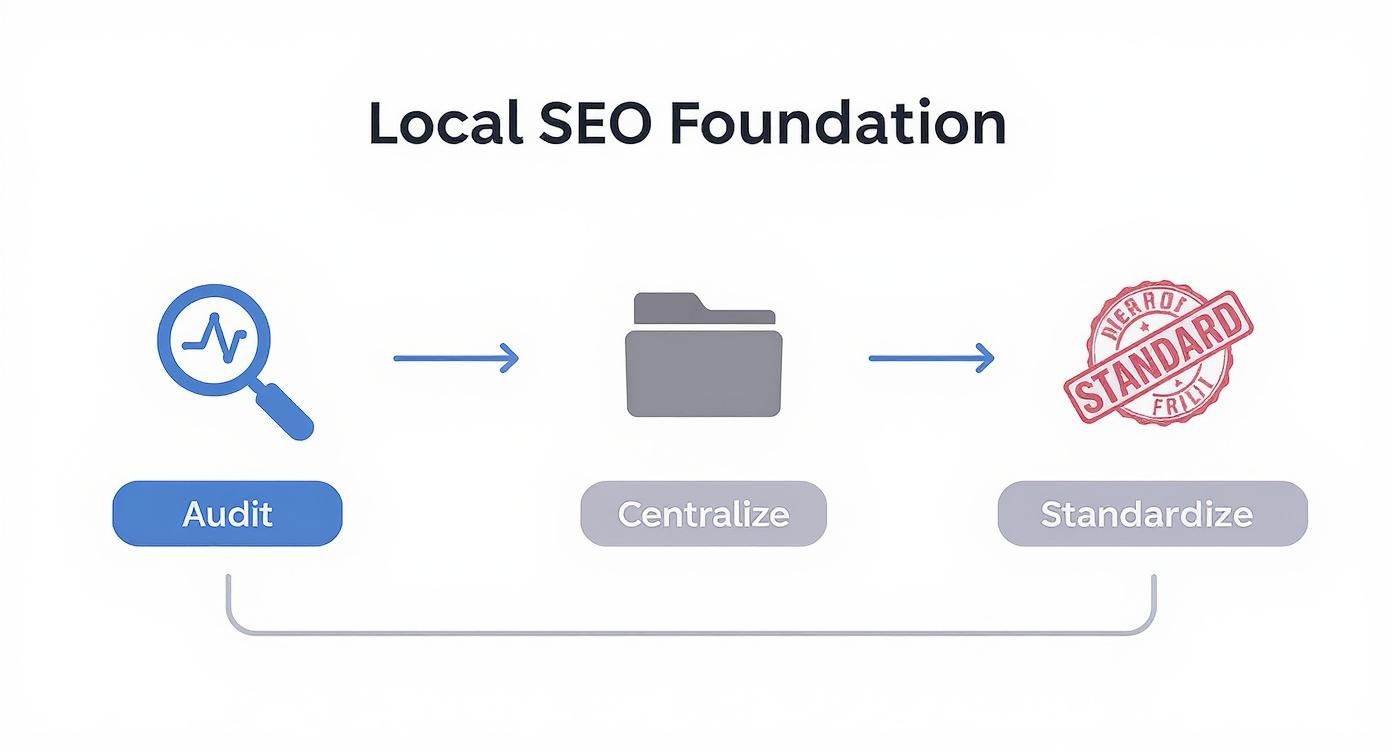
Flowchart illustrating the Local SEO Foundation steps: Audit, Centralize, and Standardize processes.

Stick to this three-step process—Audit, Centralize, Standardize—and you'll sidestep the data inconsistencies that can absolutely tank your local search rankings across all your locations.

Streamlining Content Across All Your Locations

Let's get practical. Imagine your franchise is launching a nationwide summer sale. Are you really going to log into 100 different GBP accounts to create the exact same promotional post? That would take your entire day. This is where automation tools become non-negotiable.

Platforms like OneUp let you schedule Google Business Profile posts in bulk across every location at the same time. You build the content once, and with a few clicks, it's deployed everywhere. It’s a massive time-saver and ensures your brand messaging is consistent.

But this is about more than just efficiency; it's about capturing real, ready-to-buy customers. "Near me" searches are exploding, now topping 1.5 billion every single month. And get this: 76% of people who run a local search on their phone visit a related business within 24 hours. With 46% of all Google searches now having local intent, keeping your GBP active isn't just a good idea—it's how you grab this high-intent traffic.

Advanced GBP Management with Smart Tools

Okay, basic posting is a good start, but real mastery comes from using the more advanced features to drive specific actions. For a business with multiple locations, this means tailoring content without multiplying your workload.

A tool like OneUp helps you pull this off with a few clever tactics:

  • Add Direct Calls-to-Action: Don't just post an update. Add a "Book," "Order," "Shop," "Learn more," or "Sign up" button right on your GBP posts to drive immediate conversions.
  • Create Category-Specific Posts: Group your locations into categories that make sense for you (e.g., "Urban Stores," "Suburban Outlets," "Mall Kiosks"). Then, you can push out tailored posts to just one group, making sure the message hits home for that specific audience.
  • Automate with RSS Feeds: This is a game-changer. Connect your company blog's RSS feed, and new articles can be automatically shared as GBP posts across all your locations. It creates a steady stream of valuable content without you lifting a finger.

Key Takeaway: The goal with scaled GBP management is to make every profile feel like it's managed by a local, even when you're running everything from a central dashboard. It’s this mix of bulk actions and targeted content that gets you there.

Building an Organized and Secure Workflow

As your team grows, you can't have everyone with full admin access to all your profiles. That's just a recipe for disaster—think typos, off-brand messaging, and pure chaos. You need a structured workflow with clearly defined user roles to maintain control and quality.

OneUp solves this by letting you set specific user permissions. You can assign team members to manage only certain locations or, better yet, give them "post-only" access. This means a manager has to approve their content before it goes live. It’s the perfect setup for franchises where local managers create community-specific content, but corporate needs to keep final brand oversight.

For a deeper look into maximizing each profile, you should learn how to optimize your Google Business Profile for local wins. It's packed with great tips that work perfectly with a scaled management strategy.

And if you ever hit a creative wall, leaning on a specialized tool can be a huge help. Check out how a GMB post generator can help you create engaging, optimized content in a fraction of the time. This flips your GBP management from a time-sucking chore into a powerful, scalable engine for local growth.

Creating Local Landing Pages That Actually Convert

Think of your Google Business Profiles as digital doorways. They get people’s attention. But it's your website's location pages that seal the deal. For any business with more than one location, these pages are your most valuable digital real estate.

Slapping a name, address, and phone number (NAP) on a page is table stakes. The real win is creating a unique, high-converting resource that speaks directly to each community you're in.

This means ditching the generic corporate template. A customer landing on your "Denver" page should immediately feel like they're dealing with a local business, not just a faceless cog in a national machine. That's how you win over both Google and real people.
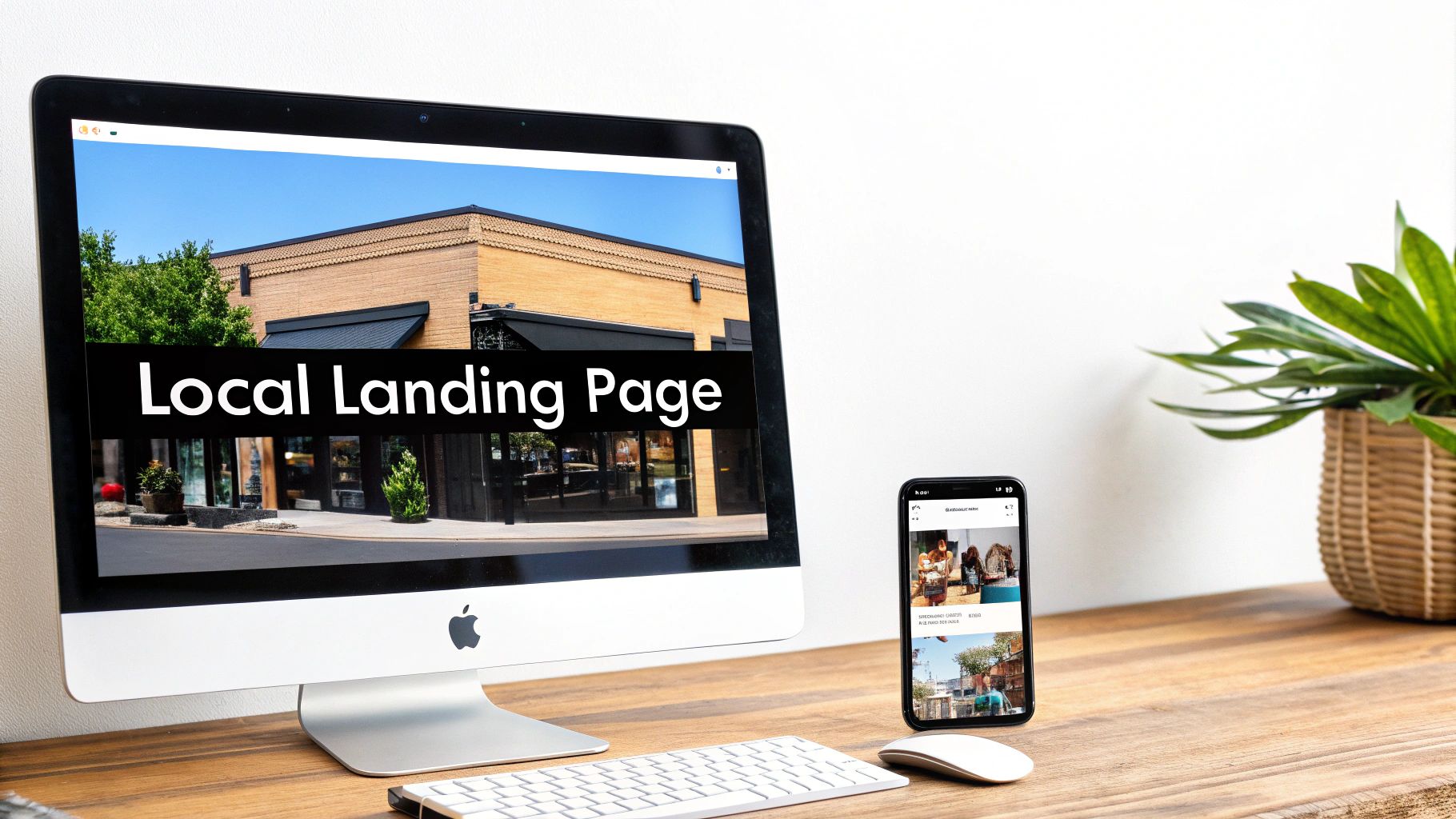
Desktop computer and smartphone on a wooden desk, displaying a 'Local Landing Page' and social media content.

Building the Core Structure for Each Page

First things first: consistency. You need a solid, repeatable template for all your location pages. This ensures every page has the essential info Google and users expect, and it makes your life a heck of a lot easier when you expand to new locations.

Every single location landing page should have these non-negotiables:

  • A Unique URL Structure: Keep it clean and logical, like yourwebsite.com/locations/city-name. This helps everyone—users and search engines—know what the page is about at a glance.
  • Location-Specific Title Tag & Meta Description: Tweak these with the city and state. It’s a small detail that can seriously boost your click-through rates from local search results.
  • Prominent NAP Information: Your full Name, Address, and Phone Number should be right there, clear as day, preferably near the top of the page.
  • An Embedded Google Map: An interactive map with your pin dropped in the right spot gives people immediate context. No one wants to hunt for directions.

This is the skeleton. Now, let’s add the stuff that brings it to life.

Injecting Hyperlocal Flavor and Trust Signals

This is where the magic happens. It’s how you separate your locations from each other and, more importantly, from your competitors. Hyperlocal content is your proof to Google and to potential customers that you're actually part of the community.

Try weaving these powerful elements into each page:

  • Photos of the Actual Location: Get high-quality shots of your storefront, the inside, and the team that works there. Stock photos are a dead giveaway for "corporate and detached." Real photos build instant trust.
  • Local Testimonials and Reviews: Pull glowing reviews from customers in that specific area. A review from "Jane D. in Austin" means a whole lot more on your Austin page than a generic one.
  • Directions from Local Landmarks: Don't just rely on GPS. Add a human touch. "We're just two blocks east of the historic Paramount Theatre" shows you actually know the neighborhood.
  • Location-Specific Promotions or Events: Are you running a sale just for that store? Sponsoring a local little league team? Shout it out. It shows you’re invested.

Pro Tip: Resist the urge to copy and paste service descriptions across all your pages. I've seen it tank rankings. Even if the service is identical, rephrase the content. Tie it to local needs or share a customer story from that area. This helps you dodge duplicate content penalties and makes the page far more relevant.

Technical SEO Essentials for Location Pages

A great-looking page is useless if search engines can't figure out what it's about. This is where you need to get a little technical. Specifically, we're talking about structured data.

LocalBusiness schema markup is a snippet of code you add to your page’s HTML. It’s like creating a perfectly organized label for search engines, telling them your exact address, hours, and phone number in a language they understand perfectly. This massively increases your odds of showing up in rich results, like the all-important Google Map Pack.

When you roll this out correctly across dozens or hundreds of pages, Google starts seeing each location as its own distinct entity. This boosts each one's individual ranking potential. It’s a small technical step with a huge payoff for your local visibility. You're basically spoon-feeding Google the info it needs to rank you for those critical "near me" searches—an absolutely essential practice for any local SEO for multiple locations playbook.

Scaling Your Citation and Review Strategy

Once your location pages are dialed in, it's time to build trust and authority off-site. For local SEO, this comes down to a powerful one-two punch: consistent online listings (citations) and a stellar reputation built on customer reviews.

Let's walk through how to manage both of these at scale, making sure your brand is not just visible, but also trusted in every single community you're in.

A person reviewing documents on a tablet and paper, with a pen in hand, on a wooden desk.

Achieving Ironclad NAP Consistency

A "citation" is just any online mention of your business's Name, Address, and Phone number (NAP). Google is constantly crawling the web, looking at these listings on major sites like Yelp and Bing Places, but also on smaller, industry-specific directories.

When Google sees the exact same information everywhere, it confirms what you've put in your Google Business Profile. This gives Google more confidence in your business, which directly helps your local rankings.

Even tiny differences—like using "St." on one site and "Street" on another—can muddy the waters and hurt your SEO. The goal is to lock in one official version of your NAP for each location and push it out everywhere, meticulously.

For a business with just a handful of locations, this is a headache. For a multi-location brand, doing it manually is straight-up impossible. This is where citation management platforms are a must-have. They let you find, fix, and build new citations from a single dashboard.

The Engine of Local Trust: Customer Reviews

Customer reviews are no longer a "nice-to-have" in local SEO; they're a massive ranking factor. And for multi-location brands, the stakes are even higher.

Consider this: 91% of consumers now trust online reviews as much as a recommendation from a friend. Even more telling for brands like yours, another 91% of consumers say that reviews for one specific location influence how they see the entire brand. That means a few bad reviews at a single branch can tarnish your whole company's reputation. Dig into more of these numbers in these fascinating local SEO statistics if you're curious.

A consistent flow of new, positive reviews sends one of the strongest possible signals to Google. But wrangling feedback across dozens or hundreds of profiles requires a real system.

Key Takeaway: The aim isn't just to get reviews. It's to build a scalable feedback loop where you're actively asking for feedback, responding to everyone, and using what you learn to make each location better.

Creating a Scalable Review Management Workflow

This is where things can get chaotic. Trying to manage reviews by logging into dozens of different GBP or Facebook accounts is a surefire way to miss things and leave customers hanging.

A centralized tool is a lifesaver here.

An all-in-one social inbox, like the one from OneUp, consolidates all your Google reviews and social media comments into a single feed. For multi-location businesses, this is a total game-changer.

Here’s how a platform like OneUp makes this manageable:

  • Centralized Monitoring: See and reply to every Google review from one dashboard. No more logging in and out of individual GBP accounts.
  • Saved Replies: Build a library of templates for common feedback. This lets your team respond in seconds while still adding a personal touch for each customer.
  • Team Collaboration: Avoid awkward double-replies or, worse, ignoring a customer completely. You can see who has responded to what.
  • Email Notifications: Get an alert the second a new review drops. This is huge for damage control on negative feedback and showing appreciation for positive ones.

A system like this transforms review management from a reactive chore into a streamlined, proactive strategy. When you respond promptly and professionally at every single location, you're not just boosting your local rankings. You're building a fortress of trust around your brand, one customer at a time—a cornerstone of effective local SEO for multiple locations.

Automating Social Signals and Local Content

Keeping your social media profiles and Google Business Profiles buzzing with activity does more than just catch a customer's eye—it sends some seriously powerful signals to search engines. Every update tells Google that your locations are active, open for business, and part of the local scene.

But let's be real. Manually posting across dozens or even hundreds of profiles is a one-way ticket to burnout.

The secret to a killer multi-location content strategy isn’t about grinding harder. It’s about working smarter with automation. By creating a unified content workflow, you can generate a constant drumbeat of local activity that keeps every single location on the map without completely draining your team's resources. This is where a good, centralized tool for local SEO for multiple locations becomes a total game-changer.

Unify Your Content Calendar

Picture this: one single, streamlined content calendar for every social platform and GBP listing you manage. That's what automation brings to the table. A tool like OneUp lets you hook up all your accounts—Facebook, X (formerly Twitter), Instagram, LinkedIn, Pinterest, TikTok, and yes, all your Google Business Profiles—into one central command center.

Forget logging into ten different platforms for ten different locations. You can plan, create, and schedule everything from one dashboard. It's a massive time-saver and ensures your brand voice stays consistent across the board. You can actually see your entire content plan for the month, making sure no location gets left behind.

Go Beyond Basic Scheduling

Simple scheduling is great, but real efficiency for a multi-location brand comes from the more advanced stuff. These are the features that let you scale your efforts without scaling your workload.

  • Bulk Uploading: Got a whole month of content ready to go? Don't schedule posts one by one. Map out hundreds of posts in a CSV file, upload it to OneUp in a few clicks, and watch your entire content calendar populate for all your locations.
  • Evergreen Content Recycling: Some content is just too good to only post once. You can set your best-performing, non-time-sensitive posts to automatically repeat at whatever interval you choose. This keeps your profiles lively with proven winners and fills content gaps with zero extra effort.
  • Automated RSS Feed Posting: Hook up your company blog’s RSS feed to automatically push new articles to your social channels and GBP listings. Your blog instantly becomes a content engine, creating a steady stream of valuable posts for every location the second you hit "publish."

Expert Insight: Automation isn't about sounding like a robot. It's about freeing up your team to do the human stuff—engaging with local customers, responding to comments, and creating that truly unique, community-focused content. Let the software handle the grunt work.

The team at OneUp is constantly rolling out new features to make this even easier. OneUp's public changelog highlights recent updates like AI caption generation in multiple languages, adding alt text to images, and a Chrome extension for easier scheduling—practical features that save agencies and multi-location businesses real time.

This kind of changelog shows they're focused on practical updates, like adding new social network integrations and making the tool easier to use—things that directly help businesses managing multiple locations.

Customize Posts for Local Flavor

Automation doesn't mean "one size fits all." With OneUp, you can create a single post and then easily tweak the caption for each social network.

For example, you can write a longer, more detailed caption for LinkedIn and then switch to a punchier, hashtag-loaded version for Instagram and X.

This is especially crucial for a platform like Instagram, where the right hashtags can blow up your reach. If you need a hand finding the best tags, you can use something like OneUp's Instagram hashtag generator to find trending and relevant options.

This mix of automated efficiency and tailored messaging is what makes a multi-location social strategy truly sing.

Your Top Multi-Location SEO Questions, Answered

When you're scaling a local SEO strategy, a few tricky questions always seem to pop up. Let's tackle the big ones I hear all the time, so you can get past the roadblocks and back to growing.

How Do I Create Unique Content for Hundreds of Location Pages?

This is the million-dollar question, isn't it? The thought of writing 100 unique service pages is enough to make anyone's head spin. But you don't have to reinvent the wheel for every single one. The trick is to start with a solid template and then inject hyperlocal details that Google and your customers will love.

Instead of just swapping out the city name, focus on customizing these key areas for each page:

  • Spotlight the Local Crew: Get photos and short, friendly bios of the team at that specific branch. It’s a simple move that instantly makes a location feel more personal and trustworthy than one using generic stock photos.
  • Showcase Neighborhood Reviews: Don't just pull any review. Find one from a customer in that specific city or even neighborhood. A glowing review from "Jessica in West Loop" means a whole lot more on your Chicago page.
  • Give Real-World Directions: An embedded map is standard, but you can do better. Add directions that reference local landmarks. Something like, "You’ll find us right next to the old movie theater on Main Street," is way more helpful and authentic.
  • Talk About Community Ties: Does this location sponsor a local little league team? Did they participate in a neighborhood charity event? Highlighting this proves you're actually part of the community, not just another corporate chain.

What's the Best Way to Manage Google Business Profile Reviews for All Locations?

If you're still logging into each Google Business Profile one by one to check reviews, you have to stop. It's a massive time sink and completely unsustainable as you grow.

The only way to do this at scale is with a tool that funnels all your reviews into a single dashboard. This is where something like OneUp's social inbox becomes a lifesaver. You can see and reply to every single Google review across all your locations from one central feed. Your team can stay on top of feedback without wasting hours just logging in and out of accounts.

Pro Tip: Set up a handful of response templates for common feedback—good and bad. But always customize them. Use the customer's name and mention something specific from their review. The goal is efficiency without sacrificing the personal touch.

Should I Create Separate Social Media Accounts for Each Business Location?

Honestly, it depends. For most businesses, the answer is probably no. Managing one primary brand account and using geo-targeted posts or ads is far more efficient. It keeps your brand voice consistent and prevents your team from getting stretched too thin.

However, there's a big exception. If your individual locations have strong local managers who are deeply embedded in their communities and can consistently create genuine, on-the-ground content, then separate accounts can be a goldmine for engagement.

If you do go down that path, a tool is non-negotiable. With OneUp, for example, you can connect an unlimited number of social accounts. This lets you manage everything from a central hub, and you can even use the bulk uploader to schedule posts for all locations at once from a single CSV file. It's a game-changer for staying organized.

How Do I Track Performance and ROI Across Different Locations?

You can't just guess which locations are pulling their weight. To get a clear picture of performance, you need to blend data from a couple of key places.

Start with Google Analytics. Set up custom segments for each location's landing page traffic. This will tell you exactly how many people are visiting each page on your website.

Next, you have to live inside your Google Business Profile Insights. For every location, you need to be tracking these KPIs:

  • Website Clicks: How many people went from your GBP listing to your location page.
  • Phone Calls: The number of calls made directly from your profile.
  • Direction Requests: How many people were interested enough to get directions to your physical spot.

When you lay this data out side-by-side for all your locations, the winners and losers become obvious. You'll quickly spot your star performers and see which underperforming branches need a little more love. This is the only way to truly measure the ROI of your local SEO efforts.


Ready to stop juggling dozens of accounts and start managing your multi-location strategy from a single, powerful dashboard? With OneUp, you can schedule posts in bulk, manage all your reviews in one inbox, and track performance with ease. See how much time you can save and start your free trial of OneUp today.

12 Best Social Media Scheduling Tools for 2025

Managing a successful social media presence requires more than just great content; it demands consistency and strategic timing. The core challenge for agencies, creators, and businesses alike is efficiently scheduling and publishing content across multiple platforms without spending countless hours tethered to a screen. The right social media scheduling tool automates this entire process, transforming a logistical headache into a streamlined, effective workflow. This allows you to focus on strategy and engagement rather than manual posting.

This guide is designed to help you find the best social media scheduling tools for your specific needs. We’ve moved beyond surface-level descriptions to provide a comprehensive analysis of the top platforms available today. Whether you're a freelance marketer managing a handful of clients, an agency lead overseeing hundreds of accounts, or a multi-location business coordinating local content, this resource will clarify which tool offers the right features at the right price point. We'll examine everything from basic scheduling to advanced features like content recycling, approval workflows, and integrated social inboxes.

Each entry includes a detailed breakdown with screenshots and direct links, covering:

  • Key Features: A quick, scannable summary of what the tool does best.
  • Pricing Tiers: A clear look at the costs and what you get at each level.
  • Pros & Cons: An honest assessment of strengths and weaknesses based on real-world use.
  • Ideal Use Case: We pinpoint who each tool is built for, from SMBs to large enterprises.

We will also highlight unique platforms like OneUp, which offers compelling differentiators such as unlimited accounts, team members, and post scheduling on all plans, alongside powerful content recycling and cross-network scheduling capabilities. To ensure a steady stream of engaging visual content for your social media channels, exploring the best AI video generators can significantly streamline your production process. Our goal is to provide the clarity you need to make a confident, informed decision and select the perfect tool to scale your social media efforts effectively.

1. OneUp

OneUp establishes itself as a powerhouse in the social media scheduling landscape by directly addressing a critical pain point for growing businesses and agencies: scalability. Its core value proposition is refreshingly straightforward. For a single fixed price, users gain access to unlimited social accounts, unlimited scheduled posts, and unlimited team members. This model removes the punitive pricing tiers common elsewhere, making it an exceptional choice for those managing extensive client rosters, multiple brand profiles, or franchise locations without fear of escalating costs.

A screenshot of the OneUp platform showing its calendar view for scheduling social media posts.

This platform excels with its expansive, direct-publishing capabilities. It supports a modern and comprehensive range of networks, including Instagram (Reels, Stories, Carousels), TikTok, Facebook, LinkedIn, X, YouTube, Pinterest, Threads, and even emerging platforms like Bluesky and Reddit. OneUp ensures that advanced post formats are fully supported, allowing users to schedule threaded posts, add first comments, include alt text, add a location to posts, create multi-image/video content, and even generate a shareable preview link for each post before it goes live.

Key Strengths & Use Cases

OneUp is more than just a scheduler; it's a complete operational hub designed for efficiency and collaboration.

  • Agency & Multi-Location Management: The workflow features are purpose-built for teams. You can set up client approval emails to get sign-off before content goes live, share read-only calendar links for transparency, and use internal notes with @mentions to collaborate on drafts. Fine-grained, per-teammate access controls ensure brand security across large organizations. You can even bulk upload posts and assign them to different social accounts, saving hours of manual work.
  • Content Creation Efficiency: Streamline your content pipeline with a suite of integrated tools. OneUp includes a Canva editor, bulk uploading via CSV, and an RSS feed auto-posting feature to automatically share blog updates. The built-in AI assistant can generate captions and images, overcoming creative blocks and accelerating production. Its unique post recycling feature allows you to automatically re-publish evergreen content at set intervals, keeping your feeds active with minimal effort.
  • Centralized Engagement & Reporting: The unified Social Inbox centralizes comments, DMs, and even Google Business Profile reviews into one manageable feed. This simplifies community management and reputation monitoring. For performance tracking, OneUp provides customizable, cross-network reports that can be scheduled for automated delivery to stakeholders.

Pricing

OneUp offers a 7-day free trial to test its full feature set. Following the trial, it operates on a simple, tiered pricing structure starting at $24/month, with all plans including unlimited social accounts, team members, and scheduled posts. This straightforward approach reinforces its commitment to predictable, scalable costs.

Pros:

  • Truly Unlimited Scaling: No per-account, per-user, or per-post fees, providing predictable costs as you grow.
  • Broad Network & Format Support: Direct publishing to modern networks like TikTok, Reels, and Threads with advanced formatting like first comments and alt text.
  • Robust Agency Workflows: Client approvals, team permissions, and internal notes streamline collaboration.
  • Efficient Content Operations: Features like post recycling, bulk upload, RSS automation, and AI generation save significant time.

Cons:

  • Advanced Social Listening: Comprehensive social listening and monitoring features are on the roadmap but not yet fully implemented.
  • No Free Forever Plan: Unlike some competitors, OneUp does not offer a free plan, focusing instead on its value-packed paid tiers.

OneUp is unequivocally one of the best social media scheduling tools for any team whose primary goal is to manage a high volume of social profiles without incurring unpredictable costs.

Visit OneUp

2. Buffer

Buffer is a long-standing and respected player in the social media scheduling space, known for its clean user interface, creator-friendly features, and transparent, scalable pricing. It excels as one of the best social media scheduling tools for individuals and small teams who need a straightforward, reliable platform without a steep learning curve.

The platform operates on a queue-based system, allowing you to set a posting schedule and simply add content to your queue for automatic publishing. Buffer's per-channel pricing model is a key differentiator. You start with a generous free plan for up to three channels, and paid plans let you add channels one by one, so you only pay for what you use. This predictability is ideal for freelancers and small businesses managing growth.

Standout Features

  • Per-Channel Pricing: Pay a flat rate for each social media account you add, making costs easy to predict as you scale.
  • AI Assistant: A built-in AI tool helps you brainstorm ideas, rephrase text, and generate content directly within the composer. If you’re looking for more advanced AI-powered tools, you might want to explore an Instagram caption generator for more specialized content creation.
  • Robust Mobile App: Buffer’s mobile apps for iOS and Android are highly functional, offering a seamless scheduling and management experience on the go.
  • Engagement Tools: Reply to comments and interact with your audience from a simple, unified inbox.
Best For Limitations
Individual Creators & Influencers Per-channel pricing can become expensive for agencies managing dozens of accounts.
Small Businesses with a few social profiles Lacks advanced features like recurring post recycling or bulk uploading from a CSV file.
Teams needing a simple, intuitive interface Unlimited accounts and team members are not standard, unlike platforms such as OneUp.

Website: https://buffer.com/pricing

3. Hootsuite

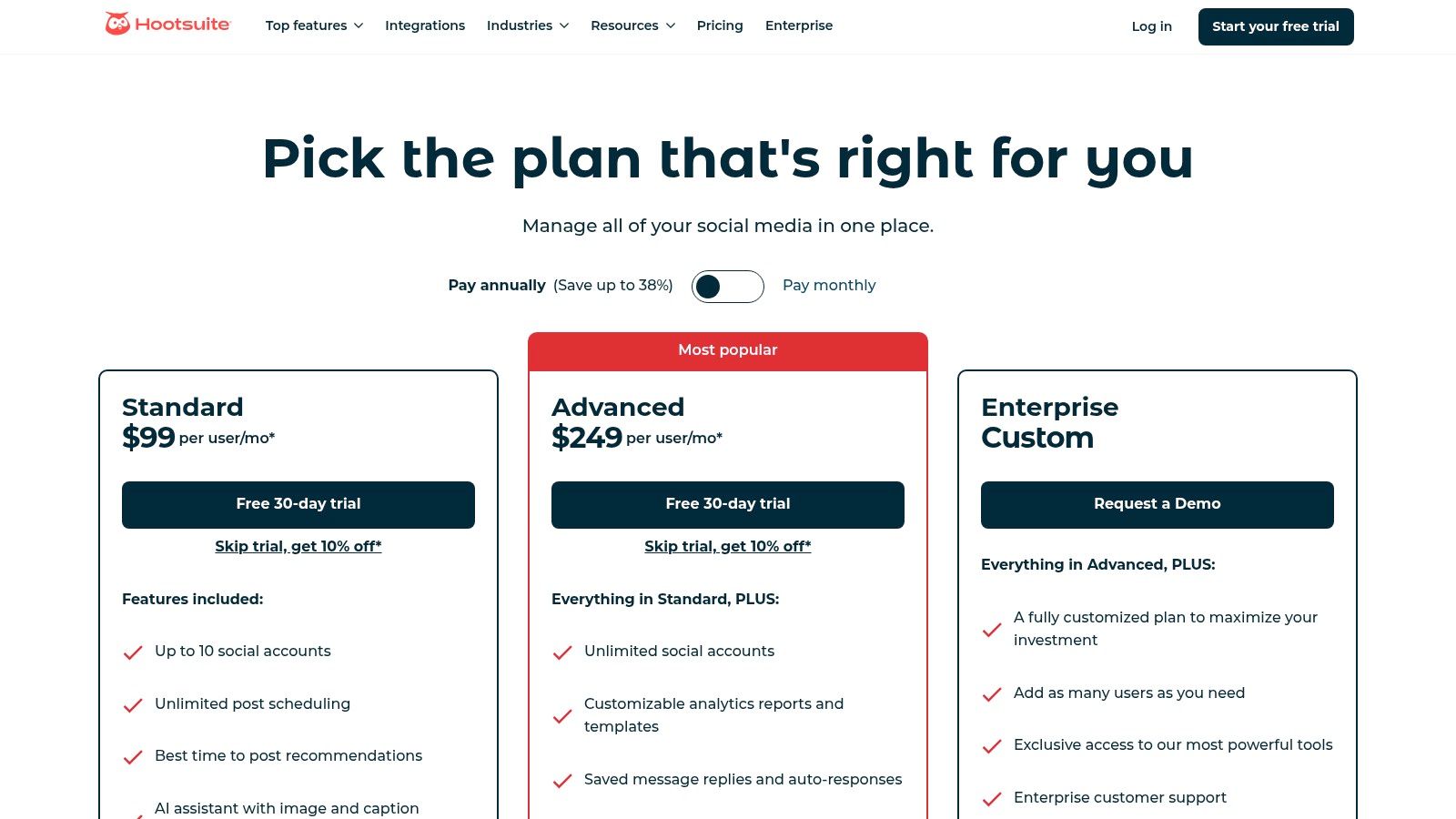
Hootsuite is one of the most established and comprehensive platforms in the social media management landscape, positioning itself as an all-in-one suite for teams and enterprises. It goes beyond simple scheduling, offering powerful tools for listening, engagement, and in-depth reporting, making it one of the best social media scheduling tools for organizations needing a centralized command center for all social activities.

Hootsuite

The platform is built around a customizable "streams" dashboard, where you can monitor keywords, hashtags, mentions, and feeds in real time across multiple networks. Hootsuite’s strength lies in its ability to scale, offering advanced team workflows, permissions, and compliance features that are critical for larger businesses. Its higher entry price point reflects a focus on robust, enterprise-grade functionality rather than individual or small business use cases.

Standout Features

  • Unified Inbox: Manage comments, mentions, and direct messages from multiple social accounts in a single, collaborative inbox to streamline engagement.
  • Best-Time-to-Post Recommendations: The platform analyzes your audience's activity and suggests optimal times to publish content for maximum reach and engagement.
  • AI Caption & Idea Generator: An integrated AI assistant helps overcome creative blocks by generating post ideas and drafting captions, which can be further optimized using a specialized Instagram hashtag generator to improve discoverability.
  • Advanced Analytics & Reporting: Create detailed, customizable reports that track performance, measure ROI, and benchmark against competitors.
Best For Limitations
Large Teams & Enterprise Clients High entry price point can be prohibitive for small businesses, freelancers, and individuals.
Agencies needing deep analytics & reporting The user interface can feel complex and overwhelming for beginners or those with simple needs.
Businesses focused on social listening Essential features like post recycling are not standard, unlike OneUp's evergreen functionality.

Website: https://www.hootsuite.com/plans

4. Sprout Social

Sprout Social is a premium, all-in-one social media management platform designed for teams and enterprises that need sophisticated analytics, engagement, and collaboration tools. It positions itself as one of the best social media scheduling tools for organizations that require deep data insights and streamlined internal workflows, moving beyond simple content publishing to provide a comprehensive suite of management features.

The platform excels at providing granular reporting and team-based approval processes, making it a strong choice for larger businesses with multiple stakeholders. Its per-seat pricing model is built for professional teams, offering unlimited profiles on higher-tier plans. While powerful, this structure is geared toward well-funded marketing departments rather than individuals or small businesses seeking a more budget-friendly solution.

Standout Features

  • Advanced Reporting and Analytics: Generate detailed, presentation-ready reports on post performance, audience demographics, and competitive analysis.
  • Team Workflows and Collaboration: Assign tasks, manage approval queues, and leave internal notes to streamline content creation and review processes.
  • Robust Publishing Suite: Features include a content calendar, asset library, and optimal send times to maximize engagement.
  • Social Listening and Monitoring: Track brand mentions, keywords, and industry trends to stay ahead of conversations relevant to your business.
Best For Limitations
Mid-to-Large Sized Businesses & Enterprises Per-user pricing model is one of the most expensive on the market.
Agencies needing advanced client reporting Lacks features like evergreen post recycling, a key benefit found in platforms like OneUp.
Teams that require complex approval workflows Key features like advanced social listening are often costly add-ons, increasing total spend.

Website: https://sproutsocial.com/pricing/

5. Later

Later has built its reputation as a leading visual-first scheduling tool, making it one of the best social media scheduling tools for brands that prioritize aesthetics. Its platform is heavily geared toward Instagram, TikTok, and Pinterest, offering a drag-and-drop visual planner that lets you preview and arrange your feed before you post. This focus on visual content strategy is its core differentiator.

The platform's calendar-centric interface provides a clear overview of your upcoming content, and features like its Link in Bio tool help drive traffic from your social profiles. While it offers a free plan, its paid tiers unlock more powerful features, such as team collaboration, approval workflows, and analytics. However, unlike platforms such as OneUp which provide unlimited accounts and team members, Later’s more advanced features and higher post limits are reserved for its premium plans.

Later social media scheduling tool pricing plans

Standout Features

  • Visual Planner: A drag-and-drop calendar that allows you to preview and perfect the look of your Instagram grid before publishing. If you're looking for a dedicated tool for this, explore how an Instagram grid planner can enhance your strategy.
  • Link in Bio Tool: Create a customizable, clickable landing page for your bio link to drive traffic and track conversions.
  • Best Time to Post Suggestions: Later analyzes your audience engagement and suggests optimal posting times to maximize reach.
  • User-Generated Content (UGC) Tools: Find, collect, and schedule content from your community by searching hashtags and mentions.
Best For Limitations
Visually-driven brands (fashion, travel, food) Post limits on lower-tier plans can be restrictive for high-volume accounts.
Content creators focused on Instagram & TikTok Advanced analytics and team features are locked behind more expensive plans.
Teams needing a simple, visual content calendar Lacks advanced evergreen content recycling and bulk CSV upload features found in OneUp.

Website: https://later.com/pricing/

6. Agorapulse

Agorapulse is a comprehensive social media management suite that excels in team collaboration, robust reporting, and powerful inbox management. It stands out as one of the best social media scheduling tools for agencies and mid-sized businesses that need more than just scheduling; they need a full command center for social media engagement, monitoring, and analytics.

Agorapulse

The platform is built around a per-user pricing model, where each plan includes a generous number of social profiles, making it cost-effective for teams managing multiple brands. Agorapulse shines with its unified social inbox, which uses automation rules to help teams efficiently manage high volumes of comments, messages, and mentions. This focus on engagement and team workflows makes it a top choice for organizations prioritizing audience interaction and detailed performance tracking.

Standout Features

  • Advanced Inbox Automation: Create automated rules to hide, review, or assign inbox items, helping teams manage engagement at scale without missing important conversations.
  • Bulk Publishing: Easily upload and schedule multiple posts at once from a CSV file, a feature that saves significant time for content-heavy strategies.
  • Detailed Reporting: Generate in-depth, customizable reports that provide clear insights into ROI, team performance, and content effectiveness.
  • Flexible Add-ons: Scale your plan by adding more users or social profiles as your business grows, with special discounts available for nonprofit organizations.
Best For Limitations
Agencies & Mid-Sized Businesses Per-user pricing can become costly for larger teams or agencies with many managers.
Teams needing powerful engagement tools Full X/Twitter functionality may require a paid add-on, increasing the overall cost.
Users requiring deep analytics and reporting Unlike OneUp, it lacks a feature for automatically recycling evergreen content indefinitely.

Website: https://www.agorapulse.com/pricing/

7. SocialPilot

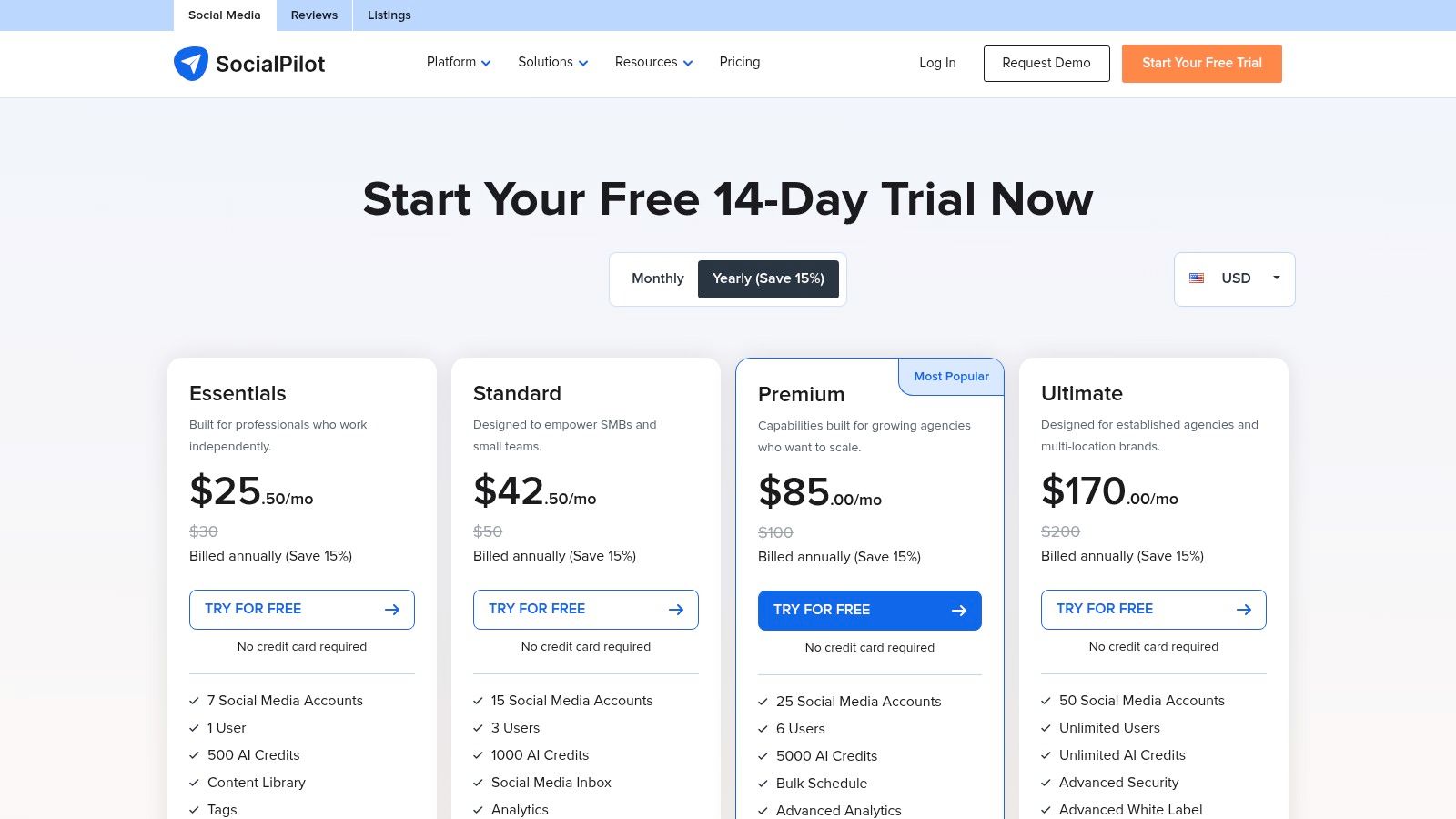
SocialPilot is a powerful and budget-friendly contender, positioning itself as one of the best social media scheduling tools specifically for growing teams and marketing agencies. It delivers a comprehensive suite of features, including bulk scheduling, client management, and detailed analytics, at a price point that offers significant value compared to more expensive enterprise platforms.

The platform is designed for collaboration, making it easy to manage multiple brands and user permissions without a hefty price tag. Its standout feature for agencies is the ability to create white-label PDF reports, allowing them to present professional, branded analytics to their clients. SocialPilot provides a balanced mix of functionality and affordability, making it an excellent choice for users who have outgrown simpler tools but aren't ready for a premium suite.

SocialPilot

Standout Features

  • White-Label Reporting: Agencies can generate and share custom-branded PDF reports with clients, adding a professional touch to their services.
  • Bulk Scheduling: Easily upload and schedule up to 500 posts at once using a CSV file, a major time-saver for large-scale content campaigns.
  • Client & Team Management: Provides robust workflows for managing client accounts and team member roles with specific permissions and approval processes.
  • Content Curation & RSS Feeds: Discover and schedule relevant content from across the web directly within the platform.
Best For Limitations
Marketing Agencies on a Budget The user interface is functional but can feel less polished than other premium competitors.
Teams Needing Collaboration & Approval Tools Some advanced analytics and inbox features are reserved for higher-priced plans.
Businesses Managing Multiple Social Profiles Lacks the unlimited accounts and team members offered by platforms like OneUp on all plans.

Website: https://www.socialpilot.co/plans

8. Sendible

Sendible is an agency-first social media management platform designed for teams that juggle multiple clients and brands. It stands out as one of the best social media scheduling tools for its robust client collaboration features, white-labeling capabilities, and scalable architecture. The platform centralizes client management, making it easy to create dedicated dashboards, set up approval workflows, and generate custom-branded reports.

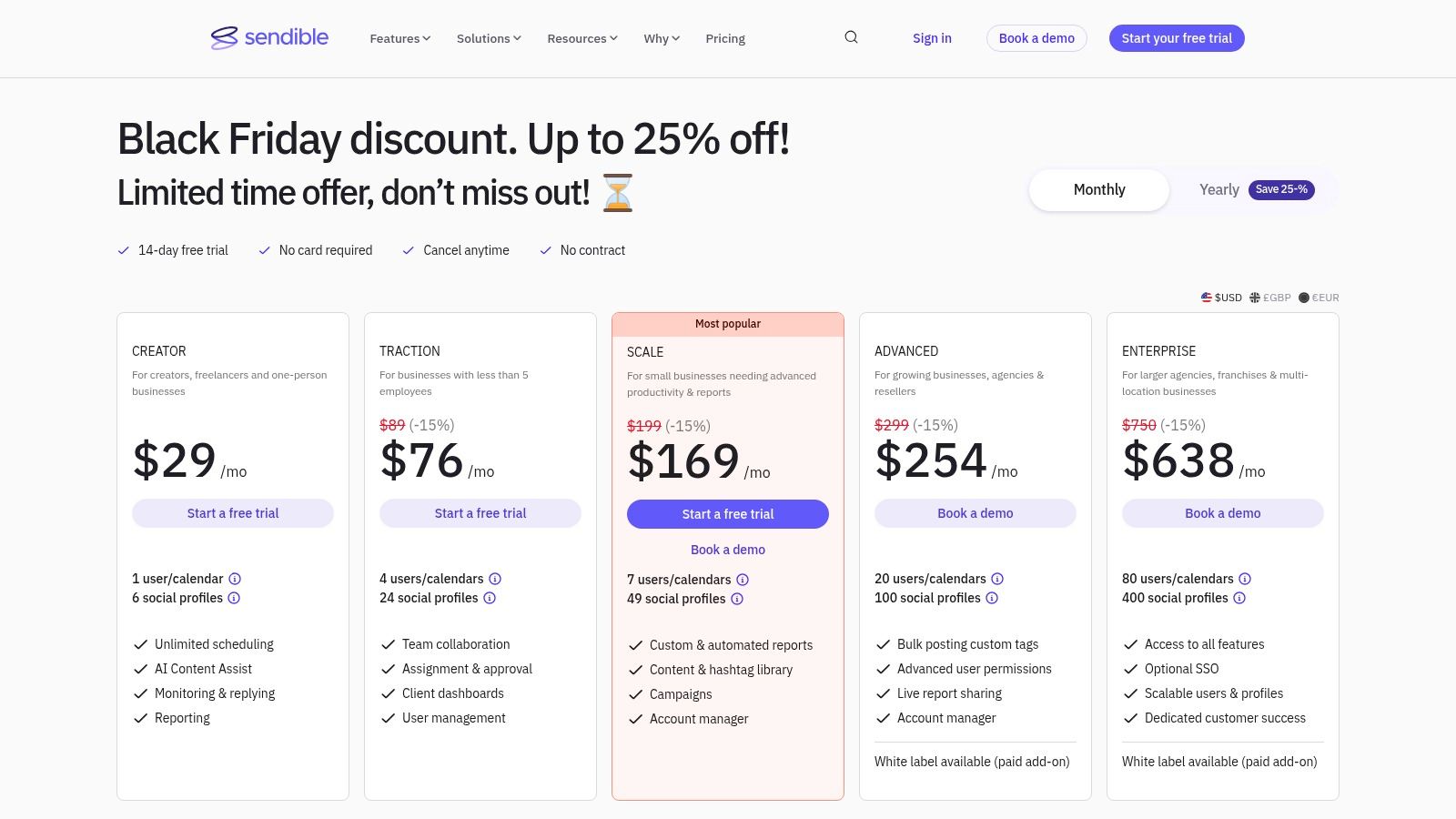
For agencies, Sendible's structure is a major advantage. It bundles users and profiles into tiered plans, offering a predictable cost model that grows with your client roster. This approach simplifies onboarding new clients and team members, ensuring everyone has access to the tools they need without the complexity of per-seat or per-profile pricing add-ons that can quickly escalate costs.

Sendible Pricing Plans

Standout Features

  • Client Dashboards & Approval Workflows: Create secure, separate workspaces for each client, allowing them to review and approve content before it goes live.
  • White-Label Solutions: Agencies can brand the entire platform with their own logo and colors, presenting a professional, unified experience to clients.
  • Bulk Scheduling & Smart Queues: Upload content in bulk via a CSV file and use smart queues to organize posts into categories for automated publishing.
  • Canva Integration: Design visuals directly within Sendible’s composer using its built-in Canva integration, streamlining the content creation process.
Best For Limitations
Marketing Agencies managing multiple clients The entry-level plan is limited to 1 user and 6 profiles, which is restrictive for teams.
Teams needing client approval workflows Advanced white-label features are only available on higher-tier plans or as paid add-ons.
Businesses requiring detailed, branded reports Lacks unlimited accounts and team members on all plans, a key benefit offered by OneUp.

Website: https://www.sendible.com/pricing

9. Loomly

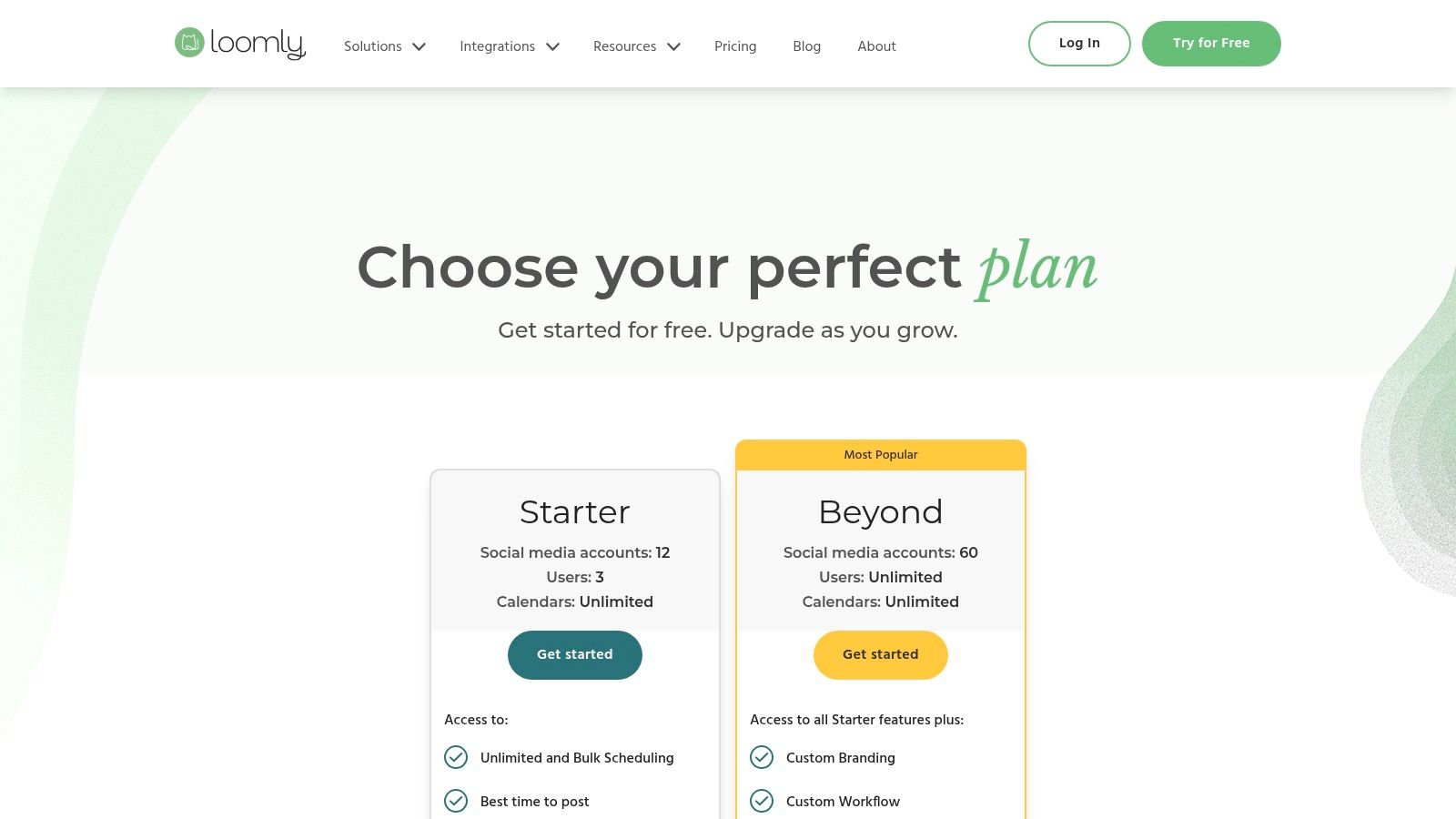
Loomly is a brand success platform that puts collaboration and planning at its core, making it one of the best social media scheduling tools for marketing teams and agencies. It operates with a calendar-first approach, providing a clear, visual overview of all scheduled content and allowing for seamless team-based workflows from idea to approval and publication.

The platform is designed to streamline the content creation process, offering features like post ideas, a central asset library, and structured approval flows. This makes it an excellent choice for organizations that need strict brand oversight and collaboration between multiple stakeholders. While Loomly offers powerful team features, its public pricing details can sometimes be less transparent, often requiring users to sign up to view the most current tiers and features clearly.

Loomly

Standout Features

  • Collaborative Workflows: Multi-user roles and custom approval flows ensure content is reviewed and approved by the right people before going live.
  • Central Asset Library: Store, organize, and manage all your media, brand guidelines, and content assets in one accessible location for the entire team.
  • Post Ideas and Inspiration: Loomly provides suggestions based on trending topics, holidays, and social media best practices to help fuel your content calendar.
  • Enterprise and Nonprofit Options: The platform scales to meet the needs of large organizations and offers discounts for nonprofit entities.
Best For Limitations
Marketing Teams & Agencies Public pricing can be opaque, sometimes requiring a sign-up to see full details.
Brands with Strict Approval Processes Lacks advanced features like recurring post recycling, a key time-saver found in OneUp.
Organizations Needing a Central Asset Library Doesn't offer unlimited accounts or team members on its standard plans.

Website: https://www.loomly.com/pricing

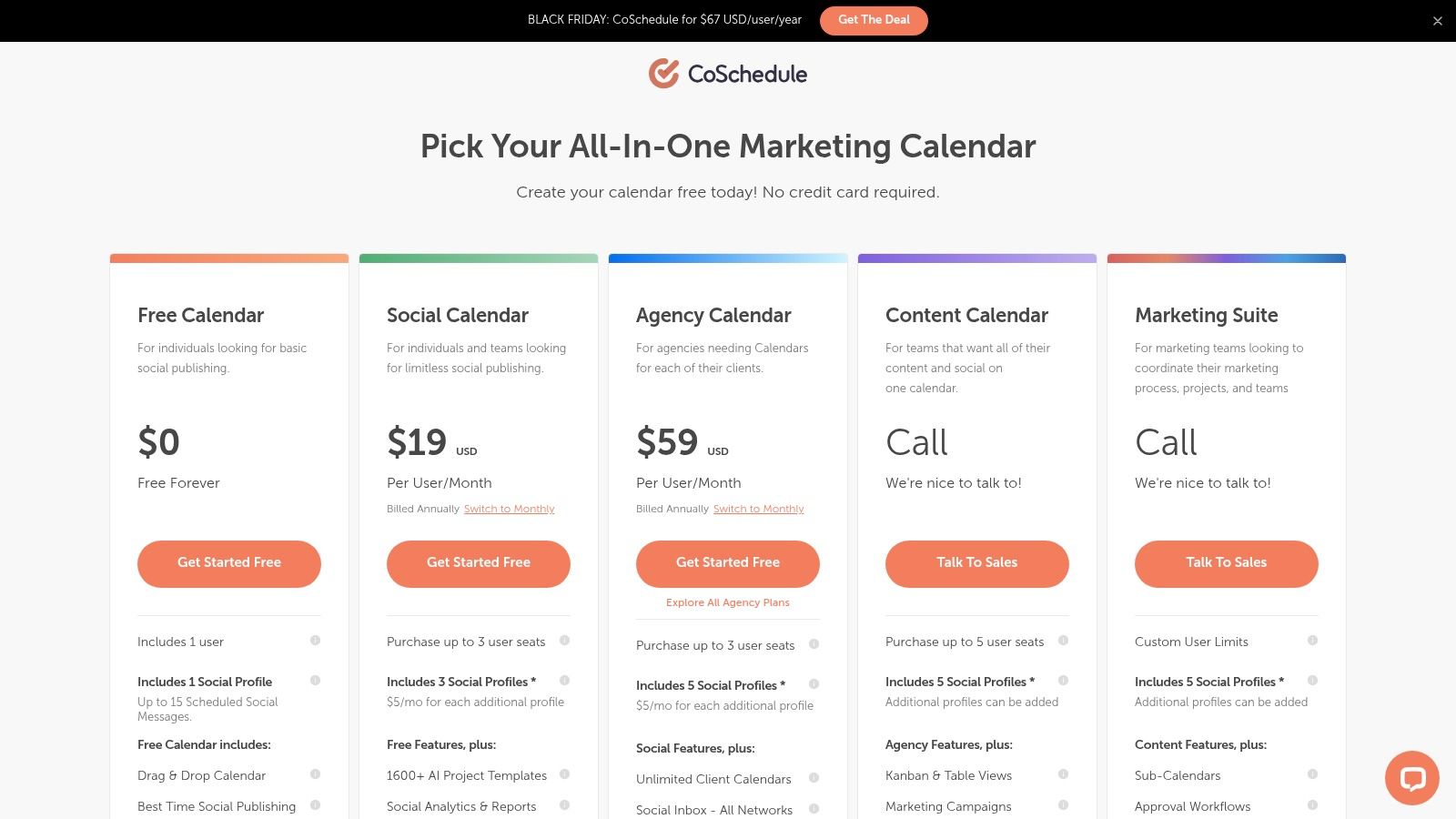
10. CoSchedule (Social Calendar)

CoSchedule carves out its niche by integrating social media scheduling directly into a comprehensive marketing calendar. Instead of being just a scheduler, it serves as a unified hub for planning all marketing activities, from blog posts and email newsletters to social campaigns. This makes it one of the best social media scheduling tools for marketing teams who want to see the bigger picture and ensure social efforts are perfectly aligned with broader content strategy.

CoSchedule (Social Calendar)

The platform’s strength lies in its visual, drag-and-drop calendar interface, which allows marketers to easily map out and reschedule an entire campaign's worth of content. The entry-level Social Calendar plan is affordable and provides core scheduling features, including "Best Time" publishing recommendations to maximize engagement. As you move to higher-tier plans, CoSchedule unlocks more advanced project management and collaboration features, positioning itself as a central command center for content-driven teams.

Standout Features

  • Unified Marketing Calendar: See all your marketing projects, including emails, blog posts, and social media, in one color-coded, drag-and-drop view.
  • Best Time Scheduling: The platform analyzes your audience's engagement patterns and suggests the optimal times to publish your posts for maximum reach.
  • AI-Powered Templates: CoSchedule's AI assistant can help generate ideas and draft copy for social posts, speeding up the content creation process.
  • Campaign-Level Planning: Group related social posts, content, and tasks into cohesive campaigns to better organize and track marketing initiatives.
Best For Limitations
Content Marketers & Bloggers Core scheduling features like post recycling are not available, unlike in platforms like OneUp.
Teams needing a unified social and content marketing calendar Some key collaboration tools are gated behind more expensive, sales-led plans.
Marketers focused on campaign-based planning X/Twitter profiles are billed separately on certain plans, which can increase costs.

Website: https://coschedule.com/pricing

11. Metricool

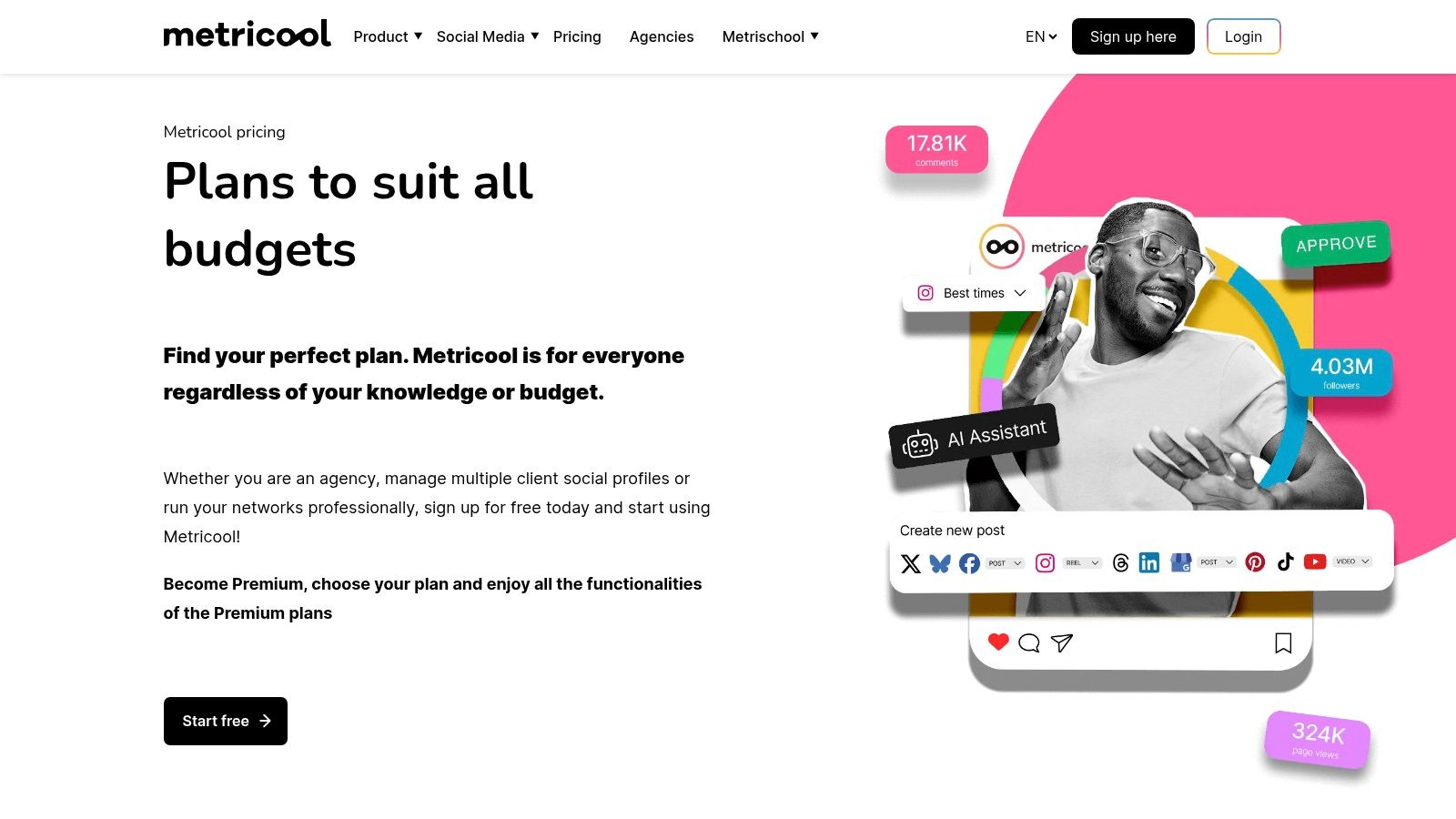
Metricool is a powerful all-in-one platform that extends beyond standard scheduling to offer robust analytics, competitor tracking, and ad management. It positions itself as one of the best social media scheduling tools for data-driven marketers and agencies who need to manage multiple "brands" under a single account, with pricing structured around this model.

The platform excels at providing a holistic view of your digital presence, integrating social media performance with website analytics and online ad campaigns. Its free plan is generous for a single brand, making it an excellent entry point for solo entrepreneurs or small businesses. For agencies, the brand-based pricing offers a scalable and predictable way to manage client accounts, providing each with its own dedicated workspace, analytics, and reporting.

Metricool

Standout Features

  • Comprehensive Analytics: Go beyond basic metrics with in-depth reporting, competitor analysis, and hashtag tracking to inform your strategy.
  • Ads Integration: Manage and analyze Facebook, Instagram, and Google Ads campaigns directly within the Metricool dashboard.
  • Brand-Based Workspaces: Each brand gets its own calendar, analytics, and settings, which is ideal for agencies managing multiple clients.
  • Looker Studio & API Access: Higher-tier plans offer integrations with Looker Studio (formerly Google Data Studio), Zapier, and API access for custom reporting and automation workflows.
Best For Limitations
Agencies managing multiple client brands X (formerly Twitter) data requires a paid add-on due to API costs.
Data-driven marketers needing deep analytics Lacks advanced features like recurring post recycling or a built-in ideas calendar.
Businesses running paid social and Google Ads The free plan has limitations on LinkedIn and X, pushing users toward paid tiers.

Website: https://metricool.com/pricing/

12. G2

While not a scheduling tool itself, G2 is an essential resource in the selection process, making it a worthy inclusion in any list of the best social media scheduling tools. It’s a massive software marketplace featuring thousands of verified user reviews, detailed feature comparisons, and pricing snapshots. For teams performing due diligence, G2 provides the crowd-sourced data needed to shortlist vendors and validate marketing claims.

Instead of relying solely on a vendor’s website, you can use G2 to compare platforms side-by-side based on real user feedback. The platform’s grid reports and user satisfaction ratings are invaluable for understanding how a tool performs in the real world. This is particularly useful for comparing the robust, unlimited account offerings of a tool like OneUp against competitors with more restrictive, per-channel pricing models.

Standout Features

  • Verified User Reviews: Access thousands of in-depth reviews from real users, filterable by company size and role, to gauge genuine product satisfaction.
  • Side-by-Side Comparisons: Directly compare features, pricing, and user ratings for multiple social media management tools in a clear, structured format.
  • Grid Reports: Visual reports that plot vendors based on market presence and user satisfaction, helping you quickly identify industry leaders and high-performers.
  • Pricing and Deals: Many listings include pricing information and links to free trials or exclusive deals, streamlining the initial procurement steps.
Best For Limitations
Teams shortlisting and comparing vendors Review quality can vary, and some entries lack sufficient detail.
Validating features before a purchase Promoted listings can sometimes influence search result placement.
Finding alternatives to current software Full access to some comparison data and reports may require a free user account.

Website: https://www.g2.com/categories/social-media-management

Top 12 Social Media Scheduling Tools Comparison

Product Core features ✨ UX & Ratings ★ Pricing & Value 💰 Target audience & USP 👥
OneUp 🏆 Unlimited accounts/posts/analytics/inbox/team; recycle scheduling; Reels/Stories/Carousels; Canva, bulk upload, AI Unified inbox, mobile & API; post-level analytics; ★★★★☆ (≈4.8/5) Fixed unlimited plan — predictable scaling 💰 Agencies, SMBs, creators — enterprise features without per‑profile fees 🏆
Buffer Queue-based scheduling, AI assistant, hashtag manager, strong mobile apps ✨ Straightforward UX; excellent mobile support; ★★★★ Per-channel pricing; generous free plan (3 channels) 💰 Freelancers & SMBs — transparent pricing, creator-friendly 👥
Hootsuite Scheduling, unified inbox, listening, deep analytics ✨ Mature platform with strong analytics; ★★★★ Higher entry price; enterprise tiers 💰 Teams → Enterprise — scalable workflows & benchmarking 👥
Sprout Social Robust publishing, advanced reporting, team workflows ✨ Premium UX; standout analytics & reporting; ★★★★☆ Per-seat pricing; costly at scale 💰 Teams & enterprises — best-in-class reporting & collaboration 👥
Later Visual planner, IG/TikTok auto-publish, link-in-bio, approvals ✨ Visual-first UI; easy content layout; ★★★★ Tiered plans with post caps on lower tiers 💰 Visually-driven brands & creators — visual planning UX 👥
Agorapulse Unlimited scheduling, inbox automation, bulk publishing, reporting ✨ Powerful inbox & reporting; team workflows; ★★★★ Per-user pricing with add-ons; clear model 💰 Agencies & teams — strong inbox + reporting 👥
SocialPilot White-label reporting, bulk scheduling, large account allowances ✨ Budget-friendly UX; solid for agencies; ★★★★ Agency-focused pricing; good value for teams 💰 Agencies & small teams — white-label & cost-effective 👥
Sendible Client dashboards, approvals, white-label, AI content assist ✨ Agency-centric UI; good onboarding; ★★★★ Bundled user+profile pricing; limited entry plan 💰 Agencies/multi-client teams — client collaboration & white-label 👥
Loomly Calendar-first scheduling, asset library, approval flows ✨ Intuitive planning & approvals; ★★★★ Monthly/annual billing; trial available 💰 Brands & agencies — easy approvals & calendar UX 👥
CoSchedule (Social Calendar) Drag-and-drop marketing calendar, best-time publishing, AI templates ✨ Tight calendar UX for planning; ★★★★ Affordable entry plan; some features gated 💰 Teams wanting social + content planning in one view 👥
Metricool Scheduling, reporting, competitor tracking, ads & Looker Studio integration ✨ Strong analytics and integrations; ★★★★ Priced per brand; free plan for 1 brand 💰 Multi-brand managers & advertisers — ads + competitor tracking 👥
G2 Filterable reviews, vendor comparisons, pricing snapshots ✨ Helpful for shortlisting; crowd‑sourced feedback; ★★★★ Free to use (some details require sign-in) 💰 Buyers & researchers — discover and compare vendors 👥

Final Thoughts

Navigating the crowded landscape of social media scheduling tools can feel overwhelming, but the right platform is a transformative asset for any marketer. As we’ve explored, the "best" tool isn't a one-size-fits-all solution; it's the one that aligns perfectly with your specific workflow, team size, budget, and strategic goals. The key is to move beyond surface-level features and assess which platform truly solves your most pressing social media management challenges.

From enterprise-grade solutions like Sprout Social and Hootsuite with their extensive analytics and team collaboration features, to visually-focused platforms like Later and Loomly that excel in content planning, each tool we've covered carves out its own niche. Your decision hinges on identifying your primary need. Are you a data-driven agency requiring robust reporting, or a solo creator who needs an intuitive visual planner? Answering this question is your first and most critical step.

Key Takeaways and How to Choose Your Tool

Selecting the right social media scheduling tool requires a clear understanding of your operational needs. Here are the core factors to guide your decision-making process:

  • Scalability and Pricing: How many social accounts and users do you need to support now versus in six months? Platforms with restrictive user or account limits can quickly become costly hurdles. This is where tools offering unlimited accounts, like OneUp, present a significant long-term value proposition, especially for agencies or businesses managing multiple brands.
  • Workflow Efficiency: Consider features that actively save you time. Does the tool support content recycling for evergreen posts? Can you schedule a single post to multiple networks simultaneously, complete with custom-tailored text and images for each platform? Features like automated post recycling and cross-network scheduling are not just conveniences; they are strategic time-savers.
  • Collaboration and Approval: For teams, a streamlined approval process is non-negotiable. Look for tools that offer clear approval workflows, allowing you to assign roles, review drafts, and provide feedback internally or with clients before anything goes live. This prevents errors and ensures brand consistency.
  • Engagement and Analytics: Scheduling is only half the battle. A truly effective tool must also help you manage engagement and measure performance. A unified social inbox to handle comments and messages, combined with clear analytics, closes the loop, turning your scheduling efforts into a measurable growth engine. For more in-depth articles and discussions on social media trends and marketing strategies, we recommend checking out branditok's blog.

Your Actionable Next Steps

Before you commit, take these final steps to ensure you've found the perfect match:

  1. Shortlist Your Top 3: Based on our review, select three tools that seem to fit your budget and primary use case.
  2. Sign Up for Free Trials: Nearly every platform offers a trial period. Use this time to actively test the features that matter most to you. Connect your accounts, schedule a week's worth of content, and test the approval workflow if you have a team.
  3. Evaluate the User Experience: Is the interface intuitive? Can you easily find the features you need? A complicated dashboard can negate any time-saving benefits the tool promises.
  4. Consider Long-Term Value: Don't just look at the entry-level price. Evaluate what you get for your money. A tool like OneUp, with its commitment to unlimited social accounts, unlimited team members, and a transparent pricing model, is built for growth, ensuring you won't be penalized for your success.

Ultimately, the best social media scheduling tools empower you to be more strategic, consistent, and efficient. By automating the manual tasks, they free you up to focus on what truly matters: creating authentic connections and building a thriving community around your brand.


Ready to experience a scheduling tool designed for unlimited growth? OneUp provides all the powerful features discussed-including unlimited accounts, post recycling, a unified social inbox, and robust approval workflows-at a price that makes sense for agencies, SMBs, and creators. Start your free trial of OneUp today and see how effortless social media management can be.

Reels vs Post Instagram Which Is Better for Growth

When you're staring at the Instagram app, deciding between a Reel or a feed post, the choice boils down to a pretty simple question: are you trying to meet new people or have a deeper conversation with the friends you already have?

That's the core of it. Reels are your ticket to discovery and broad reach, while feed posts are all about nurturing your existing community. Your strategy hinges entirely on whether you’re aiming to attract a wave of new followers or strengthen the bond with your current ones.

The Definitive Answer to Instagram Reels vs Posts

Smartphone displaying Instagram Reels interface on wooden desk with text overlay comparing Reels versus Posts

Getting a handle on the strategic job of each format is the first step to really getting Instagram to work for you. Reels are short, snappy vertical videos built for quick, entertaining hits. The Instagram algorithm is designed to aggressively push them out to people who don't follow you, making them your single most powerful tool for top-of-funnel brand awareness.

On the flip side, your traditional feed posts—whether it’s a stunning single image or a detailed multi-slide carousel—are primarily served to your followers. Their main job is to provide real value, build trust, and spark deeper engagement like comments, shares, and especially those valuable saves.

Think of it this way: Reels are your brand's flashy billboard on a busy highway, while feed posts are the in-depth, valuable newsletter you send to your loyal subscribers.

Quick Comparison Reels vs Feed Posts

To really spell it out, let's break down the fundamental differences. This quick-glance table should help you decide which format fits your immediate goal.

Feature Instagram Reels Instagram Feed Posts (Image/Carousel)
Primary Goal Attracting new audiences, maximizing reach. Engaging and nurturing your existing followers.
Algorithmic Priority Discovery; heavily promoted to non-followers. Community; shown mostly to current followers.
Content Format Short-form vertical video (up to 90 seconds). Static images or multi-slide carousels.
Ideal For Trends, behind-the-scenes, quick tips, UGC. In-depth tutorials, announcements, high-quality photos.
Key Metrics Reach, Views, Rewatches. Engagement Rate, Saves, Comments.
Lifespan Can go viral weeks or even months after posting. Longevity depends on strong initial engagement.

Ultimately, a winning Instagram strategy doesn't force a choice between one or the other; it blends both. You use Reels to draw people in, and you use Posts to convince them to stay.

Juggling this kind of balanced approach can get chaotic without the right tools. With a platform like OneUp, you can map out your entire content calendar visually, scheduling your reach-focused Reels and your community-building Posts right from one place.

OneUp lets you schedule Reels directly to Instagram, complete with a custom cover image and even an automated first comment for your hashtags. For your more detailed feed content, you can easily schedule multi-image carousels and videos. This makes sure your content mix is strategically balanced, saving you a ton of time and helping you stay consistent without ever sacrificing quality. The most effective brands don't just post content—they orchestrate a complete audience journey.

How the Instagram Algorithm Treats Each Format

To really get the difference in performance between Reels and standard feed posts, you have to look under the hood at how Instagram’s algorithm treats them. It’s not one single system running the show; Instagram uses different algorithms tailored to how we actually use different parts of the app. That means your Reel and your feed post are being judged on completely different criteria from the moment you hit "Publish."

Think of the Reels algorithm as a pure discovery engine. Its main job is to find videos that hook viewers and keep them watching, then blast that content out to a huge audience of people who don't follow you. It's all about entertainment value and re-watchability.

The algorithm for feed posts, on the other hand, is more of a community-nurturing tool. It’s designed to show your content to the people who already know and like you—your followers. Success here is measured by the immediate interaction your post gets from this core group.

The Algorithmic Signals for Reels

When you post a Reel, Instagram’s system is watching for very specific user behaviors to decide if it's a winner. These signals are all about consumption and retention.

Here’s what it’s looking for:

  • Watch Time: This is the big one. Did someone watch your entire Reel? A full watch is a massive green light for the algorithm.
  • Re-watches: Even better. Did they loop it and watch it again? A re-watch tells Instagram your content is seriously engaging.
  • Audio Usage: Using trending audio is like a cheat code. The algorithm often gives a little extra juice to content that jumps on popular sounds and music.
  • Interactions: While likes and comments are good, the algorithm loves shares and saves. These actions show that your content is so good, people want to send it to friends or come back to it later.

The algorithm's only goal is to keep people scrolling through the Reels feed for as long as humanly possible. If your content helps Instagram do that, you get rewarded with massive reach that can go way beyond your follower count.

How Feed Posts Are Evaluated

The system for feed posts—your single images and carousels—works in a much more intimate setting. It’s almost entirely focused on how your existing followers react within the first few hours of posting.

Key Takeaway: For feed posts, the speed of early engagement is everything. A post that racks up likes, comments, shares, and saves quickly from your followers has a much better shot at being shown to more of your audience and maybe even landing on the Explore page.

The signals that matter most here are different from Reels. The algorithm is weighing:

  • Comment Velocity: How many comments did you get right after you posted? Quick conversation is a huge positive signal.
  • Saves: How many people saved your post to a collection? This tells the algorithm you've created valuable, evergreen content.
  • Shares: Are people sending your post in DMs or sharing it to their Stories? That means your content is sparking conversations.
  • Time Spent Viewing: For carousels, how long did users stick around to swipe through all the slides?

This is exactly why a smart hashtag strategy is still so important for feed posts. Using an Instagram hashtag generator can help your existing community discover and engage with your content. The algorithm for posts isn't trying to make you go viral; it's trying to validate that your content is valuable to the community you've already built.

This split explains what we’re all seeing on the platform today. Instagram Reels have taken over, completely changing user behavior. In fact, Reels now make up approximately 38.5% of all Instagram feed posts, and users are spending about 50% of their time on the app watching them. Instagram is clearly pushing this format for discovery, making it an incredibly powerful tool for growth. You can explore more on these Reel trends at Awisee.com. Understanding these two different algorithmic paths is the first step to building a content strategy that makes both formats work for you.

Analyzing Performance Data: Reels vs. Posts

If the algorithm explains the "why," then the raw performance data shows you the "what." When you put the numbers side-by-side, a pretty clear story emerges about where each format shines in the ongoing reels vs post instagram debate. Put simply, if you want to get your brand in front of as many new people as possible, Reels are in a completely different ballpark.

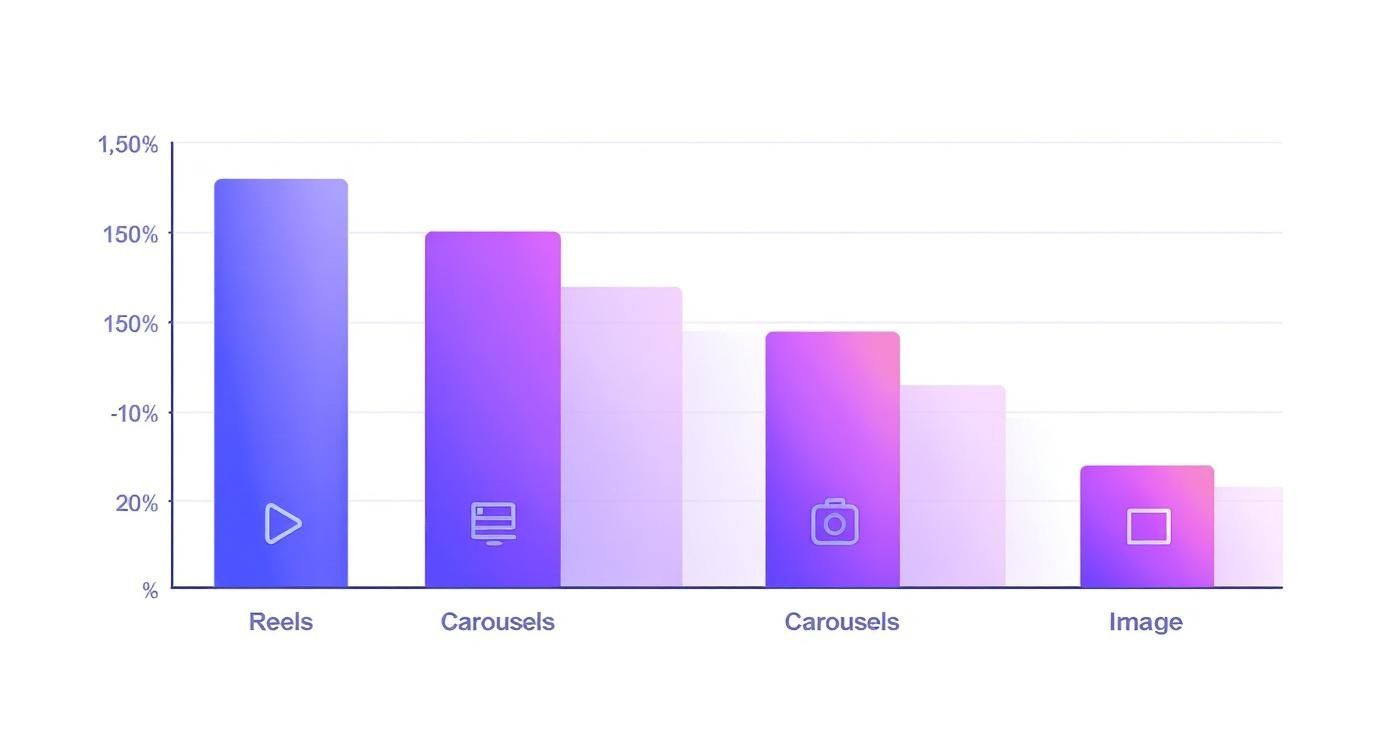
This chart drives the point home, visualizing the massive advantage Reels have in reaching new audiences compared to carousels and static images.

Bar chart comparing engagement rates for Instagram Reels, Carousels, and Image posts with performance metrics

The numbers here don't lie. Reels are the undisputed champion for discovery, blowing other post types out of the water when it comes to pure audience reach.

The performance gap isn't just a slight edge; it's a chasm that reflects how people are actually using the app now. Instagram Reels pull in an average engagement rate of 1.23%, which is comfortably ahead of carousels at 0.99% and static photos at a distant 0.70%.

But the real showstopper is the reach rate. Reels boast an average reach rate of 30.81%—that's more than double the reach of both carousels (14.45%) and static images (13.14%). This data makes it crystal clear: Reels are your go-to tool for top-of-funnel marketing.

To really nail down your strategy, it helps to see the key metrics broken down in one place.

Performance Metrics Reels vs Posts

This table provides a quick statistical look at how Instagram Reels stack up against static images and carousels across the most important performance indicators.

Metric Instagram Reels Carousel Posts Static Image Posts
Average Reach Rate ~30.81% ~14.45% ~13.14%
Average Engagement Rate ~1.23% ~0.99% ~0.70%
Primary Strength Discovery & Awareness Education & Authority Quick Visual Impact
Best For Reaching non-followers Nurturing followers Announcements, aesthetics

The data shows a clear pattern: Reels excel at broad reach, while carousels and static images play a more focused role in engaging your existing audience.

Breaking Down What The KPIs Actually Mean

Making smart decisions means looking past the vanity numbers and understanding what each metric really says about your business goals. Different KPIs tell different stories.

  • Reach: This is the total number of unique accounts that saw your post. Reels dominate here because they get pushed hard in the Reels tab and Explore page, making them perfect for brand awareness.
  • Engagement Rate: This is your (likes + comments + shares + saves) / followers. It shows how much your content resonates with the people who see it. While Reels have a higher overall rate, carousels often get more meaningful engagement.
  • Saves: A save is a powerful signal of value. When someone saves your post, they're bookmarking it for later, telling the algorithm you’ve created high-quality, useful content.
  • Shares: Think of shares as digital word-of-mouth. This is your ticket to virality, as it directly pushes your content to new, untapped audiences.

How to Use This Data in Your Strategy

The numbers are pretty clear: Reels are your growth engine, while static posts—especially carousels—are your community builders. Think about it. The high 'save' rate you often see on detailed, multi-slide carousels makes them invaluable for positioning your brand as an authority and giving real value to your followers.

Data-Driven Insight: Don't ditch feed posts just because Reels have better reach. They're two sides of the same coin. Use the massive reach from Reels to pull in new followers, then use information-packed carousels to nurture them into a loyal community.

A smart content calendar uses both. A tool like OneUp lets you schedule your entire content mix, from Reels with viral potential to deep-dive carousels. Being able to bulk upload hundreds of posts at once and see them on a visual calendar makes it easy to maintain that strategic balance. You can even create and save different sets of hashtags—one for reach (Reels) and one for community (Posts)—to streamline your workflow.

Choosing the Right Format for Your Goals

Black sign displaying social media format options with reel, carousel, post and grid layout on desk

Picking between a Reel and a Post isn't just about what looks good; it’s a strategic move that needs to line up with your actual business goals. The secret to a killer content calendar is knowing exactly what job you're giving each piece of content. Are you trying to get in front of a ton of new people, or do you want to build a deeper connection with your existing community?

Your answer points directly to the right format. When it comes to the reels vs post instagram debate, think of it like this: Reels are your top-of-funnel megaphone, and Posts are your mid-funnel conversation starter. One grabs the crowd, the other builds the relationship.

A smart strategy uses both—but with clear intention. Every single thing you publish should have a purpose and push you closer to a bigger business objective. Let's break down which format to use for specific situations.

When to Use Instagram Reels for Maximum Impact

Reels are your ticket to grabbing attention, reaching new audiences, and showing off the dynamic, human side of your brand. The algorithm is literally built for discovery, which makes them the perfect tool for growth.

Go with Reels when your main goal is:

  • Brand Discovery and Reach: If you just need to get in front of as many new eyeballs as possible, Reels are a must. Jump on a trending audio challenge or create a funny, shareable clip that hits home in your industry.
  • Showcasing Products in Action: A static photo doesn't always do a product justice. Use a Reel to actually show how it works, highlight its best features in real-time, or reveal a satisfying before-and-after.
  • Humanizing Your Brand: Nothing builds trust like a peek behind the curtain. Quick clips of your team, a day-in-the-life video, or even some funny bloopers make your brand feel real and relatable.
  • Quick, Educational Tips: Short, snappy "how-to" videos or a list of three quick tips are perfect for the fast pace of Reels. They deliver instant value and get shared like crazy.

Keep in mind, especially if you're committing to video, the technical side of things matters. For example, understanding the ins and outs of optimizing your videos for Instagram Reels can make a huge difference in how your content looks and performs.

When to Use Instagram Posts for Deeper Engagement

Feed posts, especially carousels, are where you go deep. They're built for delivering detailed information, sparking conversation, and strengthening your community. This is your best bet for establishing authority and giving lasting value to the followers you already have.

Choose a Post when you want to:

  • Deliver In-Depth Education: A 10-slide carousel is the ideal format for a step-by-step tutorial, breaking down a complex idea, or walking through a detailed case study. This is the kind of content that gets saved, which is a huge signal to the algorithm that you're providing high-value stuff.
  • Share Testimonials and Social Proof: Use a carousel to string together multiple customer reviews, user-generated photos, or an in-depth client success story with quotes and results. It’s a powerful way to build credibility.
  • Run Promotions and Announce News: When you have important details to share about a sale, an event, or a company update, a static post or carousel makes sure the information is clear, easy to read, and simple to find later.
  • Build a Strong Brand Aesthetic: High-quality single images are still the backbone of a polished, professional-looking Instagram grid. They instantly communicate your brand's identity and vibe.

Strategic Insight: The real magic happens when you pair the two formats. Drop a Reel to hook people with a quick, engaging idea, then point them to a detailed carousel post to learn more.

Writing strong captions for these detailed posts is critical. The right words can stop a scroll and turn a casual viewer into an engaged follower. If you need a hand, a dedicated Instagram caption generator can help you craft compelling copy that gets people talking.

At the end of the day, when you match your content format to a clear goal, you stop posting randomly and start building a real, powerful presence on Instagram.

Executing Your Instagram Strategy with OneUp

Knowing when to use a Reel versus a standard feed post is half the battle. The other half? Actually executing that strategy consistently. This is where the real work begins, and where a solid scheduling tool becomes a non-negotiable part of your workflow. OneUp is designed to turn your content plan from a bunch of ideas into a streamlined, automated machine.

Instead of being glued to your phone, manually posting every single day, you can build out a content calendar that strikes the perfect balance between reach-hungry Reels and community-focused feed posts. This keeps your brand consistently visible without the constant stress of real-time publishing. The right system frees you up to do what matters most: create awesome content.

Here’s a look at the simple, clean interface you’ll use inside OneUp to schedule everything out.

Everything you need—from writing the caption and choosing your networks to setting the schedule—is all in one spot.

Streamlining Your Reels and Posts Workflow

OneUp is built with specific features to make managing both formats a breeze. For Reels, you can schedule them to post directly to Instagram. This is a huge time-saver, ensuring you hit those peak engagement windows without fail. Better yet, you can upload a custom cover image and even schedule an automated first comment—a killer tactic for moving your block of hashtags out of the main caption to keep it clean.

The features for feed posts are just as robust. You can schedule single-image posts, intricate carousels, and videos without a hitch. This is especially handy for those deep-dive, educational carousels that do so much to build trust with your audience. Planning these more complex posts in advance is an absolute game-changer for maintaining content quality.

OneUp Pro Tip: Put your best evergreen content on autopilot with the repeating post feature. Got a high-performing educational carousel? Schedule it to republish every few months to catch new followers and drive home your key messages. It's the easiest way to maximize the value of content you've already created.

Advanced Features for a Cohesive Strategy

A smart Instagram strategy doesn’t live on an island. OneUp gets this, which is why it lets you post to multiple social networks at once. That killer Reel you just edited can be scheduled to Instagram, TikTok, and Facebook all at the same time, tripling its potential reach with zero extra work. You can even use an AI TikTok video generator to create engaging short-form videos that can be repurposed as Reels, feeding your content engine across platforms.

Collaboration is another area where a good tool makes all the difference. If you’re part of a team or need to get client approval, you can manage post approvals directly within the platform. No more messy email chains or missed feedback. For agencies or brands pumping out a ton of content, the ability to bulk upload hundreds of posts at a time via CSV is an absolute lifesaver.

  • Content Calendar Visualization: Get a bird's-eye view of your entire content mix—Reels, Posts, and Stories—on one visual calendar. This makes it super easy to spot gaps and ensure you’re maintaining a healthy balance.
  • Unlimited Accounts: Many tools nickel-and-dime you for every account you add. OneUp lets you connect and manage an unlimited number of social accounts on a single plan, perfect for agencies or businesses with multiple brand profiles.
  • Unified Social Inbox: Stop jumping between apps to answer comments. You can manage DMs and comments from all your connected accounts in one central inbox, ensuring you never miss a chance to engage.

Planning Your Grid for Visual Impact

Your Instagram grid is your brand’s digital storefront. A messy, disorganized grid can instantly turn off potential followers. OneUp helps you keep it looking sharp.

You can map out your feed with OneUp's Instagram grid planner to see exactly how your scheduled posts will look next to each other. This kind of visual planning is crucial for making sure your static posts and Reel covers come together to create a cohesive, attractive profile that convinces visitors to hit that "Follow" button.

Burning Questions: Your Instagram Reels vs. Posts FAQ

When you get down into the nitty-gritty of planning your Instagram content, the same questions always seem to pop up. It's not always black and white, and getting the small details right can be the difference between a post that flops and one that flies. Here are some straight answers to the most common questions we see from people in the trenches.

We'll cover everything from repurposing content and hashtag quirks to video length and whether static posts even matter anymore in a Reel-first world.

Can I Post the Same Content as a Reel and a Post?

Technically, yes, but you really, really shouldn't. It's a strategy that almost always backfires. Instagram's algorithm is built to reward content that's native to each format. If you post the exact same video clip as a Reel and then again as a standard feed post, you risk boring your audience and getting flagged for duplicative content, which can throttle your reach.

A much smarter play is to repurpose the concept, not the content. For example, film a punchy Reel showing off three quick ways to use your product. Then, build out a detailed carousel post that explains the why behind each tip, using high-quality images, text overlays, and graphics. This gives unique value in both places, satisfying the quick scrollers and the deep divers in your audience.

How Do Hashtags Work Differently for Reels and Posts?

Your hashtag game needs to change completely depending on the format. For Reels, think of hashtags as your primary discovery engine. They are absolutely vital for helping Instagram figure out what your video is about and who to show it to on the Reels tab and Explore page. Your goal is maximum exposure, so a mix of broad, niche, and trending hashtags is the way to go.

With feed posts, hashtags still help with discovery, but they also act as an organizing tool for your existing followers. Since posts have a much longer shelf life on the main feed, the right hashtags can keep driving engagement for days or weeks from people searching for specific topics within your community.

A huge time-saver here is using a scheduler like OneUp to create and save categorized hashtag sets. You can build out an optimized group for Reel discovery and another for community-focused Posts, then pop them in with a single click.

What Is the Ideal Length for an Instagram Reel?

Even though Instagram lets you create Reels up to 90 seconds long, the data is crystal clear: shorter is almost always better. The sweet spot for getting the best engagement is usually somewhere between 7 and 15 seconds. The algorithm wants to see content that people watch all the way through—or even better, watch on a loop. Short, snappy videos are just far more likely to make that happen.

If you're creating educational or story-driven content that needs a bit more time, your first three seconds are everything. You have to land an immediate, scroll-stopping hook that makes people need to see what happens next. Always favor tight, high-impact storytelling over just filling the maximum time.

Should I Stop Creating Static Posts if Reels Get More Reach?

Absolutely not. This is probably the biggest mistake people make when thinking about the "reels vs post instagram" debate. Yes, Reels are the undisputed king for top-of-funnel reach and bringing in new eyeballs. But static posts and carousels are what you need to nurture the community you already have.

Think of it like this:

  • Reels are the handshake: They introduce your brand to a massive new audience.
  • Posts are the conversation: They provide the value and substance that turns followers into loyal fans.

High-quality carousels are perfect for in-depth tutorials, sharing glowing client testimonials, making big company announcements, or doing a deep dive into product features. These formats often rack up an incredible number of "saves," which is one of the most powerful signals you can send the algorithm. The most successful brands on Instagram don't pick one format over the other—they have a masterful blend of reach-grabbing Reels and community-building Posts firing on all cylinders.


Ready to stop guessing and build a powerful, balanced Instagram strategy? OneUp gives you all the tools you need to schedule your Reels, carousels, and posts in one place. Plan your content calendar, automate your first comments, manage approvals, and see exactly how your grid will look before you publish. Start your free trial of OneUp today and take control of your Instagram workflow.

A Guide to Google Analytics UTM Parameters

At their core, Google Analytics UTM parameters are just short bits of text you tack onto the end of a URL. These simple tags are incredibly powerful, though. They tell Google Analytics exactly where your website visitors came from and which specific ad, post, or link they clicked to get there.

If you're serious about measuring marketing ROI, they're non-negotiable.

Understanding Your Campaign Traffic DNA

Campaign DNA search bar on wooden desk with laptop, notebook, and pens for tracking marketing parameters

Ever stare at your analytics, scratching your head, wondering which specific Facebook post or email link actually drove that sale? Without proper tracking, your campaign data is a black box. You're left guessing which efforts are paying off and which are just wasting money.

This is exactly the problem Google Analytics UTM parameters solve.

Think of UTM parameters as the DNA of your campaign traffic. They're tiny snippets of code added to your URLs that act like descriptive labels, telling Google Analytics a detailed story about every single click. By using them consistently, you can finally move beyond vague traffic sources like "direct" or a generic "social" and pinpoint where your visitors are really coming from.

The Anatomy of a UTM Tagged URL

A URL with UTM parameters has two main parts: the page you're sending people to (the base URL) and the tracking tags that follow a question mark (?). Each individual tag is a "key-value pair," and they're all separated by an ampersand (&).

It's simpler than it sounds. For instance, a normal link might look like this:
https://www.yourwebsite.com/summer-sale

Now, here's that same link with UTMs tacked on:
https://www.yourwebsite.com/summer-sale?utm_source=facebook&utm_medium=social&utm_campaign=summer-sale-2024

See the difference? The second URL is packed with juicy data that Google Analytics can read and organize. It instantly attributes this click to the "summer-sale-2024" campaign running on the "social" channel, specifically from "facebook".

Key Takeaway: Using UTM parameters transforms your URLs from simple links into smart data collectors. This lets you accurately measure campaign performance, justify your marketing spend, and make much smarter decisions about where to put your budget next.

UTM parameters have been around since the early days of Google Analytics (back when it was called Urchin). The three most important tags—utm_source, utm_medium, and utm_campaign—are the bare minimum you need for clean data. Using them consistently is one of the best ways to improve the accuracy of your analytics, as explained by the pros at Analytics Mates.

The Five Core UTM Parameters Explained

While you can get by with just three, there are five standard UTM parameters that give you the full picture. Getting a handle on each one is the first step to building a rock-solid tracking system.

Here's a quick cheat sheet for what each parameter does and what it looks like in practice.

Parameter Purpose Example
utm_source Identifies where the traffic came from—the specific platform or referrer. google, facebook, newsletter
utm_medium Explains how the traffic got to you—the marketing channel. cpc, social, email
utm_campaign Names the specific promotion or strategic initiative. summer-sale, q4-product-launch
utm_term Tracks specific keywords in paid search or identifies an ad's audience. running-shoes, small-business-owners
utm_content Differentiates between links pointing to the same URL, like two different ads. blue-banner-ad, video-ad

Mastering these five components is the foundation for turning raw click data into marketing intelligence you can actually use.

Building a Bulletproof UTM Naming Framework

Let's be honest, without a solid framework, your Google Analytics UTM parameters will quickly turn into a hot mess. One person uses Facebook, another uses facebook, and suddenly your data is fragmented, chaotic, and almost impossible to analyze. It's like trying to find a specific book in a library with no filing system—you know the info is in there somewhere, but good luck finding it.

A bulletproof naming framework is your single most valuable asset for clean, reliable analytics. It gets everyone on your team, from the marketing intern to the CMO, tagging URLs the exact same way, every single time. This consistency is the secret sauce to unlocking clear, actionable insights from your campaigns.

Core Principles of Clean UTM Tagging

Before you even think about templates, you need to lay down some ground rules. These are the non-negotiables that will save you from the most common data-corrupting mistakes.

  • Always Use Lowercase: This is a big one. Google Analytics is case-sensitive, which means it sees Facebook, facebook, and FaceBook as three different traffic sources. Make "lowercase only" a strict rule for all UTM values. It keeps everything neat and tidy.
  • Use Underscores or Hyphens, Not Spaces: URLs can't have spaces. While some browsers automatically convert a space to that ugly %20, it's just messy. Stick to underscores (_) or hyphens (-) to separate words, like summer_sale_2024. It looks professional and keeps things clean.
  • Keep It Simple and Descriptive: Your UTMs should tell a story at a glance. Avoid weird abbreviations or super long names that get cut off in your reports. The goal here is clarity, not complexity.

A consistent UTM naming convention isn’t just about being organized—it's about ensuring data integrity. Dirty data leads to flawed analysis and poor marketing decisions. Clean, standardized data is the foundation of a successful, data-driven strategy.

Documenting Your Framework for Team-Wide Consistency

This amazing framework you're building is useless if it only lives in your head. The real key to making this work long-term is documentation.

Create a shared spreadsheet (a Google Sheet is perfect for this) that becomes the single source of truth for anyone creating a UTM link.

Your sheet should clearly outline:

  1. The Naming Rules: List out the core principles like "lowercase only" and "use_underscores_for_spaces."
  2. Parameter Definitions: Explain exactly what each parameter (utm_source, utm_medium, etc.) means for your business.
  3. Approved Values: This is crucial. Use dropdowns or pre-approved lists for parameters like utm_source (e.g., facebook, linkedin, google) and utm_medium (e.g., social, cpc, email). This single step prevents most of the inconsistencies from ever happening.
  4. A Campaign Log: Keep a running list of all your campaign names, past and present. This helps you avoid duplicates and maintain consistency year after year.

This shared document empowers everyone on your team to build correct UTMs on their own, which means fewer errors and less time spent cleaning up data later.

This is where a social media scheduling tool like OneUp really shines, letting you create UTM presets to automate the process. OneUp is always adding features to make marketing easier, with recent updates including support for scheduling Instagram Carousels and Threads, a unified social inbox to manage conversations, and integrations with platforms like Bluesky and Giphy.

These improvements are a great example of how tools evolve based on what users actually need, whether it's adding new platforms or improving existing features—all to make managing content more efficient.

Real-World Naming Templates

To get you started, here are some practical templates you can adapt for your shared document. These cover some of the most common marketing channels.

For Organic Social Media Posts:

  • utm_source: facebook, linkedin, instagram, twitter
  • utm_medium: social
  • utm_campaign: [content_type]_[year] (e.g., blog_post_2024, webinar_promo_2024)
  • utm_content: [post_description] (e.g., 10_tips_for_seo, announcing_new_speaker)

For Paid Social Ad Campaigns:

  • utm_source: facebook, linkedin, tiktok
  • utm_medium: cpc (or paid_social)
  • utm_campaign: [product]_[objective]_[q#]_[year] (e.g., saas_demo_traffic_q3_2024)
  • utm_term: [audience_name] (e.g., marketing_managers_lookalike)
  • utm_content: [ad_creative_identifier] (e.g., blue_video_ad, testimonial_carousel_v1)

By setting up and documenting a logical framework, you turn your analytics from a cluttered mess into a powerful engine for making smart decisions. This kind of organization is especially important for teams managing tons of profiles, a key benefit you can find in OneUp's straightforward pricing plans, which offer options for unlimited accounts.

Applying UTMs Across Your Marketing Channels

Having a solid naming framework is great, but the real magic of UTM parameters happens when you apply them consistently in the real world. This is where theory meets practice, turning your rules into data points that show you exactly what’s working.

Let's get practical and walk through how to build your UTM-tagged URLs for some of the most common marketing scenarios you'll run into.

Tagging a Facebook Ad Campaign

Imagine you're running a campaign for a new feature, and you're targeting marketing managers. You want to test two different ad creatives to see which one drives more sign-ups: a video versus a carousel.

This is a perfect job for the utm_content parameter.

Here’s how you could structure the URLs for each ad:

  • Base URL: https://www.yourproduct.com/new-feature
  • utm_source: facebook (The platform where the ad is running)
  • utm_medium: cpc (To show it's paid traffic)
  • utm_campaign: new_feature_q3_2024 (Your specific marketing push)
  • utm_term: marketing_managers (The audience you're targeting)
  • utm_content: video_ad or carousel_ad (This is how you'll tell the two apart)

The final URL for your video ad would look like this:
https://www.yourproduct.com/new-feature?utm_source=facebook&utm_medium=cpc&utm_campaign=new_feature_q3_2024&utm_term=marketing_managers&utm_content=video_ad

By using utm_content to separate the creatives, you can hop into Google Analytics and directly compare the performance of video_ad against carousel_ad, all within the same campaign. Simple.

This image sums up the golden rules for keeping your UTMs clean and effective: use lowercase, separate words with underscores, and write everything down.

UTM Best Practices logo with stylized letters BFS in gradient blue and green colors

Nailing these basics is the first step toward building an analytics setup you can actually trust.

Tracking Your Weekly Email Newsletter

Email marketing is another place where UTMs are absolutely essential. Without them, traffic from your emails can get lumped into 'Direct' if people open them in certain apps, completely messing up your attribution. You have to tag every link.

Let's say you send out a weekly newsletter every Tuesday with a few different links inside.

Here’s a good template for a link pointing to a new blog post in that newsletter:

  • Base URL: https://www.yourblog.com/new-post
  • utm_source: newsletter (Identifies the specific source of traffic)
  • utm_medium: email (The marketing channel)
  • utm_campaign: weekly_digest_2024_08_20 (Names the specific email, including the date)
  • utm_content: main_cta_button (Differentiates this click from a text link in the footer, for example)

And here's your final tagged URL:
https://www.yourblog.com/new-post?utm_source=newsletter&utm_medium=email&utm_campaign=weekly_digest_2024_08_20&utm_content=main_cta_button

This level of detail lets you see not just which newsletter drove traffic, but exactly which links inside it got the most clicks. That's gold for optimizing your email layouts over time. For social media, you can achieve similar optimization by testing different messaging styles, maybe even using an AI-powered Instagram caption generator to mix things up.

By 2025, it's projected that nearly 90% of enterprises using Google Analytics 4 will depend on UTMs for their tracking. And for good reason—campaigns with proper tagging have seen up to a 30% improvement in the clarity of their conversion paths.

Bridging Offline and Online with QR Codes

UTMs aren't just for your digital campaigns. They’re fantastic for measuring the impact of offline marketing materials like flyers, posters, or business cards. Just link a QR code to a UTM-tagged URL, and you can finally track how many people engage with your physical marketing.

When you're deploying UTMs across different channels, it's worth thinking about the role of QR codes and URL parameters in driving marketing ROI, especially for connecting your offline and online worlds.

Imagine you're at a trade show with a flyer promoting a special offer.

  • Base URL: https://www.yourwebsite.com/tradeshow-offer
  • utm_source: flyer (The physical material)
  • utm_medium: offline (The channel category)
  • utm_campaign: marketing_summit_2024 (The specific event)

The URL you'd plug into your QR code generator would be:
https://www.yourwebsite.com/tradeshow-offer?utm_source=flyer&utm_medium=offline&utm_campaign=marketing_summit_2024

Now, when someone scans that QR code, Google Analytics will log a visit from the "marketing_summit_2024" campaign, attributed to an "offline" flyer. It’s a simple move that gives you hard data on something that's usually impossible to track.

For social media managers, automating this tagging process is a massive time-saver. A tool like OneUp can handle this for you, with features like scheduling repeating posts and auto-posting from an RSS feed, all while making sure every link is tagged correctly from the start.

Automating Your UTM Workflow With OneUp

Laptop displaying UTM tracking software interface on wooden desk with notebook and plant

Let's be honest: building UTM links by hand for every single social media post is a nightmare. It’s tedious, and it’s a recipe for human error. A forgotten parameter, a rogue capital letter, or a simple typo can completely splinter your data, making your analytics reports next to useless.

This is exactly why automation becomes less of a luxury and more of a necessity for any serious marketing team.

Ditching the spreadsheets and manual URL builders for a social media scheduling tool with built-in UTMs is a game-changer. It guarantees every link you share is perfectly tagged according to your rules, every single time.

How OneUp Streamlines UTM Tagging

OneUp bakes Google Analytics UTM parameters right into its scheduling workflow. What was once a mind-numbing manual task becomes a simple, set-it-and-forget-it process.

You can create custom UTM presets that automatically apply to any link you schedule. This means you define your source, medium, and campaign parameters once, and OneUp does the heavy lifting from there. It's a lifesaver for agencies or teams managing multiple brands, as each can have its own unique tracking setup ready to go.

OneUp also supports dynamic parameters, which is where the real magic happens. For example, you can set utm_source to dynamically pull the name of the social network you're posting to. A single scheduled post shared across Facebook, X, and LinkedIn will automatically get the correct source—facebook, twitter, linkedin—all from one setup.

Manual vs Automated UTM Tagging with OneUp

The difference between wrestling with UTMs manually and letting a tool handle it is night and day. One requires constant double-checking, while the other just works.

Take a look at how they stack up.

Feature Manual Tagging Automated with OneUp
Consistency Prone to human error, typos, and inconsistent naming conventions. 100% consistent based on predefined presets and dynamic fields.
Time Investment Requires manually creating a unique URL for every post on every platform. Set up once and applies automatically to all scheduled posts.
Scalability Becomes nearly impossible to manage with high post volume or multiple clients. Effortlessly scales across unlimited accounts and posts without extra work.
Accuracy High risk of fragmented data in Google Analytics due to small mistakes. Guarantees clean, reliable data for accurate campaign reporting.

Ultimately, adopting an automated system like OneUp isn't just about clawing back a few hours. It’s about building a foundation of trustworthy data you can actually use to make smart marketing decisions.

Beyond UTMs: A Complete Content Workflow

The real power kicks in when your UTM automation is part of a bigger, more efficient content system. OneUp pulls this off by integrating it across the entire scheduling process.

Picture this workflow:

  1. Design and Create: You design your post visuals right inside OneUp using its Canva integration. No more downloading and re-uploading files.
  2. Organize and Schedule: You assign the post to a content category to keep your feed balanced, then schedule it across Facebook, Instagram, and your Google Business Profiles.
  3. Automate and Repeat: If it’s an evergreen piece, you can set it as a repeating post to republish at set intervals—each time with fresh, accurate UTM tags automatically applied.

The best part? Your UTMs are applied behind the scenes throughout this entire process based on your presets. You can even use the bulk post uploader to schedule hundreds of posts from a CSV file, and OneUp will tag every single link perfectly.

By integrating UTM tagging directly into the content creation and scheduling process, you eliminate the risk of untracked links. This ensures every piece of content you publish contributes clean, actionable data to your analytics.

This seamless flow changes everything. Instead of juggling a design app, a URL builder, a spreadsheet, and a scheduler, you manage it all from one place. For any business looking to scale its social media efficiently, checking out a unified tool like OneUp is the next logical step. From its AI caption writer to the unified social inbox, it’s built to make a social media manager’s life easier.

Analyzing Campaign Data in Google Analytics 4

Alright, you've put in the work. You've consistently tagged your URLs with Google Analytics UTM parameters, built a solid naming framework, and now it's time for the payoff. All that meticulous tagging is about to translate into clear, actionable data right inside Google Analytics 4 (GA4).

This is where you get to see which campaigns are actually hitting the mark and which ones are just wasting clicks. The hard part is over; now you just need to know where to look.

Where to Find Your Campaign Data in GA4

Your home base for all things UTM in GA4 is the Acquisition section. This is Google’s hub for showing you how people are finding your website.

To get there, just navigate to Reports > Acquisition > Traffic acquisition. When you first land on this report, it groups traffic by the Session default channel group, which gives you a pretty broad overview. To see your specific UTMs at work, you'll need to switch up the primary dimension.

Click the little dropdown arrow at the top of the first column and find Session campaign. Boom. The report instantly reshuffles to show you the performance data for every unique utm_campaign you've created. Now you can see exactly which campaigns are driving the most sessions, new users, and, most importantly, conversions.

Digging Deeper with Secondary Dimensions

Seeing the campaign-level data is great, but the real magic happens when you start layering in more detail. What if you want to know which specific social media post from your big summer sale campaign did the best? Or which ad creative drove the most revenue?

That’s where secondary dimensions come in.

While you're looking at your campaign data, click the small blue plus sign (+) next to the primary dimension column. This opens up a menu where you can add another layer of data to your report.

For some seriously granular insights, try adding these:

  • Session source / medium: This breaks down your traffic by platform (e.g., facebook / cpc) for each individual campaign.
  • Session manual ad content: This pulls in your utm_content values, which is perfect for comparing A/B tests on ad copy or images.
  • Session manual term: This shows your utm_term data, super useful for analyzing specific paid search keywords or ad set audiences.

By adding Session manual ad content as a secondary dimension, for example, you can directly compare how blue_banner_ad performed against video_ad within your summer_sale_2024 campaign. No more guessing.

Building Custom Exploration Reports

The standard reports are a fantastic starting point, but if you really want to customize your view, you need to head over to the Explore section. This is GA4's sandbox, where you can build reports from the ground up to visualize the exact metrics your business cares about.

Go to the Explore tab and start a new Free form exploration. From here, you can drag and drop dimensions (like Session campaign, Session source, or Session manual term) and metrics (like Conversions, Total revenue, or Engagement rate) to build a dashboard that's tailored perfectly to your needs.

By mastering GA4's Traffic acquisition and Explore reports, you transform your UTM tags from simple text snippets into a powerful lens for understanding your marketing ROI. You can confidently answer questions about which channels, campaigns, and creatives are truly driving growth.

And while you're analyzing data in GA4, remember that a broader perspective on B2B marketing analytics can help connect the dots. Integrating this data with insights from other platforms gives you a much more holistic view of the entire customer journey, from the first click to the final sale.

Common UTM Questions Answered

Even with a solid framework, you're bound to run into some tricky situations with Google Analytics UTM parameters. Getting these little details right is what separates clean, trustworthy data from a reporting nightmare. Let’s clear up a few of the most common questions marketers have.

Think of these as the quick answers that'll help you dodge the usual mistakes and keep your campaign tracking accurate from the get-go.

What Happens If I Forget to Use UTMs?

If you share a link without UTMs, you're leaving it up to Google Analytics to guess where your traffic came from. A click from a Facebook post might just show up as facebook.com / referral. That's not terrible, but you lose all the juicy, campaign-specific details.

Even worse, if someone copies that raw link and shares it in an email or a direct message, that traffic will likely get mislabeled as Direct. Poof. It’s like your campaign never even existed in your analytics.

Forgetting UTMs is like sending a package without a tracking number. It might arrive, but you'll have no idea how it got there, and you lose all the valuable info about its journey.

Are UTM Parameters Case Sensitive?

Yes, they are, and this is one of the easiest mistakes to make. Google Analytics sees Facebook and facebook as two totally different traffic sources. This splinters your data, forcing you to manually add everything up later to see how a campaign actually performed.

The simple fix? Make it a hard-and-fast rule for your team: always use lowercase for all your UTM values. Consistency is your best friend for clean reports.

Can I Use UTMs on Internal Links?

You should never use UTM parameters on links that point from one page of your website to another. This is a cardinal sin of analytics because it overwrites the visitor's original source.

Here’s how it goes wrong: a user clicks your paid Facebook ad and lands on your site. Then, they click a UTM-tagged banner on your homepage. Just like that, their session gets re-tagged. Google Analytics now thinks they came from an "internal" campaign, and you’ve just lost all attribution for the Facebook ad you paid for.

How Should I Handle Long UTM URLs?

Let's be honest, UTM-tagged URLs are long and ugly. They're not exactly something you want to paste directly into a tweet. The best practice here is to use a URL shortener.

Tools like Bitly, or the shorteners built right into scheduling platforms like OneUp, will shrink that clunky link into something clean and shareable. The shortener just redirects the user, so all your valuable UTM tracking data is passed along perfectly to Google Analytics. It's the best of both worlds—clean links for your posts and powerful tracking on the back end.


Ready to stop building UTMs by hand and guarantee perfect tracking every time? OneUp has built-in UTM automation that adds the right parameters to every link you schedule. With features like a unified social inbox, Canva integration, and AI-powered caption writing, it's the all-in-one platform for efficient social media management. Start your free trial of OneUp today.
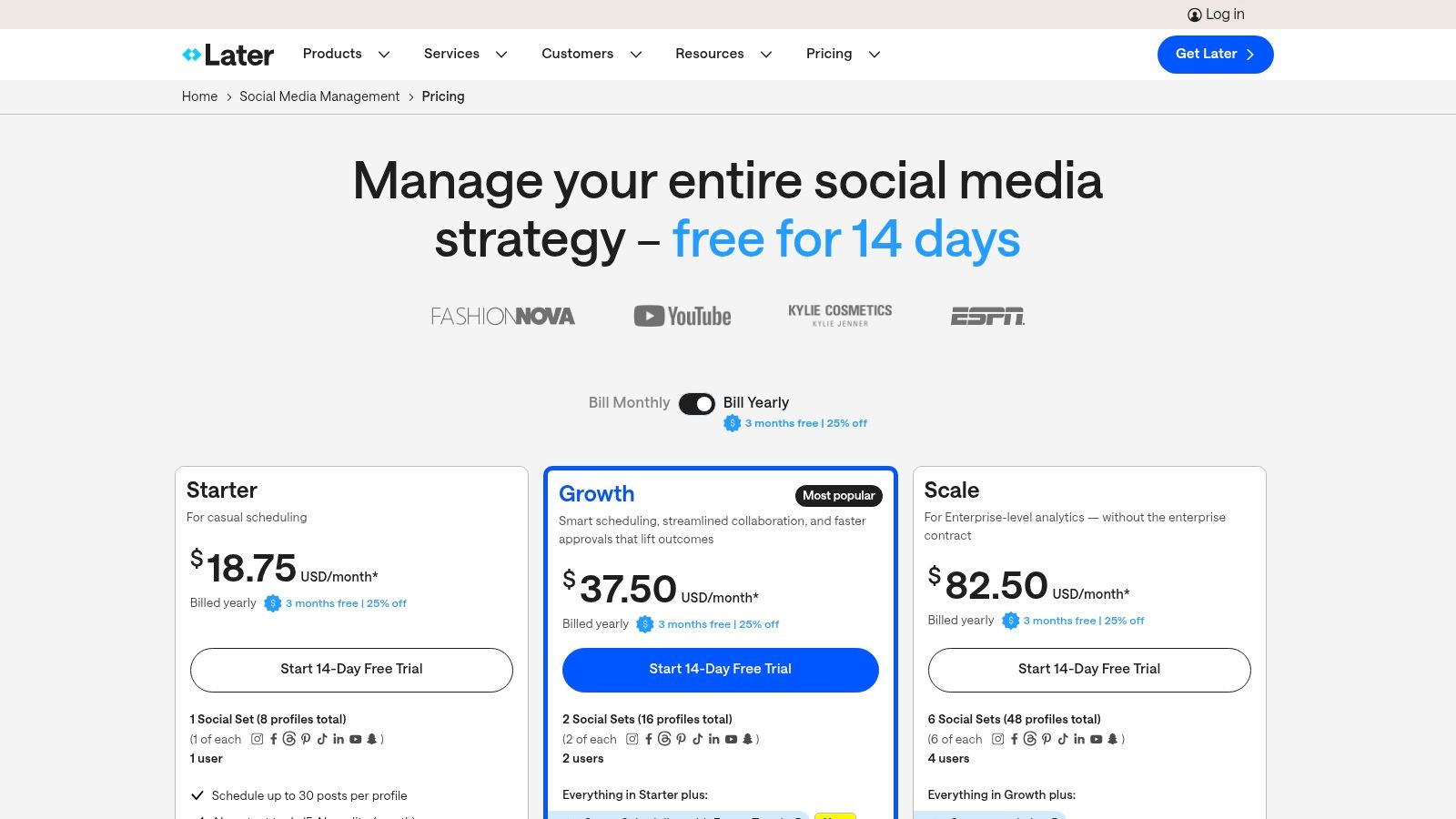
Social Media Reputation Monitoring: Protect Your Brand

Think of social media reputation monitoring as your brand’s eyes and ears online. It’s the constant, real-time process of tracking what people are saying about your business, your products, and even your competitors across social media. This isn't just a side task for the marketing team; it's a critical function that protects the very value of your brand.

What Social Media Reputation Monitoring Really Means

Brand radar text on laptop screen with smartphone displaying social media profile and notebook on blue desk

At its core, social media reputation monitoring is about flipping the script from reactive to proactive. Instead of waiting for a full-blown crisis to land on your doorstep, you’re actively tuning into the digital chatter. This lets you catch a negative comment before it snowballs, jump on opportunities to create happy customers, and ultimately, stay in control of your online image.

Imagine your brand is a ship sailing on the internet. Reputation monitoring is your radar, constantly scanning the waters. It spots the icebergs (angry customers), finds the friendly ports (brand advocates), and keeps an eye on other ships (your competition). Without it, you’re essentially sailing blind, leaving yourself wide open to storms that you could have easily navigated around.

It's So Much More Than Just Damage Control

Too many people think monitoring is just about putting out fires. It’s not. It's a goldmine of business intelligence that tells you what customers actually want, where the market is headed, and what your competitors are getting wrong. Every single mention, review, and comment is a breadcrumb of data that can make your entire strategy smarter.

To get a clearer picture, here is a breakdown of the core components of a solid reputation monitoring strategy.

Core Components of Reputation Monitoring

Component Objective Example Activity
Brand Mention Tracking To capture every conversation about your brand, direct or indirect. Setting up alerts for your company name, product names, and key executives.
Sentiment Analysis To understand the emotional tone behind the mentions (positive, negative, neutral). Using a tool to automatically categorize mentions and identify trends in customer mood.
Community Engagement To build relationships and show that you're listening and you care. Responding to a customer's question on X within the hour.
Competitive Intelligence To find market gaps and learn from your competitors' successes and failures. Tracking mentions of a competitor's new product launch to see customer reactions.

Each of these pieces works together to give you a complete, actionable view of your brand's standing online.

The Modern Challenge of Reputation

Things are getting trickier out there. The explosion of AI-generated content, for example, has thrown a real wrench in the works. Between 2020 and 2024, there was a staggering 758% increase in AI-generated reviews on major platforms. This got so bad that the FTC had to step in and ban fake reviews, which just goes to show how critical it is to have tools that can tell real feedback from automated noise.

A strong social media reputation isn't built by dodging criticism. It’s built by facing it head-on with transparency and speed. Monitoring gives you the power to turn a potential PR disaster into a masterclass in customer service.

At the end of the day, social media reputation monitoring is a non-negotiable part of any wider digital strategy. To see how this fits into the bigger picture of protecting your brand everywhere online, check out this comprehensive guide to online reputation management. It's a great resource for building a brand that can handle whatever the internet throws at it.

Key Metrics for Measuring Social Reputation

So, how do you actually measure something as fuzzy as "reputation"? It's not as simple as counting your followers. To really get a grip on it, you need to look at specific Key Performance Indicators (KPIs) that act like a dashboard for your brand’s health online.

Tracking the right data is like having a sixth sense for your business. You can spot a brewing product issue from a sudden dip in sentiment or see a campaign truly landing with a spike in your Share of Voice. It’s all about turning the noise of social media into real, actionable intelligence.

Mention Volume and Reach

The most basic starting point is Mention Volume. This is simply how many times your brand, products, or key phrases are being talked about online. A sudden jump could mean you're going viral—for better or for worse—while a slow and steady climb is a great sign of growing brand awareness.

But volume isn't the whole story. Reach adds a crucial layer by estimating how many eyeballs those mentions could have potentially landed in front of. It helps you understand not just how much you're being talked about, but how far those conversations are actually traveling.

Sentiment Analysis

This is where things get interesting. Sentiment analysis digs into the feeling behind the conversations. Tools will automatically tag mentions as positive, negative, or neutral, giving you a powerful, at-a-glance read on public opinion.

A high percentage of positive sentiment is obviously a great sign of happy customers and a strong brand. On the flip side, a sudden surge in negative comments is your early warning system. It gives you a chance to jump in and solve a problem before it blows up into a full-blown crisis.

This is a dynamic process. You need to watch your sentiment scores over time to see how public perception is shifting. Setting up real-time alerts is a game-changer here, letting you know the second there’s a spike in either positive or negative chatter. You can learn a bit more about the general concept from this social media monitoring overview from Wikipedia.

Share of Voice

Share of Voice (SoV) is all about context. It measures how much of the conversation in your industry is about you versus your competitors. It answers the question, "Are we a big fish or a little fish in this pond?"

For example, if there were 1,000 total mentions for the top three brands in your space last week, and 300 of those were about your brand, your Share of Voice would be 30%.

Keeping an eye on your SoV is a fantastic way to benchmark your performance. If that number is growing, it’s a clear sign that your marketing and PR efforts are paying off and you’re successfully carving out a bigger piece of the industry conversation.

Using Tools to Track Metrics Proactively

Knowing your numbers is one thing, but shaping them is another. This is where you have to get proactive, and a tool like OneUp is built for exactly that. It helps you build a strong foundation of positive content so you're not always playing defense.

By using OneUp to schedule a steady stream of good stuff across all your accounts—Facebook, Instagram (including Reels and Stories), X, Pinterest, TikTok, LinkedIn, YouTube Shorts, and even your Google Business Profiles—you create a positive buffer that defines your brand's narrative.

  • Features like the bulk uploader let you plan out weeks of content in one go.
  • You can create repeating posts for evergreen content to keep your message consistent without constant manual effort.
  • You can even set up posts to auto-post from RSS feeds, sharing relevant industry news to position yourself as a thought leader.
  • With Canva integration, you can design visuals right inside OneUp, ensuring your content is always on-brand.

Plus, with the unified social inbox, you can monitor and reply to comments, DMs, and even Google reviews all from one spot. It ensures you never miss a chance to engage. This proactive content strategy, combined with diligent monitoring of the KPIs we just covered, gives you true control over your social media reputation.

How to Build Your Monitoring Workflow

Having the right metrics is like having a good dashboard in your car—it tells you your speed and if you're about to run out of gas. But you still need a process for actually driving. That's where a solid social media reputation monitoring workflow comes in. It's your step-by-step navigation system for handling all the twists and turns of online conversations.

Think of it as setting up a command center. The goal is to ditch the chaotic, all-hands-on-deck scramble and replace it with a calm, organized system. This workflow breaks down into four key stages, taking every mention from the moment you spot it to its final resolution.

Infographic showing three reputation metrics: sentiment with smiley face, share of voice pie chart, and volume megaphone icon

This process isn't just about reacting; it's about building a complete picture of your brand's health by layering insights from each step. Let's walk through how to build it.

To give you a bird's-eye view, here's a quick breakdown of the essential stages in a social media monitoring workflow.

Reputation Monitoring Workflow Stages

Stage Primary Goal Key Tasks
Listening Discover every relevant conversation about your brand and industry. Track brand mentions, product keywords, competitor names, and industry hashtags. Funnel all mentions into a unified inbox.
Triage Prioritize incoming mentions to focus on the most critical issues first. Categorize mentions by urgency (High, Medium, Low). Assign conversations to the right team members.
Response Engage with your audience in a consistent, on-brand, and timely manner. Use response templates for common questions. Personalize interactions and follow brand voice guidelines.
Escalation Route complex or sensitive issues to the appropriate internal experts. Define clear rules for when to loop in Legal, Support, or PR. Hand off conversations with full context.

Each stage builds on the last, creating a repeatable system that ensures nothing important slips through the cracks.

Step 1: The Listening Phase

This is where it all starts. You need to cast a wide net to catch every important conversation happening online. It's not just about tracking your brand name—you need to listen for keywords, phrases, and hashtags tied to your products, competitors, and the industry as a whole.

For this to work without driving you crazy, you need a system that pulls all these mentions into one spot. This is where a unified social inbox is an absolute game-changer. A platform like https://www.oneupapp.io/ can consolidate everything from comments and DMs to Google reviews, so your team isn't bouncing between a dozen different apps.

Step 2: The Triage Process

Once the mentions start rolling in, you can't treat them all the same. A customer asking where to find your store hours doesn't need the same immediate attention as a viral complaint. Triage is just the process of sorting and prioritizing these conversations.

Set up a simple system based on urgency and sentiment. It could look something like this:

  • High Priority: Negative comments blowing up, service outages, or anything that smells like a PR crisis. These need an immediate response.
  • Medium Priority: Direct questions from customers, feature requests, or glowing reviews that are perfect opportunities for engagement.
  • Low Priority: General brand shout-outs or conversations that don't need a direct reply.

This sorting hat for your mentions keeps your team from getting buried in low-impact interactions and ensures the real fires get put out first.

The goal of triage isn't to ignore comments, but to allocate your resources effectively. It's about responding smarter, not just faster, by focusing on what truly matters to your brand's reputation at that moment.

Step 3: The Response Framework

With your mentions neatly sorted, it's time to engage. Your response framework should be a clear guide on who responds, what they say, and what tone they use. Consistency here is key to building a professional and recognizable brand voice.

Develop some response templates or "shortcuts" for the questions you get all the time. Many tools, including OneUp, let you save and reuse replies, which is a huge time-saver. Just make sure your team is encouraged to personalize them—nobody likes getting a canned, robotic answer. A big part of this involves smart user-generated content moderation to keep the conversations positive and productive.

Step 4: The Escalation Protocol

Let's be real: your social media team can't—and shouldn't—handle every issue. An escalation protocol is your playbook for when a conversation needs to be passed to another department.

For example:

  • A tricky technical bug? That goes to the customer support team.
  • Legal threats or serious accusations? Straight to the legal department.
  • A major service outage? That's a job for the crisis communications lead.

Having this flowchart in place saves your social managers from getting stuck answering questions they aren't equipped to handle. It ensures the right experts are pulled in at the right time, leading to a much better resolution and protecting your brand from costly mistakes.

Using Proactive Content to Shape Your Reputation

Good social media reputation monitoring isn't just about playing defense. While you absolutely have to react to conversations as they happen, the brands that truly win are the ones that get out ahead of the narrative. They do this by building a solid foundation of positive, on-brand content.

Think of this proactive approach as a sort of digital firewall. It helps insulate your brand from the occasional negative comment and lets you define your reputation on your own terms.

If you picture your social media feed as a town square, it makes sense. If you don't fill that square with your own voice and stories, someone else will. By consistently putting out valuable, engaging content, you take control of the conversation and build up a reserve of goodwill that can help you weather any storm.

Automating Your Narrative with Strategic Scheduling

This is where a good scheduling tool becomes a game-changer for reputation management. When you can plan and automate your content calendar, you guarantee a steady stream of positivity flows out across all your channels. It's this consistency that builds a brand people recognize and trust.

A platform like OneUp lets you schedule content way in advance for Facebook, Instagram (including Reels and Stories), X, Pinterest, LinkedIn, TikTok, and even your Google Business Profiles. This kind of coverage ensures your message is the same no matter where your audience bumps into you. It's like setting a positive drumbeat for your brand that just keeps going.

Proactive content does more than just drown out the negative noise. It builds a real community around your brand's values. It gives your audience something positive to talk about, share, and get behind, turning them from passive followers into genuine advocates.

OneUp’s plans are designed for growth, offering features like unlimited accounts and posts and even unlimited team members on certain tiers. This makes it affordable to build a strong, consistent content strategy without hitting a paywall for every new account or user.

Leveraging Features for Maximum Impact

To really own the narrative, you need features that help you work smarter, not just harder. It’s about moving beyond just posting stuff and into strategically shaping how people see you.

OneUp has several features built for exactly this purpose:

  • Bulk Uploading: You can plan and schedule weeks or even months of content at once with a simple CSV file. This is perfect for big campaigns, product launches, or just keeping a consistent theme going.
  • Repeating Posts: Got some evergreen content? Think testimonials, core blog posts, or company values. Set them to republish automatically at intervals you choose. This keeps your key messages in front of people without you lifting a finger.
  • RSS Feed Automation: Pull in relevant articles and news from trusted sources automatically. This positions your brand as a helpful expert in your field and keeps your feed from getting stale.
  • AI Caption and Image Generation: We all get stuck for ideas. OneUp's AI can help you whip up compelling captions or unique images, so your content calendar never has an empty slot. You can see how AI helps with content and even find some inspiration with tools like an AI Instagram caption generator.

By automating this content pipeline, you free up a ton of time. Instead of spending hours every day just trying to get something posted, your team can focus on the human side of social media reputation monitoring. That means having real conversations, analyzing sentiment, and building stronger relationships with your community. That's the secret to mastering both sides of the reputation coin.

Preparing for a Crisis Before It Happens

Crisis management dashboard displayed on laptop and mobile phone showing alert notifications and monitoring system

The best way to handle a social media firestorm is to have your fire extinguishers ready before you even smell smoke. A solid social media reputation monitoring strategy is your digital early-warning system, giving you the breathing room to mount a calm, structured defense instead of getting caught in a chaotic scramble.

This proactive approach turns a potential disaster into a manageable process. Think of it like building a fire station before a fire starts—it ensures your team has all the tools, plans, and permissions ready to roll at a moment's notice. When negative sentiment starts spiking, you won’t be asking, "What do we do now?"; you'll be executing a plan you've already rehearsed.

Setting Up Your Early Warning System

First thing's first: you need real-time alerts for high-risk keywords. These are the words and phrases that signal trouble is on the horizon. Go beyond just your brand name and start thinking about terms that scream customer frustration or product failure. This is how you intercept issues before they snowball.

Setting up these alerts is your front line. For example, you should be tracking keywords like:

  • "Fail" or "broken"
  • "Outage" or "down"
  • "Unsafe" or "recall"
  • "Scam" or "warning"
  • Key executive names paired with negative words

This creates a digital tripwire that catches concerning conversations the second they pop up, making sure you're never the last to know about a problem with your brand.

Building Your Crisis Communication Plan

An alert is only as good as the action it triggers. That's where a crisis communication plan comes in. This is your playbook, detailing every single step your team needs to take when an issue blows up. It completely removes the guesswork when the pressure is on and helps you deliver a swift, unified response.

A crisis doesn't create character, it reveals it. A well-prepared crisis plan ensures your brand's character is one of competence, control, and customer care, even when things go wrong.

Your plan needs to have a few core components that are clearly written down and easy for everyone on the team to find. This groundwork is what separates a minor hiccup from a full-blown catastrophe.

Key Components of Your Plan

  1. Identify the Response Team: Who's on point? Designate a core group with crystal-clear roles. Who has the final say on public statements? Who is glued to the mentions? Who liaises with the legal or support teams?
  2. Draft Template Statements: Don't write from scratch under fire. Prepare pre-approved holding statements for different scenarios (e.g., service outage, product issue, bad press). These templates save precious time, allowing you to get a message out quickly while you gather all the facts.
  3. Establish an Internal Alert System: How does the team get the signal? Is it a dedicated Slack channel? An emergency email list? A notification from your social media tool? Platforms like OneUp can help by pulling all your messages into a unified social inbox, making sure critical comments from every network are seen in one spot.
  4. Define Escalation Thresholds: Not every negative comment is a five-alarm fire. Decide what level of negative mention volume or sentiment shift actually triggers the full crisis plan. This data-driven approach means you react with the right level of urgency every time.

By putting this framework in place, your social media reputation monitoring goes from a simple listening exercise to a powerful, proactive shield for your brand. This structure gives you the confidence and clarity to navigate any storm with minimal damage.

Frequently Asked Questions

Jumping into social media reputation monitoring can feel like a lot. Let's clear up some of the most common questions to help you get your strategy dialed in.

How Can I Start Reputation Monitoring on a Small Budget?

You don't need a huge budget to get started. Seriously. Begin with free tools like Google Alerts and just use the built-in search on platforms like X and LinkedIn.

Carve out 20-30 minutes a day to manually search for your company name, products, and key people. Stick to the one or two platforms where your customers hang out the most. The proof you gather from doing this will make it much easier to justify paying for a tool down the road to automate everything.

What Is the Difference Between Social Monitoring and Social Listening?

Good question. Think of it like this: monitoring is about collecting the data, while listening is about understanding it.

Social monitoring is the act of grabbing all the mentions and conversations out there—it's the "what." Social listening, on the other hand, is digging into that data to figure out sentiment, spot trends, and find real insights that can shape your strategy—it’s the "why."

Monitoring helps you deal with a negative tweet in the moment. Listening helps you figure out why people are tweeting negatively and then change your whole product or marketing approach.

How Often Should My Team Check for Brand Mentions?

For most brands, checking in daily is the absolute minimum. Block out some time in the morning and again in the afternoon to scan through everything.

But if you're a bigger company or in a sensitive industry, you need real-time monitoring. A bad story can blow up in a matter of minutes. Consistency is everything; a quick response shows people you're actually paying attention and can stop a small complaint from turning into a full-blown crisis. A platform with a unified social inbox makes staying on top of this way less chaotic.

The real value of frequent monitoring is turning a potential PR disaster into a masterclass in customer service. Quick, thoughtful responses can transform a critic into a loyal advocate, demonstrating that you value every piece of feedback.

How Does OneUp Support Reputation Management?

OneUp is a killer tool for playing offense with your reputation. While it's known for scheduling, it really lets you build a "firewall" of positive, on-brand content, which is a huge part of controlling your own story online.

You can set up a constant flow of great content across all the major channels: Facebook, Instagram (including Reels and Stories), X, Pinterest, TikTok, LinkedIn, YouTube Shorts, and even Google Business Profiles.

  • Content Calendar: See your whole content plan at a glance to keep things consistent and positive.
  • Bulk Scheduling: Got a ton of content? Upload it all at once from a CSV file.
  • Repeating Posts: Set your best evergreen content to republish automatically so your key messages are always front and center.
  • Unified Social Inbox: Handle comments, DMs, and Google reviews all from one spot. Nothing slips through the cracks.
  • Saved Replies: Speed up your response time by creating and using pre-written answers for common questions inside the social inbox.
  • AI Assistant: Generate compelling post ideas and captions when you’re facing writer’s block to keep your content pipeline full.

By automating your content, your team is freed up to actually monitor what people are saying and jump into those conversations. That’s what effective social media reputation monitoring is all about. Of course, any platform handling your data should be transparent about it; you can check out OneUp's commitment to user data in their privacy policy.


Ready to take control of your brand’s narrative? With OneUp, you can schedule unlimited posts across unlimited accounts, manage engagement from a unified inbox, and automate a positive content strategy. Start your free trial today and see how easy it is to build a stronger social media reputation.

Mastering Social Media ROI A Practical Guide

Social media ROI (Return on Investment) is all about measuring the profit you get from your social media marketing compared to what you spent on it. Put simply, it’s the answer to the question, "Is all this time, money, and effort we're pouring into social media actually paying off?" A positive ROI means your strategy is making money. A negative one is a clear sign you need to rethink things.

What Social Media ROI Actually Means

Person gardening with seedlings in pots and trays, measuring value text overlay displayed

Think of your social media presence as a garden. Your posts, campaigns, and community chats are the seeds you're planting. The water and sunlight are your investments—things like ad spend, software subscriptions, and your team's salary. The return on investment is your harvest.

But what is the harvest, really?

For a long time, marketers were happy just counting the leaves (likes) or measuring how tall the plants were (follower count). These "vanity metrics" look good on a slide deck, but they don't tell you if you've grown anything you can actually eat. True social media ROI is about looking at the fruits and vegetables—the real results that actually affect your bottom line.

Moving From Vanity Metrics to Value

The real trick to measuring social media ROI is connecting a "like" on Instagram or a share on X to a genuine business outcome. This is where you have to stop focusing on flashy engagement numbers and start tracking the metrics that actually justify your marketing budget. Making this shift is how you prove your team's worth and start making decisions based on data, not just gut feelings.

So, instead of just tracking followers, you need to be measuring:

  • Leads Generated: How many people filled out a contact form after clicking that link in your LinkedIn post?
  • Website Conversions: How many sales came directly from your latest Facebook ad campaign?
  • Customer Sign-ups: How many people started a free trial from the link you dropped in a YouTube description?

We're shifting the question from "Are people seeing our stuff?" to "Is our stuff making people take profitable action?" That's the whole game.

To really nail this down, it helps to see the two side-by-side. Vanity metrics aren’t useless—they can signal brand health—but they don't pay the bills. Value metrics do.

| From Vanity Metrics to Value Metrics |
| :— | :— | :— |
| Vanity Metric (What It Looks Like) | Value Metric (What It Means for Business) | The Core Question It Answers |
| Likes and Reactions | Leads Generated from Social | Is our content attracting potential customers? |
| Follower Count | Website Traffic/Conversions | Are we driving people to where they can buy? |
| Reach and Impressions | New Customer Sign-ups | Is social media directly acquiring new customers? |
| Shares and Retweets | Sales Revenue from Social Ads | Are our paid campaigns profitable? |

This table clarifies the jump from "people like us" to "people buy from us." Making that connection is what ROI is all about.

The Role of Modern Tools in Proving Value

Connecting the dots between a social media click and a final sale used to be a massive headache. Thankfully, we've got tools now that make this much clearer. A platform like OneUp, for instance, helps you tighten up your whole process, which directly boosts your ROI.

By using features like the Canva integration to whip up graphics in minutes or scheduling posts in bulk from a CSV file, you slash the time spent on creating content. That immediately lowers your "investment" cost.

Even better, features like automatically repeating evergreen content, auto-posting from an RSS feed, or even scheduling Twitter (X) threads and Instagram Stories keep a steady flow of traffic-driving posts going out without you having to lift a finger. This maximizes your potential return and makes accurate measurement much, much easier.

How to Confidently Calculate Your ROI

Laptop displaying spreadsheet with calculator on wooden desk for calculating social media ROI

Alright, let's move from the "what" to the "how." The good news is that calculating your social media ROI isn't some dark art filled with complex calculus. It really boils down to a simple, powerful formula.

Before you dive in, it helps to get a grip on the fundamentals of marketing ROI in general. Check out this great resource on how to calculate marketing ROI effectively to build a solid foundation.

Ready? Here’s the only formula you absolutely need to know:

Social Media ROI (%) = (Profit / Total Investment) x 100

This little equation spits out a clear percentage. If it's over 0%, you're in the green. If it's negative, you’re spending more than you’re bringing in. Simple as that.

Now, let's unpack what "Profit" and "Total Investment" actually mean in the real world.

Defining Your Profit from Social Media

First up: Profit. This is the cold, hard cash you've made directly because of your social media efforts. It's not just revenue; it's the tangible value your business gained.

To figure this out, you need to be tracking things properly. Profit can come from a few places:

  • Direct Sales: This is the easiest one. Someone clicks a link in your post or ad and buys something. Cha-ching. E-commerce stores using tagged campaign links can see this value plain as day.
  • Qualified Leads: Maybe you're not selling products directly. If your sales team knows that 1 in 10 leads they get turns into a $1,000 sale, then every single qualified lead you generate from social media is worth $100.
  • Customer Lifetime Value (CLV): This is a more advanced take, looking at the total predicted revenue from a customer you brought in through social media.

The trick is to put a realistic dollar sign next to the actions you want people to take.

Calculating Your Total Social Media Investment

Next, we need to add up all the costs. Your "Total Investment" isn't just your ad budget—it’s everything you spent to get that profit. This is where a lot of people trip up.

Here’s a checklist of what to include:

  • Ad Spend: The obvious one. This is what you paid platforms like Facebook, Instagram, LinkedIn, or X to run your campaigns.
  • Tool & Software Costs: You’re likely using tools to manage everything. Subscriptions for platforms are a real cost. Looking at affordable plans from OneUp shows how a tool with unlimited accounts can give you a predictable, fixed cost for this part of the equation.
  • Content Creation Costs: Did you hire a photographer? Pay a freelance writer? Buy stock videos? All of that goes in here.
  • Team Hours: Time is money. Your team's time spent planning, creating, and managing social media is a huge, often overlooked, expense. Figure out their hourly rate and multiply it by the hours they’re dedicating to social.

Forgetting to factor in tools and time will give you a dangerously inflated ROI. Don't make that mistake.

A Practical E-commerce Example

Let’s see this formula in action. Imagine an online shop ran a campaign for one month.

  • Profit Generated: They tracked $7,000 in sales that came directly from their campaign links.
  • Total Investment Breakdown:
    • Facebook & Instagram Ad Spend: $2,000
    • Social Media Tool Subscription: $100
    • Content Creator Fee: $400
    • Team Time (20 hours at $25/hour): $500
    • Total Investment = $3,000

Now, let's plug those numbers into our formula.

ROI (%) = (($7,000 Profit – $3,000 Investment) / $3,000 Investment) x 100
ROI (%) = ($4,000 / $3,000) x 100
ROI (%) = 1.33 x 100 = 133%

Boom. A 133% ROI. This means for every single dollar they put into the campaign, they got back that dollar plus an extra $1.33 in profit.

That’s a number you can take to your boss with confidence. It’s clear, it’s defensible, and it proves your work is paying off.

The Essential Metrics You Need to Track

Alright, you've got the social media ROI formula down. Now, what numbers actually go into it? Think of the ROI equation as a recipe—the metrics are your ingredients. And just like in cooking, if you use low-quality ingredients, your final dish will be bland and uninformative.

To get a real sense of your return, you can't fixate on just one number. You need a complete picture of your customer's journey, from the moment they first see your brand all the way to becoming a loyal fan. We can break these essential metrics down into four key categories that build on one another.

Reach Metrics: The Top of Your Funnel

Reach metrics tell you a simple but crucial thing: how many people are seeing your content. This is the first step. If nobody sees your posts, nothing else matters. Think of it as casting your net—the wider, the better.

  • Impressions: This is the total number of times your content popped up on someone's screen. It’s a pure measure of visibility.
  • Audience Growth Rate: This shows you how fast you’re gaining new followers. A healthy growth rate means your brand is staying relevant and grabbing new attention.

While these numbers don't have a dollar sign attached, they're the foundation for everything that follows. More reach creates more chances for engagement and, ultimately, conversions.

Engagement Metrics: Gauging Audience Interest

Once people see your stuff, the big question is: do they care? Engagement metrics are all about how your audience interacts with your posts. This is where you find out if your message is actually hitting home.

High engagement is a massive signal to social media algorithms that your content is valuable, which usually gets you even more visibility.

Strong engagement is the bridge between visibility and profitability. It's the moment a passive viewer becomes an active participant in your brand's story, making them far more likely to take the next step toward a purchase.

Key engagement metrics include:

  • Clicks: The number of times people clicked on a link, image, or video in your post. A direct sign of curiosity.
  • Shares and Retweets: When users share your content, they’re basically giving your brand a personal recommendation to their own friends and followers. It’s powerful word-of-mouth.
  • Comments and Replies: These are gold. Direct conversations show a deep level of interaction and give you priceless qualitative feedback.

With a tool like OneUp, you can use the unified social inbox to keep an eye on comments and messages across all your accounts from one place. This makes it easy to jump in and respond, ensuring you never miss a chance to build those crucial relationships that drive positive social media ROI.

Conversion Metrics: Turning Interest into Action

This is where the rubber meets the road. Conversion metrics track the specific, profitable actions people take after seeing your social content. These are the numbers that feed directly into the "Profit" side of your ROI calculation.

To track this stuff accurately, you'll need to use tools like UTM parameters in your links. For a really deep dive into your overall marketing performance, you might also consider general reporting and analytics services.

  • Leads Generated: How many people filled out a form, signed up for your webinar, or downloaded that guide you worked so hard on?
  • Sales Revenue: What's the total dollar amount of sales that came directly from a social media link?
  • Demo Requests or Trial Sign-ups: For SaaS or service businesses, this is a huge one. It’s a clear sign of purchase intent.

Keeping an eye on these KPIs across different platforms is key. For example, Facebook is still a powerhouse for marketers, with 28% of them globally naming it their top-performing channel for ROI in 2025. A big reason for this is its robust tools for driving and tracking direct conversions. If you want to dig deeper into the numbers, you can discover more insights about social media marketing ROI.

Customer Value Metrics: The Long-Term Payoff

Finally, let's look past the first sale. The most sophisticated metrics help you understand the long-term value of a customer you acquired through social media.

  • Customer Lifetime Value (CLV): What’s the total amount of money you can expect from a single customer throughout their entire relationship with you? A high CLV from customers who found you on social is a massive win.
  • Repeat Purchases: Are customers who found you on social coming back for more? This tells you you’re attracting loyal fans, not just one-time buyers.

By tracking metrics across these four categories, you build a complete, 360-degree view of your performance. A platform like OneUp makes this way easier by giving you post-level and summary analytics for all your channels—including Facebook, Instagram, and LinkedIn—all in one dashboard. It simplifies your data collection and makes plugging numbers into your social media ROI calculation that much quicker.

Your Repeatable Framework for Measuring ROI

Trying to measure your social media ROI without a system is like trying to navigate a new city without a map. You might stumble upon some interesting things, but you'll probably just end up lost. A repeatable framework turns random numbers into real, actionable insights.

This five-step process is your map. It’ll help you build a system that consistently connects your social media hustle to tangible business results.

Think of it like the classic marketing funnel. You're guiding people on a journey from just hearing about you to becoming a paying customer.

Marketing funnel diagram showing progression from reach through engagement to conversions with icons

This path is simple: get seen (Reach), get them interacting (Engagement), and get them to buy (Conversions). Your measurement framework needs to track every stage.

1. Set Clear Business Objectives

Before you even think about tracking a single click, you have to know what you’re aiming for. Your social media goals can’t exist in a vacuum; they need to plug directly into what the business is trying to achieve.

Are you trying to boost online sales by 15% this quarter? Maybe the goal is to bring in 50 qualified leads every month. Whatever it is, get specific. These objectives are your north star, telling you which metrics actually matter. A high engagement rate is nice, but if your goal is lead gen, it's useless unless it's driving form submissions.

2. Implement a Rock-Solid Tracking System

With your goals locked in, you need the right tools to see if you're hitting them. This is where the data collection gets serious. And the cornerstone of all good social media attribution? The humble UTM parameter.

UTM parameters are little snippets of code you tack onto the end of a URL. They tell your analytics software exactly where someone came from—the source (like Facebook), the medium (social), and the specific campaign (like summer-sale-2025). This is how you prove that a particular post drove an actual sale.

But let's be real, manually adding these to every single link is a nightmare and a recipe for mistakes. That’s where a social media management platform becomes a lifesaver.

The secret to great data is consistency. By automating your tracking with a reliable system, you eliminate guesswork and ensure that every click, conversion, and sale is properly attributed back to its source, giving you a crystal-clear view of your ROI.

Tools like OneUp let you automatically add custom UTM parameters to every link you schedule. You set them up once, and the system handles the rest, ensuring no click ever gets lost in the shuffle.

3. Tally Up Your Investment (Honestly)

You can't calculate ROI without knowing the "I"—your investment. And it's more than just what you spend on ads. Social media ad spend is projected to soar past $276.7 billion in 2025, which just goes to show how much businesses are pouring into these platforms. With that much money on the line, tracking every penny is non-negotiable.

Make sure your list includes all of these:

  • Ad Spend: The obvious one. Your budget for paid campaigns across all channels.
  • Tool Costs: Subscriptions for scheduling, analytics, and design software.
  • Labor Costs: The salaries or hourly rates for your team. Their time is money.
  • Content Creation: Any cash spent on freelancers, stock photos, or video production.

4. Analyze and Attribute the Results

Okay, your tracking is humming along and you know what you've spent. Now it's time to connect the dots. Dive into your analytics platform and look at the data coming from your UTM-tagged links.

Start looking for patterns. Which platforms are driving the most conversions? What kind of content is sending the most valuable traffic to your site? This is where you go beyond vanity metrics and start building a story. You might find out that those slick Instagram posts you’ve been creating with your Instagram grid planner are secretly your top e-commerce driver.

5. Create Reports People Actually Want to Read

The final step is to pull all your findings into a clear, actionable report. Remember, this isn't just for you—it’s for your boss, your clients, and anyone else who needs to know if social media is working.

Don't just dump a bunch of numbers on them. Focus on the metrics that tie back to those business objectives you set in step one. A 150% ROI on your last campaign is fantastic, but the real magic is explaining why it worked and how you're going to do it again. That’s how you prove your value.

Actionable Strategies to Improve Your ROI

Once you've got a handle on measuring your social media ROI, the next question is always, "How do we make it better?" Knowing your numbers is just the starting line; the real race is making those numbers climb higher and higher each quarter.

Boosting your ROI really comes down to two simple levers you can pull: increase the profit you're making, or decrease the investment you're putting in.

The best strategies manage to do both at the same time. This isn't just about tweaking your ad spend and content. It's also about making your team's workflow more efficient—because time is one of the biggest, and most expensive, parts of your investment.

Streamline Your Workflow to Cut Investment Costs

Every single hour your team spends on manual, repetitive social media chores adds to the "Investment" side of your ROI calculation. Finding ways to cut that time down is one of the fastest paths to seeing a better return. This is where a solid social media management tool stops being a "nice to have" and becomes an absolute necessity.

A platform like OneUp is designed specifically to slash the hours it takes to manage a bunch of different accounts. Forget logging in and out of a half-dozen platforms—you can run your entire strategy from one place.

Here are a few ways this directly lowers your time investment:

  • Bulk Scheduling: Got a full month's worth of content planned out? You can upload a simple CSV file and schedule hundreds of posts at once. That's potentially days of tedious work condensed into just a few minutes.
  • Evergreen Content Automation: Set your all-time best-performing posts to republish automatically at intervals you choose. This keeps a constant flow of great, traffic-driving content going out without you having to lift a finger.
  • Content Categories: Organize your posts into buckets like "Blog Posts," "Product Updates," or "Customer Stories." This helps you maintain a balanced content calendar without having to meticulously plan every single post by hand.

This screenshot from OneUp's homepage gives you a glimpse of the different platforms you can manage from a single dashboard.

When you can bring accounts like Facebook, Instagram, LinkedIn, and even your Google Business Profiles under one roof, you create a single source of truth for your social media. The amount of time you save is massive.

Enhance Content Quality to Increase Returns

Now let's look at the other side of the ROI formula: "Profit." To get this number up, your content can't just show up—it has to perform. It needs to be high-quality, genuinely engaging, and built to drive action.

A big roadblock for a lot of teams is the time and skill it takes to create eye-catching visuals. This is where integrated tools are a game-changer. For example, OneUp’s built-in Canva integration lets you design professional graphics right inside the post creation window. No more switching tabs, downloading images, and re-uploading them.

Of course, a great visual needs a killer caption. The right words can be the difference between someone scrolling right past your post and someone clicking your link. If you're hitting a wall, you can use our Instagram caption generator to get the creative juices flowing and write better copy, faster.

The most profitable content strikes a perfect balance between providing value to the audience and aligning with clear business goals. It educates, entertains, or solves a problem while subtly guiding the user toward a conversion.

Optimize Ad Spend and Leverage High-Performing Tactics

While building your organic presence is essential, paid ads are often the quickest way to scale your results and see a positive social media ROI. The trick is to be smart and let data guide your budget.

  • A/B Test Everything: Don't just guess what will work. Constantly test different ad visuals, headlines, and calls-to-action to find the combination that gets you the lowest cost per conversion.
  • Double Down on Winners: As soon as your analytics show you have a clear winner from your A/B tests, shift your budget to that ad. Stop feeding the underperformers and put your money behind what's proven to work. It’s a simple but powerful way to maximize your return.
  • Explore Influencer Partnerships: Influencer marketing has become a serious engine for ROI. Projections show it could deliver an average return of $5.78 for every $1 spent in 2025, with the industry itself growing to a massive $32.55 billion. This approach works because you're tapping into the trust that influencers have already built with their audience, which often leads to much better conversion rates than you'd see from a standard ad.

By combining workflow automation to lower your costs with smarter content and ad strategies to increase your profits, you've got a powerful, two-pronged approach for consistently improving your social media ROI.

Frequently Asked Questions About Social Media ROI

Even with a solid game plan, you're bound to have questions. Let's be honest, tying social media efforts to actual business value can feel like nailing jelly to a wall sometimes.

Here are some of the most common hurdles marketers run into, along with some straight-up answers.

How Can I Measure ROI from Organic Social Media Efforts?

This is a big one. Measuring the return from your organic (aka non-paid) posts feels tricky, but it’s totally doable. You just have to be a little obsessive about tracking the customer's journey, from that first click to the final sale.

The secret sauce? UTM parameters. Slap them on every single link you share organically. This tags your traffic, so you can see exactly how many website visits, leads, or sales came directly from your social channels.

Then, you need to assign a dollar value to actions that aren't direct sales. For instance, if you know that 1 out of every 20 newsletter subscribers eventually buys something worth $100, then every email sign-up you get from social media is worth $5. Boom—you've got a tangible "profit" number for your ROI math. And with a tool like OneUp, you can automatically add UTM parameters to all your posts, making this kind of tracking a set-it-and-forget-it deal.

What Is a Good Social Media ROI to Aim For?

Everyone wants a magic number, and while it varies a ton by industry, a commonly tossed-around benchmark is a 5:1 ratio. That means for every $1 you put in, you get $5 back in profit. But getting fixated on a specific number right out of the gate can be a recipe for frustration.

Honestly, the most important goal is just getting into the green—achieving and maintaining a positive ROI. Once you're there, the focus shifts to beating your own last score. A truly good ROI is one that keeps climbing as you figure out what your audience loves, test new ideas, and make your campaigns smarter. Your own past performance is the only benchmark that really matters.

How Do I Account for the Value of Brand Awareness?

Ah, brand awareness—the "soft" metric that gives accountants headaches. It’s absolutely a valuable outcome of social media, even if it doesn’t come with a neat price tag. You can't track it like a simple conversion, but you can definitely measure its ripple effect on your bottom line.

Here’s a practical way to tackle it:

  • Track Correlated Metrics: Keep a close eye on things like brand mentions, your share of voice compared to competitors, and direct traffic to your website (people typing your URL right into their browser).
  • Look for Patterns: When you see a spike in your brand awareness metrics, does it line up with a lift in overall sales or leads a week or two later? Look for those connections.
  • Just Ask: A simple "How did you hear about us?" field in your checkout or sign-up form is pure gold. It'll tell you how many people found you on social, even if they didn't click a tracked link.

This approach helps you build a solid case for how awareness contributes to your overall social media ROI, justifying all that hard work you put into top-of-funnel content.


Ready to master your social media workflow and get a crystal-clear view of your ROI? OneUp gives you all the tools you need—from bulk scheduling and evergreen content automation to a unified inbox and powerful analytics—in one simple plan. Stop guessing and start measuring what matters. Start your free trial of OneUp today!

Understanding Social Media Impressions

Let's break down what social media impressions really are. At its core, an impression is counted every single time your content is displayed on someone's screen.

Think of it as a simple digital view count. It doesn't care if one person sees your post three times or if three different people see it once—each time it pops up in a feed, that's another impression. This is your first and most basic signal of brand visibility and tells you how much love the platform's algorithm is giving your content.

Defining Social Media Impressions

I love using a simple billboard analogy for this. Imagine you put up a billboard on a busy highway. Every car that drives by and sees it? That’s one impression.

If the same person drives past it on their morning commute and then again on their way home, they've just generated two impressions.

In the social media world, your post is the billboard, and every user’s feed is that highway. Social media impressions measure the total number of times your content—a post, a Story, a video, anything—was shown to users. It’s a raw count of how many times it appeared on a screen.

Why does this matter? Because it’s a direct reflection of how often an algorithm is serving your content to people. A high impression count is a great sign; it suggests your post is catching on, appearing in lots of feeds, and possibly being shown to the same users more than once, which is fantastic for brand recall.

Impressions vs Reach vs Engagement

It's super common to mix up impressions with other key metrics, but knowing the difference is critical to actually understanding what's working. Each metric tells a completely different part of your content's story.

This infographic does a great job of laying out the core differences at a glance.

Infographic about social media impressions

As you can see, impressions are all about the total number of views, reach focuses on the unique people who saw it, and engagement is about the actions they took.

Here's a table to make it crystal clear.

Key Social Media Metrics At A Glance

This quick comparison uses our billboard analogy to help you remember the distinct role each metric plays.

Metric What It Measures Analogy (Billboard on Highway) Why It Matters
Impressions Total number of times content was displayed Every car that passed the billboard Measures total visibility and algorithm performance
Reach Total number of unique people who saw the content The total number of individual cars that passed Measures the unique size of your audience
Engagement Total number of interactions (likes, comments, etc.) Cars that slowed down, honked, or called the number Measures audience interest and interaction quality

Getting a handle on these three pillars is the foundation of any solid social media analysis.

The Scale of Impressions Today

The number of potential impressions out there is just mind-boggling. We're talking about massive volumes driven by platforms that have become a part of daily life.

According to DataReportal, there were 5.66 billion social media user identities at the start of October 2025, and that number grew by 259 million in just the last year. That growth translates into billions upon billions of impressions served daily across YouTube, Facebook, TikTok, and Instagram.

An impression is the most basic unit of digital visibility. Before you can earn a click, a follow, or a sale, you must first earn an impression. It's the starting point for every single customer journey that begins on social media.

Understanding this is the first step, but putting it into action is what counts. Tools like OneUp are built to help you capitalize on this by making sure your content is consistently getting out there. You can schedule posts across all the major platforms—Facebook, Instagram, X, Pinterest, LinkedIn, YouTube, TikTok, and even your Google Business Profiles.

One of its most powerful features is the ability to set posts to repeat automatically. This means your best-performing content can keep generating fresh impressions long after you first hit "publish." You can even use post variations so that each repost is slightly different, keeping your feed fresh.

Why Impressions Matter For Brand Growth

A graph showing upward trending lines, symbolizing brand growth fueled by social media impressions.

It's easy to get tunnel vision, focusing only on likes, comments, and shares. But if you ignore social media impressions, you're missing the first—and arguably most important—piece of the puzzle.

Think of it like this: impressions are the foundation of your entire social media strategy. Before anyone can click, follow, or buy, they have to see your content. That's what impressions measure: pure, simple visibility.

High impression counts are about way more than just vanity. They represent mindshare. Every single time your post pops up in someone's feed, it's another tiny deposit in their mental bank for your brand. That repetition is what builds the familiarity that eventually leads to trust and sales.

Building Top-Of-Mind Awareness

Impressions are the lifeblood of brand awareness. When you're consistently racking up high impression numbers, you’re making sure your brand is the first one people think of when they need what you offer. This is absolutely critical in today's noisy, crowded markets.

Imagine a local coffee shop trying to promote a new seasonal latte. By creating content that the algorithm loves—and therefore shows to more people—they get their announcement in front of local residents over and over again.

Even if someone doesn't immediately rush out to buy it, that repeated exposure means your brand is lodged in their brain. The next time they’re craving a coffee, guess which shop pops into their head first? That's how a passive scroller becomes a future customer.

And the audience is massive. Just a decade ago, there were about 970 million people on social media. That number is set to hit an incredible 5.24 billion by early 2025. With over 65% of the global population scrolling, impressions are your ticket to getting in front of them.

Impressions are your first conversation with the algorithm. A high count signals that the platform sees value in your content and is actively showing it to more people, creating a powerful flywheel effect for your brand's visibility.

An Early Warning System For Your Strategy

Impressions aren't just for building awareness; they're also an amazing diagnostic tool. They give you instant feedback on what the platform's algorithm is actually prioritizing right now.

See a sudden spike in impressions on that Reel you posted? Or that carousel? That's the algorithm screaming at you: "I like this! Make more of it!"

This direct feedback loop lets you stay nimble. You can quickly double down on what’s working and ditch the content that’s falling flat, tweaking your strategy in almost real-time. This is where having a solid scheduling tool becomes a non-negotiable part of your workflow.

For example, using a tool like OneUp means you can act on these insights immediately. If you see videos are crushing it, you can use OneUp's bulk uploader to schedule a whole series of similar videos across all your channels—Instagram, TikTok, and even YouTube Shorts. With the RSS feed automation feature, you can even have OneUp automatically post new blog articles or YouTube videos to your social accounts the moment they go live.

You can even use a Facebook post generator to brainstorm new ideas and keep your pipeline stocked with content the algorithm will love. When you listen to these algorithmic cues, you’re setting yourself up for serious, sustained growth.

Alright, you know what impressions are and why they're a big deal. Now for the fun part: actually getting more of them. The key isn't just to throw content at the wall and hope something sticks. It’s about building a smart, reliable engine that gets your posts in front of more eyeballs, consistently.

Let's break down the practical steps you can take to make that happen.

https://www.youtube.com/embed/9psqcaPDozO

Master Your Posting Consistency

If you only focus on one thing, make it this. Consistency is the loudest signal you can send to the social media algorithms. Posting regularly tells platforms like Instagram, Facebook, and TikTok that you’re an active creator who deserves a spot in people's feeds.

Go dark for a week or post sporadically, and the algorithm starts to forget about you. Your momentum stalls. The goal is to find a rhythm you can stick to, keeping your brand top-of-mind for both your followers and the platform itself.

This is where a good scheduling tool is a lifesaver. Instead of logging in to post every single day, you can use a tool like OneUp to plan out your content weeks or even months ahead. You can queue up posts for Facebook, Instagram, X (formerly Twitter), Pinterest, LinkedIn, YouTube, and even your Google Business Profiles all from one place.

By automating the schedule with features like a visual calendar and content categories, you guarantee that steady stream of content that the algorithms love, which frees you up to focus on creating posts that people will actually want to see.

Leverage Automation for Maximum Visibility

Automation is more than just a time-saver; it’s a strategic move to squeeze every last drop of value out of your content. Smart automation helps your best stuff reach the biggest audience possible over time.

One of the easiest wins here is recycling your greatest hits. That awesome tip, tutorial, or brand story you posted months ago? It's still valuable. New followers haven't seen it, and most of your old followers probably missed it the first time around.

With a feature like OneUp’s repeating posts, you can set your best evergreen content to automatically republish at whatever interval you choose. It’s a simple way to keep a flow of proven, high-quality content in your feed without any extra effort.

Even better, use post variations. Instead of spamming the exact same post over and over, OneUp lets you create slightly different versions. This keeps your feed looking fresh and avoids tripping any spam filters, all while hammering home your key messages.

This is what it looks like to have all your accounts in one place, ready for a consistent, multi-platform attack plan to boost those impression numbers.

Create Impression-Worthy Content Faster

Let's be real: high impressions come from high-quality content. Posts that are visually sharp, well-written, and genuinely interesting are what get shared and pushed by the algorithm. The problem is, creating that kind of content consistently is a massive time-suck.

The trick is to build a workflow that combines content creation and scheduling. When your design tools and AI helpers are built right into your scheduler, the whole process becomes faster and smoother.

For example, OneUp has a Canva integration baked right in. You can design a graphic without ever leaving the post composer—no more downloading, uploading, and juggling a dozen browser tabs. It makes creating a great visual for every single post feel effortless.

And for those days when the words just aren't coming, the AI Assistant can spit out caption ideas or post concepts in seconds. This combo is a game-changer for producing more high-quality, impression-grabbing content in less time.

Optimize Your Content With Hashtags and Keywords

Think of hashtags and keywords as little signposts that guide the algorithm. They tell the platform what your content is about and who should see it. Using them correctly is one of the most powerful free things you can do to boost your impressions.

When you nail your hashtags, your content shows up in front of people actively looking for that topic, pushing your reach way beyond your current followers.

  • Platform-Specific Hashtags: On Instagram and TikTok, do your homework. Find a good mix of popular, trending tags and smaller, niche ones.
  • Keyword Optimization: For platforms that are more like search engines (think Pinterest, YouTube, and LinkedIn), focus on keywords. Pack the terms your audience is searching for into your titles, descriptions, and captions.

To make life easier, find a good Instagram hashtag generator to discover relevant tags you can save and reuse. When you combine smart optimization with great content, you create a powerful one-two punch for visibility. And remember, as you learn how to improve social media engagement, your impressions will almost always follow suit.

Impression-Boosting Tactics Checklist

To wrap things up, here’s a quick checklist of actionable tactics you can start using today. Not every tactic is perfect for every platform, but this should give you a solid starting point.

Tactic Brief Description Key Platforms Difficulty Level
Consistent Scheduling Post at a regular, predictable cadence to signal activity to algorithms. All Easy
Recycle Evergreen Content Automatically re-share your best-performing posts at set intervals. Facebook, X, LinkedIn Easy
Use High-Quality Visuals Create custom graphics, videos, or use high-res photos for every post. Instagram, Pinterest, TikTok Medium
Targeted Hashtag Research Use a mix of broad, niche, and trending hashtags relevant to your post. Instagram, TikTok, LinkedIn Medium
Keyword-Optimize Text Write titles and descriptions as if you were trying to rank in a search engine. YouTube, Pinterest, Blogs Medium
Engage With Your Audience Respond to comments and messages quickly to boost post relevance. All Easy
Analyze Post Timing Post when your specific audience is most active online. All Medium
Run Small Ad Campaigns Use paid promotion to give your best organic content an initial push. Facebook, Instagram, LinkedIn Hard

By methodically applying these strategies, you’re not just chasing impressions—you’re building a system for sustainable growth and visibility. Pick a few, master them, and then add more to your repertoire.

How To Track And Analyze Impressions

A person pointing at a screen showing charts and graphs related to social media analytics.

Racking up a ton of impressions feels great, but the raw numbers alone don't tell you the whole story. If you want to turn that visibility into a real strategy, you have to know how to track, interpret, and act on the data. This is where you graduate from just collecting numbers to making smart decisions that actually drive growth.

Your starting point is always the native analytics dashboard on each social media platform. Tools like Instagram Insights, Facebook Business Suite, and TikTok Analytics are your ground zero for impression data. They’re essential for seeing how your content is landing on a channel-by-channel basis.

But digging into these tools isn’t just about looking at the big number at the top. You need a sharp eye to see what's really driving your visibility.

Navigating Native Platform Analytics

Once you’re inside a platform’s analytics, you'll see the data is usually split into two main buckets. This is a critical distinction every social media manager needs to understand.

  • Organic Impressions: These are the views you earn fair and square. They come from awesome content, perfect timing, and genuine audience engagement. Think of them as a direct report card on how well your content vibes with the algorithm.
  • Paid Impressions: This is the visibility you buy through ads. These are guaranteed views targeted at a very specific audience that you get to define.

Knowing the difference is huge. A massive spike in impressions from a killer ad campaign tells a completely different story than one from a viral organic post. Both are good, but they inform different parts of your strategy.

While a tool like OneUp is your content engine—scheduling and firing off the posts that earn these impressions—the native analytics dashboards are where you see the results and figure out your next move. For instance, if you use OneUp to schedule posts to your Google Business Profiles, you can jump into your GBP Insights to see how that directly boosted your local visibility.

Building a Simple and Powerful Report

Data is only useful when it tells a story. Instead of a boring list of numbers, a good report shows you trends and connects your efforts to the outcome. You don’t need some crazy-complex system to get started; a simple spreadsheet is often more than enough.

Your report should answer a few key questions:

  1. What are my impression trends over time? Are you growing? Stagnating? Declining? Track your total impressions week-over-week or month-over-month to get the big picture.
  2. Which content formats are winning? Compare the average impressions for different post types. Do your Reels blow your carousels out of the water? Do text-only posts on LinkedIn get more eyeballs than posts with images? This tells you exactly where to double down.
  3. How do impressions line up with my posting schedule? Look for those spikes in visibility. Do they match up with specific campaigns or content you scheduled through OneUp? Did that series of repeating posts you set up create a sustained lift in impressions?

When you start linking impression data back to specific actions, you create a feedback loop. You're no longer just guessing what your audience wants; you're using data to prove it.

This kind of analysis also helps you zoom out and see your brand's overall footprint. To get the full picture, you should also know how to calculate Share of Voice across social media, which puts your impression numbers into context against your competitors. It’s how you move from just counting views to strategically and confidently building your brand’s presence.

Common Mistakes That Limit Your Visibility

A person looking at a social media feed on their phone with a frustrated expression, symbolizing common visibility-limiting mistakes.

Sometimes the quickest way to get more social media impressions isn’t about adding a new, complicated strategy. It’s about stopping what’s actively hurting you.

Plenty of brands are unknowingly tripping over their own feet, making simple errors that kill their visibility before a post even has a chance to take off. These aren't deep, mysterious algorithm puzzles; they're foundational mistakes that basically tell the platforms to hide your content.

Spot and fix these, and you'll often see a surprising jump in your impression count.

The Algorithm-Killer: Inconsistent Posting

If there's one thing that will absolutely tank your visibility, it's posting sporadically. Social media algorithms love active, reliable accounts. Posting consistently signals that you're a valuable contributor, and in return, they're more likely to show your content to people.

When you go dark for days or weeks, you break that momentum. The algorithm starts to forget about you, and your impressions fall off a cliff. The fix is simple, but it demands discipline: you have to maintain a steady posting schedule.

This is exactly where a tool like OneUp saves the day. The visual calendar lets you see your entire schedule laid out, so you can instantly spot any gaps. Better yet, its repeating post feature can automatically recycle your best evergreen content, guaranteeing you always have high-quality posts going out without having to reinvent the wheel every day. It's a simple way to keep the algorithm on your side.

Ignoring Platform-Specific Best Practices

Trying to use the same content everywhere is a surefire way to get ignored. Posting a long, horizontal video on TikTok or a text-heavy graphic on Pinterest just feels wrong because it is wrong for that platform. Users—and the algorithms that serve them—reward content that feels native.

Each network has its own vibe, its own rules, and its own preferred formats. If you don't adapt, you’re just creating friction for your audience, making them less likely to watch, share, or engage.

A one-size-fits-all content strategy is a one-size-fits-none reality. To maximize social media impressions, you must speak the language of each platform you're on, from aspect ratios and video lengths to caption styles and hashtag usage.

To fix this, tailor your content for each network. A perfect example is making sure your Instagram grid looks clean and cohesive. You can use tools like an Instagram grid planner to preview how your scheduled posts will look together. This helps you maintain that polished, professional aesthetic that makes people want to follow you.

Creating Content That Fails the Scroll Test

At the end of the day, impressions are earned by grabbing someone's attention. If your content doesn't make a person stop their thumb mid-scroll, it's already failed.

Generic, low-quality, or just plain boring posts get scrolled past in a millisecond. That sends a signal to the algorithm that your content isn't interesting, so it stops showing it to more people. This often happens when teams are rushed, leading to uninspired posts. The solution is to make creating good-looking content easier and faster.

OneUp helps with this by building creative tools right into the scheduler. You can fire up Canva or browse millions of free photos from Unsplash and Pixabay without leaving the post composer. This makes it incredibly easy to whip up a professional-grade graphic or find the perfect scroll-stopping image for every single post.

You can see from the OneUp changelog below that they're constantly adding new integrations and features to make creating great content more efficient.

Screenshot from https://help.oneupapp.io/en-us/article/oneup-roadmap-product-updates-changelog-new-features-and-feature-requests-1vs2exx/

This focus on improvement means you always have the right tools to overcome common hurdles and boost your visibility. By sidestepping these fundamental mistakes, you clear the way for your impression numbers to finally grow.

Your Burning Questions About Impressions, Answered

As you start digging into your social media strategy, you're bound to have some questions about what all these numbers really mean. It's totally normal. Getting a handle on these key terms is what separates a good strategy from a great one.

This is your cheat sheet for those "Wait, what's the difference again?" moments. Let's clear up the confusion so you can get back to creating awesome content.

Are Social Media Impressions The Same As Reach?

Nope, and this is probably the most common mix-up in the social media world. They are two totally different things.

Impressions are the total number of times your content popped up on someone's screen. Reach is the number of unique people who saw it.

Think of it this way: if one person sees your post five times in their feed, that's 5 impressions but only a reach of 1. A high impression-to-reach ratio can actually be a great sign—it means the algorithm likes your post enough to show it to the same people over and over, really driving your message home.

So which one matters more? It all depends on your goal. If you want to shout your brand name from the rooftops and get as many eyeballs as possible (even the same ones), impressions are your go-to. If you need to know how many individual customers you're connecting with, reach tells a clearer story.

Can My Impressions Be Higher Than My Follower Count?

Yes, and honestly, that's what you're aiming for! When your impressions blow past your follower count, it’s a sign that your content has broken out of your little bubble and is going viral.

This happens when people share your posts, you land on the Explore or "For You" pages, or the algorithm just decides to bless you. Platforms like TikTok and Instagram Reels are built for this very thing. So when you see those impression numbers climb, give yourself a pat on the back—it means your content is resonating way beyond your loyal fans.

What Is A Good Number Of Impressions For A Post?

Anyone who gives you a hard number is pulling it out of thin air. There's no magic number. "Good" is completely relative and depends on a few things:

  • Your Follower Count: An account with 1,000 followers will have a much different benchmark than one with 100,000.
  • Your Niche: A B2B software company isn't going to get the same numbers as a viral dance account.
  • The Platform: The numbers vary wildly. A 2025 Socialinsider report found that TikTok averages over 6,200 impressions per post, while Instagram is hanging out around 2,600.
  • Your Goals: Are you trying to educate a small, dedicated audience or go for broad appeal? A super-niche post might get fewer impressions but higher engagement from the exact people you want to reach.

Forget about chasing arbitrary numbers. Instead, look at your own data. Calculate your average impression rate (total impressions ÷ follower count) and focus on beating your own best. That's real growth.

How Do Paid Ads Affect Social Media Impressions?

Paid ads are basically a way to jump the line. You're buying impressions to get your content in front of a specific audience you might not reach on your own. Organic impressions are earned; paid impressions are bought.

Thankfully, every platform's analytics dashboard separates paid and organic metrics. This is super important because it lets you see what's working with your regular content versus your ad campaigns, helping you figure out your true return on investment.

Juggling both organic posts and paid campaigns can get chaotic fast. This is where a tool like OneUp really shines. You can schedule all your organic posts across every platform you can think of—Instagram, TikTok, Reddit, even Bluesky. And since OneUp offers unlimited accounts and posts on every plan, you never have to worry about hitting a limit. Plus, if you're an agency, the white-label client approval feature makes running mixed campaigns a total breeze.


Ready to stop guessing and start growing your impressions? OneUp gives you unlimited accounts, posts, and analytics for one simple price. Schedule your content, recycle your best performers, and manage all your engagement in one place. Start your free trial today.

how to respond to negative comments: calm, effective replies

When a negative comment pops up on your social media, the gut reaction might be to cringe, delete, or just plain ignore it. But that's the worst thing you can do. The key is a simple, human approach: Acknowledge their point, empathize with their frustration, and offer a real solution.

Ignoring a complaint doesn't make it go away. In fact, it does the opposite—it broadcasts to everyone watching that you might not care about your customers' experiences.

Why Ignoring Negative Comments Is a Terrible Idea

Think of it this way: in the public square of social media, silence is loud. When a customer is frustrated enough to type out a complaint, they're looking for a sign that someone is listening. Ghosting them just confirms their worst fears: that their feedback, and their business, doesn't matter to you.

And it’s not just that one person you’re losing. Everyone else—your loyal followers and potential new customers—is watching. An unanswered complaint is like a digital tumbleweed rolling through your comments section, telling people this might be a brand that doesn't stand by its products. It quietly erodes trust.

The Real Cost of Silence

Going quiet on negative feedback isn’t just bad for your image; it hits your wallet. The gap between what customers want and what businesses do is massive. Consider this: 53% of customers expect a reply to a negative review within a week, but a wild 87% of businesses don't bother. That’s a huge opportunity to do better than almost everyone else.

But this isn't just about damage control. Handling a negative comment with grace is a chance to show off your amazing customer service and the real people behind your brand. When you turn a bad experience around, you can:

  • Build Loyalty: A customer who feels heard and helped can become your biggest fan. Seriously.
  • Improve Your Business: That complaint might just be the wake-up call you needed to fix a hidden product flaw or a clunky process.
  • Showcase Your Values: Responding with genuine empathy shows everyone that you're a brand that cares.

The goal is to transform a public complaint into a public display of your commitment to customer satisfaction. Every negative comment is a chance to prove your brand's integrity.

This whole process is about closing the feedback loop. It’s not just about putting out fires; it’s a proactive way to build stronger relationships with your customers and show that you’re always listening. Engagement, even when it’s tough, is always the right call.

Your Triage Framework for Online Feedback

Let's be real: not all negative comments are created equal. Trying to tackle every single one with the same energy is a surefire way to burn out.

A genuinely frustrated customer who can't get your product to work needs a completely different response than an anonymous internet troll just trying to get a rise out of you. This is exactly why you need a triage framework. Think of it as your game plan for sorting through the noise so you can act strategically instead of just reacting to every notification that pops up.

This system helps you quickly sort, prioritize, and route incoming feedback. It’s all about focusing your limited time and energy where it truly counts—on the real customers who need your help. A solid plan ensures nothing important ever slips through the cracks.

This decision tree gives you a bird's-eye view of how to think through that initial sorting process.

Infographic about how to respond to negative comments

That very first decision—whether to engage or just ignore it—is the most critical. It sets the tone for everything that follows.

Centralize and Categorize

First things first, you have to get all your feedback into one place. Constantly jumping between Facebook, Instagram, X, LinkedIn, and your Google Business Profiles is a recipe for disaster. It's inefficient, and you're almost guaranteed to miss something important.

This is where a unified social inbox becomes an absolute game-changer.

A tool like OneUp pulls every comment, DM, and review from all your connected accounts into a single, manageable stream. You can connect an unlimited number of accounts from Facebook, Instagram, X, LinkedIn, Pinterest, TikTok, and Google Business Profiles, even on the starter plan. Instead of logging into five different apps, your team sees everything in one dashboard. This alone is a massive win for making sure a critical complaint doesn't get overlooked. Once everything is centralized, you can start sorting.

You don't need a super complicated system. Just create a few simple labels to categorize comments as they come in:

  • Customer Support Issue: A direct complaint about a product, service, or bad experience. These are always your top priority.
  • Constructive Criticism: Not an angry rant, but genuinely useful feedback on how you could improve things. This stuff is gold.
  • Misinformation: A comment that's spreading factually incorrect info about your brand. Needs to be addressed, but calmly.
  • Trolling/Spam: Abusive, irrelevant, or comments clearly meant to provoke a reaction. Don't feed the trolls.

To help you get started, here's a simple framework you can adapt for your own team. I call it the Comment Triage Matrix. It helps you quickly decide what to do based on what kind of comment you're dealing with.

Comment Triage Matrix

Comment Type Description Priority Level Recommended First Action
Urgent Support Product is broken, billing error, service outage. High Acknowledge publicly ASAP, then move to a private channel (DM/email).
General Complaint Shipping delay, poor experience, unmet expectations. Medium Empathize, apologize, and offer a specific solution or next step.
Constructive Criticism Feature suggestion, feedback on an update. Medium Thank them for the feedback and let them know you'll pass it on.
Misinformation Factually incorrect claims about your brand or product. Low Politely and publicly correct the information with a source, if possible.
Trolling/Spam Abusive language, off-topic rants, spam links. Very Low Ignore, hide, or delete based on your community guidelines. Do not engage.

This matrix isn't set in stone, of course. Use it as a starting point and tweak the priority levels and actions to fit how your team operates.

Create Clear Escalation Paths

Once you've categorized a comment, what's next? Your junior social media manager shouldn't be left alone to handle a comment about a major product failure. You need a clear escalation plan that tells everyone who handles what.

Your plan should spell out exactly who owns each type of comment. For example:

  1. Social Media Team Handles: They're on the front lines for general questions, constructive criticism, and the initial response to all support issues. They can also hide or delete trolls according to your policy.
  2. Escalate to Product/Sales: If feedback is about a specific product bug, a feature request, or incorrect pricing, it needs to get to the right department. Inside a tool like OneUp, you can use internal notes to tag a teammate directly on a comment without replying publicly. It's as easy as typing, "Hey @product-team, can you weigh in on this?"
  3. Immediate Leadership Alert: Any comment that hints at a legal threat, could blow up into a PR crisis, or mentions sensitive user data needs to be flagged for leadership immediately. No exceptions.

By setting up this kind of triage system, you transform that chaotic flood of notifications into an orderly, actionable workflow. It ensures the right person addresses the right comment at the right time, every single time. This structure is the foundation for handling negative feedback effectively, especially as you grow.

How to Craft an Effective Response

Okay, you've triaged the comments. Now comes the real work: crafting a reply that actually lands.

The goal isn't just to shut down a complaint. It's to show everyone—the unhappy customer, potential new customers, and even the silent majority just scrolling by—that your brand is on top of things. That you're empathetic, responsive, and genuinely committed to making things right. A great public response can be one of your most powerful marketing moments, believe it or not.

The best replies I've seen follow a simple but incredibly effective formula. I call it the A.C.E. method: Acknowledge, Connect, and Empathize. This isn't some rigid script; think of it as a mental checklist to make sure your reply hits all the right notes and, most importantly, sounds human.

A person thoughtfully writing a response on a laptop, with social media icons floating around them.

The A.C.E. Method Explained

Having a framework like this is a lifesaver. It keeps your replies consistent and prevents those panicked, off-the-cuff answers that almost always pour gasoline on the fire. It forces you to address the customer's feelings before you jump into a solution.

  • Acknowledge: First things first, validate their experience. A simple, "I'm so sorry to hear you had this issue," or "Thanks for bringing this to our attention," shows you're listening and taking them seriously. You're not admitting fault; you're just acknowledging their frustration.

  • Connect: Briefly touch on the specific problem they mentioned. Instead of a generic "Sorry for the trouble," try something like, "I understand how frustrating a shipping delay can be, especially when you're waiting on an important order." This small detail proves you actually read and understood their comment.

  • Empathize: This is where you build a bridge. Show them you get the emotional impact. Phrases like, "That must have been really disappointing," or "I can see why you'd be upset," shift the dynamic from a brand-vs-customer fight to a person-helping-person conversation.

Remember, an apology isn't always an admission of guilt. You're apologizing for the fact that their experience fell short of what they—and you—expected. It's a powerful way to de-escalate without getting bogged down in a "who was right" debate.

Public vs. Private Responses

One of the biggest questions is where to have the conversation. Do you reply out in the open for everyone to see, or do you immediately try to slide into their DMs?

The best strategy is usually a bit of both.

Your first response should almost always be public. This shows transparency and signals to your entire audience that you address feedback head-on, not just behind the scenes. But the second you need personal details—order numbers, email addresses, shipping info—it's time to move things to a private channel.

A perfect public-to-private handoff sounds like this:

"Hi [Name], thank you for flagging this. I'm so sorry about the mix-up with your delivery; that's definitely not the experience we want for our customers. I want to get this sorted for you right away. Could you please send us a DM with your order number?"

This approach gives you the best of both worlds. You get the public win of showing great customer service, and you get to solve the actual problem efficiently and securely in private. If you want to dig deeper into the nuances of writing these replies, there's some great advice on how to respond to comments effectively.

Adaptable Response Templates

While every situation has its own flavor, you don't need to reinvent the wheel every single time. Having a few solid, adaptable templates can be a huge time-saver and reduce the stress of staring at a blank text box. Just remember to personalize them.

Scenario 1: Product Dissatisfaction
"Hi [Name], we're really sorry to hear that the product didn't meet your expectations. We stand by our quality, so it's disappointing to know we fell short here. We'd love to learn more and make this right. Please send us a DM so we can assist you."

Scenario 2: Shipping Delay
"Hi [Name], thanks for reaching out. I'm so sorry for the delay in receiving your order—I know how frustrating that is. I've looked into this and will send you a DM with a tracking update right now. We really appreciate your patience!"

Personalizing these is the key to making them feel genuine. And if you're ever stuck on the right words, especially on a platform like Instagram where tone is everything, a little creative help can go a long way. You can play around with OneUp's Instagram caption generator to find fresh ways to phrase your empathetic responses.

Handling Feedback Across Different Platforms

A masterful response on LinkedIn will completely bomb on TikTok. It's just a fact of life in social media management. Every network has its own vibe, its own unwritten rules, and its own audience expectations. If you don't get that, you risk turning a small negative comment into a full-blown brand crisis.

What works in one corner of the internet is guaranteed to fail in another. Think about it: the formal, detailed explanation you might leave on your Google Business Profile would look completely robotic and out of touch in a chaotic TikTok comment thread. Customizing your approach isn't just a "nice-to-have"—it's everything.

Navigating X and Meta

On platforms like X (the artist formerly known as Twitter), Facebook, and Instagram, speed is the name of the game. Users on these networks expect lightning-fast replies. If you wait too long, they'll assume you're just ignoring the problem, which only adds fuel to the fire. The best move here is to acknowledge the issue quickly and then, if you need to, pull the conversation into DMs.

LinkedIn, on the other hand, is a different world. It demands a more measured, professional tone. Your replies need to be thoughtful and well-articulated, staying true to your professional brand. Rushing out a half-baked response here can do way more harm than good. This is where a tool like OneUp’s Social Inbox becomes a lifesaver. It pulls all your comments from X, Facebook, Instagram, and LinkedIn into one place, so your team can see the platform context and respond appropriately without juggling a dozen tabs.

We also have to talk about the sheer volume of junk you'll face. Spam and toxic comments are a huge problem, with recent data showing that 44% of comments on TikTok ads and 30% on Meta ads get hidden for being spammy or toxic. Your first job is to moderate effectively before you even think about replying.

The Unique Challenges of TikTok and LinkedIn

TikTok is its own unique universe. It’s informal, it’s video-first, and it runs on trends. A stuffy, corporate-jargon-filled response will stick out like a sore thumb. Your best bet is usually a short, human, and maybe even funny reply. Sometimes, a quick video response is the perfect way to tackle criticism head-on and show you’ve got nothing to hide.

Conversely, LinkedIn is your digital boardroom. Negative comments there could come from industry peers, potential hires, or major clients. Every single response has to be professional, respectful, and focused on a solution. Emojis and casual slang have no place here. Your goal is to project competence and protect your company’s reputation with every keystroke.

Here's the bottom line: a one-size-fits-all strategy for handling negative comments is doomed to fail. Your response has to feel as native to the platform as the original comment itself.

Trying to manage all these different conversational styles can be exhausting, especially when you're trying to stay on-brand across the board. If your team is struggling to come up with the right words for a fast-paced platform like X, a specialized tweet generator can be a huge help. It can spark ideas for those short, snappy replies that fit the platform’s tone perfectly, ensuring you can respond fast without sacrificing quality.

Streamlining Your Response Workflow with OneUp

Trying to manually manage your brand's reputation across a dozen different social media channels is a surefire way to burn out and let important comments fall through the cracks. The stakes are incredibly high, too. Think about it: about 73% of social media users say they're likely to buy from a competitor if a brand ignores their complaint.

This is why building an efficient, tool-supported system isn’t just a nice-to-have—it’s a must-have. A dedicated platform like OneUp can be your command center, turning a chaotic, multi-tab nightmare into a controlled, effective operation. A solid workflow makes sure every piece of feedback gets the attention it deserves, quickly and consistently.

Unify Your Social Inbox

First things first: stop the frantic channel-hopping. You need a single place where all incoming feedback lives.

With a tool like OneUp, you can create a unified Social Inbox that pulls in comments and messages from all your connected accounts. This isn't just for a couple of networks; it covers Facebook Pages and Groups, Instagram, LinkedIn, X, TikTok, and even your Google Business Profile reviews. Instead of juggling six different apps and browser tabs, everything flows into one clean, manageable dashboard.

Here’s a look at how OneUp brings conversations from different platforms into a single, organized view.

A screenshot of the OneUp social inbox interface

Just by centralizing your inbox, you immediately slash the risk of a critical comment getting lost in the shuffle. It gives your team a real-time, bird's-eye view of customer sentiment.

Collaborate with Internal Notes

Let's be real—the person running your social media accounts won't have the answer to every technical product question or complex billing issue. Getting the right response often means roping in other people from the team.

Instead of messy email chains or digging through Slack channels, you can use internal notes right inside the OneUp inbox. This feature is a lifesaver. You can tag a colleague from another department, ask for clarification, or hash out a response strategy, all privately.

  • Tag a teammate: @ProductTeam can you confirm the specs on this?
  • Discuss strategy: Let's offer a discount here, but we need to move this to DMs first.
  • Leave context: FYI, this user has complained about shipping before.

This keeps the entire conversation—both public-facing and internal—tied directly to the original comment. It’s a much cleaner, more efficient way to make sure your replies are accurate and have been run by the right people before they ever go live.

Implement a Post-Approval Workflow

For those really sensitive replies, especially when you're dealing with a serious complaint, having a second pair of eyes is non-negotiable. An approval workflow acts as a critical safety net, preventing off-the-cuff answers that could do some serious damage to your brand's reputation.

An approval process helps maintain brand consistency and gives managers the final say on delicate conversations. This is absolutely critical when you're figuring out how to respond to negative comments.

With OneUp's post-approval workflow, you can set it up so that certain replies must be reviewed by a manager before being published. This is especially handy for training new team members or when you’re navigating a high-stakes issue. OneUp also supports drafting posts, so junior team members can craft a reply and save it for a senior manager to review and approve before it goes live. It’s the best way to guarantee every single response aligns with your brand’s voice and overall strategy.

For businesses that need to nail this process, exploring the full suite of features on the OneUp platform can be a total game-changer.

Got Questions About Negative Comments? We've Got Answers.

When you're in the trenches of social media management, negative comments can feel like a minefield. You're not alone in wondering how to handle tricky situations. Having a clear game plan is everything—it's what separates a professional response from a panic-induced mistake.

Let's walk through some of the most common curveballs you'll face.

Should I Just Delete Negative Comments?

My gut reaction, and what I tell everyone who asks, is a hard no. Hitting that delete button on legitimate criticism almost always pours gasoline on the fire.

Think about it: the user will notice their comment is gone. Now, instead of just being unhappy with your product, they're angry that you're silencing them. That small complaint can quickly blow up into a public call-out about censorship, and that's a much bigger headache. Answering the comment head-on shows you're transparent and not afraid of feedback.

Of course, there are exceptions. You absolutely should have a zero-tolerance policy for certain things. Don't hesitate to delete comments and block users for:

  • Hate speech or any kind of discriminatory language.
  • Direct threats or personal harassment.
  • Spam, scams, or posting sketchy promotional links.
  • Sharing anyone's private or confidential info (doxing).

What's the Best Way to Handle a Comment That's Just Plain Wrong?

We’ve all seen it. A user posts something about your business that is factually incorrect. The key here is to correct the record gently, without making them feel stupid or starting an argument.

Your goal is to be helpful, not confrontational. A public, polite correction clarifies the information for everyone else reading the thread.

Try something like this: "Hey, thanks for bringing this up! It sounds like there might be a little mix-up on our return policy. We actually offer a 30-day return window on all purchases. You can find all the details right here…" It's respectful, fixes the bad info, and moves the conversation forward.

How Do I Deal with Trolls?

Ah, the troll. The bane of every social media manager's existence. The old internet rule is still the best one: don't feed the trolls.

They're not looking for a resolution; they're looking for a reaction. Starve them of the attention they're desperate for.

Often, a single, firm but polite shutdown is all you need. "We appreciate all constructive feedback, but we won't be engaging further on this." If they keep coming at you, use the mute or block button without a second thought. You will never, ever win a public argument with someone who's just there to fight.


Juggling all these interactions across different platforms can be a nightmare. That's where a tool like OneUp comes in. You can use the unified Social Inbox to keep an eye on all your comments in one place, leave internal notes for your team to collaborate on responses, and even set up approval workflows to make sure every reply is on-brand. OneUp even lets you bulk upload hundreds of posts at once and automatically post from an RSS feed, saving your team countless hours on content creation so they can focus on engagement. Stop switching between tabs and start managing everything from one clean dashboard. Start your free trial of OneUp today.
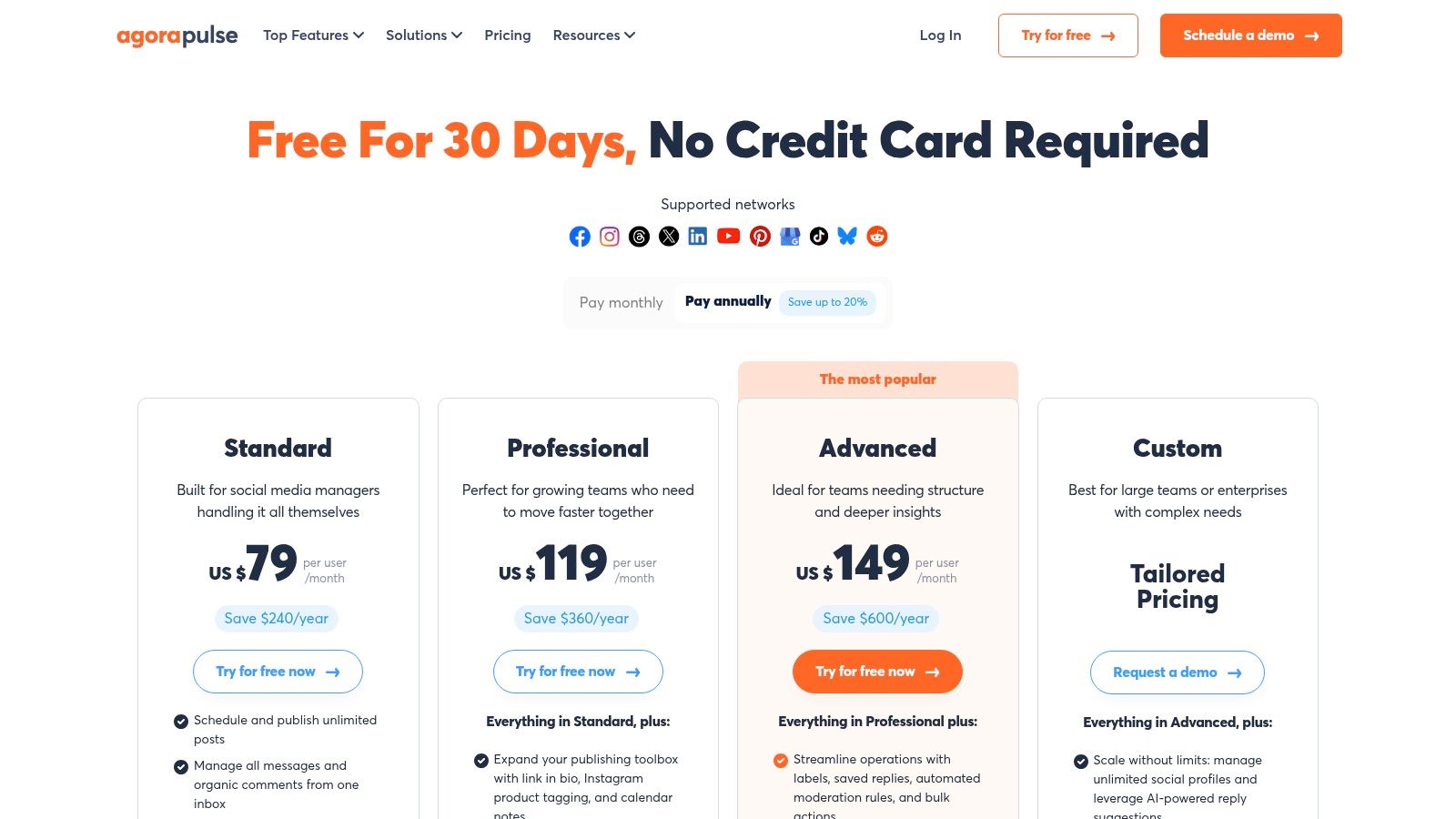
How to Automate Social Media Posts for Real Growth

Automating your social media means using a tool like OneUp to line up all your content in advance, letting it post for you across every platform. It completely flips your workflow from a reactive, time-sucking chore into a proactive system that keeps your brand visible 24/7.

Why Smart Social Media Automation Is a Necessity

Let's be real: trying to manually post to every single social media account, every single day, is a fast track to burnout. It feels like you're constantly scrambling, always busy, but never actually getting ahead of the game. This is the point where automating your social media posts stops being a "nice-to-have" and becomes a core part of your strategy.

Smart automation isn’t about setting it and forgetting it; it’s about being strategic with your time and energy. Instead of desperately searching for something to post at 3 PM on a Tuesday, you can carve out a few hours for "content batching"—where you create and schedule an entire week's or even a month's worth of posts in one go.

Maintaining a Consistent Brand Voice

Consistency is everything when it comes to building trust with your audience. When people see you showing up reliably with good content, they start to see your brand as professional and dependable. Automation makes sure that happens like clockwork.

You can schedule posts to hit at the perfect times for different audiences in various time zones, making sure your content lands when it will have the most impact—even while you're asleep. A solid tool like OneUp becomes your mission control, connecting all your important accounts in one place, from Facebook Pages and Instagram (Reels and Stories included) to LinkedIn, Pinterest, TikTok, and even your Google Business Profile. OneUp’s support for direct posting of Instagram Carousels, Stories, and Reels with custom thumbnails is a huge advantage.

The Strategic Shift from Time-Saver to Growth Engine

Social media automation isn't just for a handful of power users anymore; it's standard operating procedure. The latest data reveals that a massive 83% of marketing departments are now automating their social media posting. This isn't just about saving time, either. It’s delivering real results, with teams reporting a 14.5% jump in productivity and a 12.2% drop in marketing overhead.

This shift is all about becoming more efficient and being able to scale your efforts. It goes beyond just scheduling, highlighting the necessity of a multi-platform publishing tool for anyone who needs to be active wherever their audience spends time.

Here's a peek at the OneUp dashboard, which gives you a bird's-eye view for managing all your connected social media accounts.

Having a central hub like this is a game-changer. No more flipping between a dozen browser tabs and remembering different logins. Everything you need is in one spot.

A quick look at how these two approaches stack up reveals just how much an automated workflow can change the game for your social media management.

Manual Posting vs. Automated Workflow: A Quick Comparison

Aspect Manual Posting Automated Workflow with OneUp
Time Investment Daily, time-intensive task. Requires constant attention. Batch content in focused sessions, saving hours each week.
Consistency Prone to gaps and missed posts due to a busy schedule. Guaranteed, consistent posting schedule across all platforms.
Prime-Time Posting Difficult to hit optimal times, especially across time zones. Easily schedule for peak engagement hours, day or night.
Scalability Nearly impossible to manage multiple brands or many platforms. Effortlessly manage dozens of accounts from a single dashboard.
Content Strategy Reactive, often last-minute. Proactive and planned, allowing for better quality content.

The difference is clear. Moving to an automated system isn't just about efficiency; it's about fundamentally improving the quality and impact of your social media presence.

Unlock Next-Level Efficiency with Advanced Features

Today's automation platforms are so much more than simple schedulers. They come packed with smart features that can turn your social media into a well-oiled machine. For instance, with a tool like OneUp, you can:

  • Recycle Evergreen Content: Set your best-performing posts to republish automatically on a repeating schedule. This ensures new followers always see your greatest hits without you lifting a finger.
  • Auto-Post from RSS Feeds: Hook up your blog or your favorite news sites to automatically share relevant articles, keeping your feeds fresh and valuable for your followers.
  • Bulk Upload Posts: Got a big campaign? You can schedule hundreds of posts at once by uploading a simple CSV file or even directly from Google Drive.
  • Establish Approval Workflows: If you work with a team, you can add team members with specific permissions and set it up so that a manager has to approve posts before they go live. This keeps your quality high and your brand message on point.

When you start using features like these, you’re no longer just posting content. You're building an intelligent system that works for your brand around the clock. To see how it all comes together, you can check out all the features offered by OneUp.

Building Your Automated Content Machine

Alright, we've covered the why of automation. Now it’s time to get our hands dirty and move from theory to practice. Building a solid content machine isn't just about picking a tool; it's about setting up a workflow that turns random ideas into a steady stream of great posts. This is how you stop treating social media like a daily chore and start using it as a strategic asset.

The whole thing kicks off with strategy, not software. Before you even think about scheduling, you need to nail down your core content pillars. These are the 3-5 key themes your brand will talk about, day in and day out. For a local coffee shop, that might be "Behind the Beans," "Customer Spotlights," and "Weekly Drink Specials." This simple structure saves you from the "what do I post today?" panic and keeps your content laser-focused on your brand.

Once you have your pillars, you can start batching content. Block out a chunk of time—maybe four hours on the first Monday of the month—to create and load up everything for the weeks ahead. Trust me, this is way more efficient than scrambling to find something to post every single morning.

Setting Up Your Command Center in OneUp

With a strategy and some content ready to go, it’s time to build the technical side of your machine. We'll use OneUp as our command center because it lets you manage a huge range of platforms from one spot. This is where the real time-saving magic happens.

First things first, connect your accounts. OneUp plays nice with pretty much every major platform you can think of, including:

  • Facebook (Pages and Groups)
  • Instagram (Posts, Stories, and Reels)
  • LinkedIn (Profiles and Pages)
  • Pinterest
  • TikTok and YouTube (including Shorts)
  • Google Business Profiles

That last one is a big deal. So many businesses forget about their Google Business Profile, but it's a killer way to pull in local customers. OneUp lets you schedule Google Business Profile posts with CTAs, photos, and even videos right alongside your other social posts, so no channel gets left behind.

Streamlining Your Scheduling Workflow

Once your accounts are linked up, you can start loading in all that content you batched. One of the best ways to do this is with Content Categories. Instead of staring at a messy, unstructured calendar, you can create categories that match your content pillars, like ‘Evergreen Tips,’ ‘Company News,’ or ‘Promotional Offers.’

This infographic really nails the journey from chaotic, manual posting to a streamlined, automated workflow that actually drives growth.

As you can see, switching to an automated system isn't just about saving time. It's about creating the consistency you need to really scale up your social media game.

By slotting each post into a category, you can see at a glance if your content mix is balanced. It also opens up some powerful automation tricks, like setting all the evergreen posts in one category to repeat every few months using OneUp's repeating post feature.

For anyone managing massive campaigns or migrating a ton of content, the bulk uploader is a lifesaver. Forget scheduling posts one by one. You can prep hundreds in a CSV file or Google Sheet and upload them all in a couple of minutes. This is perfect for franchises that need to push content out to multiple location accounts or agencies bringing on a new client with a backlog of posts.

Pro Tip: OneUp allows you to upload images and videos in bulk from your computer or directly from Google Drive, Dropbox, or OneDrive. You can map out everything—post time, caption, link, and media—right in your spreadsheet for ultimate efficiency.

Creating Visually Engaging Posts Efficiently

Let's be real: visuals are everything on social media, but creating them can be a huge time-sink. Your automation workflow has to make this part easier. OneUp helps by letting you add multiple images or videos to a single post, which is great for building out carousels on Instagram or LinkedIn that tell a bigger story.

But the standout feature here is the direct Canva integration. You can literally design a graphic in Canva without ever leaving the OneUp dashboard.

Picture this: you're writing a post and realize you need a quick graphic. Instead of opening a new tab, logging into Canva, making the image, downloading it, and then re-uploading it to your scheduler, you do it all right there. That integration alone will shave a surprising amount of time off your content creation process.

The platform also handles the specific visual needs of different networks. You can schedule Instagram Reels and Stories, pop in a custom thumbnail for your videos, and even add alt text to images for better accessibility and SEO. These might seem like small details, but they're what make your automated posts look just as polished as anything you'd create by hand. By bringing your strategy, scheduling, and visual creation into one place, you finally build a content machine that works for you, not against you.

Advanced Automation for Maximum Impact

You’ve nailed your weekly scheduling routine. Now it’s time to go deeper and set up a self-running engine for your social channels. These next-level tactics turn an already efficient process into something that nearly runs on autopilot, squeezing every ounce of value from your content library while keeping your brand voice sharp.

A great starting point is auto-posting from RSS feeds. By connecting your blog, your company’s news page, or your favorite industry publications, you build a 24/7 content curation assistant. Once you have everything linked, OneUp automatically grabs new items and shares them to LinkedIn or X—no extra clicks required.

Turning Your Content into a Perpetual Motion Machine

Evergreen articles, timeless how-tos, and cornerstone guides deserve more than a single share. Post recycling lets you schedule these top performers to repeat on a chosen cadence—say every 90 days or even on the first Friday of every quarter. That way, new followers discover your best work and your core messages keep resurfacing.

Here’s what makes it click:

  • Identify Your Winners: Scan analytics for posts with the highest engagement and click-through rates.
  • Set a Sensible Cadence: Aim for a 3–6 month rotation to prevent audience fatigue.
  • Build a Deep Library: The richer your queue of evergreen content, the more dynamic your feed will feel.

With this in place, anyone exploring how to automate social media posts can tap into a constantly refreshed mix of proven hits. OneUp’s product changelog regularly surfaces updates that make recycling even more flexible.

That screenshot highlights recent additions—support for Bluesky and Threads—so you can apply these strategies across more platforms.

Fortifying Your Brand with Team-Based Workflows

When you’ve got a team in play, automation becomes as much about quality control as it is about speed. A content approval workflow helps maintain a consistent voice and catch errors before they go live.

  • Invite team members and assign specific roles
  • Require manager approval for every draft
  • Centralize feedback and revision notes

This simple step acts as a critical safety net. It ensures every single post—from the caption and hashtags to the visual assets—is on-brand, accurate, and strategically sound before it ever reaches your audience.

Picture a junior marketer drafting copy for a major launch. As soon as they hit “submit,” a senior manager receives a notification, reviews the post in-platform, and either approves with one click or sends it back for tweaks. You eliminate costly slip-ups and give your team the confidence to create.

For agencies handling multiple clients, these built-in checks are priceless. You can scale up your output without sacrificing quality. And for a polished, cohesive look, enhance your visual strategy by using an Instagram grid planner to keep your feed in step, even when several people are contributing.

Creating Better Content Faster with AI

Automation isn't just about scheduling—it's also your secret weapon against writer's block. We’ve all been there, staring at a blank screen, trying to come up with something clever.

That’s where OneUp’s AI Caption Writer comes in. You feed it a simple prompt, and it spits back multiple caption ideas that match your brand's voice. This lets you quickly scan through different tones and pick the one that feels just right.

  • Get captions generated in seconds from a basic idea.
  • Tweak the AI's suggestions directly in the editor for that final human touch.
  • Save your go-to prompts to speed things up even more next time.

The data backs this up. A huge 83% of marketers say generative AI helps them create way more content than before. And it’s not just about quantity; 71% of social media marketers have found their AI-assisted posts actually get better engagement. On LinkedIn, it’s estimated that about 54% of long-form posts have some AI help.

Optimizing Captions with AI

Consistency is everything on social media. OneUp lets you plug in your brand's keywords and style preferences, so every caption the AI suggests already feels like you.

You might want a longer, more professional tone for Facebook and LinkedIn, but something short and punchy for Instagram and X. With OneUp, you can easily switch between these formats in the same draft window without having to start from scratch.

“Using AI to draft captions shaved hours off our weekly workflow. It also improved our post performance across all platforms.”

Customizing Content for Each Network

Once you’ve got a base caption you like, OneUp’s multi-platform preview is a lifesaver. It shows you exactly how your post will look on Instagram, X, and LinkedIn, all side-by-side. You can customize the caption and media for each social network, and even add a first comment.

Platform Text Length Hashtag Count Tone
Instagram Up to 2,200 Up to 30 Friendly
X 280 chars 1-3 Witty
LinkedIn 3,000 chars 3-5 Professional

This little table is a great cheat sheet for tweaking things like character counts and hashtag strategy without ever leaving the editor. You can also fine-tune your images, alt text, and even the first comment, all in one spot.

If you’re curious to see this in action, check out our guide on the Instagram Caption Generator to see how OneUp helps you nail that perfect Instagram post.

Enhancing Efficiency With AI and Visuals

To make things even easier, OneUp integrates directly with Canva. You can whip up a graphic for your post without ever switching tabs. Just pick a template, make your edits, and drop it straight into your draft. It’s a seamless workflow.

The platform also uses AI to suggest relevant hashtags and automatically fills in your image alt text. This is a huge help for accessibility and SEO, making sure your posts are polished and reach a bigger audience.

  • Direct Canva integration for quick graphic creation
  • AI-powered hashtag recommendations
  • Automatic alt text generation for images
  • Multi-image uploads for carousels and stories

For those looking to take their video content to the next level, AI can be a game-changer there, too. You can find some of the top tools in this list of the Best AI Video Generators.

This whole process turns writing and design from two separate, time-consuming tasks into a single, smooth action. Less time juggling apps means more time actually talking to your community.

Best Practices for AI-driven Content

  • Always give AI drafts a final review to make sure the tone and brand voice are spot on.
  • Mix in your own personal stories or insights with AI suggestions to keep things authentic.
  • Switch up your post formats—use a mix of text, images, and videos to keep your audience engaged.

How to Measure and Refine Your Automation Strategy

Getting your automated workflow up and running is a huge first step, but the real magic happens next. The best social media strategies aren't "set it and forget it." Instead, think of it as a cycle: post, measure, refine, repeat. The data you gather is your secret weapon, showing you exactly what resonates with your audience and where you should double down.

This all starts with tracking the right metrics—the key performance indicators (KPIs) that actually move the needle. It's easy to get distracted by vanity metrics like follower count. While nice to see, they don't tell the whole story. Engagement rate, click-through rate (CTR), and reach give you a much clearer picture of your content's real-world impact.

Turning Analytics Into Actionable Insights

Diving into your analytics shouldn't be a chore. The goal here is simple: find the patterns. When you look at the data, you can start to see exactly when your audience is scrolling, which helps you nail down the perfect posting times for maximum visibility.

This is where a tool like OneUp makes life easier. It pulls all your data into cross-network reports, so you can see how you're doing across every platform from a single dashboard. No more logging into five different apps just to compare numbers. You can even have these reports automatically emailed to you daily, weekly, or monthly, making it a painless part of your routine.

By regularly checking your analytics, you stop guessing what works and start knowing what works. This data-driven habit is what separates a decent automation strategy from a truly effective one.

With this data, you can confidently answer the important questions:

  • Which content pillars are hitting home? If your "Behind the Scenes" content is crushing your "Product Feature" posts, that’s your cue to create more of what people love.
  • What formats are winning? Maybe short video clips are your golden ticket on Instagram, while in-depth carousels are what your LinkedIn audience craves.
  • Is my evergreen content still fresh? Keep an eye on how your recycled posts are performing over the long haul to make sure they're still relevant and pulling their weight.

Troubleshooting and Keeping Your System Healthy

Even the smoothest automated systems need a little TLC. One of the most common hiccups you'll run into is a disconnected social account. It happens—usually after a password change or when a platform tightens up its security.

Thankfully, it's almost always a quick fix. Most tools, OneUp included, will flag a disconnected account for you. All you have to do is log back in through the platform to re-establish the connection. And with OneUp's support for newer networks like Bluesky and Threads, you can manage everything in one place with the same reliability.

It's also a great idea to regularly audit your content queue. A post that was on-point six months ago might feel a little stale today. I recommend setting aside some time each quarter to scroll through your scheduled and evergreen posts. Pull anything that's outdated, swap out old images, and give your captions a refresh to keep your feed feeling current. A little proactive maintenance goes a long way.
Answering Your Top Automation Questions

One of the first questions people ask is, "Can I really post everywhere from just one tool?" Absolutely. Constantly switching between apps is a massive time sink. That's why we built OneUp to handle all your channels from a single dashboard.

Instead of juggling a dozen logins, you can manage everything in one place. OneUp supports:

  • Facebook Pages and Groups
  • Instagram Posts, Stories, and Reels
  • X (formerly Twitter)
  • LinkedIn Profiles and Pages
  • Pinterest
  • TikTok and YouTube
  • Google Business Profiles
  • And even Threads, Snapchat, Bluesky, and Reddit

Plus, you get unlimited posts, analytics, team members, a unified inbox, and approval workflows all under one simple plan. OneUp never charges you extra for adding more accounts.

Another big one: "Will automating my posts make my brand feel robotic?" Not if you do it smartly. The goal isn't to "set it and forget it" entirely.

"Automation should handle the repetitive work, freeing you up to focus on the human conversations that actually matter."

Keeping the Human Touch

Think of automation as your content foundation. To build on that, you still need to show up.

  • Carve out time each day to jump into OneUp’s unified inbox and reply to comments and messages.
  • Mix in spontaneous content. Post live Stories or hop on video when inspiration strikes.
  • Use AI-generated captions as a starting point, then inject your own personality with a quick story, an emoji, or a question.

Balancing scheduled posts with real-time interaction is the secret sauce. It shows your community there's a real person behind the screen.

Smart Ways to Recycle Your Best Content

"How do I reuse my top-performing posts without being annoying?" This is a fantastic question. You've created great content; it deserves to be seen by more than just the people who were online that one Tuesday at 2 PM.

OneUp’s repeating post feature is built for this. Instead of manually reposting, you can set your evergreen content to automatically share again every 3, 6, or 12 months. This keeps it fresh and consistently puts it in front of new followers.

A few tips to get this right:

  1. Build out a library of your best evergreen assets in your media library.
  2. Use categories or tags to easily filter and find what you need.
  3. Choose a sensible posting cadence to avoid overwhelming your audience.

What About Security?

Handing over posting access to a third-party tool can feel a little nerve-wracking. Is it safe?

Yes, because OneUp uses the official, approved APIs from each social network. This means we use secure, passwordless connections via OAuth tokens instead of ever storing your actual login credentials. It’s the difference between giving someone your house key versus giving them a temporary guest pass.

Method Access Security Level
Direct password Stores your actual passwords Low
API integration Uses secure OAuth tokens High

This approach keeps your accounts locked down and secure while still giving you the power of automation.

And if a network connection ever hiccups (it happens!), you can reauthenticate in seconds. Just click the alert in your dashboard, follow a quick prompt, and your scheduled posts are back on track without missing a beat.

Ultimately, choosing to automate your social media is about working smarter, not harder. When you pair that efficiency with genuine engagement and robust security, you're not just posting consistently—you're building trust.


Ready to automate your social posting with confidence? Try OneUp for free and see how much time you can get back.