7 Tips for the best time to post on social media

Finding the best time to post on social media often feels like trying to hit a moving target. Algorithms evolve, audience behaviors shift, and generic advice from last year simply doesn't deliver the engagement your content deserves. A great post shared at the wrong time is a missed opportunity, buried in feeds before your target audience even has a chance to see it. This guide cuts through the noise and provides a data-backed roadmap to peak visibility.

This isn't just another list of vague suggestions. We are diving deep into platform-specific, actionable posting windows for 10 major social networks, including Facebook, Instagram, TikTok, and even Reddit. We will uncover the optimal times that drive likes, comments, and shares, transforming your social media performance from inconsistent to predictable.

You'll learn not only when to post but also how to adapt these timings for different industries and global time zones. We’ll cover everything from finding your personalized best times using platform analytics to setting up a foolproof weekly schedule. But timing is only one piece of the puzzle. A truly successful social media presence also involves understanding essential content distribution strategies to ensure your message reaches its intended audience effectively.

Furthermore, we will show you how to automate this entire process. Using a tool like OneUp, you can schedule your posts for these peak times weeks or months in advance. OneUp supports scheduling to Facebook, Instagram, Twitter/X, LinkedIn, Pinterest, TikTok, YouTube, and even Google Business Profiles. You can set posts to automatically repeat, bulk upload content, and use the drag-and-drop content calendar to visualize your strategy. This allows you to execute a precise, data-driven posting schedule without the manual effort, ensuring your content consistently reaches the right people at the right moment for maximum impact.

1. Facebook: Weekday Afternoon Posts (1-3 PM)

Navigating Facebook’s algorithm requires a strategic approach to timing, and extensive data points to the weekday afternoon as a prime window for engagement. The period between 1 PM and 3 PM consistently emerges as a high-activity zone. This peak coincides with users taking lunch breaks or seeking a mid-afternoon mental reset, making them more likely to scroll through their feeds and interact with content.

Facebook: Weekday Afternoon Posts (1-3 PM)

This time slot is particularly effective for reaching both B2C and B2B audiences during work hours. For more in-depth, platform-specific insights, you might find additional value in understanding the data-backed best times to post on Facebook to refine your strategy even further. Hitting this optimal window is a key step in determining the overall best time to post on social media for your brand.

How to Implement This Strategy

Consistently posting during this narrow window can be challenging to manage manually, especially across multiple accounts. Using a scheduling tool is essential for efficiency and precision.

Pro Tip: Use a tool like OneUp to schedule your posts for this 1-3 PM sweet spot. You can schedule content to multiple Facebook Pages and Groups at once, and even set posts to automatically repeat at recurring intervals, ensuring you never miss the peak engagement window.

This approach maximizes your reach without requiring you to be online at specific times. OneUp also supports scheduling other content types like Facebook Reels and Stories, and you can even add a first comment to your scheduled posts. Plus, you can connect and post to unlimited Facebook accounts, all from a single plan.

Actionable Tips for Success

  • Test Specific Days: While 1-3 PM on weekdays is a strong general rule, test different days. Thursday at 2 PM often shows the highest engagement across various demographics.
  • Monitor Your Analytics: Use Facebook Insights to track post performance weekly. Look for patterns in reach and engagement to identify your audience's unique peak activity times.
  • Vary Your Content: Combine afternoon posts with evening or weekend content to capture different audience segments. A B2B company might find sharing a LinkedIn article at 2 PM drives professional traffic, while a lighter, more visual post works better in the evening.

2. Instagram: Evening Posts (7-9 PM)

Instagram's user behavior is heavily influenced by leisure time, making the evening a golden window for engagement. Data consistently shows that the 7 PM to 9 PM period generates the highest activity levels, as users are home from work, relaxed, and actively scrolling for entertainment. This primetime slot is when your audience is most receptive to visually engaging content, from stunning photos to captivating Reels.

This after-hours peak captures a broad audience, from casual scrollers to dedicated content enthusiasts. Brands that capitalize on this window often see significant lifts in likes, comments, and shares. For instance, fashion influencers frequently report over 50% more saves on posts published around 8 PM, while major brands like Nike have noted double the engagement on their evening posts compared to morning content. This makes the evening post a critical component when determining the best time to post on social media for visual-first platforms.

How to Implement This Strategy

Manually posting every evening during this specific time frame is impractical for busy social media managers. A robust scheduling tool is non-negotiable for maintaining consistency and capturing peak engagement without being tied to your device.

Pro Tip: Use OneUp to schedule your Instagram posts, Reels, and Stories for this 7-9 PM sweet spot. You can visually plan your feed with an Instagram grid planner, ensuring your profile remains aesthetically cohesive. OneUp also allows you to add a first comment, a perfect place for your hashtags to keep your caption clean.

By scheduling your content, you can batch your work and ensure a steady stream of high-impact posts. OneUp’s bulk upload feature and integration with Canva further streamline this process, allowing you to schedule weeks or even months of content at once, hitting that optimal evening window every time.

Actionable Tips for Success

  • Align with Your Niche: While 7-9 PM is a strong general rule, test niche-specific times. Fitness creators often find success at 6-7 AM in addition to the 8-9 PM slot, catching both early-risers and the evening crowd.
  • Leverage Instagram Analytics: Dive into your Instagram Insights to pinpoint when your specific followers are most active. Check the "Audience" tab for a daily and hourly breakdown to refine your 7-9 PM window to a more precise time.
  • Prime the Algorithm: Engage with comments on your previous posts and interact with accounts in your niche about 30 minutes before your scheduled post goes live. This signals to the algorithm that you are an active user, potentially boosting your post's initial reach.
  • Optimize for Post Type: Schedule Reels to go live right at 7 PM to capitalize on the initial algorithmic push. For carousels that require more time to consume, consider posting them slightly earlier to build momentum.

3. TikTok: Morning and Evening Dual-Peak Strategy (6-7 AM and 6-11 PM)

TikTok’s algorithm and user behavior create a unique landscape where timing is critical for viral potential. The platform exhibits distinct dual-peak usage patterns, with high engagement during the morning commute (6-7 AM) and a prolonged leisure window in the evening (6-11 PM). The algorithm heavily favors fresh content, so posting during these times gives your video the initial momentum needed to land on the coveted For You Page.

This dual-peak approach helps capture audiences during two key moments of their day: the first scroll upon waking up and the relaxed browsing before bed. For instance, educational creators often see significantly higher reach by posting at 6 AM compared to mid-afternoon. To further amplify your content, you can leverage a TikTok hashtag generator to find trending and relevant tags that boost visibility during these peak hours.

How to Implement This Strategy

Manually posting during these specific morning and evening windows is often impractical. A robust scheduling tool is necessary to consistently hit these high-engagement periods and capitalize on algorithmic boosts.

Pro Tip: Use OneUp to schedule your TikTok videos for both the 6-7 AM and 6-11 PM slots. OneUp allows you to upload your video, add your caption with hashtags, select a custom thumbnail, and schedule it for the precise moment your audience is most active. You can even add a first comment to your scheduled TikTok to kickstart engagement.

This automation ensures your content goes live at the optimal time, maximizing its initial push without requiring you to be online at dawn or late at night. OneUp’s bulk upload feature also makes it easy to plan and schedule a full week of content in one sitting.

Actionable Tips for Success

  • Catch Trending Sounds: Post your video within 1-2 minutes of a trending sound’s peak popularity to maximize amplification. Posting at 7 PM often aligns with peak sound usage.
  • Monitor Your Analytics: Use TikTok’s native analytics to check the "Follower activity" tab. This will show you the specific hours and days your audience is most active, allowing you to fine-tune your schedule.
  • Post New Trends Quickly: Aim to create and post content based on a new trend within 24-48 hours of its emergence. Scheduling it for a peak time slot will give it the best chance of going viral.

4. Twitter/X: Midday Surge (9-10 AM and 5-6 PM)

The real-time, fast-paced nature of Twitter/X makes timing more critical here than on almost any other platform. Data shows two distinct peaks in user activity: the morning commute or settle-in period from 9 AM to 10 AM and the late afternoon wind-down from 5 PM to 6 PM. These windows capture users as they start and end their workdays, catching up on news, trends, and conversations.

Because the feed moves so quickly, posting during these high-traffic times is essential for your content to gain initial traction and avoid being buried. This is especially true for breaking news, trending topics, and time-sensitive announcements. For example, a tech company dropping news at 9 AM often sees significantly higher engagement than if it were posted in the mid-afternoon lull.

How to Implement This Strategy

Manually capturing both of these narrow windows every single day is impractical for busy social media managers. A scheduling tool is non-negotiable for executing a consistent and effective Twitter/X strategy.

Pro Tip: Use OneUp to schedule your tweets and threads for these 9 AM and 6 PM peak hours. You can prepare content in batches and have it automatically published to multiple Twitter/X accounts. For longer discussions, OneUp’s thread scheduler allows you to post the first tweet at the optimal time and automatically add replies at set intervals, keeping the conversation active.

This approach ensures you capitalize on the midday surge without being chained to your desk. You can even use OneUp's "Add to Queue" feature to build a backlog of evergreen content that automatically fills your schedule during these key engagement periods. You can also upload and schedule videos and images directly.

Actionable Tips for Success

  • Align with Market Hours: For financial or business-related content, schedule posts for the opening bell at 9:30 AM ET to capture maximum attention from a relevant audience.
  • Monitor Afternoon Trends: Use the 5-6 PM slot to engage with topics that have been trending throughout the day. A timely, relevant tweet can catch fire as users log on before heading home.
  • Post Threads Strategically: Schedule the first tweet of a thread for 9 AM. Set subsequent replies to post every 10-15 minutes to keep your content at the top of followers' feeds for an extended period.
  • Test Controversial Takes: If your brand voice allows for it, the 9 AM window is often when users are most alert and ready to engage in debate, making it a good time for thought-provoking or controversial posts.

5. LinkedIn: Tuesday-Thursday 8 AM Posting (Professional Audience Peak)

For professionals, LinkedIn is the digital equivalent of the morning coffee check-in. The platform’s user base is most active at the beginning of their workday, making the window from Tuesday to Thursday around 8 AM a golden opportunity for engagement. This timeframe captures users as they plan their day, catch up on industry news, and review their professional networks before diving into their primary tasks.

Posting during this peak period ensures your content is among the first things your audience sees. This timing is especially critical for B2B brands, consultants, and individuals looking to build thought leadership. Industry reports shared on a Wednesday morning can garner tens of thousands of impressions, while job postings published during these hours often see applications flood in significantly faster. Finding the best time to post on social media for a professional audience almost always points back to this early-to-mid-week morning slot.

How to Implement This Strategy

Manually posting at 8 AM every day is impractical, especially when managing multiple time zones or client accounts. Automating your LinkedIn presence is key to consistently capturing this high-engagement window and maximizing your content's reach.

Pro Tip: Use a scheduling tool like OneUp to pre-schedule all your LinkedIn posts for these 8 AM peak times. You can schedule posts to both your LinkedIn Profile and Company Page simultaneously. OneUp also allows you to add a first comment to your posts, perfect for adding extra context or a call-to-action without cluttering the main caption.

By scheduling your content in advance, you can ensure a consistent presence during these optimal hours. You can even leverage OneUp's AI post generator, which can help you create professional and engaging content tailored for this audience, further streamlining your workflow. For more ideas on crafting compelling updates, check out tools that can help with generating effective LinkedIn posts.

Actionable Tips for Success

  • Focus on Mid-Week: Tuesday, Wednesday, and Thursday consistently outperform Monday and Friday. Professionals are often catching up on Mondays and winding down on Fridays, leading to lower engagement.
  • Engage Immediately: The first hour after posting is critical for LinkedIn's algorithm. Schedule your post for 8 AM and make a point to actively reply to all comments before 9 AM to boost visibility.
  • Leverage Document Posts: For in-depth reports or case studies, use LinkedIn's document feature (upload a PDF). These posts often have higher dwell times and engagement rates, especially when shared during morning reading hours.
  • Share Professional Stories: While corporate updates are standard, posts sharing personal career stories, lessons learned, or industry insights tend to perform exceptionally well. An 8 AM post from a CEO detailing a business challenge can generate massive engagement.

6. YouTube: Thursday-Friday Release Strategy (5-7 PM Publish Time)

YouTube's algorithm heavily prioritizes watch time, especially within the first 24-48 hours of a video's release. This makes timing your upload a critical component of your content strategy. Data consistently shows that publishing on Thursday or Friday between 5 PM and 7 PM is a powerful approach. This window captures audiences as they wind down from the work week and head into the weekend, when they have more leisure time for longer-form content.

This strategy is particularly effective because initial viewership velocity signals to the algorithm that your video is valuable, increasing its chances of being promoted on the homepage and in suggested feeds. For example, top creators like MrBeast often release their viral videos on Fridays around 5 PM EST to maximize this weekend surge. Similarly, many educational and gaming channels report peak viewership and engagement during these evening slots, as it aligns perfectly with their audience's free time.

How to Implement This Strategy

Manually uploading and publishing a video at a precise time can be stressful, especially if you manage multiple channels or have a busy schedule. Using a scheduling tool ensures your content goes live at the optimal moment, every time.

Pro Tip: Use a tool like OneUp to schedule your YouTube videos for this Thursday or Friday 5-7 PM window. You can upload your video, thumbnail, and description in advance, ensuring a seamless release without last-minute scrambling. OneUp also allows you to post the video to your YouTube Community tab or even as a YouTube Short, all from one platform.

By scheduling your release, you can focus on pre-launch promotion instead of the technical aspects of publishing. This strategic approach is a key part of finding the overall best time to post on social media for your brand.

Actionable Tips for Success

  • Promote Pre-Launch: Use your YouTube Community tab on Wednesday evening to tease the upcoming video, building anticipation for the Thursday or Friday release.
  • Use the Premiere Feature: Schedule your video as a Premiere to create a live, shared viewing experience. This builds a sense of community and encourages real-time engagement in the chat, boosting initial metrics.
  • Optimize Before the Peak: Have your title, description, tags, and custom thumbnail finalized and optimized well before the scheduled publish time to ensure the algorithm has all the necessary metadata from the moment it goes live.
  • Go Live to Boost Visibility: Consider hosting a short YouTube Live session around 6 PM on Friday to engage with your audience directly and drive them to your newly published video, capturing viewers when they are most active.

7. TikTok Shop and Commerce Posts: Lunch Hours (12-1 PM) and Evening (7-9 PM)

For brands leveraging TikTok for e-commerce, timing is everything. Unlike general content, commerce-focused posts perform best during two distinct windows: the lunch hour break from 12 PM to 1 PM and the evening leisure period from 7 PM to 9 PM. These time slots capture audiences at key moments in their purchasing journey, from casual product discovery to intentional buying decisions.

The midday window targets users scrolling during their lunch break, making them highly receptive to product hauls and recommendations. The evening slot catches them during downtime when purchase intent is often highest. For example, some fashion brands have reported a 40% sales uplift from posting during the 1 PM lunch hour, while live shopping events at 8 PM can generate significant revenue. This dual-pronged approach is essential for any brand trying to determine the best time to post on social media for sales conversions.

How to Implement This Strategy

Manually posting during these specific, high-stakes windows is risky and inefficient, especially when managing multiple product launches or campaigns. A robust scheduling tool is critical to consistently capture both impulse buyers and evening shoppers.

Pro Tip: Use OneUp to schedule your TikTok videos for these peak commerce hours. You can upload your video, craft the perfect sales-driven caption with hashtags, and set it to publish at exactly 12:30 PM or 8:15 PM. OneUp also supports adding a first comment, which is a great place to drop a direct link to your TikTok Shop or product page.

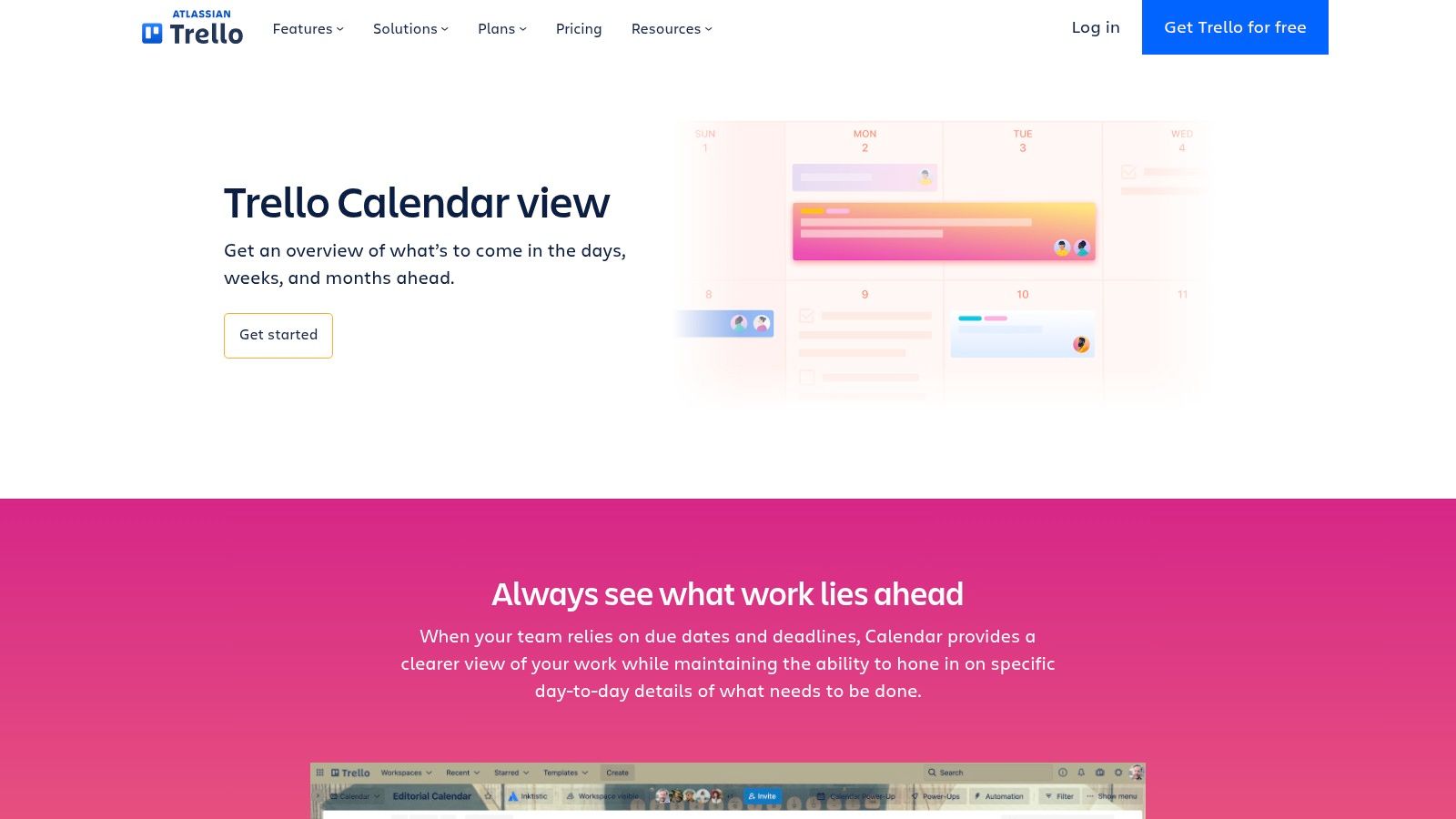
By automating this process, you ensure your most important commercial content goes live when your audience is most likely to convert, without needing to be online. OneUp’s calendar view allows you to visually map out your commerce strategy, balancing midday discovery posts with evening sales pushes.

Actionable Tips for Success

  • Tailor Content to the Time Slot: Post engaging product hauls and user-generated content (UGC) around 12 PM for the lunch-scrolling audience. Reserve live shopping events and unboxing videos for the 8 PM peak when viewers are more settled and ready to buy.
  • Create Urgency: Use the 7-9 PM window to announce limited-time offers or flash sales. The combination of evening relaxation and a sense of urgency can dramatically increase conversions.
  • Leverage Creator Content: Schedule posts from UGC creators or influencers during the lunch hour. Their authentic recommendations feel less like an ad and can capture attention more effectively during a quick scroll session.
  • Analyze Your TikTok Analytics: Pay close attention to your follower activity and post-performance data within TikTok. Identify if your specific audience deviates from these general times and adjust your schedule accordingly for maximum impact.

8. Pinterest: Morning Planning Sessions (9-10 AM and 7-8 PM)

Unlike other platforms focused on immediate social interaction, Pinterest is a discovery engine where users plan for the future. This unique user behavior creates two distinct peak engagement windows: morning inspiration sessions between 9 AM and 10 AM and evening planning from 7 PM to 8 PM. Morning users are often curating inspiration boards, while evening users are actively planning next-day activities, projects, and purchases.
Pinterest: Morning Planning Sessions (9-10 AM and 7-8 PM)

Aligning your content with this planning mindset is crucial for success. For instance, home decor brands often find their pins saved 40% more when posted in the evening, as users plan home improvement projects. Similarly, wedding planning content published on a Thursday evening can reach over 500,000 impressions as users prepare for weekend research. Mastering these windows is a key part of finding the best time to post on social media for visual-heavy brands.

How to Implement This Strategy

Manually pinning during these specific time slots every day is inefficient and prone to error. A robust scheduling tool is necessary to maintain consistency and maximize visibility when your audience is most receptive.

Pro Tip: Use a tool like OneUp to schedule your Pins across multiple boards for both the 9-10 AM and 7-8 PM peaks. OneUp allows you to upload custom images, add destination links, and set posts to automatically repeat every few months, breathing new life into your evergreen content without manual effort.

This strategy ensures your content consistently appears during prime planning periods. With OneUp's bulk upload feature and Canva integration, you can queue up weeks of content at once, saving significant time while still hitting every optimal posting window.

Actionable Tips for Success

  • Plan Seasonally: Pinterest users plan far in advance. Post seasonal content like holiday recipes or summer DIY projects at least 2-3 months ahead of time to build momentum.
  • Focus on Weekend Planning: The Thursday and Friday evening slots (7-8 PM) are especially powerful for reaching audiences planning their weekend projects, purchases, and activities.
  • Create Rich Pins: Enable Rich Pins for your website. This automatically syncs information like product prices or recipe ingredients directly to your Pins, providing more context and improving their performance in the Pinterest algorithm.
  • Repurpose Top Performers: Use your analytics to identify your most popular Pins. Schedule them to be re-pinned to different relevant boards every three months to capture a fresh audience.

9. Snapchat: After-School Hours (3-5 PM) and Late Evening (9-11 PM)

Snapchat’s core demographic, primarily users aged 13-24, engages with the platform differently than audiences on other networks. Their activity spikes during specific leisure periods, making timing crucial for visibility. Data consistently shows two optimal windows: after-school hours from 3 PM to 5 PM and a late-evening slot between 9 PM and 11 PM. These periods align perfectly with when younger audiences are winding down from school or socializing before bed.

Posting during these peak times ensures your Stories and Snaps land in front of users when they are most active and receptive. For example, major media brands like MTV have achieved over 20 million views by dropping new stories around 4 PM, capturing the after-school crowd. Similarly, brand filters launched during the 9 PM peak on weekends have generated over 100 million impressions, capitalizing on evening social interactions.

How to Implement This Strategy

Manually posting during these specific windows, especially the late-evening slot, can disrupt your workflow. A scheduling tool is the best way to maintain consistency and capture both peak engagement periods without being tied to your phone.

Pro Tip: While Snapchat's API has limitations for direct third-party scheduling, you can use a tool like OneUp to schedule push notifications to your mobile device at the perfect time. You prepare the content in OneUp, and at your scheduled time (e.g., 4 PM or 10 PM), you get a notification to complete the post in the Snapchat app in just a few taps.

This notification-based scheduling allows you to plan your Snapchat content calendar alongside your other social media channels within a single dashboard, ensuring your timing is always precise. This method is an effective workaround to find the best time to post on social media for this unique platform.

Actionable Tips for Success

  • Create Daily Habits: Post a new Story daily around 4 PM to build a routine with your after-school audience. Use Snapstreaks to encourage daily, reciprocal engagement.
  • Maximize Weekend Evenings: Schedule branded filters and interactive Lenses to go live on Friday and Saturday evenings between 9 PM and 11 PM to align with peak social activity.
  • Leverage User-Generated Content: Feature user-submitted Snaps during these peak hours to boost community engagement and make your audience feel seen.
  • Think Globally: If you have an international audience, use a scheduler to set up posting reminders that cover optimal after-school and evening hours across multiple time zones.

10. Reddit: Evening Off-Peak Strategy (6-10 PM) with Subreddit-Specific Optimization

Unlike other platforms driven by a central algorithm, Reddit's power lies in its niche communities, or subreddits. While general data points to an evening peak between 6 PM and 10 PM when users have more leisure time, a one-size-fits-all approach is ineffective here. The key to Reddit is understanding that the best time to post on social media for this platform is determined by the specific subreddit’s unique audience and their habits.

Success on Reddit requires granular, community-specific timing. For instance, posts in r/AskReddit often gain significant traction around 7 PM EST, while a technical community like r/science might see its peak engagement on a Wednesday evening. The goal is to capture the initial wave of upvotes within the first hour to trigger Reddit's algorithm and push your post to the subreddit’s "Hot" page, and potentially the front page.

How to Implement This Strategy

Manually researching and posting to multiple subreddits at their precise peak times is a significant challenge. A scheduling tool that supports Reddit is crucial for executing a targeted strategy effectively and consistently.

Pro Tip: Use a tool like OneUp to schedule your Reddit posts for these hyper-specific evening windows. You can schedule posts to any subreddit, and even add a delay between posting to different subreddits to avoid appearing spammy. OneUp also supports post flair and can automatically add your first comment, which is a common practice in many communities.

This level of automation allows you to focus on creating quality content and engaging with comments, rather than watching the clock. Scheduling ensures you hit the optimal window every time, which is critical for gaining that initial momentum.

Actionable Tips for Success

  • Research Subreddit Peaks: Before posting, spend at least a week observing your target subreddit. Note when the top posts of the day were submitted and how quickly they gained traction.
  • Aim for an Initial Boost: Your primary goal is to get 50+ upvotes within the first hour. This often requires posting at the very beginning of the subreddit's peak activity period.
  • Engage Immediately: Be prepared to reply to comments within the first 10-20 minutes of your post going live. This interaction signals value to both the algorithm and the community.
  • Leverage General Trends: If a specific subreddit’s data is unclear, start by testing posts between Thursday and Friday from 6 PM to 8 PM, as this window is a strong performer across many large communities.

Best Times to Post: 10-Platform Comparison

Platform (Timing) Implementation Complexity 🔄 Resource Requirements ⚡ Expected Outcomes ⭐📊 Ideal Use Cases 💡 Key Advantages ⭐
Facebook: Weekday Afternoon (1–3 PM) Medium — consistent scheduling; competitive window 🔄 Medium — regular posts, analytics, scheduling tools ⚡ ⭐⭐⭐⭐ — high CTR & conversions during lunch; predictable peaks 📊 B2B promos, time-sensitive announcements, business pages 💡 Predictable audience availability; strong conversion rates ⭐
Instagram: Evening (7–9 PM) Medium–High — high-quality visuals & timing sensitivity 🔄 High — polished creatives, Reels, Stories production ⚡ ⭐⭐⭐⭐ — strong likes/comments and algorithmic boost 📊 Consumer brands, influencers, visual campaigns 💡 Large engaged audience; strong Reels distribution ⭐
TikTok: Dual-Peak (6–7 AM & 6–11 PM) High — trend responsiveness; tight timing critical 🔄 Medium–High — frequent short-form content, trend monitoring ⚡ ⭐⭐⭐⭐⭐ potential — rapid FYP amplification if early engagement 📊 Viral content, youth-focused campaigns, trend-led pieces 💡 Two daily peaks; powerful algorithmic reach ⭐
Twitter/X: Midday Surge (9–10 AM & 5–6 PM) Medium — real-time posting & rapid engagement 🔄 Medium — monitoring, quick replies, thread management ⚡ ⭐⭐⭐ — immediate visibility; short content lifespan 📊 News, announcements, live commentary, industry threads 💡 Fast conversation growth; excellent for breaking news ⭐
LinkedIn: Tue–Thu 8 AM (Professional Peak) Low–Medium — consistent professional tone 🔄 Medium — thought leadership, long-form posts, engagement ⚡ ⭐⭐⭐⭐ — high-quality B2B leads & conversions 📊 B2B marketing, recruitment, executive thought leadership 💡 High-quality audience with purchase intent; strong conversions ⭐
YouTube: Thu–Fri Release (5–7 PM) High — video production and timing coordination 🔄 High — filming, editing, thumbnails, optimization ⚡ ⭐⭐⭐⭐ — extended watch time; algorithm favors early views 📊 Long-form tutorials, series, entertainment releases 💡 Weekend watch-time amplification; strong recommendation lift ⭐
TikTok Shop (12–1 PM & 7–9 PM) Medium–High — commerce setup, live events 🔄 High — influencers, live production, commerce integration ⚡ ⭐⭐⭐⭐ — elevated click-throughs and peak conversions (8–9 PM) 📊 D2C sales, live shopping, product launches 💡 High purchase intent; strong shoppable engagement ⭐
Pinterest: Morning/Evening (9–10 AM & 7–8 PM) Low–Medium — scheduling and seasonal planning 🔄 Low–Medium — pin design, descriptions, scheduler ⚡ ⭐⭐⭐ — long-term referral traffic; durable lifespan (3–6 mo) 📊 Evergreen content, DIY, wedding/event planning, discovery 💡 Long content lifespan; steady referral traffic ⭐
Snapchat: After-School & Late Evening (3–5 PM & 9–11 PM) Medium — frequent ephemeral content and timing 🔄 Medium — UGC, filters, daily stories production ⚡ ⭐⭐⭐ — strong Gen Z engagement; ephemeral reach 📊 Youth-focused activations, authentic UGC, filters & lenses 💡 Highly engaged younger demographic; authentic interactions ⭐
Reddit: Evening Off-Peak (6–10 PM; subreddit-specific) High — community research, rule compliance 🔄 Low–Medium — time for research, moderation, authentic posts ⚡ ⭐⭐⭐⭐ — high authentic engagement & sustained visibility when optimized 📊 Community-driven marketing, AMAs, niche discussions 💡 Deep, authentic engagement; long post lifespan when accepted ⭐

From Data to Domination: Automating Your Perfect Posting Schedule

Navigating the complex landscape of social media timing can feel like trying to hit a moving target in the dark. Throughout this guide, we've illuminated the peak engagement windows across every major platform, from the professional corridors of LinkedIn to the vibrant, fast-paced feeds of TikTok. We’ve explored the weekday afternoon surge on Facebook, the dual-peak strategy for TikTok, and the critical importance of industry-specific timing for platforms like YouTube and Pinterest. The data provides a powerful starting point, a strategic map to guide your initial content deployment.

However, the core takeaway is that finding the best time to post on social media isn't a one-time discovery; it's an ongoing process of refinement and optimization. The general guidelines are your hypothesis. Your unique audience data is where you find the truth. The real challenge, and the greatest opportunity for growth, lies in transforming this knowledge from a static checklist into a dynamic, automated, and highly efficient system. This is where you graduate from simply posting content to strategically engineering its impact.

The Bridge from Insight to Execution

The gap between knowing your optimal posting times and consistently hitting them is where most social media strategies falter. Manually posting across different platforms, catering to multiple time zones, and managing various client accounts is not just inefficient; it's a recipe for burnout and missed opportunities. True social media domination is achieved when data-driven insights are powered by intelligent automation.

This is where a robust social media management tool becomes indispensable. By leveraging a platform designed for this exact purpose, you can:

  • Implement Your Baseline: Schedule all your posts for the recommended peak times we've discussed. This sets up your initial experiment.
  • Analyze and Adapt: Use built-in analytics to track post performance. Which times are generating the most likes, comments, and shares for your specific accounts? Adjust your schedule based on this hard data.
  • Systematize and Scale: Create a repeatable workflow that saves countless hours. This frees you up to focus on what truly matters: creating high-quality content and engaging with your community.

Building Your Automated Content Machine with OneUp

The ultimate goal is to build a system that works for you, ensuring your best content reaches your audience at the moment they are most likely to engage, without you being tethered to your screen. A platform like OneUp is designed to be the engine of this system. Instead of just being a scheduler, it's a command center for your entire social media operation.

Consider how you can automate the principles from this article:

  1. Centralize Your Channels: Connect all your accounts, from Facebook Pages and Instagram profiles to Google Business Profiles and Pinterest boards. With OneUp, you can manage unlimited social accounts on any plan, making it perfect for agencies and businesses with a wide digital footprint.
  2. Batch and Categorize: Use OneUp's content categories to batch-schedule different types of content. You can create a "Blog Promotion" category that posts every Tuesday and Thursday at 9 AM and a "Behind the Scenes" category for Fridays at 2 PM, aligning with audience behavior patterns.
  3. Automate Evergreen Content: That high-performing post from three months ago shouldn't just sit in your archive. Set it to automatically recycle at set intervals, ensuring your best content continues to drive results and fill gaps in your content calendar.
  4. Manage Engagement Efficiently: The conversation doesn't end after you post. OneUp's unified social inbox brings all your comments and messages into one place, so you can respond promptly and keep the engagement loop going.

By combining the data-backed timing strategies with a powerful automation tool, you create a flywheel of growth. Consistent posting at optimal times leads to higher engagement, which signals to the algorithms that your content is valuable, leading to greater reach and even more engagement. This is how you turn theoretical knowledge about the best time to post on social media into consistent, predictable, and scalable results.


Ready to stop guessing and start automating your perfect posting schedule? OneUp provides all the tools you need, from scheduling and a unified inbox to evergreen recycling and detailed analytics, all with unlimited accounts. Sign up for a free trial of OneUp today and transform your data-driven insights into effortless execution.


How to Use Hashtags Effectively

Slapping a few hashtags on your post moments before you hit "publish" is a surefire way to leave reach and engagement on the table. To really move the needle, you need to treat hashtags as a core part of your content plan—something you research, categorize, and tailor for every platform.

It’s about moving beyond last-minute additions and building a smart, strategic library of tags that actually work for you.

Building a Modern Hashtag Strategy

A person's hand holding a phone displaying a social media notifications and icons.

If you're still relying on guesswork, it's time for an upgrade. A modern hashtag strategy isn't about hoping for the best; it's a deliberate system for getting your content in front of the right eyeballs. Think of hashtags as digital signposts that guide users—and, just as importantly, the algorithms—directly to your posts.

They are, at their core, a powerful classification tool. Hashtags tell platforms what your content is about, which helps them show it to people who’ve already shown interest in that topic. This is exactly why they remain a crucial engine for discoverability. When you get it right, hashtags introduce your brand to a massive audience far beyond your existing followers.

The Four Pillars of an Effective Strategy

To build a strategy that actually performs, you need to understand that not all hashtags are created equal. Different types serve different purposes, and a balanced approach ensures you're tapping into multiple discovery pathways at once.

Your strategy should always include a healthy mix of these four core types:

  • Branded Hashtags: These are unique to your business. Think #OneUpApp or a specific slogan for a new launch. They're fantastic for tracking user-generated content (UGC) and carving out your brand’s space online.
  • Community Hashtags: These plug you into specific niches and conversations. For instance, a small coffee shop could use #LatteArtLovers or #LocalCoffeeScene to connect with a passionate, built-in audience.
  • Campaign Hashtags: These are short-term tags tied to a specific marketing push, like a product launch, a contest, or an event. They create buzz and make it incredibly easy to track the results of that one initiative.
  • Trending Hashtags: These pop up around current events or viral moments. They can give you a quick visibility boost, but tread carefully. Only jump in if the trend is genuinely relevant to your brand and message.

Why a Strategic Approach Matters

Just knowing the types isn't the whole picture. The real magic happens when you organize them effectively. This is where having a dedicated tool can be a game-changer. For instance, with OneUp’s Hashtag Collections feature, you can create, save, and organize different sets of hashtags for all your content pillars.

You can have a pre-vetted group for product announcements, another for behind-the-scenes posts, and a third for customer testimonials. This keeps your messaging consistent and saves you hours of manual work. OneUp even lets you drag-and-drop posts with their hashtag collections to a new time slot on the social media calendar, making rescheduling effortless.

A well-planned hashtag strategy transforms your posts from isolated broadcasts into interconnected parts of a larger conversation. It’s the difference between shouting into the void and stepping into a room full of interested listeners.

Hashtags are still a critical tool, but their impact varies wildly between platforms. On X (formerly Twitter), brands can see an engagement boost of around 50% just by using hashtags well. On Facebook, though, less is more; posts with a single, relevant hashtag tend to get the highest engagement, and using more than ten can actually hurt your reach. You can learn more about these platform-specific hashtag insights.

This data makes one thing clear: treating hashtags as an afterthought is a costly mistake.

Finding Hashtags That Actually Work

Throwing a generic hashtag like #marketing or #business onto your post is the digital equivalent of whispering in a crowded stadium. Your message just gets lost in the noise. The real trick is finding the hashtags that plug you into a targeted, engaged audience that actually cares about what you're saying. This means building a strategic "hashtag library" instead of just grabbing the most obvious tags for every post.

The goal here is to hit that sweet spot: hashtags popular enough to get you some eyeballs, but not so saturated that your content disappears in a flash. It all starts with a little digital detective work—peeking at what your competitors, industry leaders, and target audience are already doing.

Building Your Hashtag Library

First things first, stop thinking about hashtags on a post-by-post basis. It's time to build a reusable, organized collection you can pull from. Think of it as a portfolio of assets, each one tailored to a different content theme or campaign.

I always start by digging into three key groups:

  • Your Competitors: Who’s crushing it in your space? Take a look at their posts and see which hashtags they use consistently. Don't just copy-paste; analyze which tags seem to be sparking actual conversations and engagement.
  • Industry Influencers: Find the creators and thought leaders your audience already follows. Their hashtag strategy is often a goldmine of niche, community-specific tags you would've never thought of on your own.
  • Your Target Audience: This one is huge. What hashtags are your ideal customers using on their own profiles? This gives you a direct line into the authentic, user-generated conversations you should be a part of.

This isn't just about finding popular terms. Research consistently shows that relevance and specificity are what matter. In fact, platforms can penalize posts that look spammy from excessive hashtagging. For smaller accounts, for instance, an Instagram post with at least one relevant hashtag can generate 29% more interactions. It's all about strategic use, because misusing them can actually get your content hidden.

Finding Niche and Community Tags

The most powerful hashtags are rarely the biggest ones. Sure, #digitalmarketing has millions of posts, but a tag like #smallbizmarketingstips is speaking to a much more specific—and likely more motivated—audience.

The real power of a hashtag isn't its size, but its relevance. A hashtag with 10,000 highly relevant posts is far more valuable than one with 10 million generic ones. Your content has a better chance to stand out and attract the right people.

To find these gems, you have to think like your audience. What specific problems are they trying to solve? What online communities do they hang out in? A personal trainer, for example, will find way more success with #postpartumfitnessjourney or #kettlebellworkoutideas than just #fitness.

This is especially true on video platforms, where hashtag discovery feels a lot like good old-fashioned keyword research. For YouTube creators, finding the right terms is everything, and many of the same strategies apply. There are some great guides on YouTube Keyword Research Tools that can give you some solid ideas for your own process.

To help you decide which approach to take, here's a quick breakdown of the common methods for hashtag research.

Hashtag Research Methods Comparison

Method Description Pros Cons
Manual Search Directly searching for tags and exploring related ones on each platform. Simple, free, and gives you a real-time feel for the conversation. Extremely time-consuming and hard to scale.
Competitor Analysis Reviewing the hashtags used by direct competitors and industry leaders. Provides proven, relevant tags that are already working in your niche. Risk of being a copycat; you might miss emerging trends.
Audience Research Observing the hashtags your target customers use in their own posts. Uncovers authentic, community-driven tags and user language. Can be difficult to find a large enough sample size of public profiles.
Tool-Based Research Using specialized tools to generate hashtag suggestions and analyze performance. Fast, data-driven, and provides valuable metrics like post volume and engagement. Often requires a paid subscription; may lack the nuance of manual research.

Ultimately, the best strategy is a mix of all these. Start with some manual research to get a feel for the landscape, then use tools to speed up the process and validate your choices.

Tools and Automation for Smarter Research

Let's be honest, manually hunting for hashtags is a good starting point, but it's a massive time sink. This is where the right tools can completely change the game.

Here at OneUp, we built features to take the guesswork out of it. Our platform has an integrated Instagram Hashtag Generator that gives you suggestions based on your content. It helps you find relevant, high-performing tags right inside your scheduling workflow, so you're not jumping between a dozen different tabs.

Even better, you can create Hashtag Collections. Once you’ve found winning groups of hashtags for different content pillars—like product launches, blog promotions, or behind-the-scenes posts—you can save them. The next time you create a post, you just add your curated hashtag group with a single click.

This approach lets you:

  • Organize tags by content pillar: Keep separate, optimized lists for different themes.
  • Ensure brand consistency: Use your approved branded and campaign hashtags every single time.
  • Save hours of manual work: No more typing out the same 20 hashtags over and over.

By blending smart manual research with the right tools, you build a system that’s both strategic and efficient. You'll be able to deploy hashtags that actually pull in the right audience and drive much better results from your social media efforts.

Tailoring Hashtags for Each Social Platform

Trying to use the same hashtag strategy across every social network is a rookie mistake. It's like trying to use the same key for different locks—it just won't work. Each platform has its own algorithm, its own user base, and its own set of unwritten rules.

A hashtag that crushes it on Instagram might be completely invisible on LinkedIn or just look weird on X. The secret is to get familiar with the unique vibe of each platform and tweak your approach accordingly. This means changing up everything from how many hashtags you use to where you put them and what kind you choose.

Instagram: A Visual Discovery Engine

Instagram is, without a doubt, the king of hashtags. Here, they're the main way users discover new content and accounts that match their interests. Because it's so visual, the platform rewards a smart mix of popular and super-niche tags.

Think of it like casting a wide, but very specific, net. You can technically cram in up to 30 hashtags, but the real sweet spot is somewhere between 5 and 15. This gives you enough room to hit different audiences without looking desperate or spammy.

  • Placement: You've got two main choices: in the caption or in the first comment. Both work just as well for getting discovered. A lot of brands stash them in the first comment to keep their captions clean and focused on the story.
  • Best Practices: Build a "hashtag stack." Start with a few huge, high-volume tags (like #digitalart), add several mid-sized community tags (e.g., #procreateartists), and finish with a handful of hyper-specific ones (like #characterdesignchallenge). This layered approach is your best bet for maximizing reach.
  • Pro Tip: If you're using a scheduler like OneUp, you can set it to automatically post your hashtags to the first comment on Instagram. It’s a simple trick that saves you a manual step and keeps your workflow smooth.

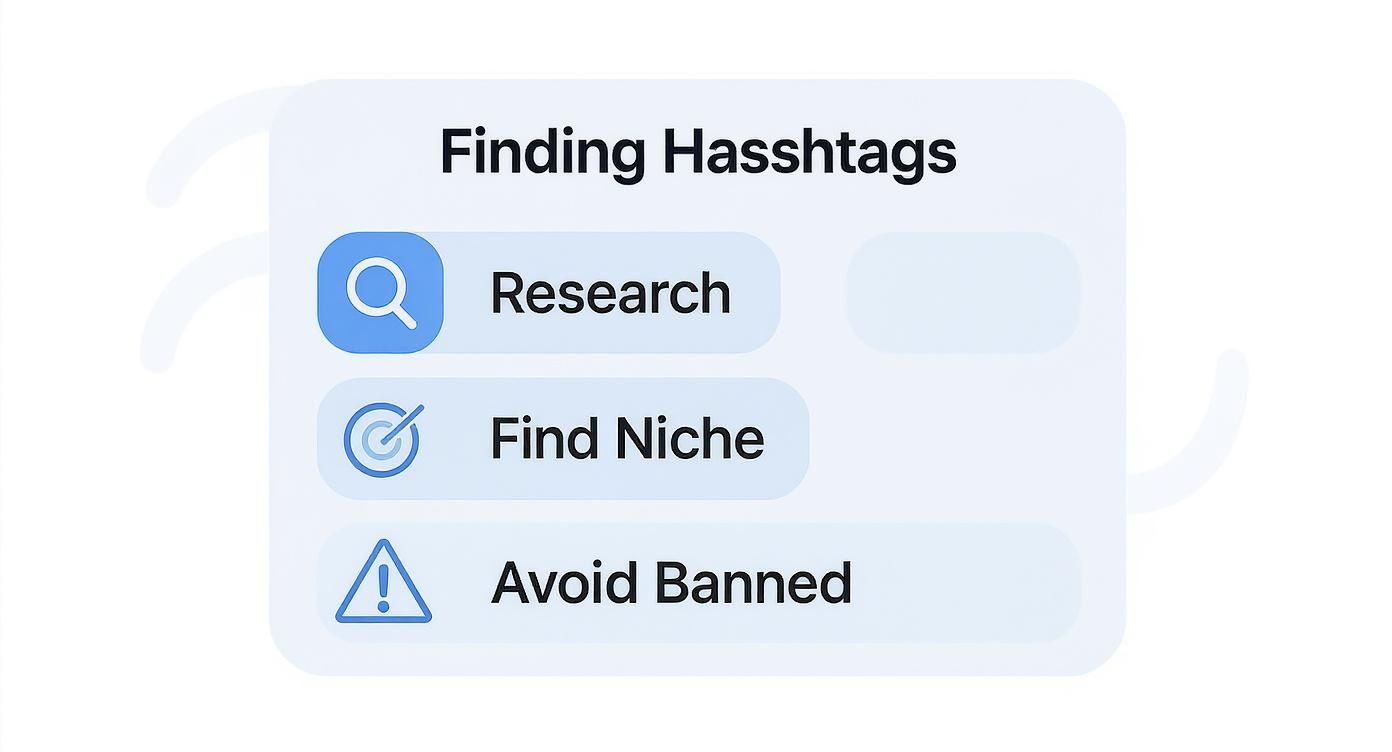
This infographic breaks down the essential steps for solid hashtag research: investigating your options, zeroing in on your niche, and making sure the tags you choose are safe to use.

Infographic about how to use hashtags effectively

It’s a great reminder that a winning strategy is built on real research, not just guesswork.

X (Twitter): The Real-Time Conversation Hub

On X (formerly Twitter), things move fast. Really fast. Hashtags here are all about categorizing tweets into live discussions, making your content searchable, and plugging it into what's trending right now. Unlike Instagram, less is always more on X.

Stuffing a tweet with a wall of hashtags just looks amateur and distracts from your actual message. People are scrolling quickly, and they want clear, concise info.

On X, a hashtag isn't just a label; it's your ticket into an ongoing conversation. Use it to add your voice where it matters, not to shout into the void.

Stick to 1-2 highly relevant hashtags per tweet. You can weave them into the sentence naturally or just tack them on at the end. The goal is simple: provide context and join a specific chat, whether it's about an industry event, a news story, or your own brand campaign.

LinkedIn: The Professional Networking Powerhouse

LinkedIn is the world of professional development, industry insights, and career-focused talk. Hashtags on this platform are basically topic filters that help professionals find content that’s relevant to their field. Used right, they can get your posts seen by people way outside your immediate network.

The tone here is more buttoned-up, and your hashtags need to match. Ditch the cutesy or generic tags. Instead, lock in on specific industry keywords, skills, and professional topics.

The magic number for a LinkedIn post is between 1 and 3 hashtags. It’s all about quality, not quantity. For instance, a marketing agency would be better off using #B2Bmarketing, #contentstrategy, and #leadgeneration to pull in the right kind of professional eyes.

TikTok: The Trend and Entertainment Epicenter

TikTok's algorithm is a beast, and hashtags are what feed it. They tell the algorithm what your video is about so it can serve it up to users who are already watching similar stuff. On TikTok, hashtags are non-negotiable if you want to tap into trends and land on the coveted "For You" page.

For the best results, aim for 3-5 hashtags per video. You'll want a blend of broad, trending tags (like the classic #fyp) and more specific tags that nail down what your content is actually about. So, a cooking video might use #easyrecipes, #mealprep, and whatever hashtag is tied to the trending sound you used.

Trends on TikTok can be born and die in a matter of hours, so you have to stay on top of what's hot. For creators who want to take the guesswork out of it, a dedicated TikTok hashtag generator can give you data-backed suggestions to help your content find its audience.

Facebook: Connecting Communities

Hashtags on Facebook have had a bit of a rocky past, but they’ve become much more useful in recent years, especially inside Groups and for general content discovery. While they aren't as mission-critical as on Instagram, they can still give your organic reach a nice little bump when you use them right.

Just like on X and LinkedIn, the key is to be subtle and strategic. Go with 1-2 super relevant hashtags to give your post some context. They tend to feel most natural on Facebook when you work them right into the post's text. For example: "We're so excited to launch our new line of eco-friendly products! #sustainability #gogreen".

At the end of the day, a one-size-fits-all approach to hashtags is just a recipe for wasted effort. By tailoring your strategy to the platform you're on, you turn them from an afterthought into a seriously powerful tool for growth.

Getting Your Hashtag Workflow Dialed In with OneUp

Trying to manage your hashtags from a messy spreadsheet or a bunch of random notes is a surefire way to burn time and get inconsistent results. A solid hashtag strategy really needs a central hub to keep everything organized. This is exactly where a social media scheduling tool becomes your best friend, turning hashtag chaos into a smooth, streamlined process.

A screenshot of the OneUp social media scheduling tool showing a visual calendar and post creation interface.

When you move past manually copying and pasting everything, you can actually focus on what matters: creating great content. Let the tool handle the grunt work. With the right setup, you bring some serious order to your strategy, making sure every post goes out with the best possible hashtags for the job.

Organize Your Tags into Hashtag Collections

Good organization is everything. Instead of digging around for the right hashtags every single time you draft a post, you can build out a library of go-to sets for different topics, campaigns, or even clients. This is what OneUp's Hashtag Collections feature was built for.

Let's say you're running the social accounts for a local gym. You could create different collections for your main content pillars:

  • #WorkoutTipsCollection: A solid mix of tags like #fitnessmotivation, #workoutideas, and #strengthtraining.
  • #NewClientPromo: For your next campaign, you'd have tags like #specialoffer, #jointhegym, and your own branded tag ready to go.
  • #MemberSpotlight: Community-building tags such as #gymcommunity, #fitnessjourney, and #clienttransformation.

When you schedule a new post, just grab the collection you need with a single click. This simple move saves a ton of time each month and keeps your branding perfectly consistent. No more guesswork.

Keep Captions Clean by Automating the First Comment

A classic debate on Instagram and Facebook is where to stick your hashtags. They work just fine in the caption or the first comment, but a lot of brands prefer putting them in the comments to keep the main caption looking clean and focused.

The problem? Trying to manually post that comment the second your content goes live is a pain, especially if you’re juggling multiple accounts.

OneUp completely automates this. You just add your hashtag collection, tick the box to "post hashtags as a first comment," and you're done. The tool takes care of it, so your caption stays clutter-free while your hashtags do their job in the background. It's a small tweak that makes a big difference.

Automate and Scale Up Your Content Schedule

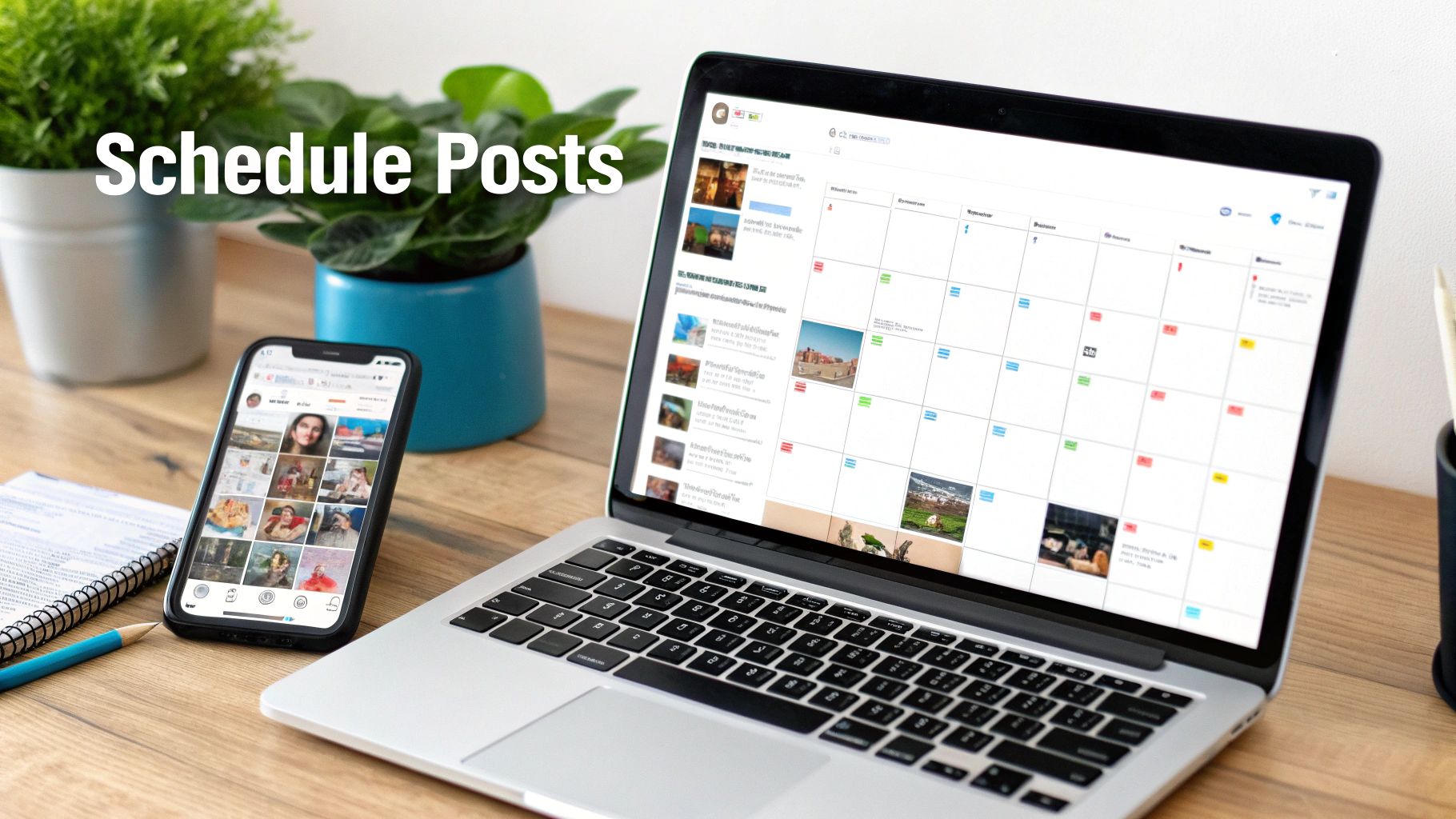
A smart hashtag plan is only as good as the posting schedule it's attached to. OneUp’s visual calendar gives you a bird's-eye view of your content plan, so you can easily see where the gaps are and make sure you have a good mix of posts going out.

But you can take it a step further by layering in automation that works perfectly with your hashtag collections.

  • Repeating Posts: Got evergreen content? Set your weekly tips or monthly reminders to post on autopilot. Attach the right hashtag collection once, and it’ll be included every time it publishes.
  • Bulk Uploading: If you have a ton of content ready, you can schedule it all at once with a CSV or Google Sheets file. You can even assign different hashtag collections to each post directly in the spreadsheet.
  • Custom Follow-Up Comments: Get the conversation going immediately by scheduling a follow-up comment to appear minutes after your post goes live. Ask a question or add a little extra info to spark engagement.

You can see how all these pieces fit together by checking out the tools over at OneUp, which helps you manage the entire process from content creation to scheduling and analytics.

The real goal here is to build a workflow where hashtags aren't an afterthought. They should be a natural, integrated part of your publishing process. Automation frees you up from the boring stuff so you can get back to creating content that people actually want to see.

At the end of the day, tools like OneUp are here to handle the repetitive, manual tasks that bog down social media managers. When you can organize your hashtags, automate first comments, and schedule repeating content, you’re not just saving time—you're executing a more sophisticated strategy without all the daily grind. That efficiency is how you scale your efforts and get real, predictable growth.

Measuring Performance to Refine Your Strategy

Throwing hashtags at your posts without measuring the results is just wishful thinking. You might feel like you're doing everything right, but until you dig into the data, you’re flying completely blind. To really nail your hashtag game, you have to stop guessing what works and start tracking what actually moves the needle.

This means looking past vanity metrics like simple "likes" and focusing on the numbers that signal real growth. Are your hashtags actually expanding your reach? Are they putting your content in front of new, relevant eyeballs? Data holds the answers, turning your strategy from a creative art into a data-backed science.

Identifying KPIs That Actually Matter

Let's be honest, not all metrics are created equal. To get a true picture of your hashtag performance, you need to zero in on the numbers that tie directly back to your social media goals.

Here are the ones I always keep a close eye on:

  • Impressions from Hashtags: This is gold. On platforms like Instagram, you can see the exact number of people who found your post through the hashtags you used. It's one of the most direct measures of a hashtag's power.
  • Post Reach: This tells you the total number of unique accounts that saw your post. If you notice a steady climb in reach when you use specific hashtag sets, you know those tags are doing their job and pushing your content out further.
  • Engagement Rate: Go deeper than likes. Look at the ratio of comments, shares, and saves. High engagement is a massive clue that your hashtags are attracting an audience that genuinely cares about what you have to say.
  • Follows from Hashtags: Some analytics tools will even show you how many new followers a specific post generated. This is a powerful way to see which tags are bringing people in who want to stick around for more.

A Simple Framework for A/B Testing

Once you know what to track, it's time to start experimenting. A/B testing is just a fancy way of saying you’re comparing two different things to see which one performs better, and it's perfect for hashtags. The process couldn't be simpler: create two very similar posts, but use a different group of hashtags for each one.

For example, on Post A, you could use a set of broad, high-volume hashtags. Then, for Post B, try a collection of super-specific, niche community tags. Publish them at similar times but on different days (to avoid tripping over your own data), and then compare the key metrics.

The whole point of A/B testing is to collect hard evidence. It replaces assumptions like "bigger hashtags are always better" with solid proof of what truly connects with your audience.

This simple testing loop removes all the guesswork. Over time, you’ll build an invaluable library of what works for your brand, your content, and your goals.

Tracking the Right Hashtag Metrics

To truly understand the impact of your hashtags, you need to monitor a few key performance indicators regularly. This table breaks down the essentials—what they are, what they tell you, and why you should care.

Metric What It Measures Why It's Important
Impressions from Hashtags The number of times your content was seen by users who found it via hashtags. A direct indicator of a hashtag's discovery power. High numbers mean the tag is working hard for you.
Reach The total number of unique accounts that saw your post. Shows how effectively your hashtags are extending your content's visibility beyond your existing followers.
Engagement Rate The percentage of users who interacted (liked, commented, shared, saved) with your post. Reveals if you're attracting the right audience—one that finds your content valuable, not just one that scrolls by.
Click-Throughs The number of clicks on links in your post or bio, attributed to a post using specific hashtags. Crucial for measuring traffic generation. It shows which hashtags drive users to take action.
New Followers The number of new followers gained from a specific post. A strong signal that your content and hashtags are compelling enough to convert viewers into community members.

By keeping an eye on these numbers, you can move from hoping your strategy works to knowing it does, making informed adjustments along the way.

Conducting a Periodic Hashtag Audit

The social media world moves fast. A hashtag that was a top performer last month might be a dud today. Trends fade, conversations pivot, and popular tags can become so oversaturated they're useless.

This is why a periodic hashtag audit is non-negotiable for a healthy, effective strategy.

Every quarter, set aside some time to review your go-to hashtag lists. Look for tags that are no longer pulling their weight in reach or engagement. This is your chance to trim the fat and swap out the underperformers with fresh, relevant alternatives you've found through your ongoing research.

For a deeper dive into measuring your overall impact, this guide on how to measure social media engagement is a great resource. By consistently measuring, testing, and refining, you ensure your hashtag strategy stays sharp, relevant, and powerful.

Your Top Hashtag Questions, Answered

Alright, you've got the strategy and the platform-specific game plan down. But what about those nagging little questions that always seem to pop up right when you're about to hit "publish"?

Let's clear those up right now. This is your quick-fire FAQ for handling the real-world details of using hashtags effectively.

How Many Hashtags Should I Actually Use?

This is the million-dollar question, and the answer is: it completely depends on the platform. There's no single magic number.

For Instagram, you've got more room to play. Aiming for 5-15 highly relevant hashtags is the sweet spot. On TikTok, however, less is more. Stick to a tight 3-5 tags that perfectly describe your video.

X (formerly Twitter) is all about brevity, so keep it to just 1-2 hashtags. For more professional or community-oriented platforms like LinkedIn and Facebook, a focused 1-3 specific tags work best to target the right conversation.

The golden rule is simple: Always prioritize relevance over hitting an arbitrary number. A few perfect hashtags will always outperform a dozen mediocre ones.

Should Hashtags Go in the Caption or the First Comment?

On Instagram and Facebook, it makes zero difference to the algorithm. Hashtags work the same for discoverability whether they're in the caption or tucked away in the first comment.

Putting them in the first comment is purely an aesthetic choice. It keeps your caption looking clean and focused on your message. It's a popular trick for a reason.

Luckily, you don't have to scramble to do this manually. Tools like OneUp can automatically post your hashtags to the first comment for you. For every other platform, like X and LinkedIn, just pop them right into the caption.

Can I Get Penalized for Using the Wrong Hashtags?

Absolutely, and it's a mistake you don't want to make. Using the wrong hashtags can seriously hurt your post's visibility.

If you use a banned or "broken" hashtag, your content could get hidden from anyone who doesn't already follow you. This is what people often call a "shadowban," and it's incredibly frustrating.

Another thing to watch out for is repetition. Pasting the same huge block of hashtags on every single post looks spammy to the algorithm and can get your content flagged. The best move is to treat each post as unique and pick a fresh, relevant set of tags every time.

How Do I Find Hashtags That Are Trending Right Now?

Finding what's hot depends on what kind of trend you're looking for.

For big, pop-culture moments, your best bet is to check the native "Explore" or "Trending" sections right inside apps like TikTok and X. They'll tell you what the world is talking about.

But for trends specific to your industry, you need to be a bit more of a detective. Keep a close eye on what influencers, competitors, and top publications in your niche are posting about. Social listening tools are also a huge help here for spotting conversations as they start to bubble up.

The goal isn't just to jump on a trend for the sake of it. It's about finding a relevant, timely conversation where your brand can genuinely add something of value.


Ready to stop the guesswork and streamline your entire hashtag workflow? With OneUp, you can create saved Hashtag Collections, automatically post to the first comment, and schedule all your content from a single, intuitive platform. Try it today and turn your hashtag strategy into a powerful growth engine. Learn more and get started at oneupapp.io.

How to Grow Instagram Followers Organically: Step-by-Step Tips

When you boil it all down, growing your Instagram followers organically really comes down to three things: creating high-value content, building a genuine community, and showing up with unwavering consistency.

This isn't about chasing a single viral hack or a magic bullet. It’s about building a solid foundation that consistently pulls in and keeps the right kind of audience for your brand.

Build Your Profile for Organic Growth

Before anyone even considers hitting that "Follow" button, they're going to land on your profile. Think of it as your digital storefront. If it’s messy, confusing, or just plain uninviting, potential followers will bounce.

An optimized profile is your first, and arguably most important, step in turning casual visitors into a loyal community. This is more than just filling in the blanks; you're strategically crafting an identity that clicks with people instantly. Your profile has to answer one simple, unspoken question from every new visitor: "What's in it for me?"

First, Define Your Niche and Audience

The quickest way to grow is to stop trying to be for everyone. When you have a well-defined niche, you can create laser-focused content that speaks directly to a specific group's problems, interests, and passions.

Ask yourself these questions:

  • Who is my ideal follower? Go deeper than just age and location. What are their hobbies? What problems are they trying to solve right now? What kind of content are they bookmarking and sending to their friends?
  • What unique value do I bring to the table? Maybe you're the go-to expert for sustainable home decor, a coach for aspiring freelance writers, or the source for the best gluten-free recipes in town. Your niche is where your passion meets your audience's needs.

A narrow focus makes you memorable. It positions you as an authority, and that's a powerful magnet for organic followers.

Optimize Every Single Profile Element

Once you know exactly who you're talking to, it's time to set up your profile to reel them in. Every piece of your profile plays a part in that split-second decision to follow or leave.

  • Professional Profile Picture: This needs to be a high-resolution logo or a crisp, well-lit headshot. It has to be instantly recognizable, even as a tiny circle in someone's feed.
  • Keyword-Optimized Name and Username: Your "Name" field (the bolded text in your bio) is searchable, so use it! Instead of just "Jen," try something like "Jen | San Diego Foodie." It makes you discoverable.
  • A Compelling Bio and Link: Your bio has one job: state who you help and how you help them. Then, use a tool like OneUp's Link in bio feature to create a clean landing page. This lets you send followers to multiple places at once—your latest blog post, product pages, or newsletter signup—and even add UTM parameters to track your clicks.
  • Switch to a Business or Creator Account: This is non-negotiable. It unlocks Instagram Insights, giving you the critical data you need on follower growth, post-performance, and audience demographics. This is how you refine your strategy over time.

Before you start, here's a quick checklist to run through. Think of it as your pre-flight check for Instagram growth.

Instagram Profile Optimization Checklist

Element Optimization Tactic Why It Matters
Profile Picture Use a clear, high-res headshot or logo. Builds instant recognition and trust.
Username Make it simple, memorable, and relevant to your niche. Easy for people to find and tag you.
Name Field Include a primary keyword (e.g., "Fitness Coach"). It's searchable and clarifies what you do.
Bio Clearly state your value proposition and who you serve. Converts visitors by answering "What's in it for me?"
Link in Bio Use a landing page tool to house multiple important links. Maximizes the single clickable link you get.
Category Choose a specific category (e.g., Blogger, Artist). Helps Instagram understand your account and show it to relevant users.
Highlights Create branded covers for organized, evergreen content. Acts as a menu for new visitors to explore your best content.
Account Type Switch to a Creator or Business account. Unlocks crucial analytics and professional features.

Getting these elements right from the start makes every other growth effort more effective. It ensures that when new people discover you, your profile is ready to convert them into followers.

And let's be clear: real engagement is everything. With the average engagement rate per post on Instagram now at a tiny 0.58%, buying followers is a dead-end strategy that will only tank your account's health. Authentic interaction is what the algorithm rewards. If you're looking to expand your knowledge, there are tons of proven strategies on how to grow social media followers that apply across different platforms.

Create Content That Naturally Attracts Followers

If your optimized profile is the front door, your content is what’s inside. It’s what makes people want to come in, look around, and ultimately, stick around for a while. Just tossing up random posts won't work. You need a deliberate content strategy that delivers real value—this is the secret sauce to growing your Instagram followers organically.

Your mission is to build a content engine. One that consistently churns out high-quality, engaging posts that your target audience actually cares about. When you get this right, your followers do the marketing for you, sharing your stuff and kicking off a powerful organic growth loop.

This whole process follows a pretty logical flow, from figuring out your niche to building out a professional presence that’s ready for growth.

As you can see, it all starts with defining your niche, writing a solid bio, and then using all the features a business account gives you. Get these fundamentals down, and you’re set up for growth.

Establish Strong Content Pillars

Before you even think about what to post today, you need to map out your content pillars. These are the 3-5 core topics your account is built on. Think of them as the guardrails that keep your feed focused, cohesive, and valuable to your audience.

For example, a personal finance coach might have pillars like:

  • Budgeting for Beginners
  • Investing Fundamentals
  • Debt Payoff Strategies
  • Building Generational Wealth

Pillars stop you from posting that random picture of your lunch that just confuses everyone. Every single post should tie back to one of these themes, constantly reinforcing who you are and what people can expect from you.

Master the High-Impact Content Formats

Instagram gives you a bunch of different ways to post, and the smartest accounts use a mix of them to keep things interesting. Each format has a specific job to do.

To help you decide what to use and when, here's a quick breakdown of the main formats for organic growth:

Instagram Content Format Comparison

Content Format Best For Key Strength
Reels Reaching new audiences, viral potential High visibility on the Explore page and Reels feed
Carousels In-depth education, tutorials, storytelling Drives high engagement (swipes) and saves
Stories Building community, behind-the-scenes content Fosters direct interaction and authenticity

Let's dig into how you can put these formats to work for you.

1. Reels for Maximum Reach
Reels are your top-of-funnel workhorse. They are hands-down the best way to get in front of people who don't follow you yet. The algorithm loves pushing entertaining, educational, or inspiring short-form video to new eyeballs on the Explore page. Get on it.

2. Carousels for Deep Engagement and Saves
Carousels, those multi-slide posts, are perfect for teaching and telling a story. They get people to slow down and spend more time with your content, which is a huge positive signal to the algorithm. Use them for step-by-step guides, checklists, or mini-blog posts that are so useful people have to hit "Save."

3. Stories for Community Building
This is where the real connection happens. Stories are for building relationships, not for being perfect. Use polls, Q&As, and quizzes to start actual conversations. It’s less about polish and more about showing the real person or people behind the brand.

Key Takeaway: A winning content mix looks something like this: Use Reels to attract new people, Carousels to educate and nurture them, and daily Stories to build a loyal community.

To keep this all straight, a good scheduling tool is a game-changer. OneUp lets you schedule your Reels, Carousels, and even multi-image Stories from one place. You can set up content categories for your pillars to keep your feed balanced and even bulk upload posts to plan out your content for weeks. This lets you focus on creating great stuff instead of the headache of posting manually. Plus, OneUp's automatic first comment feature lets you post your hashtags separately to keep captions clean.

Of course, a great visual is only half the battle. You need a killer caption to go with it. If you're ever stuck, tools like OneUp's Instagram caption generator can give you a spark of inspiration to write text that gets people talking.

Master Captions and Hashtags for Better Discovery

A killer visual might stop the scroll, but it's the right caption and hashtag combo that actually turns a casual viewer into a follower. This is where you graduate from just posting pictures to actually starting conversations.

Think of it this way: your photo or Reel is the hook, but the caption is where you build a real connection. And the hashtags? Those are the signposts that lead brand-new, interested audiences right to your digital doorstep.

Write Captions That Actually Start Conversations

The best captions feel less like an announcement and more like you're chatting with a friend. They need to invite people to think, feel, and—most importantly—respond. The easiest way to nail this is by ending your caption with a direct question.

Instead of posting a picture of your morning coffee and writing "Coffee time," try this: "My morning doesn't officially start until the coffee is brewed. What's the one non-negotiable part of your morning routine?" See the difference? That small tweak turns a passive statement into an active invitation to engage.

Here are a few caption formulas I come back to again and again:

  • Tell a mini-story: Share the "why" behind the post. Was it a big business win, a lesson learned the hard way, or just a funny moment? People connect with stories, not just pretty pictures.
  • Educate and inform: Drop a quick tip, a surprising stat, or a mini how-to guide related to your niche. This immediately positions you as an expert and gives people a reason to hit that "save" button.
  • Ask for opinions: Turn the tables and make your audience the expert. A travel blogger could ask, "Planning a trip to Lisbon! What's the one thing I absolutely can't miss?"

Pro Tip: Every single caption should have a clear call-to-action (CTA). It can be as simple as "drop your thoughts in the comments," but don't be afraid to direct people to "tap the link in our bio" or "tag a friend who needs this."

Build a Tiered Hashtag Strategy

Hashtags are the engine of discovery on Instagram. If you're serious about figuring out how to grow Instagram followers organically, you have to get them right. Just grabbing 30 popular tags and slapping them on your post is a recipe for getting lost in the noise.

A much smarter approach is a tiered strategy that balances broad reach with laser-focused relevance.

Your hashtag mix should look something like this:

  • Niche-Specific Hashtags (5-10): These are the super-targeted tags with smaller post counts (think under 100k). Instead of #homedecor, you'd use something like #sustainablehomedecor. This is how you find your people—the passionate, highly-engaged audience you're looking for.
  • Community Hashtags (5-10): These are the tags people in your industry are using to connect with each other. Think #womeninbusiness or #freelancewritersofinstagram. They’re great for networking and building relationships with peers.
  • Broad-Reach Hashtags (2-5): These are the big-leaguers with millions of posts, like #marketingtips or #digitalart. Use them sparingly. Your content won't stay at the top for long, but they can provide a quick burst of visibility.

How to Research and Organize Your Hashtags

Finding the right hashtags takes a little legwork upfront, but the payoff is massive. A great starting point is to simply look at what successful accounts in your niche are using. The Instagram search bar is also your best friend—type in a keyword, and it will spit out related tags and their post volume.

To really save time, create pre-vetted hashtag lists for each of your main content topics. This is where a tool like OneUp becomes a huge help. You can create and save different sets of hashtags right in your account.

When you go to schedule a post, you can add your perfectly researched hashtag group with a single click. OneUp's scheduling features allow you to automatically post your hashtags in the first comment, keeping your caption looking clean and focused. For anyone needing fresh ideas, a good Instagram hashtag generator can be a fantastic way to discover new tags you might have missed.

One last thing: always do a quick search on a hashtag before you use it. You need to make sure it hasn't been banned or restricted by Instagram, because using one can tank your post's reach.

Build a Community That Fuels Your Growth

A vibrant community of people interacting on their phones, representing Instagram engagement.

Let's be real: sustainable organic growth isn't just about collecting followers. It's about building a tribe of people who actually care about what you do.

Great content and the right hashtags will get you discovered, sure. But it's the community you build that makes people stick around, engage, and tell their friends about you. This is how you turn passive viewers into a loyal fanbase that does the growing for you.

The Instagram algorithm loves a good conversation. It actively pushes content from accounts where people are genuinely interacting. Every comment, DM, and Story reply sends a signal that your account is worth paying attention to.

Prioritize Proactive and Timely Engagement

This might be the single most powerful thing you can do: engage back. When someone takes a minute to leave a thoughtful comment or slide into your DMs, they're opening the door for a connection. Your job is to walk right through it.

Try to respond to comments and messages as fast as you can, ideally within the first few hours. Not only does this make the user feel seen, but it also tells the algorithm your post is sparking immediate interest, which can give its reach a nice little boost.

Your engagement shouldn't be limited to your own profile. Get out there and interact with other accounts in your niche. Leaving genuine, non-spammy comments on their posts gets you in front of their audience—a super-relevant group of potential followers—and helps you build relationships with your peers.

Keeping up with all this can get chaotic. Using a tool with a social inbox is a total game-changer here. For instance, OneUp’s Social Inbox pulls all your comments and mentions from Instagram (plus Facebook, TikTok, LinkedIn, and even Google Business Profile reviews) into a single feed. It's a lifesaver for making sure you never miss a conversation and can manage everything without flipping between a dozen apps.

Make Your Audience Part of the Story

Instagram Stories are your best friend for building real, day-to-day relationships. They're not about perfectly polished posts; they're for the raw, behind-the-scenes stuff that lets people connect with the human behind the brand.

Use Instagram's interactive features to pull your audience into the conversation:

  • Polls and Quizzes: These are quick, easy wins. Ask for opinions on a new idea, test their knowledge on a topic in your niche, or just ask something fun. It's a low-effort way for them to participate.
  • Q&A Stickers: This is a goldmine. Hosting a regular "Ask Me Anything" builds your authority and shows you're accessible. Plus, you get a direct line into what your audience wants to know.
  • Question Stickers: Use these to source feedback directly. Ask your followers what they want to see next or what their biggest pain points are. This makes them feel like they're co-creating your content with you.

Spark Growth with Collaborations and UGC

One of the fastest ways to grow organically is to tap into communities that already exist. This is where collaborations and User-Generated Content (UGC) come in—they're pure social proof.

Collaborations
Partnering with another creator or brand in your space is a classic win-win. When you use Instagram’s "Collab" feature, the post shows up on both of your profiles, instantly putting you in front of their entire audience. The trick is to find partners who have a similar audience but aren't direct competitors.

User-Generated Content (UGC)
Getting your followers to share content that features your product or brand is the holy grail of social proof. People trust other people way more than they trust a branded post.

Here’s a simple way to get the ball rolling:

  1. Create a branded hashtag: Make it unique and easy to remember (e.g., #OneUpInAction).
  2. Run a contest or challenge: Offer a prize for the best photo or video using your hashtag. This can kickstart a ton of authentic content.
  3. Feature UGC constantly: Always ask for permission and give credit, but make a habit of sharing your followers' posts on your feed or in your Stories. When people see you featuring others, it encourages them to post in the hopes of getting a shout-out too. This creates a powerful cycle of community-driven content that builds trust and attracts new followers.

Use Smart Automation to Stay Consistent

Let's be real: Consistency is the single most important signal you send to the Instagram algorithm. It's also the hardest thing to maintain when you're juggling everything else.

Post erratically, and your reach tanks. Potential followers see an inconsistent feed and just keep scrolling. The secret isn't to work yourself to the bone; it's to work smarter by leaning on automation.

This isn’t about creating a cold, robotic feed. Far from it. It's about taking the logistical nightmares off your plate so you can pour that time back into what actually grows your account: genuine community engagement. When you batch-create content and schedule it ahead of time, you can maintain a killer posting rhythm without hitting burnout. Thinking about content automation can really open your eyes to how much of this workflow can be streamlined.

Unlock Your Time with a Scheduling Partner

A solid social media scheduler is your best friend for keeping the momentum going. Tools like OneUp are built to handle Instagram's quirks, letting you map out your Reels, Carousels, and even multi-image Stories weeks or months in advance. This shifts your entire approach from a reactive, day-to-day scramble to a proactive, strategic game plan.

You can learn more about how OneUp helps thousands of brands save time and stay consistent on their social media channels.

The platform is full of features designed specifically for organic growth:

  • Automatic First Comment: No more rushing to your phone to drop your hashtags. Schedule them to post in the first comment automatically, which keeps your captions looking clean and focused.
  • Content Categories: Set up categories based on your content pillars—think "Educational," "Behind-the-Scenes," or "UGC." This is a lifesaver for making sure you’ve got a balanced content mix without having to track it all in a spreadsheet.
  • Bulk Uploader: Got a month's worth of content ready to go? You can upload it all in one go and schedule posts directly from a CSV file, Google Drive, or even Dropbox. This alone can save you hours of tedious manual scheduling.

Here's a look at the simple interface for scheduling posts, which makes it easy to see your content calendar at a glance.

Screenshot from https://www.oneupapp.io/

This kind of organization is a non-negotiable for anyone who’s serious about figuring out how to grow Instagram followers organically. It makes sure nothing slips through the cracks.

Schedule Evergreen Content on Autopilot

Some of your posts are just too good to be seen only once. Instead of letting a top-performing piece of content fade into obscurity, smart automation lets you put it back to work.

With a tool like OneUp, you can set your best posts to automatically repeat at whatever interval makes sense, like every 30 or 60 days.

This is a game-changer for your evergreen content—those super helpful tutorials, foundational blog posts, or glowing client testimonials. It keeps that valuable info circulating to new followers with zero extra effort from you.

This isn’t about spamming your audience. It’s a strategic move to re-share your highest-value assets to maximize their reach and impact over time. By automating your schedule and recycling your best stuff, you build a reliable presence that the algorithm loves, which frees you up to engage, connect, and build the community that truly fuels your growth.

Analyze and Adapt Your Instagram Strategy

Putting out great content is the engine of your growth, but if you're not analyzing the results, you’re basically driving blind. To really get a feel for what’s working, you have to dive into your Instagram Insights and let the data tell you what to do next.

This feedback loop is what separates the accounts that feel stuck from the ones that see real, sustainable growth. Don't let all the numbers overwhelm you. Just focus on the metrics that actually help you attract new followers organically.

Key Metrics for Organic Growth

Your main focus should be on the numbers that signal discovery and value. These tell you how many new people are finding your content and if they like it enough to stick around.

  • Reach and Impressions: Reach is the number of unique accounts that saw your post. Impressions are the total number of times it was seen. High reach, especially from people who don't follow you yet, is a clear sign your hashtag and content strategy is hitting the mark.
  • Saves: This is a huge one. When someone saves your post, they're bookmarking it for later, which tells the algorithm you’ve created something genuinely useful. It's a much stronger signal than a simple like.
  • Shares: Think of shares as the ultimate endorsement. When someone shares your content in a DM or to their Story, they're personally recommending you to their network. That’s a massive driver for organic growth.

The real goal is to create content so valuable that people can't help but save it for themselves or share it with a friend. These actions carry way more weight with the algorithm than a double-tap.

Growing on Instagram organically has definitely gotten tougher, but it’s far from impossible. The secret now lies in a simple cycle: create quality content, engage with your community, and analyze what performs best. Brands that post regularly and interact authentically can still see a healthy follower growth rate between 2.5% and 5% per month. You can dig into more of the latest numbers by checking out current Instagram statistics.

By regularly checking these key metrics, you can figure out what’s connecting with your audience—whether that’s a specific Reel format, a carousel topic, or a certain style of caption—and keep refining your strategy.


Streamline your entire Instagram workflow, from scheduling and analytics to community management, with OneUp. Automate your posting, manage your inbox, and get the data you need to grow faster, all in one place. Start your free trial at https://oneupapp.io.

How to Improve Social Media Engagement: A Practical Guide

Trying to boost your social media engagement without knowing your starting point is like driving with a blindfold on. Before you can create content your audience actually wants to see, you have to get real about what's working—and what's completely missing the mark.

That's where a good old-fashioned audit comes in. It's the only way to build a strategy on data, not just hunches.

Auditing Your Current Social Media Performance

A person analyzing charts and graphs on a computer screen, representing a social media audit.

Before you can map out where you're going, you need to know exactly where you stand. An audit isn’t just about pulling a bunch of numbers into a spreadsheet; it’s about finding the stories hidden in the data. What posts sparked actual conversations? Which content themes got people hitting the "save" button?

This is where you have to look past the vanity metrics. Sure, a post with a ton of likes feels good, but if it didn't lead to a single comment, share, or click, did it really move the needle? True engagement is active, not passive. It’s what turns a follower into a genuine fan.

Identifying Your Top-Performing Content

Time to roll up your sleeves and dive into the analytics dashboards on each of your platforms. A quick tip: don't just look at the last 30 days. I always recommend pulling data for the last 90 or even 180 days. This helps you spot real, sustained trends instead of getting distracted by a one-off viral hit.

As you sift through the data, sort your content by different metrics to see what truly shines. Keep an eye out for patterns in these key areas:

  • Shares and Reposts: This is gold. When someone shares your content, they're vouching for you with their own audience. It's the ultimate signal that you created something genuinely valuable or entertaining.
  • Saves and Bookmarks: Content that gets saved is content people want to come back to. Think tutorials, checklists, or inspiring quotes. This is a huge clue about what your audience finds useful for the long haul.
  • Comments: Don't just count them; read them. Are you getting thoughtful questions and personal stories, or just a bunch of emojis? Real conversations are a sign of a strong, connected community.
  • Clicks: If your post included a link, the click-through rate (CTR) tells you how compelling your call-to-action was. Did your visual and caption work together to make someone take that next step?

Looking at your content through these different lenses helps you understand why something worked, not just that it worked.

To keep things organized, I find a simple checklist helps you stay on track and not miss anything important during your audit.

Social Media Engagement Audit Checklist

Here’s a quick-reference checklist to guide you through auditing your current social media performance across key engagement metrics.

Metric to Audit What to Look For Why It Matters
Shares/Retweets Identify content formats (e.g., infographics, videos) that get shared the most. Shows your content is valuable enough for followers to endorse to their own networks.
Saves/Bookmarks Look for educational or evergreen content (how-tos, tips, resource lists) with high save rates. Indicates you're creating content your audience wants to reference again and again.
Comment Quality Analyze the sentiment and substance. Are comments questions, personal stories, or just emojis? Deep, meaningful comments signal a strong community connection, not just passive scrolling.
Click-Through Rate (CTR) Check which visuals, hooks, and calls-to-action are driving the most link clicks. Measures how effective your content is at driving traffic to your website or landing pages.
Reach vs. Engagement Compare posts with high reach to see if they also have high engagement. High reach with low engagement might mean your content isn't resonating, even if it's being seen.

Using this framework ensures you're looking at the whole picture, setting you up to make smarter decisions for your future content.

Setting Realistic Benchmarks and Goals

With your top content identified, you can now set some benchmarks. A straightforward way to do this is to calculate your average engagement rate for each platform. The simple formula is: (Total Engagements ÷ Total Followers) x 100. This gives you a clear number to beat.

It’s also important to have some perspective. The average person spends around 2 hours and 19 minutes on social media every day, hopping between about seven different platforms a month. But engagement rates can be brutally low. For example, the average for a Facebook page is just 0.07%, though image posts do a little better at 0.12%. You can dig into more of these numbers over on ClearVoice's blog about social media statistics.

Don't get hung up on chasing some universal industry average. The best strategy is to benchmark against yourself. Aim for slow and steady growth month-over-month. That's how you win in the long run.

Leveraging Tools for a Deeper Audit

Let's be honest, manually pulling all this data from every single platform is a huge time suck. This is where a good social media management tool comes in handy. A platform like OneUp can pull all your analytics into a single dashboard, which is a massive game-changer.

Its custom cross-network reports let you see how you're doing across all your accounts at a glance, without constantly switching between tabs. You can schedule automated email reports to keep your team in the loop or use post-level analytics to quickly pinpoint your winners and losers. OneUp even shows the best time to post based on your historical data, which removes the guesswork. By streamlining the data collection, you can spend less time digging and more time actually planning your next move.

Crafting Content That Sparks Conversation

Once you've finished auditing your performance, the real work begins: improving your content. Knowing what resonated with your audience in the past is your playbook for creating future posts that don't just get seen, but actually get people talking. The goal here is to stop broadcasting messages and start real conversations.

This requires a mental shift. You have to start creating every post as an invitation to interact. Maybe it's a compelling question, a relatable story, or a visually stunning carousel that just begs to be saved. It’s all about making your content feel human and delivering genuine value.

Writing Captions That Invite Replies

Your visual might stop the scroll, but it's your caption that kicks off the conversation. It’s time to ditch the generic, one-sentence descriptions. A truly great caption adds context, shares a point of view, and, most importantly, asks for something in return.

Start with a powerful first line—your hook. It needs to grab attention right away. From there, you can build on it with a story, a quick tip, or a behind-the-scenes look. Then, wrap it up with a clear call-to-action that isn't just "buy now."

Try out a few of these techniques:

  • Ask open-ended questions: Instead of a simple "Do you like this?" try asking, "How would you use this in your daily routine?"
  • Use fill-in-the-blanks: Something like, "My favorite way to unwind after a long week is ________. Your turn!" works wonders.
  • Prompt for advice or tips: "We're planning our next product color. What shades should we consider?" This makes your audience feel like part of the process.

If you’re ever just staring at a blank screen, you could also explore using an AI-powered caption generator to help brainstorm some hooks and ideas. Writer's block can kill your momentum, but a little creative spark from a tool can be all you need to get going.

The Power of Visual Storytelling

In a feed that's more crowded than ever, your visuals are your first impression. Your images, videos, and graphics have to be thumb-stopping. But beyond just looking good, they need to tell a story that fits your brand and connects with your audience.

Let's be real, in 2025 the digital world is noisy. We're talking about 5.42 billion people on social media, juggling an average of 6.83 different platforms every month. In this environment, video isn't just nice to have—it's essential. A massive 78% of people actually prefer learning about products through short-form video. You can dig into more stats like this in the 2025 Social Media Statistics report from Sprout Social.

Your visuals shouldn't just be pretty—they should be functional. A carousel post can break down a complex topic into digestible slides, making it highly saveable. A Reel can show the human side of your brand, building an emotional connection that a static image can't.

Leveraging Different Content Formats

Relying on just one type of content is a huge missed opportunity. A solid strategy mixes up formats to keep your feed interesting and appeal to different people's preferences. Think about your core content pillars, and then figure out which format tells that story best.

  • Carousels: These are perfect for educational content, step-by-step guides, or showing off a few products at once. Every slide is another chance to keep your audience engaged.
  • Short-Form Video (Reels, TikToks, Shorts): This is where you show off your personality, jump on trends, and tell quick, attention-grabbing stories.
  • User-Generated Content (UGC): Sharing posts from your customers is one of the strongest forms of social proof out there. It builds community and trust by showing real people who genuinely love what you do.
  • Interactive Stories: Use polls, quizzes, and "Add Yours" stickers on Instagram Stories to get instant feedback and make your followers feel included.

Using a tool like OneUp makes managing all this variety so much simpler. You can schedule different content types like multi-image carousel posts for Facebook and Instagram, Reels, YouTube Shorts, and even Instagram Stories from one place. This streamlines your workflow so you can keep a consistent and varied content mix without the chaos.

Of course, creating great content is just one piece of the puzzle. To really build a connection, you need to explore potent audience engagement strategies that go beyond the post itself. This bigger-picture view is what turns passive scrollers into a loyal, active community.

Winning on Each Platform With Tailored Tactics

A one-size-fits-all approach to social media is a recipe for wasted effort. What gets your audience talking on Instagram can feel completely out of place on LinkedIn. If you really want to see your engagement numbers climb, you have to treat each platform like its own unique ecosystem, with distinct cultures, algorithms, and audience expectations.

Think of it this way: your core message is the ingredient, but the platform is the recipe. You wouldn't use the same cooking method for every dish, right? The same logic applies here. You need to adapt your content's format, tone, and delivery to suit the environment you're in, which means shifting from just cross-posting the same image everywhere to strategically tailoring your content.

This handy infographic breaks down some of the most effective ways to start conversations online, no matter which platform you're using.

Infographic about how to improve social media engagement

The key takeaway? Successful engagement hinges on a mix of attention-grabbing hooks, authentic storytelling, and community-driven content like UGC.

Mastering Instagram and TikTok

For visual-first platforms like Instagram and TikTok, the name of the game is dynamic, engaging video. Instagram Reels and interactive Story features—think polls, Q&As, and "Add Yours" stickers—are your best friends. These tools are literally designed to encourage immediate participation, which signals to the algorithm that your content is valuable. For a deeper dive on this, check out these proven strategies to increase Instagram engagement.

TikTok, on the other hand, is all about trends and authenticity. Success there means actively participating in the culture of the platform. This involves more than just posting videos; it means using trending sounds, jumping on challenges, and using stitches or duets to interact with other creators' content.

Don't just follow trends—find a way to connect them back to your brand's unique voice. The most engaging content on TikTok often puts a fresh, industry-specific spin on a popular format, making it feel both relevant and original.

Tools like OneUp are built to handle this variety. You can schedule your Instagram Reels and even Stories directly, and its mobile app makes it easy to handle TikTok posts. You can batch your creative work without sacrificing the in-the-moment feel that these platforms thrive on.

Excelling on Professional and Community Platforms

When you shift to platforms like LinkedIn and X (formerly Twitter), the vibe becomes much more professional and conversational. On LinkedIn, thought leadership is king. Instead of flashy videos, focus on creating insightful text posts, detailed carousels that break down complex topics, and professional articles. I've found that multi-image posts, native documents, and videos perform particularly well here.

X is all about real-time conversation and concise, impactful thoughts. Long-form threads are a seriously powerful tool for storytelling or deep dives into a specific topic, often driving huge engagement. If you're stuck, you can check out an AI-powered Tweet generator to help you craft compelling threads that keep readers hooked. With a tool like OneUp, you can schedule these entire threads in advance, ensuring your detailed content goes live at the perfect moment.

The data backs this up. TikTok is a powerhouse for organic engagement, with smaller creators seeing rates as high as 7.5%. That's worlds away from Instagram, where similar accounts average around 3.65%. Meanwhile, LinkedIn shows strong numbers for specific formats like multi-image posts (6.6%) and videos (5.6%). These figures make it crystal clear: different content performs uniquely on each network.

Engaging on Facebook, Pinterest, and YouTube

Facebook's real strength now lies in community building, especially within Facebook Groups. These spaces allow for more niche, in-depth conversations away from the chaos of the main feed. Running polls, asking for member feedback, and sharing exclusive content can create a highly engaged, loyal community.

Pinterest is a visual discovery engine where people are actively looking for inspiration and solutions. Success here depends on creating high-quality, aesthetically pleasing Pins with clear, keyword-rich descriptions. Think tutorials, infographics, and checklists that are highly "saveable."

Finally, YouTube offers a huge opportunity for long-form engagement. While Shorts are great for discoverability, your core YouTube strategy should focus on providing deep value through detailed tutorials, vlogs, or educational series. Engagement here isn't just about likes and comments, but in watch time and subscriber growth, rewarding content that truly holds a viewer's attention.

To make this easier to digest, here’s a quick-glance table breaking down where to focus your efforts on each platform.

Platform-Specific Content Strategies at a Glance

Platform Top Performing Content Type Key Engagement Tactic
Instagram Reels and Interactive Stories Use polls, Q&As, and "Add Yours" stickers to prompt immediate interaction.
TikTok Short-form videos using trends Participate in trending challenges and use popular sounds to increase visibility.
X (Twitter) Threads and real-time commentary Break down complex topics into engaging threads to drive discussion and shares.
LinkedIn Text posts and Document Carousels Share industry insights, data, and professional stories to establish authority.
Facebook Community-focused content in Groups Post polls, questions, and exclusive content within groups to foster a loyal community.
YouTube In-depth, long-form videos Create valuable tutorials or educational series to maximize watch time and build subscribers.
Pinterest "Saveable" visual guides and infographics Design aesthetically pleasing Pins with keyword-rich descriptions for discoverability.

Ultimately, tailoring your content is non-negotiable. By understanding the nuances of each platform and giving your audience what they expect to see there, you'll be well on your way to building a genuinely engaged community.

Building a Consistent Presence With Smart Scheduling

https://www.youtube.com/embed/2TzRQn-Ib_s

Let's be real: amazing content doesn't mean much if no one ever sees it. The not-so-secret key to winning with social media algorithms is just showing up, day after day. But who has the time to manually post across a half-dozen platforms every single day? That's a one-way ticket to burnout.

This is where smart scheduling becomes your best friend.

When you plan and automate your content calendar, you're not just saving time. You're freeing up mental energy from the constant "what do I post today?" scramble. It's about working smarter to maintain that steady drumbeat of content that keeps your brand top of mind.

Automating Your Workflow Without Sounding Like a Robot

The biggest hang-up people have with scheduling is the fear of sounding robotic. I get it. But modern scheduling isn't about "set it and forget it." It’s about building an efficient system.

The best approach is to batch your content—set aside a block of time to write all your captions, knock out your visuals, and plan the posts for the week or even the month ahead.

Honestly, this makes your content better. When you aren't rushing to hit "publish," you have the space to be more creative and strategic. A solid platform like OneUp lets you build out this entire workflow in one place. You can schedule posts to all your accounts, including Facebook, X (formerly Twitter), Instagram, LinkedIn, Pinterest, TikTok, and even Google Business Profiles.

This screenshot from OneUp shows just how easy it is to get all your social accounts into a single dashboard.

Having a unified view like this is the first real step to an efficient workflow that saves you headaches and prevents those awkward content gaps.

Using Unique Features to Actually Boost Engagement

Not all schedulers are built the same. To really move the needle on how to improve social media engagement, you need features that are designed for impact, not just posting. OneUp, for example, has a few tricks up its sleeve that directly help you create a more engaging content plan.

  • Evergreen Post Recycling: Got a killer blog post or a tip that always gets engagement? OneUp lets you set posts to automatically repeat at intervals you choose. This keeps your best stuff in front of new followers without you lifting a finger.
  • Content Categories: A balanced feed is a good feed. You can organize your scheduled posts into categories (like "Blog Posts," "Behind the Scenes," "Promotions"). Then, you can set a posting schedule for each category, which guarantees you're automatically putting out a healthy mix of content.
  • Direct Canva Integration: Visuals are everything. With the built-in Canva integration, you can design your graphics right inside OneUp while creating your post. No more downloading and re-uploading files—it makes creating on-brand visuals so much faster.

The real power of a scheduling tool isn't just posting for you—it's enabling a more thoughtful and diverse content strategy that you wouldn't have time for otherwise.

For instance, trying to maintain a perfectly curated Instagram feed is a huge time sink. A dedicated tool can be a lifesaver here, and you can learn more about nailing that perfect aesthetic with an Instagram grid planner.

Expanding Your Reach to Underused Platforms

So many businesses pour all their energy into the big platforms and totally ignore high-intent channels like Google Business Profiles. Scheduling regular updates, offers, and photos to your GBP listing keeps it fresh and tells Google your business is active—a nice little signal that can help your local search ranking.

And it doesn't stop there.

Being able to schedule YouTube Shorts, Instagram Stories, and entire X threads from the same dashboard is a massive advantage. These are high-engagement formats that most competitors are still managing manually. With a tool like OneUp, you can even bulk upload posts via a CSV file or connect an RSS feed to automatically share new blog posts. This makes it ridiculously simple to schedule out weeks of content for all of your channels at once. No platform gets left behind, and that consistent, multi-channel presence is exactly how you capture attention everywhere your audience hangs out.

Turning Followers Into a Thriving Community

A diverse group of people interacting and smiling in a vibrant, friendly community setting.

Let's be real: real social media engagement isn't just a numbers game. It's about building relationships.

This is the secret sauce that separates accounts with passive followers from those with a genuine, active community. You have to show up, listen, and make people feel seen to turn those scrollers into real advocates for your brand.

It all boils down to small, consistent actions that prove there’s a human behind the curtain. The goal is to stop broadcasting at people and start having two-way conversations.

Master Your Inbox and Comments

The heart of any good community is communication. A quick, personal reply can easily turn a casual commenter into a loyal fan for life.

And it’s not just about replying anymore. Research shows that 41% of brands are now proactively commenting on other posts just to get their name out there. That shows you just how crucial active participation has become.

But trying to juggle DMs, comments, and mentions across a half-dozen platforms is pure chaos. Important messages are bound to fall through the cracks.

This is exactly why a unified inbox isn't a "nice-to-have"—it's a must. Using a tool like OneUp lets you pull all those conversations into one clean dashboard.

  • Unified Social Inbox: It brings in Facebook and Instagram comments and DMs, LinkedIn comments, and even Google Business Profile Q&As and reviews so you never miss a beat.
  • Mobile App Notifications: Get push notifications for new messages so you can reply fast, even when you're not at your desk.
  • Saved Replies: Set up quick replies for common questions. You save time, but can still add a personal touch.

A system like this makes sure you're not just pushing out content, but actually managing the community that forms around it.

Spark Conversations and Encourage Participation

Don't just sit back and wait for people to talk to you. You've got to be the one to start the conversation.

This means asking thoughtful, open-ended questions in your captions instead of just making statements. It’s a simple shift, but it makes a world of difference.

Instead of saying, "Here's our new product," try something like, "We're so excited about our new product! What's the first thing you'd do with it?" See the difference? One is a dead end, the other is an invitation to share.

The best community managers are expert conversation starters. They know how to pose questions that tap into their audience's experiences, opinions, and creativity, making every post an opportunity for connection.

Celebrate Your Community with User-Generated Content

Want to show your audience you truly value them? Put them in the spotlight.

User-generated content (UGC) is the ultimate form of social proof because it’s authentic and comes straight from your real customers. When you share a customer’s photo or testimonial, you’re not just getting free content—you’re building incredible trust and showing your appreciation.

Here are a few ways to actively encourage UGC:

  • Create a simple, unique hashtag for your customers to use.
  • Run a contest or challenge that asks for photo or video submissions.
  • Feature a "customer of the week" on your profile.

Just remember to always ask for permission before you repost something and give clear credit to the original creator. This builds a positive, respectful relationship with your biggest fans, effectively turning them into a volunteer marketing army for your brand.

Got Questions? We've Got Answers

Diving into social media engagement always sparks a few questions. It’s a common part of the process for brands and creators trying to connect more deeply with their audience. Here are some of the most frequent ones we get, answered straight up.

What Is a Good Social Media Engagement Rate?

Honestly, a "good" engagement rate is a moving target. It really depends on your industry and the specific platform you're on.

A 1% rate might be perfectly fine on Facebook, but on Instagram, most brands are aiming for something closer to 1-3%. Then there’s TikTok, which is a whole different ballgame—rates there can easily clear 5%.

Instead of getting hung up on a universal magic number, you’re much better off benchmarking against your own history and your direct competitors. The real goal is steady, month-over-month improvement.

The best way to measure what matters is to calculate your own engagement rate (total engagements ÷ total followers x 100). Keep an eye on which content pillars are bumping that number up. It’s all about beating your last record, not chasing someone else’s.

How Long Does It Take to See Real Improvement?

Think of improving social media engagement as a marathon, not a sprint. You might notice some small wins within a few weeks of trying a new tactic, like jumping on a video trend. But for significant, lasting growth, you should realistically plan for 3 to 6 months.

Why so long? Because that's enough time to actually:

  • Test out different content formats and topics.
  • Figure out what your audience genuinely loves (not just what you think they love).
  • Build some momentum with each platform’s algorithm.
  • Foster the real human connections that turn followers into a community.

Consistency is the name of the game here. Dipping in and out with sporadic efforts just won't get you the results you’re looking for.

Should I Use Paid Ads to Boost Engagement?

Absolutely. Paid ads can be an amazing wingman for your organic strategy. I like to think of it like this: organic content is for nurturing the community you already have and building trust. Paid ads are for getting your best stuff in front of a much wider, super-targeted audience.

A really effective play is to find your top-performing organic posts—the ones that are already getting great engagement—and then put a little ad budget behind them. This combo of authentic, proven content and strategic amplification is one of the quickest ways to grow and engage your audience at scale.

How Can a Tool Like OneUp Help with Threads and Google Business Profile Engagement?

This is where having the right tool in your corner makes a huge difference. While many schedulers don't support these platforms yet, a tool like OneUp does. For X (formerly Twitter), you can schedule entire threads ahead of time, which is a lifesaver for telling longer stories or breaking down complex topics that drive a ton of interaction.

And for your Google Business Profile, OneUp lets you schedule posts with photos, special offers, and CTAs right to your listing. This keeps your profile looking fresh and active, which is a massive signal for local SEO and helps you stand out to nearby customers.

Being able to manage these unique channels from the same place you schedule your Instagram Reels, Stories, and multi-image carousels is just so much more efficient. You can even bulk upload posts with a CSV file or use the direct Canva integration to pull your designs right in. It makes sure no channel, big or small, gets left behind.


Ready to finally get your social media workflow under control and start building a real community? With OneUp, you can manage unlimited accounts, schedule every post type you can think of, and engage with your audience—all from one spot. Start your free trial of OneUp today and see the difference for yourself.

12 Best Social Media Content Calendar Tools for 2025

In the fast-paced world of social media, a well-organized content calendar is the backbone of any successful strategy. It transforms chaotic, last-minute posting into a streamlined, strategic operation, ensuring your content is consistent, timely, and aligned with your marketing goals. But with countless tools available, moving beyond a basic spreadsheet can feel overwhelming. Before diving into the myriad of tools available, it's essential to truly understand what a content calendar is and why it's a foundational element for a successful social media strategy.

This guide moves beyond generic templates to provide a comprehensive review of the 12 best social media content calendar tools and resources available today. We compare dedicated scheduling platforms that automate publishing, like OneUp with its Google My Business post scheduling and auto-splitting of threads for X (formerly Twitter), against flexible project management templates from Airtable and Asana for bespoke planning. Our goal is to help you find the right solution to plan, collaborate, and execute your content with precision.

Whether you're a solo creator, a growing agency managing multiple clients, or part of a large marketing team, this list will help you pinpoint the perfect fit. We analyze key features, pricing, and ideal use cases for platforms including Hootsuite, Buffer, and Sprout Social, alongside powerful template resources from HubSpot and Etsy. Each option includes detailed analysis, screenshots, and direct links to get you started immediately, helping you find the best tool to organize your workflow and elevate your social media presence.

1. OneUp

OneUp distinguishes itself as a premier social media content calendar by eliminating a major growth barrier: per-user and per-account pricing. Its standout feature is a fixed-price model that offers truly unlimited social accounts, users, and scheduled posts. This makes it an exceptionally scalable and predictable solution for agencies, multi-location businesses, and growing teams who need robust functionality without escalating costs.

The platform provides a comprehensive suite for managing the entire content lifecycle. The visual, drag-and-drop calendar serves as the central hub for planning, while advanced scheduling options allow for incredible efficiency. You can bulk upload hundreds of posts at once, set content to automatically repeat at custom intervals (e.g., every 3 weeks), and schedule posts to multiple accounts simultaneously. OneUp supports a wide range of post types, including direct publishing of Instagram Reels, Stories, carousels (with first comments), multi-image TikToks, and even posts to personal Facebook profiles.

OneUp

Key Strengths and Use Cases

OneUp’s feature set is built for practical, real-world social media management, making it an ideal choice for teams that value both power and efficiency.

  • For Agencies & Freelancers: The client approval workflow is a significant advantage. You can share read-only calendar links for feedback, assign specific social accounts to different team members, and group accounts into categories for different clients, streamlining management and preventing accidental posts.
  • For Content Creators & SMBs: The built-in content creation tools are a major time-saver. An AI assistant generates caption ideas, while a direct Canva integration lets you design visuals without leaving the platform. You can also auto-post from RSS feeds to effortlessly share curated content and use a custom short link with your own domain for branded links.
  • For Engagement & Reporting: A unified social inbox consolidates comments and messages from your connected accounts, including Google Business Profile reviews. The analytics suite provides post-level and summary data, with options to create custom cross-network reports that can be automatically emailed on a schedule. You can even add a custom logo to these reports.

Platform Details & Considerations

Pros:

  • Unlimited Everything: A single fixed price covers unlimited accounts, users, posts, and analytics, offering unmatched scalability.
  • Broad Network Support: Direct publishing to Instagram, TikTok, Facebook (Pages, Groups, Profiles), LinkedIn (Profiles, Pages), X, YouTube, Pinterest, Google Business Profiles, Threads, and Bluesky.
  • Advanced Post Types: Natively handles Reels, Stories, carousels, long-form threads (auto-splitting for X), and YouTube Shorts.
  • Robust Collaboration Tools: Includes approval workflows, read-only calendar links, account categories, team member permissions, and post drafts.

Cons:

  • No Public Pricing: While a free 7-day trial is available, you must visit the pricing page or start the trial to see the exact fixed-price plan details.
  • Some Features in Development: Social listening is listed as a "coming soon" feature, and certain platform-specific limitations (like longer X posts requiring X Premium) still apply.

OneUp provides a powerful, all-in-one solution that effectively serves as one of the best social media content calendar options available, especially for those prioritizing growth and team collaboration without unpredictable costs.

Visit OneUp

2. Hootsuite

Hootsuite offers one of the most established and robust social media content calendar tools on the market, known as the "Planner." It’s an ideal solution for larger teams and organizations that require sophisticated approval workflows, governance, and comprehensive campaign oversight. The platform moves beyond simple scheduling to provide a collaborative environment where managers can map out content, assign tasks, and provide feedback on drafts before they go live.

Hootsuite

What sets Hootsuite apart is its enterprise-grade feature set and extensive educational resources. The visual, drag-and-drop calendar allows for effortless rescheduling, while different views (day, week, month) help teams visualize their entire content strategy. For businesses prioritizing skill development, Hootsuite Academy provides valuable certifications and training, making it a powerful tool for upskilling your marketing team. The interface is professional and packed with data, which can feel complex for a solo user but is invaluable for a team managing multiple brands and campaigns.

Key Features & Pricing

  • Best For: Marketing agencies and enterprise-level teams needing advanced collaboration and approval features.
  • Key Features: Drag-and-drop calendar, multi-level approval workflows, content library for asset management, and comprehensive analytics.
  • Pricing: Plans start with the Professional tier at $99 per month. A limited free plan is also available for individuals.

Pros:

  • Mature, enterprise-grade workflows and security.
  • Excellent training resources via Hootsuite Academy.
  • Handles nearly all major social networks.

Cons:

  • Can be expensive for small businesses or freelancers.
  • The interface can be overwhelming for beginners.

Website: https://www.hootsuite.com

3. Buffer

Buffer provides one of the most streamlined and intuitive social media content calendar experiences, making it a favorite among creators, startups, and small businesses. Its clean, user-friendly interface simplifies the process of planning, creating, and scheduling posts across multiple platforms. The platform focuses on core scheduling and analytics features, stripping away the complexity that can overwhelm smaller teams or solo entrepreneurs. This focus on simplicity ensures users can get their content calendar up and running in minutes, not hours.

What truly makes Buffer stand out is its approachable design and helpful creator-focused tools. The unified calendar view gives a clear snapshot of your upcoming content, while the integrated AI Assistant helps overcome writer's block by generating fresh caption ideas. This feature is a powerful addition for those looking to speed up content creation; for more advanced options, you can also explore a dedicated Instagram caption generator. While it lacks the deep, enterprise-level approval workflows of competitors, Buffer's strength lies in its speed, ease of use, and a generous free plan that offers significant value for those just starting their social media journey.

Key Features & Pricing

  • Best For: Individuals, creators, and small businesses seeking an easy-to-use and affordable scheduling tool.
  • Key Features: Unified drag-and-drop calendar, AI Assistant for caption ideation, engagement inbox, and a free plan for up to three channels.
  • Pricing: A robust free plan is available. Paid plans start with the Essentials tier at $6 per month, per channel.

Pros:

  • Extremely approachable user interface that is quick to learn.
  • Affordable per-channel pricing model is great for starting out.
  • Helpful AI Assistant simplifies the content creation process.

Cons:

  • Advanced analytics and collaboration tools are locked behind higher-priced tiers.
  • The per-channel pricing can become expensive as a business scales.

Website: https://buffer.com

4. Later

Later has carved out a niche as the premier visual-first social media content calendar, making it an indispensable tool for brands where aesthetics are paramount. Originally built for Instagram, its platform is intuitively designed around a visual planner that lets you see exactly how your grid will look before you post. This focus on visual content extends to TikTok, Pinterest, and other image-heavy platforms, allowing creators and social media managers to curate a cohesive and professional online presence with ease.

Later

What truly makes Later a standout choice is its seamless blend of powerful planning features with a user-friendly interface. The drag-and-drop calendar is complemented by features like an AI Caption Writer to overcome creative blocks, a hashtag suggestion tool, and the ability to collect and schedule user-generated content (UGC). For agencies and freelancers, its "link in bio" tool and client approval links streamline workflows significantly. Later's visual-centric approach makes it one of the best Instagram grid planners available, offering a clear path from content planning to polished execution.

Key Features & Pricing

  • Best For: E-commerce brands, creators, and marketers focused on visual platforms like Instagram, TikTok, and Pinterest.
  • Key Features: Visual-first calendar, AI caption writer and hashtag tools, UGC collection, link-in-bio feature, and analytics.
  • Pricing: A free plan is available for individuals. Paid plans start with the Starter tier at $25 per month.

Pros:

  • Excellent visual planning and grid preview for Instagram.
  • Intuitive, clean interface that is easy to onboard.
  • Strong focus on creator-centric tools like UGC and link in bio.

Cons:

  • Advanced collaboration features are reserved for higher-priced plans.
  • Post limits on lower-tier plans can be restrictive for high-volume accounts.

Website: https://later.com/pricing

5. Sprout Social

Sprout Social provides an enterprise-level, unified social media management platform where the content calendar is a core component of a much larger ecosystem. Designed for sophisticated marketing teams, its calendar goes beyond simple scheduling to integrate content creation, approval workflows, and performance analytics in one fluid interface. The platform is built for collaboration, allowing managers to assign tasks, review posts, and maintain brand consistency across multiple channels and users with precision.

Sprout Social

What makes Sprout Social a top-tier choice is its deep integration with powerful analytics and listening tools. Teams can use the calendar to plan and execute campaigns, then immediately track their impact with robust reporting features, closing the loop between content strategy and business results. The interface is clean and intuitive despite its power, and features like AI Assist help streamline content creation and replies. This makes it one of the best social media content calendar options for businesses that view social media as a critical revenue and customer care channel.

Key Features & Pricing

  • Best For: Large organizations and agencies that require an all-in-one solution with deep analytics, team governance, and customer engagement tools.
  • Key Features: Powerful publishing calendar, multi-level approval workflows, robust analytics and reporting, social listening tools, and AI Assist for content creation.
  • Pricing: Plans begin with the Standard tier at $249 per month for one user. A generous 30-day free trial is available.

Pros:

  • In-depth analytics and reporting provide actionable insights.
  • Excellent governance and collaboration features for teams.
  • Offers a full 30-day free trial to test all features.

Cons:

  • High per-seat pricing makes it expensive for smaller teams.
  • The best value is typically realized with multi-user plans.

Website: https://sproutsocial.com/pricing/

6. CoSchedule Marketing Calendar

CoSchedule’s Marketing Calendar is an agile and highly integrated tool designed for marketers who need to manage more than just social media. It serves as a unified hub for all marketing activities, including social campaigns, blog posts, email newsletters, and projects. This holistic view makes it one of the best social media content calendar options for teams aiming to align their social strategy with broader marketing initiatives. The platform’s strength lies in its ability to provide clarity and organization across multiple channels and projects simultaneously.

CoSchedule Marketing Calendar

What makes CoSchedule stand out is its smart automation and organizational features. The drag-and-drop interface allows for easy rescheduling of entire campaigns, while the "Best Time Scheduling" feature analyzes audience engagement to post content at optimal times. Its standout automation, ReQueue, intelligently re-shares your best-performing evergreen content to fill gaps in your calendar, maximizing reach with minimal effort. This blend of comprehensive marketing planning and intelligent social automation makes it a powerful asset for content-heavy teams looking to streamline their entire workflow from a single calendar view.

Key Features & Pricing

  • Best For: Solo marketers, marketing teams, and agencies needing a unified calendar for all marketing activities, not just social media.
  • Key Features: Drag-and-drop calendar, Best Time Scheduling, AI assistant, social analytics, bulk scheduling, and the ReQueue automation feature.
  • Pricing: A free calendar is available for individuals. Paid plans with more features and user seats scale up, and discounts are offered for nonprofits.

Pros:

  • Excellent free calendar for getting started.
  • ReQueue feature automates evergreen content sharing effectively.
  • Provides a holistic view of all marketing efforts in one place.

Cons:

  • Advanced suite features require contacting the sales team for pricing.
  • X/Twitter profile billing may have separate considerations on some plans.

Website: https://coschedule.com/pricing

7. Canva Content Planner (Canva Pro/Teams)

Canva has evolved from a user-friendly design tool into a powerful content creation and management hub, and its Content Planner is a testament to this expansion. Integrated directly into the Canva Pro and Teams subscriptions, it allows users to design, schedule, and analyze social media posts without ever leaving the platform. This creates a seamless workflow that is perfect for solopreneurs, small businesses, and teams that prioritize visual content and efficiency. The tool eliminates the friction of downloading designs and uploading them to a separate scheduler.

Canva Content Planner (Canva Pro/Teams)

What makes Canva's Content Planner a standout choice is its unique position as an all-in-one design and scheduling solution. After creating a graphic, you can immediately add it to the calendar, write a caption, and schedule it for multiple platforms. The built-in insights provide a quick overview of post-performance, helping you understand what resonates with your audience. While its analytics aren't as deep as enterprise-level suites, its convenience and integration with Canva's massive asset library make it an incredibly practical and effective social media content calendar for visually-driven brands. Its utility extends to various content types, making it a solid choice for those who want to create compelling visuals, including using a Pinterest post generator to produce engaging Pins.

Key Features & Pricing

  • Best For: Small businesses, solo creators, and marketing teams who already use Canva for content creation.
  • Key Features: Integrated design-to-schedule workflow, visual content calendar, post-performance insights, and access to Canva's full library of templates and assets.
  • Pricing: The Content Planner is included with Canva Pro (starting at $14.99/month for one person) and Canva for Teams plans.

Pros:

  • Streamlines the workflow by combining design and scheduling.
  • Extremely intuitive and easy to use, especially for non-designers.
  • Cost-effective, as it's bundled with a full design suite.

Cons:

  • Lacks the advanced analytics and deep approval features of dedicated SMM platforms.
  • Auto-publishing capabilities are more limited compared to specialized tools.

Website: https://www.canva.com/pro/content-planner

8. Airtable (Social Media Calendar templates)

Airtable isn't a dedicated social media tool, but a hyper-flexible database platform that offers some of the most powerful and customizable social media calendar templates available. It’s the perfect solution for teams that find traditional tools too rigid and need to build a bespoke workflow from the ground up. Instead of being confined to a predefined structure, Airtable allows you to create your own fields, views, and automation rules, making it a true content command center.

Airtable (Social Media Calendar templates)

What makes Airtable a standout choice for a social media content calendar is its adaptability. You can start with a pre-built template and then customize it with unique fields for campaign goals, pillar content, author assignments, or even a character-count helper. Its multiple, switchable views are a key differentiator; you can visualize your content in a traditional calendar, organize tasks on a Kanban board, view assets in a gallery, or analyze data in a grid. This flexibility supports a more holistic content planning process that can integrate directly with other marketing operations managed within Airtable.

Key Features & Pricing

  • Best For: Marketing teams and agencies that need a completely customizable content planning and approval system.
  • Key Features: Guided social calendar templates, multiple switchable views (calendar, Kanban, list, gallery), and highly customizable fields and collaborative filters.
  • Pricing: A generous free plan is available. Paid plans with more advanced features and higher record limits start at $20 per seat/month (billed annually).

Pros:

  • Highly customizable to fit any bespoke workflow.
  • Smooth collaboration with powerful filtering and sorting options.
  • Integrates planning with other business operations.

Cons:

  • Requires more initial setup and maintenance than out-of-the-box SMM tools.
  • Some advanced features are gated behind paid plans.
  • Does not directly post to social media networks.

Website: https://www.airtable.com/articles/social-media-calendar-templates

9. Asana (Social Media Calendar template)

For teams already embedded in Asana for project management, leveraging its Social Media Calendar template is a natural and efficient extension. Rather than being a dedicated social media tool, Asana acts as a powerful planning and production hub where social content is just one part of a larger marketing ecosystem. This approach is ideal for integrating social media tasks, like content creation and approvals, directly with broader campaign initiatives and editorial workflows.

Asana (Social Media Calendar template)

What makes Asana a strong contender for the best social media content calendar is its ability to centralize communication and track progress from ideation to completion. The pre-built template comes with custom fields for tracking status (e.g., Drafting, Awaiting Approval, Scheduled), social channels, and publication dates. Using the Calendar view, managers can easily drag and drop tasks to reschedule posts, while the workflow automation can automatically route content drafts to the right stakeholders for approval. It seamlessly connects your social strategy to the rest of your project management, ensuring nothing falls through the cracks.

Key Features & Pricing

  • Best For: Marketing teams that already use Asana for project management and want to integrate their social content planning.
  • Key Features: Pre-built social media calendar template, custom fields for detailed tracking, Calendar view with drag-and-drop rescheduling, and robust approval workflows.
  • Pricing: The template can be used with Asana's free Basic plan. Paid plans with more advanced features start at $10.99 per user/month.

Pros:

  • Excellent for integrating social planning with broader marketing projects.
  • The free template and plan are very generous and functional.
  • Easy to reschedule posts and visualize the schedule in the Calendar view.

Cons:

  • Does not have native auto-publishing; must be paired with a scheduling tool.
  • The project management interface can be overkill for simple scheduling needs.

Website: https://asana.com/templates/for/marketing/social-media-calendar

10. Trello (Calendar view + editorial calendar)

Trello is a highly flexible, card-based project management tool that can be transformed into a simple yet effective social media content calendar. While not a dedicated social media platform, its strength lies in its visual simplicity and customizability. Teams can create a content pipeline using boards, lists (e.g., Ideas, In-Progress, Approved, Published), and cards for individual posts, making it a great free-form editorial planner.

Trello (Calendar view + editorial calendar)

What makes Trello a standout option for foundational planning is its Calendar View. This feature, part of the Premium plan, converts your cards and due dates into a traditional monthly or weekly calendar, allowing for easy drag-and-drop rescheduling. For those who need a light, visual system to manage content ideas and track production status without the complexity of a full-scale SMM tool, Trello provides an intuitive and affordable solution. It excels at the planning stage, giving teams a clear overview of their content strategy before moving posts into a dedicated scheduling tool.

Key Features & Pricing

  • Best For: Individuals, freelancers, and small teams looking for a simple, visual way to plan and organize content ideas before scheduling.
  • Key Features: Kanban-style boards, Calendar View for monthly/weekly planning, iCal sync, and customizable cards with checklists and due dates. Advanced views (Timeline, Table, Dashboard) are available in Premium.
  • Pricing: A robust free plan is available. Premium plans, which include the Calendar View and other advanced features, start at $5 per user/month (billed annually).

Pros:

  • Highly visual and intuitive card-based system is easy to learn.
  • Affordable compared to dedicated social media management software.
  • Extremely customizable with Power-Ups and templates.

Cons:

  • Requires integrations or Power-Ups for direct social media publishing.
  • Core calendar and advanced view features require a paid Premium plan.

Website: https://trello.com/views/calendar

11. HubSpot (Free Social Media Content Calendar templates)

For teams and individuals not yet ready to invest in a paid software solution, HubSpot offers one of the best social media content calendar templates available for free. Delivered as a downloadable Excel or Google Sheets file, this resource is an excellent starting point for organizing a content strategy from the ground up. It provides a structured framework to plan post frequency, campaign themes, and platform-specific messaging without the immediate financial commitment of a dedicated tool.

HubSpot (Free Social Media Content Calendar templates)

What makes HubSpot’s offering stand out is its educational context. The templates are accompanied by comprehensive how-to articles, checklists, and strategic guidance to help users build an effective content plan. This approach empowers marketers to understand the "why" behind their scheduling, not just the "what." While it lacks automation, this foundational tool is perfect for establishing solid planning habits. It’s also designed to integrate smoothly with HubSpot's broader marketing ecosystem, providing a clear upgrade path for businesses as they grow.

Key Features & Pricing

  • Best For: Startups, small businesses, and solo marketers needing a free, foundational tool to organize their content strategy before adopting a scheduling platform.
  • Key Features: Free downloadable monthly planning calendars, platform-specific tabs for organized posting, and extensive how-to articles and checklists for strategic guidance.
  • Pricing: Completely free. Access typically requires submitting an email address for the download link.

Pros:

  • No cost, making it accessible to anyone.
  • Provides practical, clear instructions and a solid planning foundation.
  • Pairs well with HubSpot’s other marketing tools for future growth.

Cons:

  • Manual process; templates do not auto-publish to social media.
  • Requires a separate scheduling tool for implementation.
  • Downloading the resource may require providing contact information.

Website: https://blog.hubspot.com/marketing/social-media-checklist

12. Etsy (Marketplace for social media content calendar templates)

For those who prefer a manual, DIY approach without committing to a monthly software subscription, Etsy is an unexpected treasure trove. The marketplace offers hundreds of instant-download social media content calendar templates from independent creators. These are perfect for solo entrepreneurs, freelancers, or small businesses who want a structured plan but don't need automated publishing. You'll find everything from intricate Google Sheets and Excel files to beautifully designed, printable PDFs and Canva templates.

What makes Etsy a unique addition to this list is the sheer variety and affordability. Many templates are not just blank calendars; they come pre-filled with content prompts, hashtag suggestions, and important 2025 marketing holidays. This makes it an excellent, low-cost solution for brainstorming and long-term planning. While you sacrifice the direct integration of a SaaS tool, you gain a tangible, customizable asset that you can adapt to your specific workflow, making it a contender for the best social media content calendar in the template category.

Key Features & Pricing

  • Best For: Freelancers, small business owners, and marketers who prefer manual planning with pre-made templates.
  • Key Features: Instant-download templates for Google Sheets, Excel, and Canva; bundles often include content prompts, seasonal ideas, and analytics trackers; huge variety of visual styles and layouts.
  • Pricing: Most templates are available for a one-time purchase, typically ranging from $5 to $30.

Pros:

  • Extremely affordable with a single, one-time payment.
  • Massive selection of creative and functional designs from many sellers.
  • Many templates come with valuable bonus content like post ideas.

Cons:

  • Quality and features vary significantly between sellers; checking reviews is essential.
  • Requires manual posting as there is no integration with social media platforms.

Website: https://www.etsy.com

Top 12 Social Media Content Calendar Comparison

Tool Key features (✨) UX / Quality (★) Pricing & Value (💰) Target audience (👥) Unique selling point (✨ / 🏆)
OneUp 🏆 Create, recycle & schedule (carousels, Reels, Stories), Canva & AI, unified inbox, API ★ 4.8/5 (320+ reviews) 💰 Fixed single price; unlimited accounts/posts/analytics; free trial 👥 Agencies, SMBs, creators, franchise/local marketers ✨ Unlimited everything + unified inbox & analytics — 🏆 Recommended
Hootsuite Visual content calendar, approvals, team workflows, publishing ★ Enterprise-grade, feature-rich 💰 Tiered, can be costly for small teams 👥 Enterprises & governance-focused teams ✨ Mature governance + Hootsuite Academy
Buffer Unified calendar, AI caption assistant, engagement inbox (paid) ★ Simple, approachable UI 💰 Low entry price; per-channel scaling 👥 Creators, startups, small teams ✨ Fast to learn, clean scheduler
Later Visual calendar, Instagram grid planner, UGC collection, AI tools ★ Visual-first, creator-friendly 💰 Clear plans; post limits on lower tiers 👥 Creators, influencers, visual brands ✨ Strong visual workflows & client approval links
Sprout Social Publishing calendar, deep analytics, listening, engagement tools ★ Deep analytics & listening 💰 Premium per-seat pricing 👥 Mid-large teams, enterprises ✨ Robust reporting + social listening
CoSchedule Marketing Calendar Drag-and-drop calendar, Best Time, ReQueue automations, AI ★ Planner-focused, reliable 💰 Scales with users/profiles; nonprofit discounts 👥 Marketers, agencies, editorial teams ✨ ReQueue automation + Best Time suggestions
Canva Content Planner In-app scheduling from designs, templates, performance insights ★ Design-led, easy for non-designers 💰 Included with Canva Pro/Teams 👥 Small businesses & teams who design in-house ✨ All-in-one design + scheduling, Magic Resize
Airtable (templates) Custom DB templates, calendar/Kanban/gallery views, fields ★ Highly customizable 💰 Free templates; paid for advanced features 👥 Teams needing bespoke workflows ✨ Build custom content schemas & views
Asana (template) Social calendar template, approvals, custom fields ★ PM-centric, workflow-first 💰 Free template; no native publishing 👥 Project teams & editorial workflows ✨ Integrates planning with broader project work
Trello (Calendar) Board-based cards, Calendar/Timeline views (Premium), iCal ★ Simple, visual & quick to customize 💰 Affordable; Premium for advanced views 👥 Small teams, solo planners ✨ Lightweight editorial boards & templates
HubSpot templates Downloadable calendars (Excel/Sheets), guides & checklists ★ Practical, instructive templates 💰 Free (may require email) 👥 Beginners planning cadence & campaigns ✨ Free guided templates to start planning
Etsy (templates) Marketplace of ready-made Google Sheets/Canva calendars ★ Variable (seller-dependent) 💰 One-time low-cost purchases 👥 DIY planners, budget-conscious users ✨ Wide variety & instant downloads (no subscription)

Choosing the Right Calendar to Elevate Your Content Game

Navigating the landscape of social media management tools can feel overwhelming, but finding the best social media content calendar for your needs is a pivotal step toward achieving strategic consistency and measurable growth. Throughout this guide, we've explored a diverse range of solutions, from robust, all-in-one platforms like OneUp and Sprout Social to visually-driven planners like Later and Canva, and highly customizable template-based systems using Airtable or Asana. The core takeaway is that the "best" calendar is not a one-size-fits-all designation; it is the tool that most seamlessly integrates with your team’s workflow, budget, and specific marketing objectives.

Your decision ultimately hinges on a clear understanding of your operational priorities. Are you a solo creator who needs an affordable, user-friendly scheduler? Or are you part of a large agency juggling dozens of client accounts and requiring sophisticated approval workflows, team collaboration features, and in-depth analytics? The right choice empowers you to move beyond reactive posting and build a proactive, well-orchestrated content machine.

Key Factors in Your Final Decision

As you weigh the options, revisit these critical evaluation criteria to make an informed choice:

  • Scalability and Growth: Consider not just your current needs but where you see your brand or agency in the next year. A tool like OneUp stands out by offering unlimited social media accounts, unlimited users, and unlimited scheduled posts across all its pricing plans, ensuring your costs don't balloon as you expand your client base or social media presence. This predictable pricing model is a significant advantage for growing businesses.
  • Workflow Integration: How well does the calendar fit into your existing processes? If your team lives in a project management ecosystem, a template within Asana or Trello might be the most logical choice. Conversely, if your primary bottleneck is content design, Canva’s integrated Content Planner offers an unbeatable creation-to-scheduling pipeline.
  • Feature Depth vs. Simplicity: Don't pay for features you'll never use. While enterprise solutions like Sprout Social offer powerful listening and analytics tools, they can be overly complex and expensive for smaller teams. A more focused tool might provide the exact features you need, such as OneUp’s ability to schedule a post to repeat automatically at set intervals, its direct scheduling for Google Business Profile posts, Instagram Stories and Reels, and even personal Facebook profiles.
  • True Content Creation Support: A calendar is just one piece of the puzzle. The most effective strategies pair meticulous planning with high-quality creative assets. To truly elevate your content game beyond just scheduling, explore other powerful content creation tools for social media that can enhance your visual output and streamline your asset production.

Implementing Your New Calendar for Maximum Impact

Once you’ve made your selection, successful implementation is key. Start by migrating your existing content ideas and plans into the new system. Onboard your team with a clear training session, establishing guidelines for post creation, approval workflows, and hashtag usage. Use the initial weeks to test different features, analyze performance data, and refine your strategy based on what the tool's analytics reveal. The goal is to transform your new calendar from a simple scheduling grid into the central hub of your entire social media operation, fostering collaboration, ensuring brand consistency, and ultimately driving meaningful results.


Ready to streamline your social media management with a powerful, scalable, and affordable platform? OneUp offers a comprehensive social media content calendar with unlimited accounts, users, and posts on every plan. Start your free trial today and discover how features like automated post recycling, custom short links, and an integrated social inbox can transform your content strategy.

Top 10 best social media analytics tools

Navigating the flood of social media data can feel overwhelming. While vanity metrics like likes and follower counts are easy to track, they rarely tell the whole story about what drives actual business growth. True success lies in understanding the deeper performance trends, audience behaviors, and competitive shifts hidden within your data. This is where the best social media analytics tools become essential, transforming raw numbers into a clear roadmap for your strategy.

This guide moves beyond surface-level feature lists to provide a comprehensive, practical comparison of top-tier platforms. We dive deep into each tool, offering an honest assessment of its strengths, limitations, and ideal use cases. You'll find detailed summaries, pros and cons, transparent pricing information, and specific recommendations tailored for agencies, small businesses, and creators alike. Whether you're trying to prove ROI, refine your content strategy, or simply understand what resonates with your audience, this resource is designed to help you make an informed decision.

Each review includes screenshots and direct links to help you visualize the platform's interface and explore it further. We analyze everything from reporting depth and competitive analysis features to user experience and key integrations. Beyond the comprehensive platforms, specific tools like an Instagram engagement calculator can provide focused insights into audience interaction, which is crucial for driving growth. Our goal is to equip you with the clarity needed to select a tool that not only reports on your past performance but also empowers you to build a more effective future on social media.

1. OneUp

OneUp establishes itself as a powerful, all-in-one social media management solution, particularly for users who need to scale without unpredictable costs. Its core value proposition is an unlimited-everything model for a single fixed price. This includes unlimited social accounts, users, posts, and analytics, making it a standout choice for agencies, multi-location brands, and growing businesses tired of per-seat or per-profile pricing tiers.

This approach democratizes access to robust publishing and analytics features that are often gated behind expensive enterprise plans in other tools. The platform combines deep scheduling capabilities, such as post recycling and direct publishing of modern formats like Reels and Stories, with a comprehensive suite of management tools. This makes it one of the best social media analytics tools for teams that need efficiency and predictability.

OneUp

Key Features & Analytics Capabilities

OneUp’s analytics are designed for practical, day-to-day performance tracking and strategic reporting. Users can generate custom, cross-network reports to compare performance across different platforms in a single view. The system also supports scheduled email reports, automating the process of keeping clients or internal stakeholders informed.

Beyond summary reports, you get detailed post-level metrics to understand what content resonates with your audience. The unified inbox is another critical feature, centralizing comments, DMs, and even Google Business Profile reviews. This allows teams to monitor engagement and respond directly from one dashboard, closing the loop between publishing, analytics, and community management.

  • Pros:

    • Truly Unlimited Model: A fixed price for unlimited social accounts, team members, posts, and analytics provides predictable scaling.

    • Broad Network Support: Direct publishing to a wide range of platforms, including modern networks like TikTok, Threads, Snapchat, and Bluesky.

    • Powerful Collaboration: Features like approval workflows, shareable read-only calendars, and granular team permissions are ideal for agency-client dynamics.

    • Integrated Toolkit: In-app Canva integration, bulk uploading, a shared media library, and a unified inbox create a seamless end-to-end workflow.

  • Cons:

    • Pricing Transparency: The website advertises a fixed-price promise but does not display specific pricing tiers publicly.

    • Emerging Features: Advanced social listening is a planned feature but not yet available, which may require a supplementary tool for users needing it immediately.

Best For

OneUp is ideally suited for social media managers at agencies, freelancers, and marketers at multi-location businesses. Its unlimited structure and robust collaboration tools are purpose-built to handle a high volume of client or location-based accounts without inflating costs.

Website: https://oneupapp.io

2. Sprout Social

Sprout Social is a comprehensive, all-in-one social media management platform that stands out for its enterprise-grade analytics and reporting capabilities. It's a top-tier choice for mid-market businesses and agencies that need to produce detailed, presentation-ready reports without exporting raw data into spreadsheets. Its robust feature set makes it one of the best social media analytics tools for teams that require deep insights and streamlined workflows.

The platform excels at cross-network performance measurement, allowing users to track and compare metrics across Facebook, Instagram, X (formerly Twitter), LinkedIn, and more from a single dashboard. What truly sets it apart is the quality of its reporting suite. You can generate beautiful, customizable reports that visualize everything from post-performance and audience growth to competitive benchmarks and paid campaign results. This saves significant time for social media managers who regularly present findings to clients or leadership.

Pros and Cons

Pros:

  • Deep, presentation-ready reporting: Create polished, client-facing reports with minimal effort.

  • Scales for complex teams: Excellent for managing multiple profiles and accommodating various team member roles.

  • Clear, documented billing: While premium, the pricing structure and add-ons are well-explained.

Cons:

  • High per-user cost: Pricing is per-seat, which can become expensive for larger teams.

  • Costly add-ons: Key features like advanced social listening and premium analytics often require additional investment.

Pricing

Sprout Social offers a 30-day free trial. Paid plans start with the Standard plan at $249 per user/month, with Professional and Advanced tiers offering more features. Learn more at sproutsocial.com/pricing.

3. Hootsuite

Hootsuite is one of the most established names in social media management, offering a powerful blend of scheduling, engagement, and analytics tools. It is particularly effective for small to mid-sized businesses (SMBs) and agencies that need a reliable, all-in-one platform to manage their entire social presence. Its analytics suite has evolved significantly, making it a strong contender among the best social media analytics tools for teams that value both publishing and performance tracking in a single interface.

The platform provides a comprehensive overview of key metrics and allows for the creation of shareable, customizable reports. Standout features include competitor benchmarking, which helps you gauge your performance against others in your industry, and best-time-to-post recommendations to optimize content reach. Hootsuite's real strength lies in its practicality; it presents complex data in an accessible format, allowing users to quickly identify top-performing content and measure ROI without needing to be a data scientist. The familiar dashboard and extensive integration ecosystem make it an easy choice for teams already accustomed to its workflow.

Pros and Cons

Pros:

  • Familiar interface and large ecosystem: A widely used tool with many integrations and a gentle learning curve.

  • Pragmatic combination of analytics and publishing: Seamlessly connect performance data with your content calendar.

  • 30-day trial to evaluate paid plans: A generous trial period to test advanced features before committing.

Cons:

  • Feature depth scales with plan: Historical data access and reporting limits are tied to higher-priced tiers.

  • Pricing details can require extra clicks: Verifying the full cost and feature set for each plan on their site can be complex.

Pricing

Hootsuite offers a 30-day free trial on its paid plans. The Professional plan is the entry-level paid tier, designed for a single user, with the Team and custom Enterprise plans adding more users and advanced capabilities. Learn more at hootsuite.com/plans.

4. Brandwatch (Measure)

Brandwatch offers an enterprise-grade social media analytics suite, with its "Measure" product focusing specifically on owned channel performance. It is a powerful choice for large organizations and agencies managing complex social programs that demand highly customizable, real-time dashboards. For teams that need to integrate owned media analytics with best-in-class social listening, Brandwatch presents a unified, albeit premium, solution.

The platform excels at creating unlimited, shareable dashboards that track over 100 different metrics across major social networks. One of its standout features is Iris, an AI analyst that automatically surfaces insights and explains performance spikes or dips, saving teams significant time on manual data interpretation. This focus on speed and scalability makes Brandwatch one of the best social media analytics tools for enterprise-level reporting where custom KPIs and flexible data visualization are non-negotiable. Its open API also allows for deep integration with external business intelligence platforms.

Pros and Cons

Pros:

  • Highly customizable: Build unlimited, fast-loading dashboards tailored to specific business goals.

  • Scales for enterprise: Designed to handle a high volume of data and complex team workflows with ease.

  • AI-assisted insights: Iris, the built-in AI, helps quickly identify the "why" behind performance data.

Cons:

  • Quote-based enterprise pricing: Lacks transparent pricing, with costs skewing high and tailored to large budgets.

  • High total cost of ownership: The full suite, combining Measure with other Brandwatch products, is a significant investment.

Pricing

Brandwatch operates on a custom, quote-based pricing model. You must contact their sales team for a demo and a tailored price package based on your organization's specific needs. Learn more at brandwatch.com/products/measure/.

5. Sprinklr (Social + Insights)

Sprinklr is an enterprise-grade, unified customer experience management (Unified-CXM) platform where social media analytics is just one part of a much larger ecosystem. It is designed for large, global corporations that require sophisticated governance, compliance, and deep consumer intelligence alongside their social media management. Its strength lies in consolidating dozens of potential point solutions into a single, AI-powered platform, making it one of the best social media analytics tools for organizations operating at a massive scale.

The platform’s analytics capabilities are powered by proprietary AI that delivers predictive insights and automated reporting across more than 30 social and messaging channels. Sprinklr excels at real-time social listening, pulling data from over a billion web sources to inform brand health, competitive intelligence, and campaign strategy. What truly differentiates it is the ability to connect social data with other customer touchpoints like marketing, advertising, and customer care, providing a holistic view of the customer journey that few other tools can match.

Pros and Cons

Pros:

  • Unified enterprise platform: Combines analytics, listening, engagement, and more at a global scale.

  • Advanced AI and listening: Provides deep consumer intelligence and predictive insights from a vast data set.

  • Strong governance and security: Built for regulated industries with complex compliance and workflow needs.

Cons:

  • High complexity and cost: Implementation can be a significant undertaking, and pricing is geared toward large enterprises.

  • Overkill for smaller teams: The vast feature set is often more than what SMBs or smaller agencies need.

Pricing

Sprinklr uses a custom pricing model tailored to enterprise needs, and specific costs are not publicly listed. It typically involves a significant investment in both licensing and implementation. You can request a custom demo and quote at sprinklr.com/products/social-media-management/.

6. Buffer

Buffer is widely recognized for its clean, intuitive social media scheduling tools, but its "Analyze" dashboard makes it a strong contender for teams seeking straightforward and affordable analytics. It's an excellent choice for small businesses, creators, and nonprofits that need clear performance insights without the complexity or cost of enterprise-level platforms. Buffer provides a solid foundation for tracking key metrics and understanding audience behavior, making it one of the best social media analytics tools for those prioritizing simplicity and efficiency.

The platform offers a unified dashboard to monitor performance across Instagram, Facebook, LinkedIn, and other channels. Users can easily track reach, engagement, and audience demographics, and create custom PDF reports to share with stakeholders. A key feature is its recommendation engine, which suggests the best times to post, content types, and publishing frequency based on historical data. This practical guidance helps lean teams optimize their strategy quickly. When crafting content, tools like an Instagram caption generator can further enhance post quality alongside Buffer's scheduling capabilities.

Pros and Cons

Pros:

  • Transparent pricing and quick setup: Extremely easy to get started with clear, affordable plans.

  • Fast to deploy: The user-friendly interface means minimal training is required for new team members.

  • Generous nonprofit discounts: Offers a 50% discount to registered nonprofit organizations.

Cons:

  • Limited network support: Analytics for some platforms like TikTok and YouTube are not as comprehensive.

  • Advanced features are gated: The most powerful analytics and reporting tools are reserved for higher-priced plans.

Pricing

Buffer offers a limited free plan for basic publishing. Paid plans with analytics start with the Essentials plan at $6 per channel/month, with Team and Agency tiers available for more advanced needs. A 14-day free trial is available for all paid plans. Learn more at buffer.com/pricing.

7. Iconosquare

Iconosquare is an analytics-first platform with deep roots in Instagram performance tracking that has expanded to cover a full suite of major social networks. It is a powerful choice for agencies and brands that prioritize in-depth profile analytics, competitor benchmarking, and detailed reporting. For those who need to understand exactly what is driving their performance on visual-first platforms, Iconosquare is one of the best social media analytics tools available.

The platform excels at providing granular data, such as distinguishing between the performance of promoted and organic posts, which is invaluable for measuring ROI. Its reporting features are a key highlight, offering customizable and white-label options on higher tiers that are perfect for agencies presenting results to clients. Iconosquare also offers practical scheduling tools, including a visual grid planner to help you perfect your Instagram feed layout before publishing.

Pros and Cons

Pros:

  • Strong Instagram analytics heritage: Offers exceptionally deep insights for Instagram profiles.

  • Clear feature mapping by tier: It's easy to understand which plan you need for specific features.

  • Generous 14-day free trial: Ample time to test the full feature set before committing.

Cons:

  • Euro-denominated pricing: The USD equivalent can fluctuate, making budgeting less predictable.

  • Key agency features gated: Advanced tools like API access and white-label reports are reserved for higher-cost plans.

Pricing

Iconosquare offers a 14-day free trial for its paid plans. The Pro plan starts at €49 per month (paid annually), with Advanced and Enterprise tiers available for teams needing more profiles, users, and advanced features. Learn more at iconosquare.com/plans-and-pricing.

8. Rival IQ

Rival IQ is a competitive intelligence and social media analytics platform designed for brands and agencies that need to know exactly how they stack up against the competition. It excels at delivering clear, actionable benchmarks by tracking a group of competitors and highlighting who is winning on engagement, activity, and audience growth. This laser focus makes it one of the best social media analytics tools for developing a data-driven strategy based on rival performance.

The platform's strength lies in its automated analysis and alerts. Rival IQ can identify a competitor's boosted posts, pinpoint their top-performing content formats, and even analyze hashtag performance to reveal new opportunities. Its reporting features are designed for comparison, making it easy to create landscapes that visualize your share of voice and key performance metrics against other players in your industry. For agencies, this provides a powerful way to demonstrate value and context to clients by showing results not in a vacuum, but against specific market rivals.

Pros and Cons

Pros:

  • Practical competitor and boosted-post insights: Easily identify which competitor content is getting paid support.

  • Transparent, self-serve pricing: Clear monthly plans without needing to talk to a sales team first.

  • Strong benchmarking features: Core functionality is built around head-to-head performance analysis.

Cons:

  • Limits on tracked companies: The number of competitors you can track is a primary driver for plan selection and cost.

  • Lightweight social listening: Listening volume is better suited for specific keyword tracking rather than broad brand health monitoring.

Pricing

Rival IQ offers a 14-day free trial. Plans begin with the Drive plan at $239/month, with Engage and Analyze tiers offering more tracked companies and features. You can also explore its hashtag analytics in more detail to find the right ones for your posts. Discover which hashtags can improve your reach with this Instagram hashtag generator. Learn more at rivaliq.com/pricing/.

9. Talkwalker

Talkwalker is an enterprise-grade consumer intelligence and social listening platform that goes far beyond standard social media metrics. It's designed for large brands and agencies that need to tap into a vast ocean of online conversations to understand brand health, competitive positioning, and consumer sentiment on a global scale. This makes it one of the best social media analytics tools for organizations requiring deep market research and broad data coverage.

The platform’s strength lies in its immense data-gathering capabilities, pulling from over 150 million sources, including social networks, blogs, forums, and news sites in 187 languages. Talkwalker excels at providing a holistic view of a brand's digital footprint through customizable dashboards, real-time alerts for crisis management, and proprietary AI-powered features like image and video analytics. Its unlimited user model is a significant advantage for large, cross-functional teams that need widespread access to consumer insights without per-seat cost constraints.

Pros and Cons

Pros:

  • Extensive data and language coverage: Ideal for global brands monitoring conversations across diverse markets.

  • Unlimited users per plan: Allows entire organizations to access insights without prohibitive per-seat costs.

  • Robust onboarding and training: Provides comprehensive support to help teams maximize the platform's value.

Cons:

  • Enterprise-focused pricing: The platform is a significant investment, making it inaccessible for smaller businesses.

  • Add-on costs for key features: Access to historical data, backfills, and certain integrations may require additional fees.

Pricing

Talkwalker’s pricing is quote-based and tailored to enterprise needs. They offer distinct plans for Social Listening, Analytics, and a comprehensive platform. You can request a personalized demo and pricing information at talkwalker.com/pricing.

10. Meltwater

Meltwater is an enterprise-level media intelligence platform that extends far beyond typical social media analytics, integrating social listening with comprehensive PR and earned media monitoring. It’s designed for large organizations and PR departments that need to track brand mentions, sentiment, and share of voice across social, news, and broadcast media in one unified system. This holistic view makes it one of the best social media analytics tools for businesses where public relations and social strategy are deeply intertwined.

The platform's strength lies in its expansive data-gathering capabilities and sophisticated listening modules. Meltwater allows users to set up complex queries to monitor conversations about their brand, competitors, and industry trends globally. Its reporting is highly customizable, enabling teams to build cross-departmental dashboards that connect social media performance to broader business objectives like brand reputation and market penetration. The availability of managed services and dedicated support also makes it a viable option for teams without in-house analytics experts.

Pros and Cons

Pros:

  • Broad suite: Combines PR, social, and influencer analytics into a single platform.

  • Scalable packages: Offers enterprise-level solutions with managed services available for hands-on support.

  • Comprehensive media monitoring: Tracks brand mentions across a vast array of online news, social media, and broadcast sources.

Cons:

  • Opaque pricing: Pricing is available only via a sales consultation and can be a significant investment.

  • Complex for small teams: The extensive suite of features may be overwhelming and overly complex for small businesses with basic needs.

Pricing

Meltwater’s pricing is custom and requires a consultation with their sales team. They offer modular suites tailored to specific business needs, from social listening to full media intelligence. Learn more at meltwater.com/en/pricing.

11. G2 – Social Media Analytics Category

While not a tool itself, the G2 Social Media Analytics category is an invaluable meta-resource for comparing and shortlisting software. It functions as a massive, user-driven marketplace where you can see how real practitioners rate various platforms. This makes it one of the best social media analytics tools discovery platforms, allowing you to filter potential solutions based on features, company size, and user satisfaction scores before committing to a demo.

The platform's strength lies in its crowdsourced reviews and detailed comparison grids. You can see live category rankings, read in-depth user feedback on specific pros and cons, and compare features side-by-side in a filterable format. This is particularly useful for discovering emerging tools or finding alternatives to mainstream options. Instead of relying solely on vendor marketing, G2 provides a layer of social proof that helps you build a confident shortlist and verify which tools genuinely meet the needs of businesses like yours.

Pros and Cons

Pros:

  • Crowdsourced, current sentiment: Get honest feedback from actual practitioners and peers.

  • Discover emerging tools: A great way to find new and niche analytics platforms beyond the market leaders.

  • Detailed feature filters: Easily narrow down options based on specific functionalities you require.

Cons:

  • Sponsored placements can influence ordering: Be aware that some top-of-list results may be promoted.

  • Pricing data can lag: Always verify pricing and feature details directly on the vendor's website, as G2's information may not be current.

Pricing

G2 is free to use for browsing and comparing software. Pricing for the tools listed on their platform varies by vendor, but G2 often provides direct links to free trials, demos, and pricing pages. Explore the category at g2.com/categories/social-media-analytics.

12. Capterra – Social Media Analytics/Reporting Resources

Unlike the other tools on this list, Capterra is a comprehensive software marketplace rather than a standalone analytics platform. This Gartner-owned resource is invaluable for the research phase, offering editorial roundups, user reviews, and comparison filters that help you discover and vet different options. It's an excellent starting point for businesses trying to understand the landscape of best social media analytics tools and narrow down choices based on specific features, budget, and business size.

The platform excels at providing context and social proof. Instead of just listing features, Capterra aggregates authentic user reviews, ratings, and detailed pros and cons for hundreds of tools. You can quickly compare top contenders side-by-side, access vendor product pages, and get a realistic sense of pricing and implementation. This makes it a crucial first stop to build a shortlist of platforms to trial, saving you time by consolidating market research into one searchable hub.

Pros and Cons

Pros:

  • Broad market coverage: Features a vast directory of tools, from niche solutions to enterprise platforms.

  • User-driven insights: Real user reviews provide an honest look at a tool's strengths and weaknesses.

  • Useful comparison filters: Easily narrow down options by feature, pricing model, and company size.

Cons:

  • Potential for paid placement: Be aware that vendor visibility can be influenced by advertising; always verify claims.

  • Not a direct tool: It's a research resource, not an analytics tool itself, adding a step to your process.

Pricing

Capterra is a free-to-use resource for buyers. It provides links to vendor websites where you can find specific pricing information and sign up for free trials. Explore their social analytics category at capterra.com/resources/social-media-marketing-analytics/.

Top 12 Social Media Analytics Tools — Feature Comparison

Product ✨ Key features / USP 👥 Best for ★ Quality / Trust 💰 Pricing / Value
OneUp 🏆 ✨ Unlimited accounts/posts, recycle & Reels, Canva + unified inbox 👥 Agencies, multi-location brands, creators, freelancers ★★★★★ (≈4.8/5) 💰 Fixed flat price — unlimited scale; free trial
Sprout Social ✨ Deep native analytics, report automation, competitor insights 👥 Mid-market & enterprise social teams ★★★★☆ 💰 Per-seat + add-ons — premium
Hootsuite ✨ Publishing + best-time suggestions, benchmarking templates 👥 SMBs & agencies ★★★★☆ 💰 Tiered plans; per-account/user limits
Brandwatch (Measure) ✨ Enterprise dashboards, AI insights, open API & exports 👥 Enterprise analysts & comms teams ★★★★★ 💰 Quote-based — enterprise
Sprinklr (Social + Insights) ✨ Unified social + listening, governance & AI recommendations 👥 Global enterprises & regulated teams ★★★★★ 💰 Quote-based — enterprise
Buffer ✨ Simple scheduler + Analyze reports, quick setup 👥 Small teams, creators, nonprofits ★★★★☆ 💰 Affordable; free plan & transparent pricing
Iconosquare ✨ Instagram-first analytics, competitor benchmarking, white-label 👥 Agencies & creators focused on IG ★★★★☆ 💰 Mid-range; EUR pricing
Rival IQ ✨ Competitor benchmarking, alerts, exports & Looker Studio connector 👥 Agencies/brands tracking rivals ★★★★☆ 💰 Transparent monthly plans; company limits
Talkwalker ✨ Broad listening & Analyze, custom IQ Apps, global coverage 👥 Global brands & enterprise agencies ★★★★★ 💰 Quote-based — enterprise
Meltwater ✨ PR + social listening, earned media measurement, managed services 👥 PR teams & enterprise comms ★★★★☆ 💰 Quote/modular — premium
G2 – Social Media Analytics Category ✨ Live rankings, crowd reviews, feature filters 👥 Buyers shortlisting vendors ★ Aggregated reviews 💰 Free to browse; vendor pricing varies
Capterra – Social Media Analytics Resources ✨ Editorial roundups, user reviews & filters 👥 Buyers researching options by use case/budget ★ Aggregated reviews 💰 Free to browse; vendor pricing varies

How to Choose the Right Analytics Tool for Your Strategy

Navigating the landscape of social media analytics tools can feel overwhelming, but the right choice ultimately boils down to a single, critical factor: alignment. As we've explored, from comprehensive enterprise platforms like Sprinklr and Brandwatch to agile, user-friendly solutions like OneUp and Buffer, there is no universal "best" tool. The best social media analytics tool is the one that directly serves your unique strategy, team structure, and business objectives.

Your goal isn't just to collect data; it's to gather actionable intelligence that drives meaningful growth. A freelance creator's needs will differ vastly from a multi-location franchise or a large marketing agency. The key is to move beyond feature lists and focus on the practical application and return on investment for your specific context.

A Practical Framework for Your Final Decision

Before you commit to a subscription or even a free trial, use this strategic checklist to clarify your requirements and shortlist the most promising candidates. Answering these questions honestly will save you time, resources, and the frustration of adopting a tool that doesn't fit your workflow.

  • What are my top 3 reporting priorities? Are you focused on audience growth, engagement rates, competitor benchmarking, or proving ROI through conversion tracking? Pinpoint your non-negotiable metrics first. This initial step is fundamental, as understanding what to track will dictate the features you need. To dive deeper into this, it's worth learning how to measure content performance effectively.

  • Does the pricing model support my growth? Look beyond the entry-level price. Consider the cost per user, per connected profile, and any caps on reports or mentions. A tool that seems affordable now might become prohibitively expensive as your team or client roster expands.

  • How much time can my team dedicate to setup and learning? Platforms like Sprout Social offer robust features but may require more extensive onboarding. Tools like Iconosquare or Buffer are known for their intuitive interfaces that allow for quicker implementation. Be realistic about your team's capacity for training.

  • Does it integrate with my existing martech stack? A powerful analytics tool that doesn't connect with your scheduling platform, CRM, or other essential software will create data silos and manual work. Check for native integrations with tools you already use, such as OneUp for scheduling, to ensure a seamless workflow.

  • What level of customer support will I need? Do you require a dedicated account manager and 24/7 phone support, or are you comfortable with email and a comprehensive knowledge base? Test the support response time during your trial period.

From Analysis to Action: Your Next Steps

Once you have a shortlist of two or three tools, the most crucial step is to leverage their free trials. Don't just click around the dashboard. Use this period to replicate your actual reporting processes.

  1. Connect Your Core Profiles: Link the social media accounts you manage daily.

  2. Build a Real Report: Try to create one of your standard weekly or monthly reports. How intuitive is the process? Can you easily customize it to show the data you care about?

  3. Test a Key Feature: If competitor analysis is vital, run a comparison. If hashtag tracking is a priority, set up a few key trackers.

  4. Evaluate the User Experience: Is the interface clean and easy to navigate, or cluttered and confusing? A tool you enjoy using is a tool you will use.

Investing in one of the best social media analytics tools is more than just a software purchase; it’s an investment in a smarter, more efficient, and data-driven marketing strategy. By carefully evaluating your needs against the capabilities of these platforms, you can transform raw data into a clear roadmap for success, turning insights into impactful actions that resonate with your audience and achieve your business goals.


Ready to pair powerful analytics with streamlined scheduling? OneUp simplifies your social media management by helping you schedule posts across all major platforms, ensuring your data-informed content strategy is executed flawlessly. Start your free trial of OneUp today and see how easy it is to act on your insights.

10 Social Media Marketing Best Practices for 2025

The social media landscape is in constant flux, with new platforms, algorithm updates, and evolving user behaviors demanding a strategic, agile approach. Simply having a presence is no longer enough; success in 2025 hinges on mastering the fundamentals and implementing sophisticated strategies that drive tangible business results. To truly unlock this success and go "beyond the basics", it's essential to develop a winning social media content strategy that serves as the foundation for all your efforts. This guide moves beyond generic advice to provide actionable steps, real-world examples, and insights that modern marketers can implement immediately.

This comprehensive listicle outlines 10 essential social media marketing best practices designed for agencies, small businesses, and social media managers. We will cover everything from defining clear KPIs and creating platform-specific content to engaging authentically and using analytics to refine your approach. You will learn not just what to do, but how to do it efficiently.

Throughout this guide, we'll demonstrate how to operationalize these practices using powerful scheduling and management tools. For example, a platform like OneUp can help you schedule posts to Facebook, Instagram, X (formerly Twitter), LinkedIn, Pinterest, TikTok, YouTube (including Shorts), and even Google Business Profiles. You can schedule posts in bulk, set posts to automatically repeat at custom intervals, and even connect an RSS feed to auto-post relevant content from blogs. By integrating the right tools, you can streamline your workflow, ensure consistency, and dedicate more time to what truly matters: building a thriving online community and achieving your business objectives. Let's dive into the practices that will help you lead the conversation in your industry.

1. Define Clear Goals and KPIs

Effective social media marketing begins long before you post your first piece of content. It starts with a clear, strategic foundation built on well-defined goals and Key Performance Indicators (KPIs). Without specific objectives, your efforts lack direction, making it impossible to measure success, demonstrate return on investment (ROI), or justify your budget. This foundational step is one of the most critical social media marketing best practices because it transforms random activity into a results-driven strategy.

Define Clear Goals and KPIs

The SMART framework (Specific, Measurable, Achievable, Relevant, Time-bound) is the gold standard for setting goals. Instead of a vague target like "increase engagement," a SMART goal would be: "Increase our Instagram post engagement rate by 15% over the next quarter by implementing a new interactive Stories strategy." This approach connects your social media activities directly to broader business objectives, such as lead generation, brand awareness, or customer retention.

How to Operationalize Goal Tracking

Tracking these goals consistently across multiple platforms can be a major challenge. This is where a social media management tool becomes indispensable.

Pro Tip: Automate your reporting to ensure consistency and save time. Platforms like OneUp allow you to see analytics for your posts and even generate custom reports that can be exported as a PDF or CSV file. This keeps everyone aligned and makes it easy to track KPIs without manual data compilation.

By connecting your accounts to a tool like OneUp, you can monitor analytics from all your profiles in a single dashboard. This centralized view helps you establish baseline metrics before launching a campaign and then track progress against your defined KPIs in real-time.

Actionable Tips for Implementation

  • Set Platform-Specific KPIs: Don't use a one-size-fits-all approach. Assign 3-5 primary KPIs for each platform that align with its strengths. For example, focus on link clicks and conversions for LinkedIn, but prioritize reach and saves on Pinterest.
  • Establish a Review Cadence: Review your metrics weekly to spot immediate trends and analyze them more deeply on a monthly or quarterly basis to inform your long-term strategy.
  • Connect Social to Revenue: Whenever possible, tie your social media goals directly to revenue targets. Track metrics like social-driven website traffic, lead form submissions, and attributed sales to clearly demonstrate ROI. Airbnb, for example, excels at this by tracking not just engagement but also booking conversions originating from each social channel.

2. Know Your Audience and Create Buyer Personas

Attempting to market to everyone is a surefire way to connect with no one. The second crucial step in building a successful strategy is to deeply understand who you're talking to by conducting in-depth audience research. This process involves identifying demographics, behaviors, pain points, and online habits to create detailed buyer personas. Implementing this foundational step is one of the most impactful social media marketing best practices as it ensures your content, tone, and platform choice are laser-focused on the people who matter most to your business.

Know Your Audience and Create Buyer Personas

A buyer persona is a semi-fictional, detailed representation of your ideal customer. For instance, Slack developed distinct personas for tech leads, operations managers, and executives, each with unique needs and communication preferences. This allows them to tailor content that solves specific problems for each group. Similarly, Glossier built its empire by understanding the precise purchasing behaviors of beauty-conscious millennials, shaping its entire social strategy around that persona.

How to Operationalize Persona-Driven Content

Once you have your personas, the challenge is creating and distributing content that speaks to each one without overwhelming your team. A social media management tool is essential for organizing this multi-faceted approach.

Pro Tip: Use content categories and post labels to organize your content calendar by persona. With OneUp, you can create categories like "Tech Lead Content" or "Executive Insights" and assign posts accordingly. You can even filter your calendar view by these categories, ensuring you maintain a balanced content mix that consistently addresses the needs of each key audience segment.

By using a tool like OneUp, you can schedule posts far in advance for each persona-specific campaign. The visual calendar view allows you to see how your content is distributed across different audience segments, helping you identify gaps and ensure no persona is neglected. This systematic approach transforms audience insights into an actionable content plan.

Actionable Tips for Implementation

  • Gather Qualitative and Quantitative Data: Combine hard data from Google Analytics and your CRM with qualitative insights from customer surveys and interviews. For a deeper understanding of the process, explore how to identify your target audience to build a comprehensive data-backed foundation.
  • Utilize Social Listening: Monitor conversations and hashtags relevant to your industry to understand your audience's pain points, language, and interests in their own words.
  • Create 3-5 Detailed Personas: Give each persona a name, photo, and background story. Document their goals, challenges, preferred social platforms, and the type of content they engage with.
  • Review and Refresh Quarterly: Audiences evolve. Revisit and update your buyer personas every quarter using new data to ensure your marketing messages remain relevant and effective.

3. Post Consistently and Strategically with a Content Calendar

Consistency is the engine of social media growth. Sporadic posting confuses both your audience and platform algorithms, leading to diminished reach and engagement. A documented content calendar is the solution, transforming your social media from a reactive task into a proactive, strategic operation. This core component of social media marketing best practices involves planning what to post, when, and on which platform to build audience expectation and maximize visibility.

A well-managed calendar ensures your content aligns with marketing campaigns, seasonal events, and product launches. Starbucks, for instance, masterfully coordinates its social media content months in advance to build hype for seasonal offerings like the Pumpkin Spice Latte, ensuring a consistent message across all channels from the moment of launch. This strategic foresight turns simple posts into powerful, integrated marketing assets.

How to Operationalize Content Scheduling

Manually posting across multiple platforms at optimal times is inefficient and prone to error. A social media scheduling tool is essential for implementing a content calendar effectively and maintaining a consistent presence without being tied to your screen.

Pro Tip: Use a scheduling tool that supports content categorization and post recycling. In OneUp, you can create categories like "Blog Posts," "Customer Testimonials," or "Promotions" and set them to automatically post on a recurring schedule. This automates your evergreen content sharing, keeping your profiles active with valuable content. You can also drag and drop posts on the calendar to quickly reschedule them.

With a platform like OneUp, you can bulk schedule hundreds of posts at once via CSV upload, visually plan your feed with an Instagram grid planner, and set posts to repeat at custom intervals. This batching process saves immense time and ensures your content pipeline is always full.

Actionable Tips for Implementation

  • Follow the 70/20/10 Rule: Structure your calendar so that 70% of content is valuable and educational, 20% is shared from other relevant sources, and only 10% is directly promotional.
  • Determine Your Cadence: Start with a minimum posting frequency of 3-5 times per week per platform and adjust based on performance data. Use platform analytics to identify when your specific audience is most active.
  • Batch Create Your Content: Dedicate specific blocks of time each week or month to create all your social media content at once. This improves efficiency and ensures a cohesive brand voice and aesthetic. For visual platforms, consider using an Instagram grid previewer to maintain a polished look.
  • Leave Room for Spontaneity: While planning is crucial, don't schedule your calendar to 100% capacity. Leave about 20% of your schedule open to engage with real-time trends, breaking news, or user-generated content.

4. Create Platform-Specific Content

Treating every social media platform as an identical broadcast channel is one of the most common mistakes in digital marketing. Each platform has its own unique audience, algorithm, culture, and accepted content formats. Tailoring your content to fit the specific context of each network is a cornerstone of effective social media marketing best practices. This approach ensures your message resonates with the platform's user base and is favored by its algorithm, leading to significantly better reach and engagement.

Simply cross-posting the same image and caption everywhere ignores why users visit each platform. Someone scrolling through LinkedIn is looking for professional insights, while a TikTok user wants short-form, authentic entertainment. Brands like GoPro master this by sharing intense, 15-second action clips on Instagram Reels to grab immediate attention, but post detailed, long-form tutorials on YouTube to educate their dedicated followers. This strategy respects the user's intent on each platform, maximizing impact.

How to Operationalize Content Customization

Creating unique content for 5-6 different platforms can seem daunting, but a social media management tool simplifies the workflow. It allows you to tailor a single core idea for multiple networks from one place.

Pro Tip: Use a tool that allows for post customization within the scheduling process. In OneUp, you can upload your base media and text, then click the "Customize post for each network" option. This lets you tweak the caption length, add platform-specific hashtags, tag users, resize images, and even generate AI-assisted text variations for each channel, all before scheduling.

This process transforms a time-consuming task into an efficient one. For example, you can take a professional insight and easily adapt it for different platforms: a formal text post for LinkedIn, a visually engaging infographic for Instagram, a quick, conversational poll for Twitter, and a short video explanation for Facebook, all scheduled from a single draft.

Actionable Tips for Implementation

  • Adapt Your Tone and Style: Match the platform's native language. Use a professional, insightful tone on LinkedIn, a witty and brief voice on Twitter, and an aspirational, visual-first approach on Instagram. For professional platforms, consider using an AI LinkedIn post generator to help craft well-structured, engaging content.
  • Optimize for Format Nuances: Pay attention to technical specifications. Use vertical video (9:16) for TikTok and Reels, high-resolution square (1:1) or vertical (4:5) images for Instagram, and landscape video (16:9) for YouTube.
  • Analyze Platform-Specific Analytics: Don't just look at aggregate data. Dive into the analytics for each platform to see what's working where. You might find that carousel posts excel on Instagram, while text-only updates drive the most conversation on LinkedIn. Use these insights to double down on what works for each channel.

5. Engage Authentically with Your Community

Social media is fundamentally a two-way street. Broadcasting content without engaging in the resulting conversation is a missed opportunity to build meaningful relationships. Authentic community engagement involves actively responding to comments, messages, and mentions, participating in relevant conversations, and amplifying user-generated content (UGC). This approach humanizes your brand, transforming passive followers into a loyal, vocal community of advocates. It is one of the most impactful social media marketing best practices for building lasting trust and brand affinity.

Brands like Wendy's, with its famously witty Twitter replies, and Glossier, known for its rapid and personal responses to customer comments, have built massive, devoted followings through this strategy. They don't just sell products; they foster a sense of belonging by making their audience feel seen and heard. This creates a powerful feedback loop that fuels loyalty and generates valuable social proof.

How to Operationalize Community Engagement

Managing conversations across multiple platforms can quickly become overwhelming, leading to missed messages and delayed responses. A unified social inbox is essential for staying on top of all interactions.

Pro Tip: Centralize all your DMs, comments, and mentions into a single stream. Tools like OneUp offer a Social Inbox that consolidates interactions from Facebook Pages, Instagram, and LinkedIn. This allows you to reply to everyone from one place, ensuring no comment or question slips through the cracks.

Using a dedicated tool helps maintain a consistent brand voice, even with multiple team members managing engagement. You can assign conversations and track response times, turning community management from a reactive chore into a streamlined, strategic function.

Actionable Tips for Implementation

  • Set a Response Time Goal: Aim to respond to all comments and messages within 24 hours, and ideally within just a few hours for urgent inquiries. Speed shows you care.
  • Ask Open-Ended Questions: Encourage dialogue by asking questions in your posts and replies. Instead of just saying "Thanks!", try "Thanks, [Name]! What was your favorite part?"
  • Amplify User-Generated Content: Actively search for and reshare content created by your customers. This not only provides you with authentic content but also makes the original creator feel valued.
  • Turn Negatives into Positives: View complaints as an opportunity to demonstrate exceptional customer service. A prompt, empathetic public response can win over not just the unhappy customer but everyone else watching.

6. Use Data and Analytics to Inform Strategy

Operating without data is like navigating without a map. Regularly analyzing social media performance metrics and audience insights is essential to guide content decisions, optimize campaigns, and refine your entire strategy. This data-driven approach moves you beyond guesswork, revealing exactly what resonates with your audience, the optimal times to post, and which content formats drive action. This is one of the most crucial social media marketing best practices as it enables continuous improvement and justifies budget allocation with concrete evidence.

A data-centric mindset transforms your social media from a content-publishing machine into a strategic growth engine. For example, Netflix analyzes viewing patterns to optimize its content promotion, timing social media announcements and trailers to coincide with peak audience interest. Similarly, Spotify's annual "Wrapped" campaign is a masterclass in data utilization, turning individual user listening data into massively shareable content that generates enormous organic engagement.

How to Operationalize Goal Tracking

Tracking performance across multiple channels is key to building a data-informed strategy. Manually compiling spreadsheets from each platform's native analytics is time-consuming and prone to errors. A centralized social media management tool is vital for efficient analysis.

Pro Tip: Don't just look at data in isolation. Use analytics to identify your top-performing posts and easily repurpose them. Tools like OneUp allow you to set evergreen posts to automatically repeat at set intervals, ensuring your best content continues to drive results without manual effort. You can also automatically add UTM parameters to your links to better track traffic sources.

By connecting your accounts to a tool like OneUp, you can view all your key metrics in one place. This simplifies the process of comparing performance across networks, identifying trends, and generating comprehensive reports to share with stakeholders.

Actionable Tips for Implementation

  • Focus on Core Metrics: Track these essential metrics across all platforms: reach, impressions, engagement rate, click-through rate (CTR), and conversion rate. This provides a holistic view of your performance funnel.
  • Conduct A/B Testing: Systematically test variables like headlines, images, calls-to-action, and posting times to identify what performs best. Use the results to create a set of best practices for your specific audience.
  • Establish a Reporting Cadence: Create weekly or monthly analytics reports to track progress against your KPIs. Compare current performance against historical data and industry benchmarks to contextualize your results.
  • Replicate Success: Dive deep into your top-performing content. Identify common themes, formats, and topics, and integrate these successful elements into your future content calendar to improve overall performance.

7. Invest in High-Quality Visuals and Multimedia

In today’s visually saturated social media landscape, generic or low-quality visuals are easily ignored. Investing in high-quality graphics, videos, and photography is essential to capture attention, stop the scroll, and convey professionalism. This practice is crucial because compelling visuals significantly boost engagement, brand recall, and information comprehension, ultimately building trust and credibility with your audience. This is one of the most impactful social media marketing best practices for making your brand memorable in a crowded feed.

Invest in High-Quality Visuals and Multimedia

Brands like National Geographic, known for its breathtaking photography, generate millions of interactions per post, demonstrating the power of stellar imagery. Similarly, Dollar Shave Club’s viral launch video, produced on a modest budget, became a marketing phenomenon due to its humor and authenticity. These examples show that "high-quality" doesn't always mean high-cost; it means creating content that is sharp, well-composed, and aligned with your brand's identity.

How to Operationalize Your Visual Content Strategy

Managing a high volume of visual assets across different platforms requires an organized system. A social media management tool is critical for scheduling, customizing, and analyzing the performance of your multimedia content.

Pro Tip: Use a tool with built-in design and editing features to streamline your workflow. OneUp’s Canva and Unsplash integrations allow you to design professional graphics or find royalty-free images directly within the post composer. You can also use its built-in image editor to crop, filter, and add text to your visuals without ever leaving the platform.

With a tool like OneUp, you can upload your videos and images, schedule them for optimal times, and even post them as the first comment on platforms like Facebook and LinkedIn to maximize visibility. This centralized approach saves time and ensures a consistent, high-quality visual presence.

Actionable Tips for Implementation

  • Establish a Visual Style Guide: Define your brand's core colors, fonts, and filter styles to maintain a cohesive and recognizable aesthetic across all platforms.
  • Optimize for Each Platform: Use the correct aspect ratios for each placement (e.g., 9:16 for Reels/Stories, 1:1 for Instagram feed posts).
  • Prioritize Video Content: Shoot videos in a vertical format for mobile-first platforms and always include captions, as over 80% of users watch videos without sound.
  • Leverage Accessible Tools: Start with free, powerful tools like Canva for graphics and CapCut or DaVinci Resolve for video editing. For specialized needs, consider hiring freelance talent from platforms like Upwork or Fiverr.

8. Leverage Influencer and Brand Ambassador Partnerships

In a crowded digital landscape, third-party validation can be more powerful than direct advertising. Collaborating with influencers, content creators, and loyal brand ambassadors allows you to tap into pre-existing, trusted communities and amplify your message authentically. This strategy is a cornerstone of modern social media marketing best practices because it leverages genuine voices to build credibility and reach highly engaged, niche audiences that traditional ads might miss.

These partnerships move beyond simple promotion to co-created, valuable content. Instead of just pushing a product, you’re associating your brand with a trusted figure, gaining an endorsement that feels more like a personal recommendation. Glossier, for instance, built its empire by partnering with beauty micro-influencers, fostering an authentic, user-centric community from the ground up. Similarly, Daniel Wellington created a perception of ubiquity by collaborating with hundreds of micro-influencers simultaneously.

How to Operationalize Influencer Partnerships

Managing multiple influencer campaigns, tracking their content, and measuring performance can become chaotic without a system. A centralized platform is essential for maintaining order and proving ROI.

Pro Tip: Use a shared content calendar to coordinate influencer posts with your own brand's content schedule. Tools like OneUp provide a clear visual calendar where you can map out all upcoming posts. By giving team members access, you can ensure your influencer campaigns are cohesive and you avoid content clashes.

By using a tool with a shared calendar, you can give influencers or team members visibility into the overall content plan. You can also use features like post approvals in OneUp to review and approve influencer-created content before it goes live, ensuring it aligns perfectly with brand guidelines while still preserving their authentic voice. You can even create internal notes on posts that are only visible to your team.

Actionable Tips for Implementation

  • Prioritize Engagement Over Follower Count: A micro-influencer (10K-100K followers) with a highly engaged, niche audience often delivers a much better ROI than a mega-influencer with millions of passive followers.
  • Define Clear Expectations: Create a detailed brief outlining campaign goals, key messages, deliverables, and usage rights, but allow for creative freedom to ensure the content feels natural to their audience.
  • Implement Robust Tracking: Provide each influencer with a unique trackable link (UTM parameter) or a specific discount code. This allows you to attribute website traffic, leads, and sales directly to their efforts, making it easy to calculate ROI.
  • Build Long-Term Relationships: Instead of one-off sponsored posts, focus on building ongoing ambassador programs. This fosters deeper brand loyalty and creates more authentic, long-term advocacy for your business.

9. Run Strategic Paid Advertising Campaigns

While organic reach is valuable, its decline across major platforms makes paid advertising essential for scalable growth. Strategic paid campaigns on platforms like Facebook, Instagram, and LinkedIn allow you to bypass algorithmic limitations and deliver your message directly to highly targeted audiences. This is one of the most powerful social media marketing best practices because it provides predictable results and allows you to complement your organic efforts with precision-targeted reach.

Paid social is about more than just boosting posts; it’s about building sophisticated funnels. By targeting users based on demographics, interests, behaviors, or previous interactions with your brand (retargeting), you can guide potential customers from initial awareness to final conversion. For example, B2B companies use LinkedIn Ads to target specific job titles and company sizes, ensuring their high-value content reaches key decision-makers.

How to Operationalize Paid Campaigns

Managing the content for paid campaigns alongside your organic calendar requires a streamlined workflow. Creating and scheduling ad-specific content in advance ensures your campaigns are ready to launch without last-minute scrambling.

Pro Tip: Don't let your best-performing organic content fade away. Use a social media tool to identify top posts and then repurpose them for paid campaigns. OneUp allows you to easily find, edit, and re-schedule successful content, giving it a second life as a high-engagement ad creative. Simply duplicate the post, make your tweaks for the ad copy, and schedule it.

By planning your ad content within your primary scheduling tool like OneUp, you maintain a cohesive content strategy. This centralized approach ensures your paid and organic messaging are aligned, preventing disjointed brand experiences and saving valuable production time.

Actionable Tips for Implementation

  • Build Layered Audiences: Start with a clear campaign objective (e.g., lead generation) and use detailed audience layering. Combine interest targeting with behavioral data and create lookalike audiences from your best customers for maximum relevance.
  • A/B Test Single Variables: Create 3-5 ad variations for each campaign but only change one element at a time, such as the headline, visual, or call-to-action. This isolates what works and allows for data-driven optimization.
  • Refresh Creative to Avoid Fatigue: Monitor ad frequency and refresh your visuals and copy every 1-2 weeks. Ad fatigue leads to higher costs and lower engagement, so keeping content fresh is crucial for long-term campaign success. Dropbox famously used this approach with targeted Facebook ads to acquire millions of users at a low cost during its early growth.

10. Create Valuable, Shareable Content & Build Community Through Hashtag Strategy

One of the most powerful social media marketing best practices is to prioritize value over promotion. By following the 80/20 rule, where 80% of your content educates, entertains, or inspires and only 20% promotes your brand, you build trust and audience loyalty. This value-first approach, combined with a strategic hashtag strategy, transforms your social media from a sales channel into a thriving community hub, increasing both engagement and discoverability.

This method shifts the focus from "what can we sell?" to "what can we provide?" Successful brands like HubSpot embody this by offering extensive free guides and educational content, positioning themselves as industry authorities. Similarly, GoPro's #GoProAwards campaign brilliantly uses a branded hashtag to generate a massive library of user-generated content that both engages their community and showcases their product in authentic, compelling ways.

How to Operationalize Content and Hashtag Strategy

Consistently applying the 80/20 rule and managing hashtags across multiple platforms requires careful planning and efficient tools. A content calendar is essential, and a social media scheduler streamlines the entire process.

Pro Tip: Use a tool with built-in content and hashtag assistance. OneUp's AI Assistant can generate post ideas and captions, while its AI-powered hashtag generator can suggest relevant tags to optimize for reach on platforms like Instagram without manual research.

With a platform like OneUp, you can schedule your 80/20 content mix weeks or months in advance. You can also save sets of researched hashtags directly within the tool as "Hashtag Groups" and add them to your posts with a single click, ensuring consistency and saving valuable time on every piece of content you create.

Actionable Tips for Implementation

  • Build the 80/20 Rule into Your Calendar: When planning your content, explicitly label each post as either "value" or "promotional" to ensure you maintain the correct balance.
  • Diversify Your Value Content: Mix it up with industry insights, how-to guides, tutorials, and customer success stories to keep your audience engaged and provide different forms of value.
  • Use a Tiered Hashtag Approach: For platforms like Instagram, combine 1-2 very popular hashtags (over 1 million posts), 3-5 medium-sized ones, and 5-10 niche-specific tags to maximize your reach across different audiences. You can research and validate these with an Instagram hashtag generator.
  • Create and Promote a Branded Hashtag: Develop a unique hashtag for your brand or a specific campaign (like #ShareACoke). Encourage its use in your bio, on your posts, and in contests to foster a sense of community and track user-generated content.

Top 10 Social Media Marketing Best Practices Comparison

Strategy 🔄 Implementation Complexity ⚡ Resource Requirements 📊 Expected Outcomes 💡 Ideal Use Cases ⭐ Key Advantages
Define Clear Goals and KPIs Medium — establish SMART goals and baselines Low–Medium — analytics tools, time to set up Clear measurement of performance, improved ROI visibility All campaigns, teams needing accountability and ROI Measurement clarity, better resource allocation, accountability
Know Your Audience & Create Buyer Personas High — in-depth research and segmentation Medium–High — surveys, interviews, social listening tools Higher relevance and conversion, reduced wasted spend New products, targeted campaigns, personalization More relevant messaging, improved targeting, higher engagement
Post Consistently with a Content Calendar Medium — planning and scheduling discipline Low–Medium — scheduling tools, planning time Consistent reach, predictable engagement, smoother workflows Ongoing publishing, multi-channel programs, campaigns Improved quality, team alignment, time efficiency
Create Platform-Specific Content High — tailor formats, tone, and timing per platform High — varied creative assets and production time Higher engagement and algorithm preference per platform Brands active on multiple platforms, audience-specific strategies Maximized engagement, authentic platform fit
Engage Authentically with Your Community Medium–High — ongoing moderation & human responses Medium — community managers, CRM/tools Increased loyalty, brand advocacy, improved service perception Customer service-focused brands, community building Stronger relationships, social proof, higher retention
Use Data & Analytics to Inform Strategy Medium–High — analysis, A/B testing, attribution Medium — analytics platforms, analyst time Optimized content, better ad spend efficiency, predictive insights Performance-driven teams, optimization and testing Objective decisions, trend identification, measurable ROI
Invest in High-Quality Visuals & Multimedia Medium–High — production workflows and standards High — equipment, designers, editing tools Higher engagement, stronger brand recall, better shares Visual products, competitive feeds, storytelling campaigns Attention-grabbing content, professionalism, improved emotional impact
Leverage Influencer & Brand Ambassador Partnerships Medium — partner selection, contracts, management Medium–High — compensation, vetting tools Expanded reach, authentic endorsements, UGC generation Awareness campaigns, niche/audience targeting, launches Credibility, targeted reach, scalable UGC
Run Strategic Paid Advertising Campaigns Medium–High — targeting, testing, optimization High — ad budgets, platform tools, specialists Scalable reach, fast conversions, precise attribution Demand generation, rapid growth, retargeting efforts Precise targeting, quick results, measurable ROI
Create Valuable, Shareable Content & Hashtag Strategy Medium — consistent valuable content and hashtag research Medium — content creation, research tools Increased organic reach, authority, community growth Thought leadership, long-term brand building, UGC campaigns Shareability, low-cost discoverability, community engagement

Putting It All Together: Your Blueprint for Social Media Dominance

Navigating the dynamic landscape of social media can feel like trying to hit a constantly moving target. We've explored a comprehensive suite of ten social media marketing best practices, moving from foundational strategy to advanced execution. From defining crystal-clear goals and KPIs to deeply understanding your audience through detailed personas, the groundwork you lay is what separates fleeting success from sustainable growth.
The journey doesn't end with strategy. The real magic happens in the consistent, day-to-day execution. This means creating a meticulously planned content calendar, tailoring every piece of content to the specific nuances of each platform, and investing in high-quality visuals that stop the scroll. It's about fostering genuine community through authentic engagement and leveraging strategic hashtag usage to expand your reach. By combining these organic efforts with targeted paid advertising campaigns and influencer partnerships, you create a multi-faceted approach that captures attention from every angle.
From Theory to Action: Operationalizing Your Strategy

Understanding these principles is one thing; implementing them consistently across multiple platforms and client accounts is another challenge entirely. This is where the gap between knowing and doing often appears, leading to burnout and inconsistent results. The key to bridging this gap is not working harder, but working smarter by building an efficient, technology-powered workflow.

Key Takeaway: The most successful social media strategies are not built on sporadic bursts of creativity, but on a repeatable, scalable system that operationalizes best practices. Your goal is to turn strategic concepts into daily, manageable tasks.

To truly master social media marketing, you need a central command center. This is where a robust social media management tool becomes indispensable. Instead of juggling multiple browser tabs, spreadsheets, and native platform schedulers, you can unify your entire workflow. This consolidation is critical for maintaining consistency, especially for agencies and businesses managing a high volume of content across numerous profiles.

Building a Sustainable Engine for Growth

The ultimate goal of adopting these social media marketing best practices is to build a predictable engine for business growth. When you consistently apply these strategies, social media transforms from a reactive, time-consuming task into a proactive, value-driving asset. You move from simply posting content to building a tangible community, driving qualified leads, and generating measurable ROI.

This transformation requires a commitment to a few core operational pillars:

  • Centralized Scheduling: Use a tool that allows you to schedule posts far in advance across all major platforms. Features like creating recurring post categories in OneUp allow you to automate evergreen content, ensuring your feed never goes dark even during busy periods. You can also bulk upload posts, schedule Threads, and even schedule the first comment on your posts.
  • Streamlined Collaboration: For teams, having a unified workspace is non-negotiable. Look for features that allow for draft approvals, internal notes, and assigning tasks. With OneUp, you can add unlimited team members without an extra charge, enabling seamless collaboration between managers, creators, and clients.
  • Data-Driven Iteration: Your strategy must be a living document, constantly refined by performance data. Analytics are not just for monthly reports; they are your guide for day-to-day decisions. Regularly review what’s working and what isn’t, and don’t be afraid to pivot based on the insights you gather.

By embedding these practices into your daily operations with the right technology, you create a powerful flywheel. Great content leads to engagement, engagement builds community, and a strong community drives business results. This system allows you to focus less on the manual labor of posting and more on the high-level strategy that truly moves the needle. You are no longer just participating in social media; you are mastering it.


Ready to transform your social media workflow from chaotic to streamlined? OneUp is the all-in-one tool designed to help you implement these best practices with ease, offering unlimited accounts, scheduling, and team members on every plan. Start your free trial today and build your blueprint for social media dominance.

Article created using Outrank

Top 2025 picks: best social media management tools

In 2025, effective social media management extends far beyond simply scheduling posts. It’s the operational core for building a brand, nurturing community engagement, and demonstrating tangible return on investment. With a complex web of platforms and constantly shifting algorithms, the right tool isn't just a helpful utility; it's your strategic command center. However, navigating the crowded market to select the best social media management tools can be a daunting task, leading to decision paralysis and wasted resources.

This guide is designed to cut through that noise. We've conducted a rigorous, hands-on evaluation of the top platforms available, moving past marketing jargon to focus on practical application. We'll dive into the specific features that solve real-world problems for agencies, small businesses, and creators. To make an informed decision when choosing your social media command center, it's vital to be aware of the latest social media marketing best practices for 2025.

Inside, you'll find a detailed breakdown of each tool, complete with screenshots and direct links. We’ll compare platforms on criteria like advanced client approval workflows, AI-powered content generation, and robust analytics suites. We’ll also highlight unique functionalities, such as OneUp's ability to post directly to Google Business Profiles with photos and videos, schedule posts from a Chrome extension, and manage recurring posts that automatically republish at set intervals. Forget generic feature lists; this resource offers a clear, comprehensive comparison to help you confidently select the perfect partner to achieve your social media objectives.

1. OneUp

OneUp stands out as a formidable contender in the social media management space, built specifically for users who need to scale without incurring prohibitive costs. Its core strength lies in an exceptional "unlimited" model, offering a single fixed price for unlimited social accounts, posts, team members, and analytics. This makes it an ideal choice for growing agencies, franchises, and businesses that manage a large volume of social profiles and don't want their software budget to balloon with their success.

The platform's direct publishing capabilities are extensive, covering not just major players like Instagram, Facebook, and X, but also emerging and specialized networks like TikTok, YouTube Shorts, Threads, Bluesky, Snapchat, and Reddit. This broad support is what makes it one of the best social media management tools available today.

Core Features & Real-World Application

OneUp excels in both efficiency and collaboration, with a feature set that addresses common pain points for social media professionals.

  • Advanced Content Publishing: Beyond simple posts, you can directly schedule complex formats like Instagram Reels, Stories, and Carousels; multi-image posts on Google Business Profiles; and threaded posts for X and Threads. It also supports custom video thumbnails, first comments to house hashtags on Facebook and LinkedIn, alt text for accessibility, post URL shortening with Bitly, and text formatting.
  • Agency and Team Workflows: Collaboration is streamlined with client approval requests that trigger email notifications and the ability to share a simple preview link, preventing bottlenecks. You can provide clients with shareable, read-only calendar links for transparency and group accounts into categories for organized management. Granular per-user access restrictions, including post approval requirements and internal post notes, ensure team members only see and manage the accounts they are assigned to.
  • Productivity & Automation Engine: The platform is packed with time-saving tools. Integrate directly with Canva to design visuals, use the AI assistant to generate captions, or bulk schedule hundreds of posts using a CSV or Google Sheets upload. Its Evergreen Content feature allows you to automatically recycle your best-performing posts at custom intervals, and you can auto-post from RSS feeds or a Chrome extension, keeping your content calendar full with minimal effort. You can also import posts from other tools like Buffer.

Practical Use Case: An agency managing 50 client accounts can add all profiles and onboard their entire team without paying extra per seat or connection. They can create separate account categories for each client, assign specific managers, and set up an approval workflow where clients must sign off on posts before they go live, all from a single dashboard.

Pricing and Access

OneUp’s pricing model emphasizes its unlimited promise, offering a 7-day free trial to test its full capabilities. While specific plan tiers are detailed on their pricing page, the main draw is the fixed-cost structure that supports unlimited growth. The platform also provides an API for custom integrations and has dedicated iOS and Android apps for on-the-go management.

  • Pros: Unbeatable scalability with its unlimited accounts and users model, direct publishing to a very wide range of networks including emerging platforms, robust agency-focused collaboration features, and powerful automation tools like post recycling and bulk scheduling.
  • Cons: Some advanced publishing features are dependent on network API limitations (e.g., personal profiles may require mobile notifications), and a comprehensive social listening suite is currently listed as "coming soon."

Website: https://oneupapp.io

2. Hootsuite

Hootsuite is one of the original and most recognizable names in social media management, evolving into a full-stack platform that scales from solo entrepreneurs to large enterprise teams. It's a powerhouse for organizations that need robust, all-in-one functionality covering content creation, scheduling, engagement, analytics, and team collaboration. Hootsuite's longevity in the market means it offers some of the most mature and refined workflows available.

The platform distinguishes itself with its extensive network coverage, supporting major platforms alongside a vast ecosystem of app integrations. This makes it one of the best social media management tools for teams needing to centralize a complex digital presence. Recent additions like its AI-powered "OwlyWriter AI" for caption generation and integrated Canva templates streamline the content creation process significantly, allowing users to move from idea to scheduled post without leaving the dashboard.

Hootsuite

Core Features & Use Cases

  • Best For: Enterprise teams, agencies, and SMBs requiring comprehensive analytics and broad platform support.
  • Key Strength: Its unified inbox, known as "Streams," allows users to monitor multiple feeds, keywords, and hashtags in a single, customizable view. This is invaluable for real-time engagement and social listening.
  • Unique Feature: The platform's deep reporting and competitive benchmarking capabilities provide granular insights that are crucial for data-driven strategies.

While Hootsuite's AI helps with content, some users find that dedicated tools can offer more advanced options. For instance, you can explore how a specialized Facebook post generator can further enhance your creative workflow.

Pricing and Limitations

Hootsuite's pricing is on the premium side, starting with its Professional plan at $99 per month for one user and 10 social accounts. While this investment provides access to powerful features, it can be a significant jump for those accustomed to entry-level tools. The platform also has a steeper learning curve for its advanced analytics and team assignment features, requiring some initial setup and training to maximize its potential.

3. Sprout Social

Sprout Social is an enterprise-grade platform known for its polished user experience and powerful, data-driven features. It’s designed for teams that require best-in-class reporting, reliable support, and a unified system for managing publishing, engagement, and analytics. Sprout Social positions itself as a premium solution for businesses that prioritize deep insights and scalable team workflows, making it a top choice for established agencies and mid-to-large companies.

The platform excels at turning raw social data into actionable business intelligence. Its suite of tools, including the Smart Inbox and advanced listening features, allows teams to not only manage conversations but also to uncover trends and analyze competitor performance. Integrated AI Assist features help refine content and replies, ensuring brand messaging remains consistent and effective across all channels, solidifying its reputation as one of the best social media management tools for data-focused teams.

Sprout Social

Core Features & Use Cases

  • Best For: Mid-to-enterprise level businesses and agencies that need sophisticated reporting and team collaboration features.
  • Key Strength: Its Smart Inbox centralizes all incoming messages into a single stream with advanced filtering, tagging, and task-assignment capabilities, streamlining engagement at scale.
  • Unique Feature: Sprout's analytics produce clean, stakeholder-ready reports that clearly demonstrate social media ROI, a crucial feature for proving value to leadership.

For teams looking for robust scheduling without the enterprise price tag, a tool like OneUp can be a great alternative, offering features like a drag-and-drop calendar and direct Instagram scheduling.

Pricing and Limitations

Sprout Social's premium positioning is reflected in its pricing, which starts at $249 per month for a single user. This per-seat model can become costly for larger teams, and key functionalities like advanced social listening and employee advocacy are offered as separate, premium add-ons. While the platform is incredibly powerful, the investment required means it's best suited for organizations with a significant budget allocated to social media management.

4. Buffer

Buffer has built its reputation on simplicity and accessibility, making it a go-to choice for individuals and small businesses taking their first steps into structured social media management. It offers a clean, intuitive interface that strips away complexity, focusing on core scheduling and publishing functionalities. This streamlined approach allows users to get started quickly without a steep learning curve, making it one of the best social media management tools for those who prioritize ease of use.

The platform excels at straightforward content planning and scheduling, offering a simple queue system that automates posting times for optimal engagement. Buffer's commitment to transparent, channel-based pricing means users only pay for what they need, a refreshing model compared to bundled-tier platforms. While it may not have the deep enterprise features of its larger competitors, its focus on fundamental tools, coupled with a generous free plan, provides immense value for creators and small teams.

Core Features & Use Cases

  • Best For: Individuals, creators, and small businesses seeking a simple, affordable, and user-friendly scheduling tool.
  • Key Strength: Its incredibly clean user interface and straightforward content calendar make planning and scheduling social posts fast and hassle-free.
  • Unique Feature: Buffer's pay-per-channel pricing model offers unmatched flexibility, allowing users to scale their plan precisely as their needs grow without paying for unused slots.

While Buffer includes a basic hashtag tool, users often need more advanced suggestions for platforms like Instagram. Exploring a dedicated Instagram hashtag generator can help you find more targeted and effective tags to boost your reach.

Pricing and Limitations

Buffer offers a highly accessible entry point with a free plan that supports up to three channels, making it ideal for testing the waters. Paid plans are very affordable, starting at just $6 per month per channel. This model is cost-effective but can become less competitive for agencies managing a large volume of accounts. Its limitations surface in its analytics and team collaboration features, which are less robust than enterprise-level solutions. For example, OneUp offers more advanced team features like internal post notes and client approval workflows, which are crucial for agency settings.

5. Later

Later began as an Instagram-first scheduling tool and has since blossomed into a comprehensive platform celebrated for its visual-centric approach. It's designed for brands, creators, and marketers who lead with aesthetics, making it a top choice for platforms like Instagram, Pinterest, and TikTok. The platform excels at helping users plan and visualize their content feed, ensuring a cohesive and polished look before anything goes live.

Its strength lies in its user-friendly visual calendar, which provides a drag-and-drop interface to organize posts and preview how a grid will appear. This focus on visual planning makes it one of the best social media management tools for e-commerce brands and influencers. Later also integrates powerful features like a link-in-bio tool (Linkin.bio), product tagging, and user-generated content management, streamlining the path from content to commerce.

Later

Core Features & Use Cases

  • Best For: E-commerce brands, creators, and businesses that prioritize visual content on Instagram, TikTok, and Pinterest.
  • Key Strength: Its highly intuitive Visual Planner allows you to see exactly how your Instagram grid will look, facilitating a perfectly curated aesthetic.
  • Unique Feature: The "Linkin.bio" tool transforms your social bio link into a clickable, shoppable landing page, directly connecting your audience with your products or content.

While Later's visual planner is excellent, some teams might need more advanced grid planning. In that case, you can explore a dedicated Instagram grid planner to supplement your workflow.

Pricing and Limitations

Later offers a welcoming free plan for individuals, but its paid plans start at a reasonable $25 per month for the Starter plan, which includes one user and one "Social Set" (one profile per platform). The primary limitations appear in the entry-level tiers, which cap the number of posts per profile and reserve advanced analytics and collaboration tools for higher-priced plans. This structure can require an upgrade as your team or content volume grows.

6. Agorapulse

Agorapulse has carved out a strong reputation as a comprehensive, end-to-end solution particularly favored by agencies and mid-market teams. It excels at combining scheduling, engagement, listening, and reporting into a single, intuitive platform. The emphasis is on streamlining team workflows and proving social media ROI, making it one of the best social media management tools for organizations that need to demonstrate clear value from their efforts.

The platform is designed to manage high-volume social interactions efficiently. Its unified inbox acts as a central command center for all incoming comments, messages, and mentions, preventing any customer interaction from slipping through the cracks. For agencies, features like white-label reporting and straightforward per-user pricing make it exceptionally easy to manage multiple clients and scale services without unpredictable cost escalations.

Agorapulse

Core Features & Use Cases

  • Best For: Marketing agencies, mid-sized businesses, and teams that require robust reporting and streamlined inbox management.
  • Key Strength: Its unified "Social Inbox" is powered by automated moderation rules that can assign, flag, or hide content based on keywords, saving teams immense amounts of time. It also includes ad comment monitoring.
  • Unique Feature: The platform’s built-in ROI reporting connects social media activities directly to website traffic and conversions, helping teams attribute tangible business outcomes to their social strategy.

For those focusing on visual-heavy platforms, integrating a tool like OneUp can be beneficial. OneUp allows you to directly schedule Instagram Carousels and Stories, offering a more specialized workflow for creating engaging, multi-part visual content that complements Agorapulse’s broader management capabilities.

Pricing and Limitations

Agorapulse offers a free plan for very small-scale users, with paid plans starting at $49 per user per month (billed annually). While its per-user model is transparent, the cost can add up as teams grow, and certain features are reserved for higher-tier plans. Its social listening capabilities are effective for brand mentions and core keywords but may not be as deep as dedicated, enterprise-level listening suites for complex market research.

7. SocialPilot

SocialPilot is engineered for scale, making it a standout choice for agencies, growing teams, and businesses managing a high volume of social media accounts. It strikes an exceptional balance between comprehensive features and affordability, delivering robust scheduling, client management, and reporting functionalities without the enterprise-level price tag. The platform is designed to streamline agency workflows, from content creation to client approval, all within a centralized hub.

Its primary strength lies in its cost-effective scalability. Unlike many competitors that charge steeply per user or account, SocialPilot’s plans offer generous limits, allowing agencies to expand their client base without a proportional increase in overhead. Features like bulk scheduling via CSV upload, white-label PDF reports, and dedicated client approval portals make it one of the best social media management tools for teams focused on efficient, high-volume output and professional client servicing.

SocialPilot

Core Features & Use Cases

  • Best For: Marketing agencies, SMBs, and multi-location businesses needing to manage many social accounts cost-effectively.
  • Key Strength: Its agency-centric workflow, which includes client management dashboards, secure content approval loops, and customizable white-label reporting.
  • Unique Feature: The platform's bulk scheduling functionality is a massive time-saver, allowing users to schedule up to 500 posts at once by uploading a single CSV file.

For teams looking to add even more automation, a tool like OneUp can be a great supplement. OneUp offers unique features like automatically importing posts from an RSS feed and setting posts to repeat at custom intervals, which can complement SocialPilot’s bulk scheduling capabilities.

Pricing and Limitations

SocialPilot's pricing is highly competitive, with its Professional plan starting at $30 per month for one user and 10 social accounts. The popular Agency plan supports five users and 50 accounts for $100 per month, offering significant value. However, while the interface is functional, it can feel less modern than some premium competitors. Its social listening and engagement features are also more basic, lacking the advanced keyword monitoring and sentiment analysis found in more enterprise-focused platforms.

8. Sendible

Sendible is a social media management platform designed from the ground up with marketing agencies and teams managing multiple clients in mind. It excels at streamlining client workflows, offering features like individual client dashboards, team collaboration tools, and robust, white-label reporting capabilities. The platform provides a centralized hub to manage content, engage with audiences, and demonstrate ROI to stakeholders efficiently.

The platform distinguishes itself by focusing on agency-specific needs. Its content engine integrates with Canva, Google Drive, and Dropbox, making asset management simple. Furthermore, Sendible's ability to create separate, permission-based dashboards for each client ensures that workflows remain organized and secure. This makes it one of the best social media management tools for agencies looking to scale their services without overwhelming their teams.

Sendible

Core Features & Use Cases

  • Best For: Marketing agencies, freelancers, and businesses managing social media for multiple brands or clients.
  • Key Strength: Its client management features, including dedicated workspaces and an approval system, allow for seamless collaboration between an agency and its clients.
  • Unique Feature: The platform offers advanced, pre-built reporting templates that integrate with Google Analytics, providing a deep, comprehensive look at performance that can be easily white-labeled and shared.

While Sendible’s all-in-one approach is great, some workflows can be further optimized. For example, for those who manage Google Business Profiles, a dedicated tool like OneUp can offer more specialized features, such as scheduling Google Business Profile Questions & Answers and multi-photo posts to expand your local marketing.

Pricing and Limitations

Sendible offers a clear pricing structure, with its Creator plan starting at $29 per month for one user and 6 social profiles. The agency-focused plans start at $89 per month. While this is competitive, the white-labeling feature, a key selling point for many agencies, is a paid add-on or included only in higher-tier plans. Some users also note that the interface can feel busy compared to more minimalist tools, presenting a slight learning curve for new team members.

9. Loomly

Loomly is a social media management platform built around a central, intuitive content calendar. It’s designed for teams that prioritize structured planning, collaboration, and multi-step approval workflows. This calendar-centric approach provides a clear, visual overview of all planned content, making it an excellent choice for agencies and marketing teams that need to maintain brand consistency and get stakeholder buy-in before anything goes live.

The platform excels at simplifying the content creation journey from an initial idea to a published post. Loomly offers post ideas, a library for assets, and a guided post-builder that ensures every piece of content is optimized for its target platform. Its clean user interface and logical structure make it one of the best social media management tools for teams that value organization and a seamless approval process above all else.

Loomly

Core Features & Use Cases

  • Best For: Marketing teams and agencies needing robust, multi-stage approval workflows and a highly visual content planning system.
  • Key Strength: Its end-to-end content management system, which includes post ideas, an asset library, optimization tips, and mockups for every post before it's scheduled.
  • Unique Feature: The platform’s highly granular approval system allows for custom roles and multi-level sign-offs, ensuring total control over what gets published.

While Loomly provides excellent planning tools, some teams might need more specialized scheduling functions. For example, OneUp offers features like the ability to automatically add a first comment to posts on Facebook and LinkedIn, set posts to repeat, and directly upload video files up to 1GB for scheduling.

Pricing and Limitations

Loomly’s pricing starts with a Base plan at $32 per month for two users and 10 social accounts. This makes it an accessible option for smaller teams. However, some advanced features, such as interactions and in-depth analytics, are reserved for higher-tier plans. Its social listening and engagement functionalities are also less comprehensive than those found in enterprise-level suites, making it better suited for content planning and execution rather than deep social monitoring.

10. Zoho Social

Zoho Social leverages the power of its vast business software ecosystem to offer a social media management tool that is deeply integrated and highly efficient, especially for existing Zoho users. It provides a comprehensive suite of features for scheduling, monitoring, and analytics, positioning itself as a powerful, value-driven solution for small to medium-sized businesses and agencies that need their social media efforts to connect directly with their sales and customer service workflows.

The platform’s standout quality is its seamless integration with Zoho CRM. This connection allows teams to enrich leads from social media interactions, track the social sales funnel, and manage customer relationships without switching applications. For businesses embedded in the Zoho ecosystem, this native tie-in transforms social media from a marketing channel into an integral part of the entire customer lifecycle, making it one of the best social media management tools for unified business operations. The clean interface and straightforward workflows ensure users can get started quickly.

Core Features & Use Cases

  • Best For: SMBs, agencies, and any business already using the Zoho suite of applications.
  • Key Strength: Native integration with Zoho CRM and Zoho Desk, which allows for unparalleled lead and customer management directly from social media interactions.
  • Unique Feature: The SmartQ predictions engine suggests the optimal time to post content based on your audience's past engagement, maximizing reach and impact automatically.

For teams that need more advanced scheduling capabilities, such as auto-posting from RSS feeds or scheduling recurring posts to promote ongoing campaigns, a tool like OneUp can be a valuable addition. OneUp’s ability to schedule posts to appear multiple times can significantly enhance content visibility beyond Zoho’s standard scheduling.

Pricing and Limitations

Zoho Social offers exceptional value, including a limited forever-free plan perfect for individuals just starting out. Paid plans are competitively priced, with the Standard plan starting at just $15 per month for one brand. While it covers the essentials effectively, its advanced social listening and monitoring features are not as robust as dedicated enterprise-level tools. Some features and integrations may also vary based on the user's region and specific plan, requiring careful review before committing.

11. Metricool

Metricool is a powerful all-in-one platform that excels at combining social media management with robust analytics, making it a favorite among data-driven marketers, freelancers, and agencies. It goes beyond standard scheduling to offer a comprehensive suite of tools for competitor tracking, ad campaign management, and creating professional client reports, all from a single dashboard. This analytical focus sets it apart in a crowded market.

The platform distinguishes itself with its highly affordable and scalable pricing model, which is structured around managing multiple brands. This makes it one of the best social media management tools for agencies or consultants who need to onboard numerous clients without incurring exponential costs. Its integrated AI assistant, smart link-in-bio tool, and direct integrations with Google Looker Studio further cement its position as a central hub for digital marketing analytics and execution.
Core Features & Use Cases

  • Best For: Freelancers, agencies, and data-focused SMBs needing deep analytics and multi-brand management on a budget.
  • Key Strength: Its exceptional analytics and reporting capabilities, which allow users to track performance, analyze competitors, and export white-labeled reports effortlessly.
  • Unique Feature: The deep integration with ad platforms (like Facebook Ads and Google Ads) allows users to monitor and analyze campaign performance directly alongside their organic social metrics.

While Metricool offers a great AI assistant, users seeking more specialized content creation features might look at dedicated tools. For instance, OneUp provides unique options like the ability to post a link as a text post or a photo post on Facebook, offering more creative flexibility.

Pricing and Limitations

Metricool offers a generous free plan that includes one brand and a limited number of monthly posts, making it highly accessible. Paid plans are very competitive, starting at just $22 per month for 5 brands. However, the interface, which is heavily geared toward analytics, can feel complex for users who prioritize a simple, straightforward scheduling experience. Additionally, X/Twitter functionality is often treated as a paid add-on, and API limits can vary depending on the chosen plan, which may be a consideration for heavy users of the platform.

12. Capterra (Social Media Management category)

While not a management tool itself, Capterra’s Social Media Management category is an essential starting point for anyone researching the market. It’s a comprehensive software comparison marketplace that aggregates hundreds of tools, presenting them side-by-side with verified user reviews, feature lists, and pricing information. Think of it as a strategic first step before committing to demos or trials, helping you create a shortlist based on unbiased data.
Capterra empowers you to filter the vast landscape of social media tools by specific criteria, such as pricing models, required features, and business size. This allows you to quickly sift through the noise and discover niche or budget-friendly options that might not appear in other roundups. Its user-generated reviews provide invaluable, real-world insights into a platform's usability, customer support, and true value, making it one of the best resources for an informed decision.
Core Features & Use Cases

  • Best For: Any business, from freelancers to enterprises, at the beginning of their tool selection process.
  • Key Strength: Its powerful filtering system and verified user reviews offer a neutral, comprehensive overview of the market, which is perfect for discovering and comparing solutions.
  • Unique Feature: The "Compare" functionality lets you select up to four tools and view their features, pricing, and ratings in a detailed head-to-head table.

Review sites are great for broad comparisons, but it's important to also look at a tool's specific capabilities. For example, a platform like OneUp offers unique features such as a Chrome extension for easy scheduling, automatic post recycling, and direct Instagram post scheduling that might not be highlighted in a general directory.

Pricing and Limitations

Access to Capterra is completely free for buyers, as its revenue comes from software vendors who pay for placement and leads. This model can be a limitation; be aware that sponsored listings are often featured prominently at the top of category pages, which can influence visibility. Additionally, while most reviews are helpful, the quality and depth can vary significantly from one product to another.

Top 12 Social Media Management Tools — Feature & Pricing Comparison

Product Core features (✨) UX / Quality (★) Value & Pricing (💰) Target Audience (👥)
🏆 OneUp ✨ Unlimited accounts/posts/analytics, recycling, multi‑network publishing (Reels/TikTok/Threads/Shorts), bulk CSV, Canva, AI captions, unified inbox, API & mobile ★4.8/5 (320+ reviews) 💰 Fixed unlimited plan + free trial; public plan details limited 👥 Agencies, SMBs, creators, franchises, freelancers managing many profiles
Hootsuite ✨ Scheduling, AI suggestions, unified inbox, robust analytics & listening ★★★★☆ (enterprise‑grade) 💰 Premium pricing; scales for enterprise 👥 Solo marketers → enterprise teams
Sprout Social ✨ Smart Inbox, deep analytics, listening, employee advocacy, AI Assist ★★★★☆ (best‑in‑class reporting) 💰 Per‑seat pricing; add‑ons for advanced features 👥 Mid→enterprise teams needing strong analytics/support
Buffer ✨ Simple scheduling, channel‑based pricing, engagement inbox, basic AI ★★★★☆ (clean & easy) 💰 Transparent, low entry; free plan (3 channels) 👥 Individuals & small teams
Later ✨ Visual calendar, IG/TikTok workflows, link‑in‑bio, product tagging ★★★★☆ (visual UX for creators) 💰 Good value for creators; entry tier limits posting 👥 Creators, visual brands, commerce
Agorapulse ✨ Unified inbox with rules/translations, team workflows, white‑label reporting ★★★★☆ (agency‑friendly) 💰 Clear per‑user pricing; add‑ons may increase cost 👥 Agencies & mid‑market teams
SocialPilot ✨ Bulk scheduling, white‑label reporting, high account limits, client approvals ★★★☆☆ (functional, less polished) 💰 Competitive agency pricing; cost‑effective scaling 👥 Agencies managing many accounts
Sendible ✨ Client dashboards, GA reporting, Canva/Drive integrations, white‑label ★★★☆☆ (feature‑rich but busy UI) 💰 Agency plans; white‑label is paid add‑on 👥 Agencies needing client‑facing dashboards
Loomly ✨ Calendar‑centric planning, approvals, scheduling & analytics ★★★★☆ (clear planning UX) 💰 Mid‑tier pricing; scales by users/calendars 👥 Teams needing structured planning & approvals
Zoho Social ✨ Scheduling, real‑time monitoring, analytics, native Zoho CRM tie‑ins; agency plans ★★★☆☆ (best with Zoho ecosystem) 💰 Excellent SMB value; forever‑free option after trial 👥 Small businesses, Zoho users, agencies
Metricool ✨ Scheduling, robust analytics & competitor tracking, ads integrations, AI assistant ★★★★☆ (analytics‑forward) 💰 Affordable per‑brand scaling; free plan & AI credits 👥 Freelancers & agencies seeking strong analytics
Capterra (directory) ✨ Category hub, verified reviews, pricing filters, shortlists & buyer guides ★★★★☆ (neutral comparison hub) 💰 Free to use; helps surface vendor options 👥 Buyers researching & shortlisting tools

Making Your Final Decision

Navigating the crowded landscape of the best social media management tools can feel overwhelming. We've explored a dozen powerful platforms, from enterprise-grade giants like Sprout Social to visually focused schedulers like Later and comprehensive all-in-one solutions. The key takeaway is that the "best" tool is not a one-size-fits-all answer; it's the one that aligns perfectly with your specific operational needs, team structure, and strategic goals.

Your final choice hinges on a clear understanding of your own workflow. Don't let an impressive feature list distract you from what truly matters. Instead, work backward from your daily, weekly, and monthly tasks. Is your primary bottleneck content creation, client approvals, or performance reporting? Answering this will instantly narrow your options and highlight the platforms that solve your most pressing problems.

Key Takeaways and Actionable Next Steps

Reflecting on our analysis, several core themes emerge. Budget-conscious teams and freelancers should prioritize tools like OneUp, which offers a transparent, fixed-price model with unlimited social accounts and users, preventing costs from spiraling as you grow. In contrast, large corporations with complex compliance and customer care needs will find the investment in Sprout Social or Agorapulse justified by their advanced CRM and governance features.

Here are the critical steps to take before committing to a platform:

  1. Define Your Must-Have Features: Create a checklist. Do you absolutely need direct Instagram Reels scheduling, automated first comments, Google Business Profile post scheduling, or robust team collaboration with approval workflows? Tools like OneUp excel here, offering unique features like automatic recycling of evergreen posts and RSS feed automation to keep your content queues full.
  2. Audit Your Content Workflow: How do you create and approve content? If your process involves multiple stakeholders, look for platforms with strong internal commenting, user permissions, and clear approval stages. If you are a visual-first brand, a tool with a built-in media library, Canva integration, and a visual calendar like Later or Loomly is essential.
  3. Stress-Test with Free Trials: This is non-negotiable. A user interface that looks great in a demo might feel clunky in practice. Connect your core accounts, schedule a week's worth of diverse content (including videos, carousels, and stories), and run a performance report. This hands-on experience is the ultimate tie-breaker.
  4. Evaluate Scalability and Pricing: Consider where your business will be in one or two years. A tool that's affordable today might become prohibitively expensive as you add team members or social profiles. This is a significant advantage of platforms with fixed-cost tiers, which provide predictable expenses and support your growth without financial penalty.

Factors to Consider During Implementation

Once you’ve made a selection, the work isn't over. A smooth implementation process is crucial for team adoption and maximizing your ROI. Focus on a phased rollout, starting with one or two core social media channels to work out any kinks.

Pay close attention to team training. The best social media management tools have extensive knowledge bases and responsive customer support. Encourage your team to explore these resources. Most importantly, establish clear internal guidelines for using the tool, covering everything from content tagging conventions and URL shortening practices to the client approval process. For agencies, features like OneUp's ability to share post previews via a simple link for client approval can dramatically streamline this often-tedious part of the workflow, making implementation faster and more efficient from day one.

Ultimately, the right social media management tool should feel like a strategic partner. It will not only save you countless hours on manual tasks but also provide the data and insights needed to refine your strategy, prove your value, and build a more engaged community around your brand.


Ready to simplify your social media management without unpredictable costs? OneUp provides a powerful, all-in-one platform with unlimited accounts, users, and scheduling on a fixed-price plan. Start your free 7-day trial of OneUp today and see how effortless managing your entire social presence can be.

Article created using Outrank

10 Actionable social media management tips to grow brands

In the fast-paced world of digital marketing, staying ahead requires more than just posting content; it demands a strategic, efficient, and adaptable approach. Whether you're an agency managing dozens of clients, a small business building its brand, or a creator engaging a growing community, the right social media management tips can transform your efforts from chaotic to streamlined. This guide breaks down ten essential strategies, moving beyond generic advice to offer actionable steps and advanced techniques. We will explore how to build a robust content pipeline, foster genuine community engagement, and make data-driven decisions that deliver tangible results.

Central to this efficiency is leveraging powerful tools. For instance, platforms like OneUp are designed to simplify complexity, offering features like a unified social inbox for all DMs and comments, AI-powered caption generation, and the ability to schedule and automatically recycle evergreen content. With OneUp, you can manage unlimited accounts, bulk upload posts from a CSV, and even schedule Google Business Profile posts, photo uploads, and "Add a photo" updates, all for a single flat price. By integrating these expert social media management tips with the right technology, you can reclaim your time, amplify your message, and achieve your social media goals with precision and confidence.

1. Master Your Workflow with Strategic Content Calendars

A strategic content calendar is the central nervous system of any effective social media operation. It elevates your planning from simply scheduling posts to building a cohesive brand narrative across all your platforms. By planning your content at least two to four weeks in advance, you ensure message consistency, align with broader marketing campaigns, and unlock major efficiencies through content batching.

This proactive approach is one of the most powerful social media management tips because it transforms your role from reactive to strategic. Instead of scrambling for content daily, you free up valuable time for high-impact activities like real-time community engagement, trend analysis, and performance optimization.
Master Your Workflow with Strategic Content Calendars

How to Implement a Strategic Calendar

Platforms like OneUp are built to make this process seamless. A visual, drag-and-drop calendar provides a clear overview of your monthly plan. For agencies or multi-brand businesses, a key feature is the ability to group social accounts into categories. This allows you to schedule specific content for one client’s accounts without cluttering the view for others.

This strategy is especially powerful when combined with a visual grid planner. To learn more about crafting a perfectly curated feed, check out this guide to using an Instagram grid planner.

Actionable Tips for Calendar Mastery

  • Batch Your Content: Dedicate one or two days a month to create all your core content. Use OneUp's Canva integration to design visuals directly within the scheduling workflow for maximum efficiency.
  • Automate Evergreen Posts: Identify your best-performing, non-time-sensitive content. Use OneUp's "repeat post" feature to automatically recycle these posts at set intervals, filling your calendar with proven winners.
  • Leave Room for Spontaneity: Don't schedule your calendar to 100% capacity. Leave about 20% of your slots open to jump on trending topics, share user-generated content, or post spontaneous updates.
  • Streamline Approvals: For teams and agencies, use features like OneUp’s shareable, read-only calendar links. Clients can review and approve scheduled content without needing a login, simplifying your entire approval workflow.

2. Audience Research and Persona Development

Effective social media management is impossible without knowing who you're talking to. Audience research is the process of deeply understanding your target audience through data analysis and behavioral research to create detailed "buyer personas." This foundational step informs every single content decision, ensuring your messaging resonates, engages, and converts.

This practice is one of the most critical social media management tips because it shifts your strategy from guesswork to data-driven precision. Instead of creating content you think your audience wants, you create content you know they need. This insight powers higher engagement, builds stronger community loyalty, and ultimately drives better business results.

Audience Research and Persona Development

How to Implement Audience Research

The goal is to move beyond basic demographics and uncover the psychographics of your followers: their goals, challenges, and motivations. For example, Netflix doesn't just know you're in a certain age group; it analyzes your viewing behavior to recommend content and tailor its marketing campaigns, ensuring maximum relevance. Similarly, Glossier built its empire by studying the conversations and aesthetics of beauty enthusiasts on Instagram.

This process involves gathering data from multiple sources. You can leverage platform analytics, conduct customer surveys, and monitor online conversations. This research culminates in creating 3-5 detailed personas, each with a name, story, and specific characteristics that represent segments of your audience.

Actionable Tips for Persona Development

  • Analyze Platform Analytics: Dive into the native analytics on Facebook, Instagram, and LinkedIn. Identify key demographic data like age, gender, location, and most active times. This is your starting point for building a data-backed audience profile.
  • Conduct Surveys and Interviews: Directly ask your existing customers and most engaged followers about their pain points, goals, and content preferences. Use tools like Google Forms or SurveyMonkey to gather qualitative insights.
  • Monitor Competitor Audiences: Analyze the followers of your top competitors. What kind of content do they engage with most? What questions are they asking? This provides valuable clues about your shared target audience.
  • Update Personas Regularly: Audiences evolve, and so should your personas. Schedule a review every quarter to ensure your understanding remains accurate and your content strategy stays relevant.

3. Consistent Brand Voice and Visual Identity

A consistent brand voice and visual identity are the cornerstones of a memorable and trustworthy online presence. This means every tweet, post, image, and reply should feel like it comes from the same distinct personality, building recognition and fostering a deeper connection with your audience. Think of Wendy's witty tone or Apple's minimalist aesthetic; their consistency makes them instantly recognizable.

This strategic alignment is one of the most vital social media management tips because it transforms your brand from just another account into a reliable, familiar entity. Consistency builds equity and trust, ensuring your audience knows what to expect, which in turn encourages loyalty and engagement across all platforms.

Consistent Brand Voice and Visual Identity

How to Implement Brand Consistency

The first step is creating a comprehensive brand guidelines document that details your tone of voice, color palette, typography, and image editing styles. This document becomes the single source of truth for your entire team, ensuring everyone creates content that is perfectly on-brand.

Tools like OneUp help enforce these guidelines at scale. Using OneUp’s Canva integration, you can access your saved Canva Brand Kit templates directly within the scheduling dashboard. This ensures that every visual created is consistent, whether it's an Instagram story, a Facebook post, or a LinkedIn graphic, streamlining the creation process and eliminating off-brand visuals.

Actionable Tips for Brand Cohesion

  • Document Everything: Create a detailed brand style guide. Define your tone (e.g., humorous, professional, inspirational), list approved fonts and color hex codes, and provide examples of on-brand vs. off-brand messaging.
  • Use Content Categories: In OneUp, create and assign post categories to different content pillars (e.g., "Educational," "Behind-the-Scenes," "Promotional"). This helps you visually plan your calendar to ensure a balanced and consistent mix of brand messaging.
  • Establish Visual Rules: Decide on a consistent filter or editing style for all photography. Stick to a limited palette of 2-3 primary colors and 1-2 fonts to make your feed instantly recognizable.
  • Onboard Your Team: Ensure every team member, from copywriters to designers, has reviewed and signed off on the brand guidelines. A shared understanding is crucial for maintaining a unified voice across all accounts and interactions.

4. Prioritize Engagement and Community Management

Social media isn't a broadcast channel; it's a conversation. Prioritizing engagement and community management means actively interacting with your audience by responding to comments, messages, and mentions. This practice transforms passive followers into a loyal community, building brand affinity and signaling to platform algorithms that your content is valuable and sparks interest.

This hands-on approach is one of the most critical social media management tips for humanizing your brand and fostering genuine connections. When you consistently show up for your audience, they are more likely to show up for you, boosting reach, loyalty, and conversions. Think of it as the digital equivalent of greeting every customer who walks into your store.

How to Implement Proactive Community Management

Effective community management requires a centralized system to track conversations across multiple platforms. A unified social inbox is essential for this, allowing you to view and reply to all comments, messages, and mentions from a single dashboard. This prevents missed messages and ensures timely responses, which are crucial for maintaining a positive brand reputation.

For example, OneUp's dedicated social inbox lets you manage comments from Facebook, Instagram, LinkedIn, YouTube, and TikTok, plus Google Business Profile reviews, without constantly switching between apps. This streamlined workflow empowers you to handle interactions efficiently, whether it's Zappos providing lightning-fast customer service or Duolingo engaging with memes about its brand.

Actionable Tips for Building Your Community

  • Respond Promptly: Aim to reply to all legitimate comments and messages within 24 hours. A quick, personalized response shows your followers that you value their input and are actively listening.
  • Encourage Discussion: Don't just answer questions; ask them. Pose follow-up questions in your replies to keep the conversation going and encourage deeper engagement.
  • Amplify User-Generated Content (UGC): Regularly share and celebrate content created by your followers. This not only provides you with authentic content but also makes your community members feel seen and appreciated.
  • Monitor Brand Mentions: Use social listening to track conversations about your brand, even when you aren't tagged. This allows you to join relevant discussions, address concerns, and thank users for positive feedback.

5. Data Analytics and Performance Tracking

Effective social media management is impossible without a clear understanding of what’s working and what isn’t. Systematic data analytics and performance tracking are what separate professional strategy from guesswork. By monitoring key performance indicators (KPIs), you can measure ROI, understand audience behavior, and make evidence-based decisions to continually optimize your content.

This data-driven approach is one of the most crucial social media management tips because it provides a direct feedback loop between your actions and your results. Instead of simply pushing content out, you begin a cycle of posting, measuring, learning, and refining. This ensures your efforts are always aligned with tangible business objectives, whether that's driving website traffic, generating leads, or increasing brand awareness.

How to Implement Performance Tracking

The goal is to move beyond vanity metrics and focus on data that informs your strategy. For example, a brand like Airbnb uses analytics to identify which destinations generate the most engagement, helping them tailor content to peak travel seasons. Similarly, an e-commerce store can track which product posts drive the most clicks and conversions, directly informing inventory and promotion decisions.

Tools with built-in analytics are essential for this process. OneUp provides clear, concise analytics for each of your posts, showing key metrics like likes, comments, shares, and clicks. This allows you to quickly identify top-performing content without having to manually sift through each social platform’s native analytics dashboard, saving significant time and effort.

Actionable Tips for Data Mastery

  • Define Your Core KPIs: Don't get overwhelmed by data. Select 5-7 primary KPIs that directly align with your business goals, such as engagement rate, click-through rate (CTR), and conversion rate.
  • Establish Baselines: Before you can measure improvement, you need a starting point. Document your baseline metrics and set realistic monthly or quarterly growth targets.
  • Track Content-Driven Traffic: Use UTM parameters in the links you share via OneUp. This allows you to precisely track how much website traffic and how many conversions originate from specific social media posts.
  • Create Insightful Reports: Go beyond simply listing numbers. Create monthly reports that explain why certain content performed well. For instance, "Posts featuring user-generated content saw a 15% higher engagement rate this month, suggesting we should prioritize this format."
  • Test and Iterate: A/B test different content formats, captions, and calls-to-action to identify what resonates most with your audience. Use your findings to refine your content calendar for the following month.

6. Strategic Use of Hashtags and Keywords

A strategic approach to hashtags and keywords is one of the most vital social media management tips for maximizing organic reach. This practice elevates hashtags from a simple afterthought to a powerful tool for content discoverability. By researching and deploying relevant terms, you ensure your content appears in front of target audiences actively searching for your niche, products, or services.

This research-based method transforms your content from shouting into the void to joining relevant, high-traffic conversations. Instead of hoping for engagement, you actively place your posts on the digital pathways your ideal customers frequent. This increases visibility, drives qualified traffic, and builds a community around shared interests, as seen with iconic campaigns like Nike’s #JustDoIt and Glossier’s #GlossiePink.

How to Implement a Strategic Hashtag System

A key part of this strategy is understanding the right mix and placement for each platform. For instance, on Instagram, hashtags are crucial for discovery in feeds and Reels, while on LinkedIn, they help categorize professional content for wider visibility. Using a tool with a built-in hashtag generator can streamline this entire process, saving valuable research time.

This strategy is particularly effective when you need to understand which hashtags are driving the most impact. To get started, you can find the perfect mix with an Instagram hashtag generator that provides data-driven suggestions.

Actionable Tips for Hashtag Mastery

  • Balance Your Hashtag Mix: Aim for a combination of popular and niche hashtags. A good starting point is 30% popular (over 1 million posts) to tap into large trends and 70% niche-specific to reach a more targeted, engaged audience.
  • Create a Branded Hashtag: Develop a unique hashtag for your brand or a specific campaign, like Starbucks did with its #RedCupContest. Use OneUp to save this hashtag in a post template, ensuring it's consistently included in relevant content.
  • Place Hashtags Strategically: On Instagram, you can add hashtags in the first comment to keep your caption clean. OneUp’s "Schedule first comment" feature automates this, maintaining a polished look for your posts without sacrificing discoverability. To maximize your visibility, explore the best Reels hashtags for Instagram that can help your content get viral in 2025.
  • Monitor and Refine: Don't just set and forget your hashtags. Regularly review your post analytics to see which hashtags are performing best. Use this data to refine your lists monthly, removing underperformers and testing new options.

7. Embrace a Video-First Content Strategy

Video, particularly short-form content, has become the dominant language of social media. Platforms like TikTok, Instagram Reels, and YouTube Shorts prioritize video in their algorithms because it captures attention and drives unprecedented engagement. Integrating a video-first mindset is one of the most crucial social media management tips for staying relevant and achieving organic growth.

This strategic shift involves prioritizing the creation and distribution of short, compelling videos (typically 15-60 seconds) that are designed to be consumed quickly. Brands like Duolingo have revitalized their entire image with a viral TikTok presence, while creators like Zach King build massive followings on the back of quick, magical video edits. This content format is powerful because it’s authentic, entertaining, and highly shareable.

Video Content and Short-Form Media Strategy

How to Implement a Video-First Strategy

Adopting video doesn’t require a Hollywood budget. The key is consistent, platform-native content. Tools like OneUp simplify this by allowing you to schedule and publish videos, including Instagram Reels and TikTok videos, directly to your accounts. You can upload your video, add a cover image, craft the perfect description, and schedule it to post at peak engagement times, all from one dashboard.

This unified approach is essential for maintaining a steady stream of content without being tied to your phone. To perfect your video descriptions and boost discoverability, consider using a specialized tool to craft compelling captions. Learn more about writing engaging text with a TikTok caption generator.

Actionable Tips for Video Mastery

  • Hook Viewers Immediately: The first 1-3 seconds are critical. Start with a strong visual hook, a provocative question, or a surprising statement to stop the scroll.
  • Use Trending Audio: Incorporate trending sounds and music to increase your content's algorithmic reach. Aim to use a sound within 3-7 days of it becoming popular.
  • Repurpose with Purpose: Don't let long-form content sit idle. Edit webinars, podcasts, or YouTube videos into a series of short, impactful clips perfect for Reels or TikTok.
  • Optimize for Silent Viewing: A majority of users watch videos without sound. Always add clear, easy-to-read captions to ensure your message lands. OneUp's integration with Canva makes adding text overlays to your videos simple.

8. Influencer Partnerships and Collaborations

Strategic collaborations with influencers and brand advocates are a powerful way to extend your reach, build credibility, and tap into new, highly engaged audiences. This approach leverages the trust and authority that creators have built with their followers, allowing your brand message to be delivered as a trusted third-party recommendation rather than a direct advertisement.

This method is one of the most effective social media management tips because it humanizes your brand and provides social proof at scale. Instead of just talking about your products, you have authentic voices sharing their genuine experiences, which can drive higher-quality traffic and conversions than traditional advertising.

How to Implement Influencer Collaborations

Managing influencer campaigns involves identifying the right partners, coordinating content, and tracking results. Before outreach, it’s crucial to vet potential influencers to ensure their audience demographics align with your target customer and that their engagement is authentic. For example, brands like Daniel Wellington built their empire by partnering with a vast network of micro-influencers, creating a sense of widespread, organic popularity.

While OneUp focuses on scheduling and analytics for your owned channels, you can use it to support your influencer campaigns. Schedule announcement posts on your own profiles to amplify the collaboration, and use the social media inbox to engage with comments and questions generated by the partnership, keeping all communication centralized.

Actionable Tips for Partnership Success

  • Prioritize Micro-Influencers: Partner with creators who have smaller but highly dedicated followings. They often deliver more authentic engagement and a higher return on investment than macro-influencers.
  • Vet Authenticity Thoroughly: Use third-party tools to analyze an influencer's follower demographics, engagement rates, and check for signs of fraudulent activity before committing to a partnership.
  • Establish Clear Agreements: Clearly outline deliverables, content usage rights, timelines, and compensation in a formal contract to avoid any misunderstandings.
  • Track ROI with Unique Codes: Provide each influencer with a unique discount code or trackable link. This allows you to directly measure the sales and conversions generated from each collaboration.
  • Foster Long-Term Relationships: Consider building an ambassador program with your best-performing influencers. Long-term partnerships feel more genuine to audiences and can yield more consistent results than one-off posts.

9. Crisis Management and Reputation Monitoring

In today's 24/7 digital landscape, a single negative comment or viral issue can escalate into a full-blown crisis in minutes. Proactive reputation monitoring and a well-defined crisis management plan are non-negotiable social media management tips for protecting your brand's integrity, trust, and bottom line. It’s about being prepared before disaster strikes, not just reacting to it.

A solid strategy allows you to control the narrative, mitigate damage, and often turn a negative situation into a demonstration of excellent customer care and transparency. Just as KFC famously turned a chicken shortage into the award-winning "FCK" campaign, a prepared brand can navigate challenges with grace and even humor, reinforcing brand loyalty when it matters most.

How to Implement Crisis and Reputation Protocols

Effective management starts with listening. Tools that offer social listening and keyword monitoring are essential for catching brand mentions, relevant hashtags, and potential issues as they surface. This constant awareness allows your team to assess sentiment and engage before a small spark becomes an inferno. A crucial aspect of brand protection is to master social media crisis management today, equipping your team for rapid response.

Internally, clear communication is paramount. Using a platform like OneUp, you can add internal notes to posts. This feature can help align your team on how to respond to sensitive topics, ensuring everyone is on the same page. You can attach private instructions or context to a scheduled post, guiding community managers on approved messaging without cluttering the public-facing content.

Actionable Tips for Reputation Mastery

  • Establish a Response Team: Designate a core crisis team with clear roles (e.g., communications lead, legal review, customer service head) so everyone knows their responsibility when an issue arises.
  • Develop Response Templates: Create pre-approved templates for common negative scenarios like shipping delays, product complaints, or service outages. This ensures a swift, consistent, and on-brand initial response.
  • Set Up Real-Time Alerts: Use social listening tools to create alerts for your brand name, key products, and executive names. A rapid response, ideally within an hour, can de-escalate many situations.
  • Take Sensitive Issues Private: Publicly acknowledge the comment, then immediately ask the user to move to a private channel like DMs to resolve the specific issue. This shows you're responsive while protecting user privacy.

10. Optimize Your Reach with a Multi-Platform Strategy

A multi-platform strategy means you stop broadcasting the exact same message across all your social channels. Instead, you tailor your content to fit the unique audience, algorithm, and native features of each platform. This approach acknowledges that a user on LinkedIn expects different content than a user scrolling through TikTok, transforming your social presence from a monotonous echo into a dynamic, multi-faceted conversation.

This is one of the most critical social media management tips because it respects the user's context. Brands like Duolingo master this by maintaining a professional, insightful tone on LinkedIn while embodying an unhinged, meme-savvy personality on TikTok. The result is deeper engagement on each platform because the content feels native and purpose-built, not lazily cross-posted.

How to Implement a Multi-Platform Strategy

The key is to map your core message to each platform's strengths. A single marketing campaign can be dissected and reassembled: a polished carousel for LinkedIn, a quick, engaging Reel for Instagram, a behind-the-scenes video for TikTok, and a conversational thread for Twitter. This doesn't mean creating entirely new campaigns for each channel, but rather adapting the format and tone.

Tools like OneUp are essential for managing this complexity. You can create a base post, then use its post customization feature to automatically generate unique captions for each specific social network using AI, all within the same scheduling window. This makes adaptation efficient rather than burdensome.

Actionable Tips for Channel Optimization

  • Adapt Content Formats: Use OneUp's post customizer to tailor a single idea. Turn a blog post into a text-heavy LinkedIn update, a visual carousel for Instagram, and a short-form video script for TikTok without leaving the scheduler.
  • Create Platform-Specific Schedules: Your audience on LinkedIn might be most active during business hours, while your Instagram followers engage in the evenings. Use separate scheduling queues for each platform to optimize send times.
  • Leverage Native Features: Don't just post a link. Use OneUp to schedule Instagram Stories with link stickers, create engaging Twitter threads by scheduling each tweet, and upload native videos to each platform to satisfy algorithmic preferences.
  • Audit Your Audience: Before committing to a platform, analyze your demographics. Prioritize the 3-4 core platforms where your target audience is most active and engaged, then expand once you've mastered them.

10-Point Social Media Management Comparison

Strategy Implementation Complexity 🔄 Resource Requirements ⚡ Expected Outcomes ⭐📊 Ideal Use Cases 💡 Key Advantages
Content Calendar Planning and Scheduling Medium 🔄 — setup of tools & workflows Medium ⚡ — scheduling tools, time for batch creation ⭐⭐⭐ 📊 — consistent posting; improved engagement 💡 — Teams needing predictable cadence and campaigns Reduces daily workload; aligns content with goals
Audience Research and Persona Development High 🔄 — data collection & analysis work High — analytics tools, surveys, research time ⭐⭐⭐ 📊 — targeted content; higher conversion rates 💡 — Product launches, market-fit validation, segmentation Enables personalization; lowers wasted ad spend
Consistent Brand Voice and Visual Identity Medium 🔄 — create and enforce guidelines Medium — design assets, copy guidelines, training ⭐⭐⭐ 📊 — stronger recognition and trust 💡 — Brands seeking differentiation and cohesion Simplifies content decisions; builds loyalty
Engagement and Community Management High 🔄 — real-time interaction and moderation High — dedicated team, social tools, escalation processes ⭐⭐⭐⭐ 📊 — increased loyalty, advocacy, feedback 💡 — Consumer-facing brands focused on retention Boosts algorithmic reach; creates authentic advocates
Data Analytics and Performance Tracking Medium-High 🔄 — KPI setup, dashboards, interpretation Medium — analytics platforms, analyst time ⭐⭐⭐ 📊 — measurable ROI; informed optimizations 💡 — Teams making data-driven strategy adjustments Identifies top content; optimizes budget and tactics
Strategic Use of Hashtags and Keywords Low-Medium 🔄 — research and ongoing monitoring Low — keyword/hashtag tools, periodic audits ⭐⭐⭐ 📊 — improved discoverability and organic reach 💡 — Organic growth campaigns and niche targeting Cost-effective visibility; aids community discovery
Video Content and Short-Form Media Strategy High 🔄 — creative production and editing workflows High — equipment, editing tools, creative time ⭐⭐⭐⭐ 📊 — high engagement, shareability, retention 💡 — Brands aiming for virality and strong attention Platforms favor video; humanizes brand, drives conversions
Influencer Partnerships and Collaborations Medium 🔄 — outreach, contracts, alignment Medium-High — influencer fees, management tools ⭐⭐⭐ 📊 — extended reach and third-party credibility 💡 — Product launches, audience expansion, social proof Access to engaged audiences; authentic endorsements
Crisis Management and Reputation Monitoring High 🔄 — 24/7 monitoring and rapid response plans High — listening tools, PR/legal support, trained team ⭐⭐⭐ 📊 — mitigates reputational damage; faster containment 💡 — High-exposure brands and regulated industries Prevents escalation; preserves stakeholder trust
Multi-Platform Strategy and Channel Optimization High 🔄 — platform-specific strategies per channel High — specialized content, varied formats, analytics ⭐⭐⭐⭐ 📊 — maximized engagement per platform 💡 — Brands with diverse audiences across networks Optimizes reach by respecting platform behaviors

Bringing It All Together: Your Path to Social Media Mastery

Navigating the dynamic landscape of social media can feel like an endless race, but it doesn't have to be a chaotic sprint. The ten pillars we've explored, from meticulous content planning and deep audience research to proactive community management and data-driven performance tracking, are not just individual tasks. They are interconnected components of a cohesive, powerful engine for brand growth. Mastering social media isn't about doing more; it's about doing the right things more efficiently and intelligently. The core theme weaving through all these expert social media management tips is the principle of strategic automation and streamlined workflow.

The journey from a reactive poster to a proactive strategist requires a foundational shift in how you approach your daily tasks. It’s about building systems that save time, reduce errors, and free up your mental energy to focus on high-impact activities like creative strategy and audience connection. By implementing a unified content calendar, developing consistent brand guidelines, and establishing a crisis management plan, you transform your social media presence from a collection of random posts into a predictable, scalable, and resilient marketing channel. This strategic framework is what separates fleeting viral moments from long-term, sustainable success.

From Theory to Action: Implementing Your New Workflow

The true value of these social media management tips is realized only through consistent application. To move from knowledge to execution, you need a central hub that can handle the diverse demands of modern social media without forcing you to juggle a dozen different browser tabs and subscriptions. This is where a dedicated platform becomes less of a luxury and more of a necessity for serious brands, agencies, and creators.

Imagine a single dashboard where you can:

  • Plan and Schedule: Bulk upload hundreds of posts via CSV, including visually planning your Instagram grid with a drag-and-drop editor.
  • Recycle and Repurpose: Set your most effective evergreen content to automatically republish at set intervals, ensuring your content calendar is never empty.
  • Manage Community: Consolidate all your comments, messages, and mentions from Facebook, Instagram, LinkedIn, YouTube, and TikTok into one unified social inbox, allowing you to respond faster.
  • Collaborate Seamlessly: Invite team members, leave internal notes on specific posts, and manage a multi-step approval workflow for clients or internal stakeholders.
  • Measure and Report: Track post-performance with detailed analytics and generate insightful reports to prove ROI and refine your future strategy.

This integrated approach is the key to unlocking efficiency. Instead of just knowing you should repurpose video content, you can use a tool to schedule Reels, TikToks, and YouTube Shorts simultaneously. Rather than just understanding the importance of engagement, you can actively manage all conversations from one place, ensuring no comment or question goes unanswered.

The Ultimate Goal: Building Authentic Connections at Scale

At its heart, successful social media management is about building and nurturing relationships. Every strategy, from hashtag research to influencer collaborations, is a means to an end: creating genuine connections with your audience. When you’re bogged down by manual posting, disorganized spreadsheets, and scattered communication, you lose the time and energy required for authentic engagement.

By embracing the tips outlined in this guide and leveraging a powerful tool to execute them, you reclaim that vital resource. You can spend less time on repetitive administrative tasks and more time analyzing performance data, participating in meaningful conversations, and crafting creative campaigns that resonate deeply with your target personas. This is how you build not just a following, but a loyal community that advocates for your brand. The path to social media mastery is an ongoing journey of learning and adaptation, but with the right strategies and tools, you are perfectly equipped to lead the way.


Ready to turn these expert social media management tips into your daily reality? OneUp provides all the features you need, from a unified social inbox and multi-channel scheduling to post recycling and team collaboration, in one intuitive platform. Start your free trial of OneUp today and take control of your social media workflow.

Article created using Outrank

How to Plan Social Media Content That Actually Works

Posting on social media without a plan is just making noise. To get real results, you need a solid foundation built on clear goals, a deep understanding of your audience, and a consistent schedule. This upfront thinking ensures every single post has a purpose and contributes to your bigger business goals.

Build Your Foundation for Social Media Success

Before you even dream up your next post, let's lay some groundwork. Just winging it might get you a few likes here and there, but it won't lead to meaningful growth or conversions. A little strategic planning now pays off big time later.

First things first: ditch vague wishes like "get more followers" and set some real, measurable goals. The SMART framework (Specific, Measurable, Achievable, Relevant, Time-bound) is perfect for this.

  • Specific: Instead of "boost engagement," try "increase our average Instagram post comment rate by 15%." See the difference?
  • Measurable: You can track this using native platform analytics or a tool like OneUp, which offers both post-level and summary analytics.
  • Achievable: If you average 10 comments now, aiming for 1,000 next month is a setup for failure. A 15% jump, however, is a solid, challenging goal.
  • Relevant: Does getting more comments help your bigger goal of building a lively community? If yes, it's relevant.
  • Time-bound: Give yourself a deadline, like "in the next 90 days."

Just like that, you've turned a fuzzy idea into a clear target that will shape every piece of content you create.

Get to Know Your Audience Deeply

Once you know what you want to accomplish, you need to know who you're talking to. This is where creating detailed audience personas comes in handy. Don't just stop at basic demographics; you need to dig into their psychographics. What keeps them up at night? What are their biggest motivations? What’s their sense of humor like?

With a projected 65.7% of the world's population on social media by 2025, and the average person juggling 6.84 different platforms each month, you can't afford a generic approach. In fact, 34% of consumers are actively turned off by too much self-promotion, which underscores the need to put your audience first. If you want to dive deeper, you can explore more data about social media usage to really sharpen your strategy.

This whole foundational process—defining goals, finding your audience, and analyzing data—is what your entire plan rests on.

Infographic about how to plan social media content

As the infographic shows, it all starts with clarity on your objectives and the people you want to connect with.

How do you get this info? Start with your existing analytics. Send out a simple survey to your email list. And don't be afraid to poke around your competitors' follower lists. The aim is to build a data-backed picture of your ideal customer so every caption and creative feels like it was made just for them.

Develop Your Core Content Pillars and Idea Engine

Now that you know your goals and your audience, you can finally stop asking that dreaded question: "What the heck am I supposed to post today?"

The secret is to establish your content pillars—the 3 to 5 core themes you’ll talk about, day in and day out. Think of them as the main shows on your brand's TV network. They keep everything you post relevant and on-brand.

Content pillars live at the intersection of what you know and what your audience cares about. If you sell sustainable home goods, your pillars might be something like "Eco-Friendly Cleaning Hacks," "Zero-Waste Living," and "Sustainable Product Spotlights." Simple, right?

A person brainstorming content ideas on a whiteboard, surrounded by sticky notes representing different social media content pillars.

Brainstorming Your Content Pillars

To nail down your pillars, just start dumping ideas. Grab a whiteboard or a notebook and list out every topic even remotely related to your industry. Don't filter yourself yet—the goal is just to get it all out.

Once you have a massive list, start grouping similar ideas into broader themes.

Not sure where to start? Ask yourself these questions:

  • What are the top 10 questions customers are constantly asking?
  • What’s the one thing our brand knows better than anyone else?
  • What topics really get our audience talking (or even arguing)?
  • What keywords are people plugging into Google to find what we offer?

This process will quickly highlight the big-picture topics that should anchor all your content. You're looking for pillars that are broad enough for you to create tons of posts, but specific enough that they feel uniquely yours.

Building Your Never-Ending Idea Engine

Once your pillars are set, you have a solid framework for an endless stream of fresh post ideas. This is where you move from strategy to actual, tangible content. The goal is to build an "idea engine" that never sputters out.

One of the smartest ways to keep that engine running is to put parts of it on autopilot. This is where a tool like OneUp can be a game-changer. Instead of spending hours hunting for relevant industry news, you can have it come directly to you.

OneUp's RSS Feed Automation: This feature is a lifesaver. You can plug in the RSS feeds from your favorite blogs, news sites, and industry leaders. New articles automatically pop up in your drafts, ready for you to add your own spin and share. It’s an easy, automated way to mix valuable third-party content into your calendar with almost zero effort.

Keeping Your Content Fresh and Engaging

An idea engine needs a few different types of fuel to keep from getting stale. A great visual trick is mind mapping. Put one of your pillars in the center of a page and just start branching out with sub-topics, questions, and different content formats (like videos, carousels, or quick tips).

It also never hurts to see what’s working for your competitors. A quick scan of their top-performing posts can tell you a lot about what resonates with the audience you share.

To keep things interesting, you should always be on the lookout for new social media content ideas that you can filter through your brand's unique voice. When you combine your own brainstorming with a little competitive intel and smart automation, you’ll never run out of things to say. Your pillars give you structure, and your idea engine gives you the variety.

Design a Practical and Flexible Content Calendar

Alright, let's talk about the single most important tool in your social media arsenal: the content calendar. This is way more than just a spreadsheet. Think of it as the central nervous system for your entire social media operation. It’s where your abstract strategy—all those pillars, goals, and audience notes—gets real and becomes an actionable plan.

A solid calendar brings clarity to the chaos. It ensures you’re posting consistently and, most importantly, it kills that daily "what on earth do I post today?" panic. This is your command center.

The Essential Anatomy of a Content Calendar

Whether you're using a simple Google Sheet or a sophisticated tool, every effective content calendar needs to track the same core pieces of information. If you skip these, you're just inviting confusion and making more work for yourself later.

At a minimum, your calendar has to include:

  • Post Dates and Times: Exactly when is this post going live? On which platform?
  • Target Platforms: Is this for Instagram, LinkedIn, your Google Business Profile, or all of the above?
  • Content Pillar: Which core theme does this post connect back to? This is crucial for keeping your content mix balanced.
  • Format: Reel? Carousel? Single image? Plain text? Story? Be specific.
  • Copy: The final, approved caption, complete with hashtags and mentions.
  • Visuals: A direct link to the final image or video file. No more hunting through Dropbox folders.
  • Status Tracker: A simple way to see where things stand. Is a post a Draft, In Review, Approved, or Scheduled?

For visual-heavy platforms like Instagram, you also need to think about your grid's aesthetic. You can't just post randomly and hope it looks good. This is where a dedicated OneUp Instagram grid planner is a lifesaver. It lets you drag and drop scheduled posts to see exactly how your feed will look before anything is published.

Establishing a Realistic and Effective Posting Cadence

So, you have the structure. Now, how often should you actually post? Honestly, consistency trumps raw frequency every time. But you still need to show up enough to stay on people's radar.

Research from Hootsuite and Critical Truth actually suggests that top brands aim for 48 to 72 posts per week across all their platforms combined. That breaks down to roughly 7 to 10 posts a day. That number might sound insane, but it highlights just how critical smart planning and efficiency are.

Trying to create 7-10 brand-new, masterpiece posts every single day is a recipe for burnout. The good news? You don't have to. The same study found that 48% of social media marketers lean heavily on repurposing content, sharing similar posts across channels with a few strategic tweaks. This is the key to a sustainable plan.

Your posting cadence needs to be a sweet spot between what the platform algorithms prefer and what your team can realistically handle. Start with a manageable schedule, prove it works, then scale up.

This is where a powerful scheduling tool stops being a "nice-to-have" and becomes absolutely non-negotiable. Manually managing this kind of volume is a nightmare. A tool like OneUp is built specifically for this challenge, with features designed to make high-volume scheduling not just possible, but easy.

  • Bulk Upload: Forget scheduling posts one by one. You can map out hundreds in a CSV file and upload them in minutes. What used to take a whole day can now be done in the time it takes to drink a coffee.
  • Repeating Posts: Got some killer evergreen content? Timeless tips, glowing testimonials, or helpful guides? Don't just post them once and let them get lost in the feed. Set them to automatically republish every 60 days (or whatever interval you choose) to keep your calendar full of proven winners.

Let's pull this all together with a sample calendar structure. This is what it might look like in a simple spreadsheet:

Sample Weekly Content Calendar Structure

Date Platform Content Pillar Format (Video, Image, Text) Copy Draft Visual Asset Link Status (Draft/Scheduled)
Oct 21 Instagram Product Education Reel "Here's a hack you didn't know about our new feature…" [Link to Video] Approved
Oct 21 LinkedIn Industry Insights Text + Image "New report shows a 25% shift in consumer behavior…" [Link to Image] Scheduled
Oct 22 GBP Customer Story Image + Text "Shoutout to our amazing customer Jane for sharing this!" [Link to Photo] In Review
Oct 22 TikTok Behind the Scenes Video "A day in the life at our HQ. It's not always glamorous!" [Link to Video] Draft
Oct 23 Instagram Community Q&A Story (Poll) "What do you want to see more of from us this month?" [Link to Graphic] Scheduled
Oct 23 X (Twitter) Company News Text "Excited to announce our partnership with @Company…" N/A Approved

By combining a well-structured calendar with a smart, sustainable cadence and the right automation tools, you build a system. Your calendar stops being a chore and starts being a strategic asset that powers your entire social media presence.

Master Your Content Creation and Repurposing Workflow

With your calendar structured, it's time to shift gears from planning to actually producing. Creating high-quality, engaging content is the engine of your social media plan, but it doesn't need a Hollywood-sized budget. The real key is efficiency and creativity—especially when it comes to making your assets work harder for you.

This means moving beyond just one-off posts. You need to start seeing every piece of content as a potential goldmine of future material. The ultimate productivity hack in social media is repurposing, which is really just the art of transforming one core asset into a dozen different social media posts.

A social media manager at a desk, surrounded by screens showing various content formats like video, carousels, and graphics, illustrating an efficient workflow.

Crafting Compelling Content from Scratch

Before you can repurpose anything, you need a strong starting point. Whether that's a blog post, a video, or a customer story, the initial creation process is what sets the stage.

  • Writing Engaging Captions: Your words matter just as much as your visuals. Captions provide context, drive conversations, and show off your brand’s personality. For those days you're staring at a blank screen, an Instagram caption generator can be a great way to spark some ideas. Inside OneUp, the built-in AI Assistant can also help you brainstorm fresh caption ideas right in the post editor.

  • Designing Thumb-Stopping Visuals: You don't have to be a professional designer to create great graphics. Tools like Canva are perfect for this, and OneUp’s direct Canva integration lets you design and schedule your visuals in one seamless flow. No more downloading and re-uploading files.

  • Producing Short-Form Video: In today's social media world, video is non-negotiable. It’s what people want to see. In fact, 87% of marketers report a direct, positive impact on sales from using video content. It’s a powerful tool for driving real results.

The Art of Smart Repurposing

Repurposing is how you scale your content output without scaling your workload. It’s about working smarter, not harder, to fill your calendar with valuable content. Think of it as content recycling—you extract the absolute maximum value from every single thing you create.

If you really want to level up your output, there are some great strategies that show you how to create 30 days of LinkedIn content in just 30 minutes by mastering these kinds of efficiency techniques.

Let's walk through a real-world scenario. Imagine you just published a 1,500-word blog post on "5 Tips for Better Time Management." Here's how you can slice and dice that one asset into a full week's worth of content:

  1. Instagram Carousel: Turn each of the five tips into a separate slide with a bold headline and a quick explanation. Simple and effective.
  2. LinkedIn Post: Pull a key statistic or a powerful quote from the article and build a longer, thought-provoking text post around it.
  3. Short Video (Reel/TikTok): Film a quick 30-second video where you talk through your top three tips from the post.
  4. Quote Graphics: Lift 2-3 of the most impactful sentences and turn them into shareable quote graphics for Instagram, Facebook, and X (formerly Twitter).
  5. Instagram Stories: Use the poll or quiz sticker to ask your audience about their biggest time management struggles, then drop a link to the full blog post.

You've just created nine distinct pieces of social media content from a single blog post. This is the core of an efficient content creation workflow.

This approach ensures your core messages reach a wider audience across different platforms and formats. It reinforces your expertise without forcing you to constantly reinvent the wheel. It's a foundational strategy for anyone serious about planning social media content that doesn't lead to burnout.

Streamline Your Workflow with Scheduling and Automation

Let’s be honest: manually posting content every single day across a half-dozen platforms is a recipe for disaster. It's a one-way ticket to burnout, and your consistency will inevitably suffer. This is where you stop being a reactive content poster and start becoming a proactive strategist.

Smart scheduling and automation tools are what separate the pros from the amateurs. They turn your social media plan from a frantic daily scramble into a well-oiled machine that hums along in the background. By batching your content creation and scheduling it out, you reclaim your time to focus on what actually moves the needle—engaging with your audience and digging into your performance data.

A social media manager efficiently scheduling posts on a laptop, with a calendar and automation icons in the background.

Beyond Basic Scheduling: Advanced Automation Tactics

True efficiency isn’t just about plugging posts into a calendar. It's about automating the strategic parts of your plan. The best tools today let you build a high-performing, perfectly balanced feed with minimal day-to-day effort. A platform like OneUp is built specifically for this, turning complex strategies into simple, set-it-and-forget-it workflows.

One of the most powerful features I've seen is the ability to create post 'Categories'. Think of these as digital buckets for your content pillars. You can create a category for 'Blog Posts,' 'Quick Tips,' 'Promotions,' and 'Behind the Scenes.'

Then, you can give each category its own unique posting schedule. For example, you can tell OneUp to share something from your 'Quick Tips' bucket every Monday and Wednesday morning, and pull from the 'Blog Post' category every Friday afternoon. Just like that, your content mix stays varied and on-strategy without you ever having to manually balance it again.

By categorizing and automating your posting schedule, you guarantee a balanced content flow. This prevents you from accidentally posting too much promotional content in a row, keeping your audience engaged and your feed valuable.

Unlocking Platform-Specific Opportunities

Here’s a hard truth: not all social platforms are the same, and your automation tool needs to understand that. Too many schedulers take a one-size-fits-all approach, which means you’re missing out on unique ways to connect with different audiences.

A perfect example is your Google Business Profile (GBP). For any local business, it's an absolutely critical channel, yet most schedulers offer the most basic posting features. With a tool like OneUp, you can schedule not just your standard updates but also specific Event posts with start/end times and Offer posts with coupon codes and redemption links. This is a huge leg up on competitors who are probably neglecting their GBP entirely.

Another game-changer is a direct Canva integration. The old way was a clunky, multi-step headache: design in Canva, download the file, then re-upload it to your scheduler. Now, you can do it all in one motion. You can design your graphic inside Canva and push it straight to your OneUp schedule with a single click. It seems small, but it adds up to a ton of saved time.

Work Smarter with Intelligent Features

Flawless execution comes down to the details. A top-tier scheduling tool is packed with intelligent little features that shave hours off your week and make your posts more effective.

Think about these time-saving automations:

  • Automatic First Comment: For platforms like Instagram or LinkedIn, you can schedule the first comment to go live the second your post does. This is the perfect spot to drop your hashtags on Instagram (keeping the caption clean) or add a supplementary link on LinkedIn without cluttering the main post.
  • Custom URL Shorteners: Want to track click-throughs accurately? Connect your custom shorteners like Bitly or Rebrandly. You get cleaner-looking links and much better analytics on what’s working.
  • Bulk Scheduling: Got a month's worth of content planned out in a spreadsheet? With a CSV upload feature, you can schedule hundreds of posts in minutes. That’s a task that used to take a full day, now done before your coffee gets cold.

Still not convinced? Let's break down the difference between the manual grind and smart automation.

OneUp Features vs Manual Social Media Planning

Task Manual Process How OneUp Streamlines It
Content Mix Manually tracking post types in a spreadsheet to ensure balance. Set up Categories with their own schedules for an automatically balanced feed.
Design Workflow Design in Canva > Download file > Upload to scheduler > Schedule post. Design and schedule directly from Canva with the built-in integration.
GBP Events Log into Google Business Profile separately to create special posts. Schedule Event and Offer posts directly from the same calendar as your other content.
First Comment Post manually, then quickly add a comment with hashtags or links. Automatically schedule the first comment to be published with the post.

The takeaway is simple: the right tool doesn’t just schedule posts, it automates your entire strategy. It gives you back your time and ensures your social media presence is consistent, strategic, and professional.

Common Questions About Social Media Content Planning

Even with the best playbook in hand, a few questions always seem to pop up. Let's tackle some of the most common hurdles social media managers run into, so you can navigate the finer points of content planning like a pro.

How Far in Advance Should I Plan Social Media Content?

For most businesses, planning content one month in advance is the sweet spot. This gives your team plenty of breathing room to create high-quality posts, run them through approvals, and get everything scheduled without being so locked in that you can't jump on a trend.

Now, if you're gearing up for a big, integrated marketing campaign or a major product launch, you'll want to push that timeline out to two or three months. This ensures everything is coordinated perfectly across all your different marketing channels.

The best approach is usually a hybrid one. Plan your core content—your educational posts, product features, and community spotlights—a month out. But here's the key: intentionally leave a few empty slots in your calendar each week. These are your golden opportunities for those reactive, of-the-moment posts that show your brand is paying attention.

What Are the Best Tools for Content Planning?

Honestly, the best tools are the ones that bring planning, scheduling, collaboration, and analytics together under one roof. You can definitely start with a spreadsheet, but you'll quickly find that dedicated platforms are built from the ground up to save you time and prevent those "oops, wrong account" mistakes.

When you're shopping around, look for a tool that offers a solid mix of these features:

  • A visual content calendar: You need to see your entire month at a glance. No exceptions.
  • Bulk scheduling: This is a non-negotiable for efficiency. The ability to upload and schedule a month's worth of posts from a CSV file is a game-changer.
  • Automatic post recycling: Why let great content die? Tools like OneUp have a Repeating Posts feature that's perfect for automatically resharing your best evergreen content.
  • Deep platform support: Make sure the tool covers all your channels, especially the ones that often get overlooked, like Google Business Profile. OneUp even supports unique GBP post types like Events and Offers.
  • Collaboration tools: To keep your team in sync, look for things like internal notes on posts and client approval workflows. OneUp allows for unlimited team members on every plan.

How Do I Measure the Success of My Content Plan?

Measuring success always comes back to those SMART goals you set in the beginning. Your metrics are just the proof that you're hitting your targets. It's easy to get distracted by vanity metrics, so stay focused on the numbers that actually move the needle for your business.

Try to tie your key performance indicators (KPIs) directly to your goals:

  • For brand awareness: Keep an eye on reach (how many unique people see your post) and impressions (the total number of times your post was seen).
  • For audience engagement: This is all about likes, comments, shares, and saves. These actions show your content is actually connecting with people.
  • For driving business: Track click-through rates (CTR) on your links and, most importantly, the conversions or leads you generate.

Use a mix of the native analytics from each platform and the data from your scheduling tool. In OneUp, for example, you can see both post-level and summary analytics to get the full picture. Carve out time each month to review these numbers, see which content pillars and formats are killing it, and use those insights to make next month's plan even better.

How Can a Small Team Manage a Content Schedule?

For small teams, efficiency isn't just a nice-to-have; it's a survival tactic. The secret is to work smarter, not harder, by leaning heavily on solid processes and automation.

First off, don't spread yourself too thin. Focus your energy on the one or two platforms where your audience is most active. It’s far better to be a rockstar on one channel than to be just okay on five.

Second, get into the habit of batching. Dedicate specific blocks of time to specific tasks. For example, you could spend one day planning the entire month's content, another day creating all the visuals, and then use a tool with a bulk uploader to get everything scheduled in one session.

Finally, master the art of repurposing and automation. A single blog post can be transformed into multiple quote graphics, a short video clip, and several text posts. Combine this with features like OneUp's ability to set posts to automatically repeat at set intervals, and you can maintain an active, high-quality feed with a fraction of the effort.


Ready to turn your social media plan into a streamlined, automated, and effective machine? With OneUp, you get unlimited accounts, posts, team members, and powerful features like post categories, Canva integration, and Google Business Profile scheduling—all for one simple price. Stop the daily scramble and start executing your strategy with precision by exploring everything OneUp has to offer.